Fall of Dagu
Anglo-French forces storm the Dagu Forts and advance toward Tianjin and Beijing.
Qing Dynasty (清朝) · HISTORICAL EVENT
火烧圆明园
The Destruction of the Old Summer Palace (火烧圆明园), which culminated between October 18 and 20, 1860, was a catastrophic cultural tragedy and war atrocity perpetrated by Anglo-French expeditionary forces during the climax of the Second Opium War. Spanning over 350 hectares, Yuanmingyuan was constructed across 150 years by five successive Qing emperors, synthesizing the finest traditions of classical Chinese landscape architecture with European baroque…
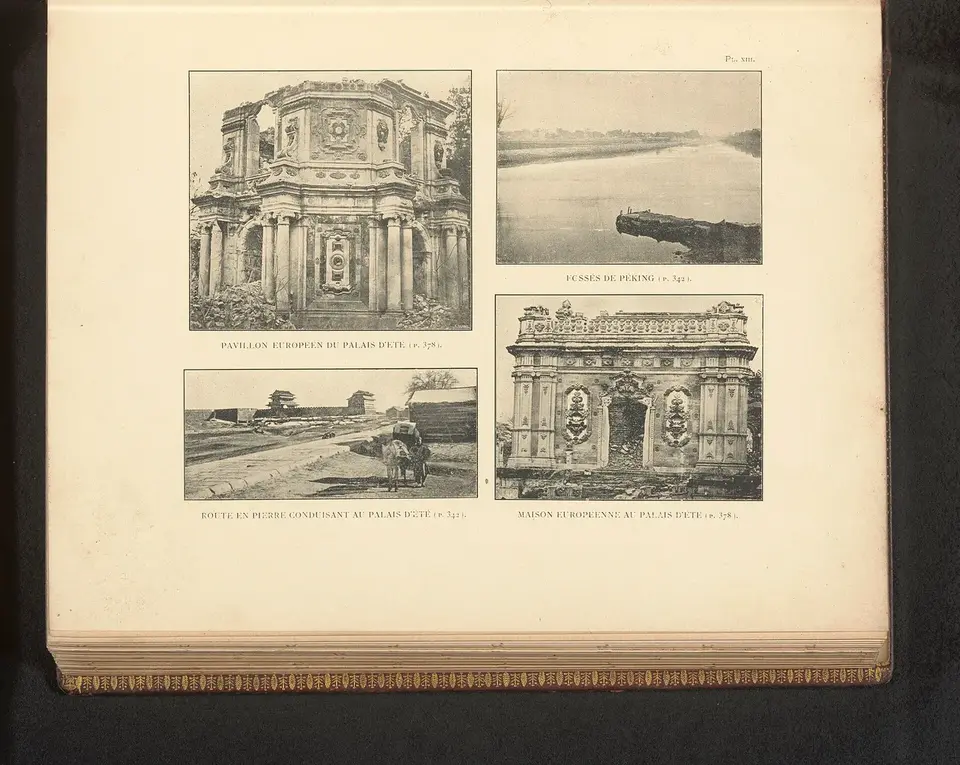
The Destruction of the Old Summer Palace (火烧圆明园), which culminated between October 18 and 20, 1860, was a catastrophic cultural tragedy and war atrocity perpetrated by Anglo-French expeditionary forces during the climax of the Second Opium War. Spanning over 350 hectares, Yuanmingyuan was constructed across 150 years by five successive Qing emperors, synthesizing the finest traditions of classical Chinese landscape architecture with European baroque waterworks and housing an immense treasury of imperial art, bronzes, and classical manuscripts. Following the defeat of General Sengge Rinchen's cavalry at the Battle of Baliqiao in September 1860, the Xianfeng Emperor fled to the Mountain Resort in Chengde, abandoning Beijing to Prince Gong. On October 6, French and British troops breached the palace gates, spending twelve days plundering thousands of priceless imperial artifacts, jades, porcelains, and historical scrolls. To inflict a psychological blow on the Qing sovereign for the deaths of British captives, High Commissioner Lord Elgin ordered the total incineration of the palace complex. Three thousand five hundred British troops torched the vast palace halls, pavilions, and adjacent imperial gardens in the Western Hills, sending smoke clouds over the capital for three days. Over three hundred palace attendants perished in the flames. The devastation forced the signing of the Treaty of Beijing and remains a searing symbol of national humiliation in modern Chinese history.
Anglo-French forces storm the Dagu Forts and advance toward Tianjin and Beijing.
Peace talks collapse; Qing authorities arrest British diplomat Harry Parkes and his delegation.
General Sengge Rinchen's cavalry is routed by allied artillery outside Beijing.
The Xianfeng Emperor abandons Beijing for Chengde; Prince Gong remains to negotiate.
French vanguard overcomes eunuch resistance and captures the Great Palace Gate of Yuanmingyuan.
Allied forces pillage millions of cultural artifacts, bronzes, and imperial books.
Lord Elgin orders 3,500 British troops to torch the palace; fires rage for three days and nights.
Prince Gong signs the Convention of Beijing, conceding Kowloon and paying sixteen million taels.
In 1856, Great Britain and France launched the Second Opium War under the pretexts of the Arrow Incident and the execution of Father Auguste Chapdelaine. After capturing the Dagu Forts in 1858 and compelling the signing of the Treaty of Tianjin, the allied powers escalated the conflict in 1860 to enforce ratified treaty exchanges. A joint expeditionary force of eighteen thousand troops captured Tianjin and marched along the Grand Canal toward Beijing.
Initial parleys commenced at Tongzhou between imperial commissioners and British envoy Harry Parkes. However, Parkes made imperious demands, including the right to enter Beijing with an armed guard and personally deliver credentials directly to the emperor without the traditional kowtow ceremony. Suspecting diplomatic duplicity, imperial commissioners arrested Parkes and his delegation of thirty-nine European and Indian escorts, transporting them to Beijing and confining them in the Board of Punishments and Yuanmingyuan. The incident abruptly severed peaceful negotiations.
Following the collapse of the talks, imperial forces under Mongol Prince Sengge Rinchen and Manchu General Sheng Bao made a desperate stand at Baliqiao (Eight-Li Bridge) to shield Beijing. On September 21, 1860, thirty thousand Qing cavalry and infantry charged allied lines with desperate courage. However, they were shattered by disciplined British and French rifle volleys, modern artillery, and Congreve rockets. The imperial cavalry disintegrated, leaving the capital completely defenseless.
Early the following morning, terrified of being captured, the thirty-year-old Xianfeng Emperor abandoned the capital under the guise of an autumn hunting excursion, fleeing north to the Mountain Resort in Chengde with his imperial consorts. The desertion triggered panic among the imperial bureaucracy and populace. The emperor left his twenty-seven-year-old half-brother, Prince Gong (Yixin), in Beijing with plenipotentiary authority to sue for peace.
On the evening of October 6, 1860, allied cavalry skirts Beijing's northeastern battlements, and the French vanguard under General Cousin-Montauban reached the Great Palace Gate of Yuanmingyuan. The palace was defended by twenty-odd elite banner eunuchs under Chief Eunuch Ren Tai, who fought with halberds and daggers until they were cut down. The French occupied the grand complex that night.
The following morning, British commander Sir James Hope Grant arrived with British troops. At the Hall of Uprightness and Brightness, the two commanders agreed to allow their troops to plunder the palace treasures without restraint. What followed was a frenzied sacking without parallel in modern history. British and French officers and soldiers roamed through the grand pavilions, including the Hall of Peaceful Waters and the European Palaces, smashing padlocks and prying open jewel chests.
Precious jade carvings, solid gold chalices, imperial silk robes, ancient Shang and Zhou sacrificial bronzes, Song dynasty ceramics, and rare mechanical clocks were looted. Because the wealth was too vast to carry, soldiers smashed massive porcelain vases with rifle butts, ripped silk embroideries for bedding, and shattered antique furniture. Renowned French novelist Victor Hugo later condemned the crime in his letter to Captain Butler: "Two bandits entered a world wonder: Yuanmingyuan... One plundered, the other burned... These two bandits are called France and England."
While the plundering proceeded, the allies advanced to the Anding Gate of Beijing, demanding the surrender of the captives. On October 8, the Qing court released the surviving prisoners. Of the thirty-nine hostages, twenty-one had died of gangrene, starvation, and physical torture, including Thomas Bowlby, correspondent for The Times. The allied command was enraged by the fatalities.
British High Commissioner James Bruce, the 8th Earl of Elgin, concluded that an exemplary act of retribution was required. Elgin reasoned that burning civilian quarters in Beijing would harm innocent subjects, while burning the Forbidden City might completely dissolve the imperial government and prevent treaty ratification. Yuanmingyuan, as the private summer retreat and pleasure ground of the emperor where several captives had been tortured, was chosen as the target. Elgin declared: "It was the Emperor's favorite residence, and its destruction could not fail to be a blow to his pride as well as his feelings."
On October 18, 1860 (the 5th day of the 9th lunar month), Elgin dispatched 3,500 British soldiers carrying torches, sulfur, and combustible materials into the palace. Systematically moving through the compound, the soldiers ignited the great wooden halls, including the Hall of Uprightness and Brightness and the Ancestral Shrine. Fanned by autumn winds, the flames converged into an immense inferno, sending a massive plume of black smoke that darkened the midday sun over Beijing. Trapped behind locked gates, over three hundred maidservants, eunuchs, and artisans were burned alive.
The conflagration spread beyond Yuanmingyuan to consume the adjacent imperial parklands, known collectively as the Three Mountains and Five Gardens. The British torched the Temple of Great Gratitude and Longevity at the Summer Palace (Qingyiyuan), the palaces of the Fragrant Hills (Jingyiyuan), the mountain pavilions of the Jade Spring Mountain (Jingmingyuan), and the Spring Garden. The fires raged continuously for three days and three nights, subsiding on October 20 to leave blackened stone pillars, shattered masonry, and charred timber across the western suburbs.
Paralyzed by the destruction of the imperial retreats and facing threats to bombard Beijing, Prince Gong conceded to all allied ultimatums. On October 24 and 25, Prince Gong met Lord Elgin and French envoy Baron Gros in the Board of Rites, exchanging ratifications of the Treaty of Tianjin and signing the Convention of Beijing. The treaties ceded Kowloon Peninsula to Britain, opened Tianjin as a treaty port, imposed sixteen million taels of silver in combined war indemnities, and legalized foreign missionary purchase of property across China.
The destruction of Yuanmingyuan represents one of the greatest cultural catastrophes in human history. Over 1.5 million cultural artifacts—ranging from prehistoric jade and Shang bronze ritual vessels to unique Song paintings, early dynastic editions of the Complete Library of the Four Treasuries, and priceless astronomical clocks—were looted, destroyed, or dispersed into private Western collections and national museums like the British Museum and Fontainebleau. The architectural marvel that synthesized European hydraulic rococo with classical Chinese garden layout was permanently ruined, leaving behind only the iconic marble ruins of the Western Palaces.
The traumatic destruction of the Summer Palace shattered the traditional world order of the Qing Empire. The subsequent death of Xianfeng in 1861 triggered the Xinyou Coup, bringing Empress Dowager Cixi and Prince Gong to power. Convinced that China faced an unprecedented existential crisis, reform-minded Qing statesmen recognized that traditional Confucian statecraft could not deter Western imperialist weaponry. This agonizing realization gave birth directly to the Self-Strengthening Movement (Yangwu Movement), initiating modern China's century-long industrial, military, and educational modernization.