Imperial Commission
Emperor Yongle decrees the compilation of an exhaustive reference collection under Xie Jin, establishing the phonetic rhyme organization.
Ming Dynasty (明朝) · HISTORICAL EVENT
永乐大典
The compilation of the Yongle Encyclopedia (永乐大典) was a massive state-sponsored cultural initiative personally launched and supervised by Emperor Yongle (Zhu Di) of the Ming dynasty. In the first year of his reign (1403), Emperor Yongle decreed that Imperial Hanlin Scholar Xie Jin organize a large body of scholars to compile an exhaustive reference collection. The initial draft, titled Wenxian Dacheng (Grand Collection of Literature), failed to…
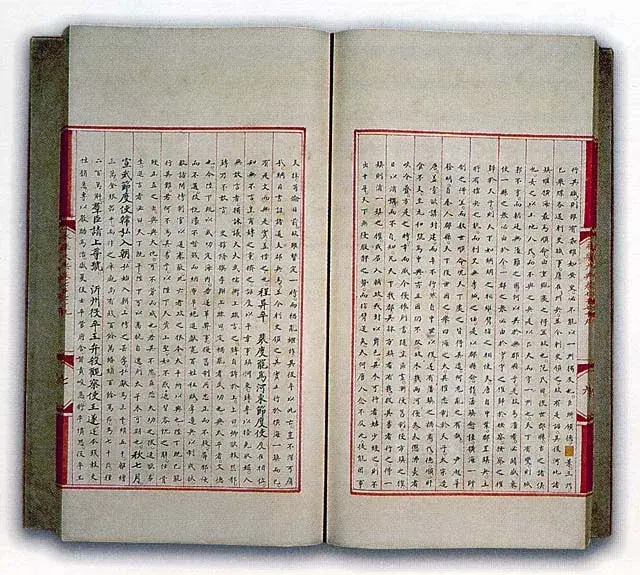
The compilation of the Yongle Encyclopedia (永乐大典) was a massive state-sponsored cultural initiative personally launched and supervised by Emperor Yongle (Zhu Di) of the Ming dynasty. In the first year of his reign (1403), Emperor Yongle decreed that Imperial Hanlin Scholar Xie Jin organize a large body of scholars to compile an exhaustive reference collection. The initial draft, titled Wenxian Dacheng (Grand Collection of Literature), failed to meet imperial expectations due to gaps in coverage. Consequently, in 1405, the emperor appointed Grand Preceptor of the Crown Prince Yao Guangxiao to co-lead a comprehensive revision alongside Xie Jin, gathering over 2,000 scholars and Imperial Academy students at the Wenyuan Chamber in Nanjing. Completed in 1407, the monumental work was personally named Yongle Dadian by Emperor Yongle, with final scribal transcription finishing in the winter of 1408. Spanning 22,877 chapters across 60 index chapters bound into 11,095 volumes, it recorded between 7,000 and 8,000 literary, historical, philosophical, scientific, and technical titles from the pre-Qin era to the early Ming dynasty, representing the largest paper encyclopedia in ancient Chinese history.
Emperor Yongle decrees the compilation of an exhaustive reference collection under Xie Jin, establishing the phonetic rhyme organization.
Xie Jin presents the initial draft, titled Wenxian Dacheng, but the emperor orders an expanded re-compilation due to incomplete coverage.
Yao Guangxiao and Xie Jin are named joint supervisors, convening over 2,000 scholars at the Wenyuan Chamber in Nanjing.
The revised work is completed; Emperor Yongle authors the imperial preface and formally names it Yongle Dadian.
Hundreds of scribes complete hand-copying all 11,095 volumes in fine regular script for permanent storage in the Wenyuan Chamber.
Emperor Shizong orders Gao Gong, Qu Jingchun, and Zhang Juzheng to supervise the creation of a duplicate copy, finished five years later.
Throughout successive dynasties from the Qin and Han through the Song and Yuan, vast numbers of ancient manuscripts and canonical texts had been repeatedly destroyed or fragmented by warfare and transmission errors. Although Emperor Taizu of Ming had ordered the gathering of scattered books, comprehensive and systematic collation remained incomplete. Emperor Yongle observed that existing records were dispersed haphazardly across countless treatises, making retrieval extremely cumbersome. He determined that a universal compendium organized phonetically by rhyme groups was urgently required to facilitate institutional governance and statecraft.
Following the Jingnan Campaign, Zhu Di took the throne as an imperial prince, generating underlying skepticism and psychological distance among Jiangnan intellectuals and traditional scholar-officials. To stabilize the societal atmosphere and win the allegiance of the literati, Emperor Yongle needed to demonstrate extraordinary reverence for Confucian scholarship and civil governance. By summoning prominent scholars, Hanlin officials, and Imperial Academy students from across the provinces to the capital, the court successfully integrated the intellectual elite while cementing the cultural orthodoxy and legitimacy of the Yongle reign.
In the seventh month of 1403, Emperor Yongle formally issued an imperial edict commissioning the compilation, appointing Hanlin Reader-in-Waiting Xie Jin as chief compiler and mobilizing 147 court literati. During an imperial audience, Emperor Yongle instructed Xie Jin that the collection must encompass classical canons, histories, philosophers, literature, astronomy, geography, divination, medicine, Buddhism, Daoism, and technical crafts, ordering that all materials be organized under phonetic rhyme categories without shrinking from immense breadth.
Working around the clock with holdings in the Imperial Library, Xie Jin's editorial circle completed an initial draft within a year and a half. In the eleventh month of 1404, the compilation was presented to the court, and the emperor conferred the title Wenxian Dacheng. However, upon reviewing the manuscript, Emperor Yongle concluded that the scope of collected texts remained incomplete and lacked exhaustive depth, ordering an immediate and extensive expansion of the project.
In the first month of 1405, Emperor Yongle launched the full-scale overhaul. To augment academic prestige and administrative coordination, he appointed the eminent Buddhist monk and political strategist Yao Guangxiao to supervise the endeavor alongside Xie Jin, with Minister of Rites Zheng Ci and Vice Minister of Justice Liu Jichi overseeing logistics, supplies, and academic appraisals. The imperial court issued decrees across the empire to solicit rare private collections, family manuscripts, and local gazetteers, simultaneously granting the compilers full access to the vast imperial archives at the Wenyuan Chamber.
To provide sufficient editorial manpower, the government selected 2,169 prominent scholars, provincial degree holders, and Imperial Academy students to assemble in Nanjing. The compilation body was organized into structured echelons comprising directors, associate directors, compilers, editorial expeditors, and scribes. Methodologically, the entire work adhered to the phonetic sequence of the Hongwu Zhengyun (Orthodox Rhymes of Hongwu). Under each rhyme word, entire texts, historical annals, philosophical treatises, poems, and technical monographs were copied in full without arbitrary abbreviations, ensuring complete textual integrity.
Following more than two years of rigorous collation by thousands of participants, the manuscript was finalized and presented to Emperor Yongle in the eleventh month of 1407. Highly satisfied with its profound erudition and encyclopedic breadth, the emperor composed the imperial preface and formally christened the work Yongle Dadian. The finished compendium encompassed 22,877 chapters, with 60 chapters of tables of contents, bound into 11,095 physical volumes containing an estimated 370 million Chinese characters and preserving between 7,000 and 8,000 individual works.
Because block-printing such an enormous text was prohibitively expensive and technically impractical, Emperor Yongle decreed that the entire encyclopedia be transcribed by hand in exquisite regular script. Hundreds of skilled scribes were selected to write on high-grade mulberry paper ruled with red double-border columns using premium Huizhou ink. The entire transcription and binding undertaking was concluded in the winter of 1408, and the master manuscript was securely housed in the Wenyuan Chamber in Nanjing as an irreplaceable national treasure.
The completion of the Yongle Encyclopedia marked an unprecedented landmark in the preservation of ancient Chinese literature. By incorporating intact texts rather than brief extracts, the compendium preserved vast quantities of pre-Qin, Han, Tang, Song, and Yuan documents that subsequently vanished from independent circulation. During the Qing dynasty, compilers of the Siku Quanshu (Complete Library in Four Sections) recovered hundreds of long-lost classical treatises directly from surviving volumes of the encyclopedia.
As the supreme cultural symbol of the early Ming dynasty, the encyclopedia demonstrated the civilizational self-confidence of the empire. However, because only a single original set was hand-copied, the work remained highly vulnerable. Although a full duplicate set was transcribed during the Jiajing reign, the original Yongle set mysteriously disappeared during the Ming-Qing transition. The Jiajing duplicate suffered severe devastation during the 1900 Boxer Rebellion and foreign invasions, leaving scattered surviving volumes dispersed in libraries and private collections worldwide.
The History of Ming (Ming Shi, Treatise on Literature) recorded: "From dictionaries and rhyme guides to all hundred schools of thought, it gathered everything across vast expanses, an achievement unmatched in all antiquity." This confirmed its unparalleled magnitude and status as a monumental milestone of Chinese archival heritage.
In the General Catalog of the Siku Quanshu, the eminent Qing scholar Ji Yun commended: "It organized words by rhyme and correlated affairs by word; from the classics, histories, philosophers, and literary collections to astronomy, geography, medicine, and mechanical arts, nothing was omitted. A single compilation rendered all ancient and modern matters immediately accessible." This appraisal highlighted its exceptional utility as an indispensable bibliographic research instrument.