Western Jin Conquers Wu and Promulgates the Zhantian Ordinance
Emperor Wu of Jin unifies China, abolishes agricultural colonies, and enacts statutory regulations governing peasant and official land allotments.
Western Jin Dynasty (西晋) · HISTORICAL EVENT
占田制
The Land-Allotment System (占田制, Zhantianzhi), fully designated as the Land-Allotment and Taxation System (Zhantian Ketian Zhi), was a fundamental state agrarian and fiscal reform promulgated by Emperor Wu of Jin (Sima Yan) in 280 CE (the first year of the Taikang era) following the conquest of Eastern Wu and the reunification of China. Under this statutory code, adult male peasants were legally permitted to hold up to seventy mu of agricultural…
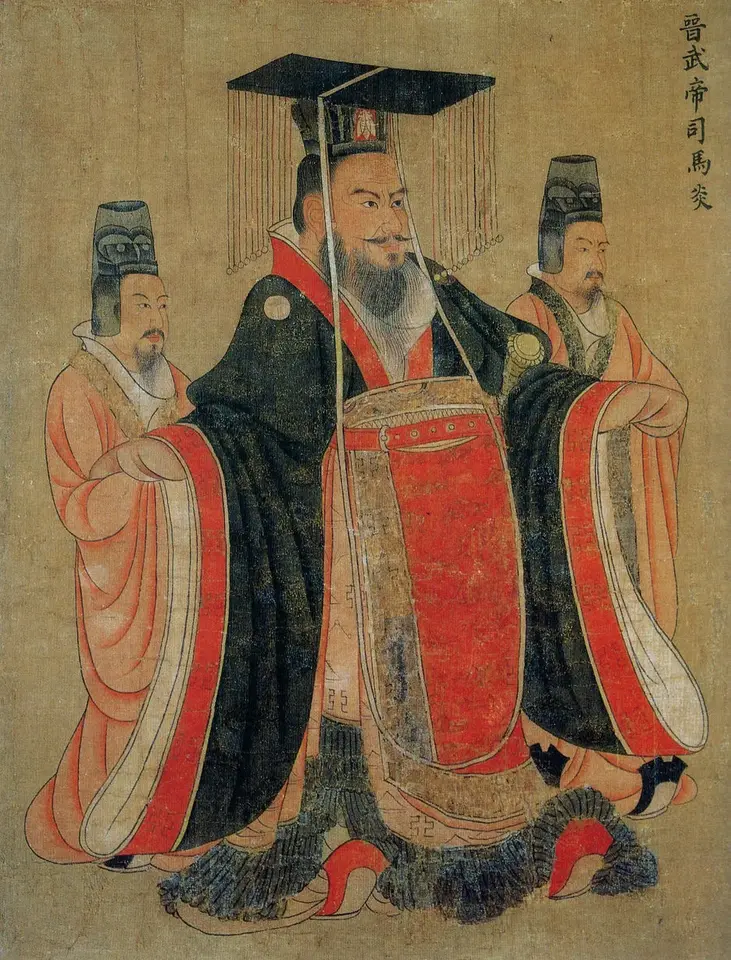
The Land-Allotment System (占田制, Zhantianzhi), fully designated as the Land-Allotment and Taxation System (Zhantian Ketian Zhi), was a fundamental state agrarian and fiscal reform promulgated by Emperor Wu of Jin (Sima Yan) in 280 CE (the first year of the Taikang era) following the conquest of Eastern Wu and the reunification of China. Under this statutory code, adult male peasants were legally permitted to hold up to seventy mu of agricultural land, while adult females could hold thirty mu. Concurrently, the state enforced mandatory taxation (ketian) on fifty mu for adult males and twenty mu for adult females at an annual rate of eight sheng of grain per mu. For imperial officials, the system allocated land allotments ranging from ten to fifty qing based on the Nine-Rank bureaucratic hierarchy, alongside legal tax exemptions for personal kin and tenant retainers. The system recognized peasant landholding rights, curbed arbitrary aristocratic land seizures, stimulated extensive land reclamation, and established the fiscal foundation for the prosperity of the "Rule of Taikang." Furthermore, it institutionalized the economic privileges of aristocratic clans, serving as an indispensable precursor to the later Equal-Field System of the Northern Dynasties and Tang.
Emperor Wu of Jin unifies China, abolishes agricultural colonies, and enacts statutory regulations governing peasant and official land allotments.
Local authorities conduct nationwide land and household registration, enforcing the tax rate of eight sheng per mu.
Registered households increase to 3.77 million; state granaries fill, marking the peak of the "Rule of Taikang."
Sima Yan dies; regency intrigues weaken the central government's capacity to supervise provincial landholding.
Imperial princes mobilize provincial armies against each other, disrupting the nationwide agrarian fiscal framework.
Widespread chaos compels peasant smallholders to seek protection inside private aristocratic manors, collapsing state ketian tax revenues.
Han-Zhao forces sack the imperial capital, capturing Emperor Huai and terminating regular cadastral governance across northern China.
Chang'an falls; the Western Jin Dynasty dissolves as elites flee to the south, formally ending the historical operation of the system.
The century of warfare following the collapse of the Eastern Han severely disrupted northern agricultural production, leaving extensive arable tracts abandoned throughout the Yellow River basin. To resolve acute military grain shortages and resettle dislocated refugees, the Cao Wei regime instituted widespread state agricultural colonies (tuntian). These military and civilian colonies played a critical strategic role in sustaining grain supplies throughout the Three Kingdoms Period.
However, as sociopolitical stability returned under the early Jin court, the severe structural shortcomings of the colony system became evident. Colony cultivators (tunding) were reduced to hereditary servile status, subjected to strict personal dependence and oppressive grain levies reaching 50 to 60 percent of their harvest.
Mass desertions, widespread resistance, and illicit engrossment of colony tracts by aristocratic estates weakened state control. Consequently, the Western Jin court abolished state colony bureaus, converting former colony laborers into regular commandery tax-paying households. This major transition required a comprehensive state legal framework to redefine property rights and taxation.
In 265 CE, Sima Yan usurped the Cao Wei throne to found the Western Jin Dynasty. In 280 CE, Western Jin ground and naval campaigns conquered the rival state of Eastern Wu in Jiangnan, terminating decades of tripartite fragmentation.
Following nationwide reunification, Emperor Wu faced urgent challenges in reconstructing the civilian economy. Across the war-ravaged north, vast fertile tracts remained untilled, and displaced populations required immediate resettlement. In the south, prominent Jiangnan lineages controlled extensive wetlands and numerous unregistered private dependents.
To transition from wartime mobilization to peacetime economic revitalization, reconstitute accurate household registers, and assert direct state authority over labor and arable land, an overhaul of imperial land and taxation policies was imperative.
The Western Jin Dynasty was erected upon the political foundation of influential aristocratic clans. Powerful lineages dominated the upper echelons of the central government, leveraging the Nine-Rank system to monopolize imperial appointments.
Exploiting their judicial and administrative privileges, prominent families annexed fertile lands and enrolled thousands of destitute peasants as private clients (dianke) and domestic retainers. These dependents were concealed from official census registries, depriving the imperial exchequer of vital tax grain, cloth levies, and corvée labor.
To avert fiscal insolvency, Emperor Wu devised a statutory compromise: formally acknowledging the customary land rights of peasant smallholders to stimulate agricultural reclamation, while establishing explicit legal ceilings for aristocratic estates to reconcile state revenue requirements with elite interests.
In 280 CE (the first year of Taikang), following imperial thanksgiving rituals at the ancestral temples celebrating the conquest of Wu, Emperor Wu issued the Zhantian Ordinance in conjunction with revised household textile levies. This imperial code systematically delineated peasant land quotas, marking the formal inception of the system.
The ordinance instituted precise age and demographic categories for registered subjects: males and females aged sixteen through sixty were classified as principal adults (zhengding), while individuals aged thirteen to fifteen and sixty-one to sixty-five were designated secondary adults (ciding). Under the code, every adult male was legally entitled to hold up to seventy mu of arable land, while adult females were allotted thirty mu.
Rather than representing an immediate bureaucratic redistribution of state-owned fields, the decree constituted statutory legal recognition of existing peasant landholdings. It authorized farming households to clear and claim abandoned waste tracts up to the prescribed ceiling without fear of arbitrary confiscation.
Alongside ownership ceilings, the ordinance implemented the compulsory ketian tax system. The term ketian designated the mandatory acreage upon which direct grain taxes were levied.
Statutory regulations stipulated that adult males were taxed on an assessed baseline of fifty mu, adult females on twenty mu, and secondary adult males on twenty-five mu, while secondary females were exempted. The standard tax assessment was fixed at eight sheng of grain per assessed mu. Consequently, every registered adult peasant was obligated to deliver grain taxes according to statutory quotas, regardless of whether their actual under-tillage acreage matched the full limit.
In tandem with agricultural levies, the Western Jin court enforced household textile collections (hudiao). Standard households headed by an adult male delivered three bolts of silk fabric and three catties of silk floss annually; households headed by women or secondary males paid half this rate. Frontier ethnic minorities paid adjusted textile levies, significantly simplifying the complex poll and property taxes of the Han-Wei era.
To secure the allegiance of aristocratic lineages for the new land code, Emperor Wu incorporated explicit statutory privileges based on bureaucratic ranking, transforming political status into codified economic immunity.
The ordinance granted extensive land quotas graduated across the Nine-Rank official hierarchy: officials of the First Rank were entitled to hold up to fifty qing (five thousand mu) of arable land, with limits decreasing by five qing for each descending grade down to ten qing for the Ninth Rank.
Furthermore, the code legalized the exemption of kinship dependents and client retinues from state corvée and taxes. High-ranking nobles were permitted to register up to fifteen tenant households (dianke) and three personal retainers (yishike) as exempt dependents. These legal exemptions removed aristocratic tenants from state fiscal registers, formally recognizing the private clientage networks of the aristocracy.
Acknowledging profound economic and cultural disparities across the vast empire, the Western Jin court adopted flexible regional policies in administering the Zhantian Ordinance.
In the newly integrated commanderies of the former Eastern Wu realm across the south, where social conditions remained delicate, the central government halved regular ketian tax obligations. Along the western and northern border commanderies inhabited by diverse non-Han populations, tribute levies were collected in indigenous fabrics at reduced rates.
Prefects and commandery governors were instructed to conduct land surveys, reconstruct cadastral registers, and appoint agricultural overseers to inspect seasonal tillage. Protected by legal safeguards over cleared tracts, millions of dislocated refugees returned to ancestral villages, reclaiming abandoned fields and expanding registered acreage.
Within a decade of its implementation, the Land-Allotment System fostered substantial agrarian recovery. However, its continued operation depended heavily on centralized bureaucratic control. Following Emperor Wu's death in 290 CE, the accession of the developmentally challenged Emperor Hui precipitated violent factional power struggles among imperial regents.
The ensuing War of the Eight Princes erupted into sixteen years of continuous internal warfare among regional royal garrisons. Imperial armies plundered farmland, tore down hydraulic dikes, and devastated northern cities. Concurrently, northern nomadic confederations invaded the Central Plains during the Disaster of Yongjia, sacking Luoyang and Chang'an.
Amid pervasive destruction and mass migrations southward across the Yangtze, cadastral registers were lost, and civil administration ceased to function. Aristocratic lineages retreated into fortified rural manors (wubao) to preserve private armies and retainers, rendering the central agrarian statutes void and bringing the system to a complete dissolution.
By establishing clear statutory recognition for peasant landholding, the Zhantian Ordinance relieved former colony laborers from feudal servitude and motivated smallholders to reclaim abandoned terrain.
During the decade of the "Rule of Taikang," rural stability returned to the Central Plains. According to the Book of Jin (Jinshu), registered households rose to 3.77 million, encompassing over 18.8 million individuals by 282 CE. State granaries were well-stocked, livestock multiplied across the countryside, and the empire enjoyed an interlude of agrarian prosperity unprecedented since the late Han.
The Land-Allotment System operated as a compromise between state centralization and aristocratic privilege. While establishing formal limits on peasant holdings, it granted generous rank-based land quotas and legal tax exemptions for tenant clients (dianke).
High-ranking officials could legally accumulate thousands of mu of arable land alongside dozens of untaxed tenant families. This statutory concession accelerated the consolidation of large-scale private manors, deepened rural social polarization, and encouraged competitive extravagance among grandees such as Shi Chong and Wang Kai, ultimately undermining imperial political stability.
In the long-term institutional evolution of ancient Chinese land tenure, the Western Jin Land-Allotment System occupies a pivotal transitional position. It adapted the ancient Warring States concept of rank-allotted lands (mingtian) and statutory land limits into a comprehensive imperial code.
More importantly, its core mechanisms—standardized peasant holding quotas matched with compulsory fiscal assessments—directly inspired the Equal-Field System (Juntianzhi) promulgated two centuries later by Emperor Xiaowen of Northern Wei. The structural principles of open-field allotments, mulberry lands, and fiscal redistribution that sustained the Sui and Tang Dynasties trace their lineage to the Western Jin experiment.