Unification of the Grasslands
Temujin unifies the nomadic tribes, founds the Mongol Empire, and reorganizes the military for future campaigns against Jin
Jin Dynasty / Mongol Empire · HISTORICAL EVENT
野狐岭之战
The Battle of Yehuling (野狐岭之战) took place in the autumn of 1211 (the third year of the Da'an era of Jin and the sixth year of Genghis Khan's reign) and was a catastrophic engagement in which the mobile cavalry forces of the Mongol Empire under Genghis Khan completely crushed the primary field army of the Jurchen Jin Dynasty at the strategic pass of Yehuling (located on the boundary between modern Wanquan District and Zhangbei County in Zhangjiakou, Hebei…
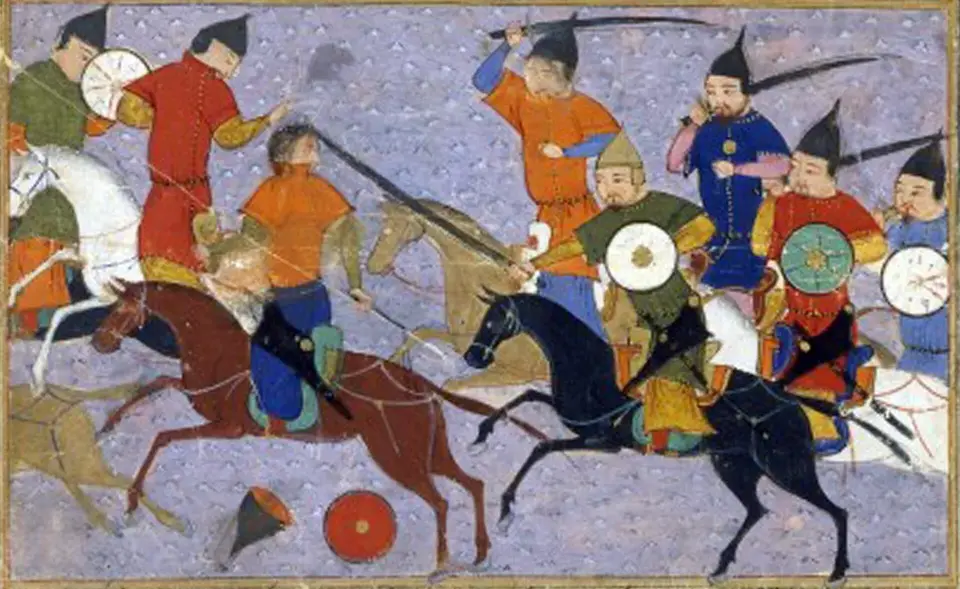
The Battle of Yehuling (野狐岭之战) took place in the autumn of 1211 (the third year of the Da'an era of Jin and the sixth year of Genghis Khan's reign) and was a catastrophic engagement in which the mobile cavalry forces of the Mongol Empire under Genghis Khan completely crushed the primary field army of the Jurchen Jin Dynasty at the strategic pass of Yehuling (located on the boundary between modern Wanquan District and Zhangbei County in Zhangjiakou, Hebei Province). During its dominance over northern China, the Jin Dynasty had long enforced severe suppression policies against the nomadic tribes of the Mongolian plateau, conducting periodic slaughter campaigns known as "reducing the adult male population" and inciting tribal rivalries. Following the unification of the steppe tribes and the founding of the Mongol Empire, Genghis Khan launched an expeditionary invasion in the spring of 1211 to settle these historical scores. Jin frontier commanders initially adopted a passive static defense along long earthen ramparts and trenches. After the swift loss of Wusha Fortress, the newly appointed Jin commander Wanyan Chengyu abandoned frontline strongholds and concentrated 300,000 troops along the narrow mountain defile of Yehuling. Genghis Khan adopted a daring central breakthrough maneuver: general Muqali led elite dismounted guards charging into the Jin center at Huan'erzui, followed by crushing flank assaults from the main cavalry columns. The Jin army disintegrated in massive panic, and subsequent encirclement at Huihebao wiped out the remnants. This battle eradicated the core defensive force of the Jin Dynasty and paved the way for the Mongol conquest of North China.
Temujin unifies the nomadic tribes, founds the Mongol Empire, and reorganizes the military for future campaigns against Jin
Genghis Khan launches the southern campaign; Jebe executes an outflanking strike and captures Wusha Fortress
Muqali leads dismounted vanguard penetrating the Jin center; Mongol cavalry shatters the 300,000-strong Jin force at Yehuling
Mongol forces pursue and encircle the surviving Jin units at Huihebao, completely destroying Jin's northern field army
During the twelfth century, the Jurchen Jin Dynasty maintained hegemony over the northern nomadic tribes through harsh political subordination and military suppression. Jin rulers frequently dispatched punitive expeditions into the Mongolian grasslands to execute systematic massacres intended to curb tribal demographics and prevent unified resistance. Early Mongol khans suffered brutal humiliation; notably, Ambaghai Khan of the Khamag Mongol confederation had been executed by the Jin court on a wooden donkey.
In 1206, Temujin brought all warring steppe factions under single rule and was proclaimed Genghis Khan, inaugurating the Mongol Empire. Through the rigid social-military structure of the thousand-household system (mingghan) and the fierce imperial bodyguard (keshig), the Mongol military achieved unprecedented cohesion, tactical agility, and combat effectiveness. After securing his western flank through campaigns against Western Xia, Genghis Khan made the strategic resolve to strike eastward against Jin.
By 1211, the Jin court under Prince Weishao (Wanyan Yongji) was paralyzed by bureaucratic inertia, fiscal weakness, and deep-seated distrust within the imperial clan. Upon receiving intelligence of the Mongol mobilization, the Jin government hastily marshaled central imperial guards and frontier provincial garrisons, reportedly mustering an army of 450,000 men.
The initial supreme commander, Duji Sizhong, opted for a rigid, passive line defense. He dispersed his forces along the fortified frontier trenches and perimeter walls around Wusha Fortress. This extended cordon defense severely diluted Jin defensive depth, surrendered tactical initiative, and left fortified positions vulnerable to rapid localized concentration and penetration by mobile cavalry.
In the spring of 1211, Genghis Khan held a solemn kurultai along the Kherlen River, swearing an oath to avenge steppe ancestors before leading approximately 100,000 cavalry southwards across the Gobi Desert. By August, the Mongol vanguard commander Jebe executed a rapid flanking maneuver, bypassing heavily guarded posts and striking directly at the vulnerable juncture of the Jin outer defense network near Wusha Fortress.
Jebe directed concentrated mounted archery barrage coupled with rapid charges, breaching the ramparts and capturing the fortress in a swift assault. The Jin border network was fractured. Stunned by the defeat, the Jin court dismissed Duji Sizhong and transferred full command to Wanyan Chengyu.
Lacking operational resolve, Wanyan Chengyu panicked in the face of rapid Mongol advances. Instead of consolidating forward defensive strongpoints, he ordered a general withdrawal, abandoning key frontier administrative hubs such as Hengzhou and Changzhou. He concentrated his entire force of 300,000 infantry and cavalry at the narrow, rugged mountain defile of Yehuling to mount a static bottleneck defense.
However, cramming hundreds of thousands of troops into a narrow, twisting mountain gorge proved a disastrous tactical miscalculation. The steep terrain deprived the Jin armored cavalry of room to maneuver and charge, while massive formations of conscripted infantry became jammed together in disorderly columns. Communications broke down, and the army was rendered completely incapable of coordinated defensive reaction.
Genghis Khan advanced to the northern foothills of Yehuling. Recognizing through reconnaissance that the massive Jin army was paralyzed in a bottleneck and paralyzed by rigid command, he resolved on a daring frontal breakthrough aimed directly at the headquarters banner of the Jin commander at the strategic ridge of Huan'erzui.
General Muqali volunteered to lead the assault, pledging victory to Genghis Khan. Muqali personally led elite dismounted keshig shock troops armed with long spears and iron sabers in an uphill frontal charge under heavy projectile fire. Muqali's shock troops shattered the Jin forward line and penetrated directly into the command post. As the Jin center fell into chaos, Genghis Khan unleashed the full weight of the Mongol cavalry wings in a sweeping downhill assault. Jin formations broke completely, triggering a catastrophic stampede down the mountain gorges. Countless Jin soldiers perished, and Wanyan Chengyu fled southward with a small detachment of survivors.
The retreating Jin soldiers attempted to regroup behind the defensive ramparts of Huihebao. Knowing that momentum was critical, Genghis Khan ordered relentless pursuit, giving the enemy no respite. The Mongol light cavalry rapidly enveloped the fortress, cutting off escape routes and water access.
For three days and three nights, Mongol cavalry launched continuous waves of assaults against the besieged stronghold. The remaining Jin resistance collapsed completely. More than 200,000 Jin troops were slaughtered or captured across the battlegrounds, leaving human remains scattered across a hundred leagues. The primary field army of the Jin Dynasty was completely obliterated.
The twin victories at Yehuling and Huihebao resulted in the total destruction of the Jin Dynasty's elite field forces. Jin losses exceeded several hundred thousand men, while imperial armories, grain depots, and defensive equipment fell into Mongol hands. Mongol columns swept through Juyong Pass and the northern plains of Hebei, laying siege directly to the Jin capital of Zhongdu.
The Battle of Yehuling fundamentally altered the balance of power between the Mongol Empire and the Jin Dynasty. Stripped of its main strike force, the Jin empire lost the operational capacity to contest the open plains against Mongol cavalry and was reduced to passive urban defense. The severe political and military crisis precipitated internal coups within the Jin court, culminating in the assassination of Prince Weishao and the subsequent abandonment of Zhongdu as the court fled southward to Kaifeng, ultimately sealing the doom of the Jurchen dynasty.