Imperial Commission
Emperor Wen of Song decrees that Palace Secretariat Attendant Pei Songzhi compile an exhaustive commentary on the concise Records of the Three Kingdoms.
Liu Song of the Southern Dynasties · HISTORICAL EVENT
三国志注
The Commentary on the Records of the Three Kingdoms (Sanguozhi Zhu, 三国志注) is a monumental historiographical work compiled by the eminent historian Pei Songzhi under imperial decree during the sixth year of the Yuanjia reign (429) of the Liu Song dynasty. While Chen Shou's Records of the Three Kingdoms (Sanguozhi) had long been recognized as standard official history, its narrative was heavily condensed and missing numerous substantial facts…
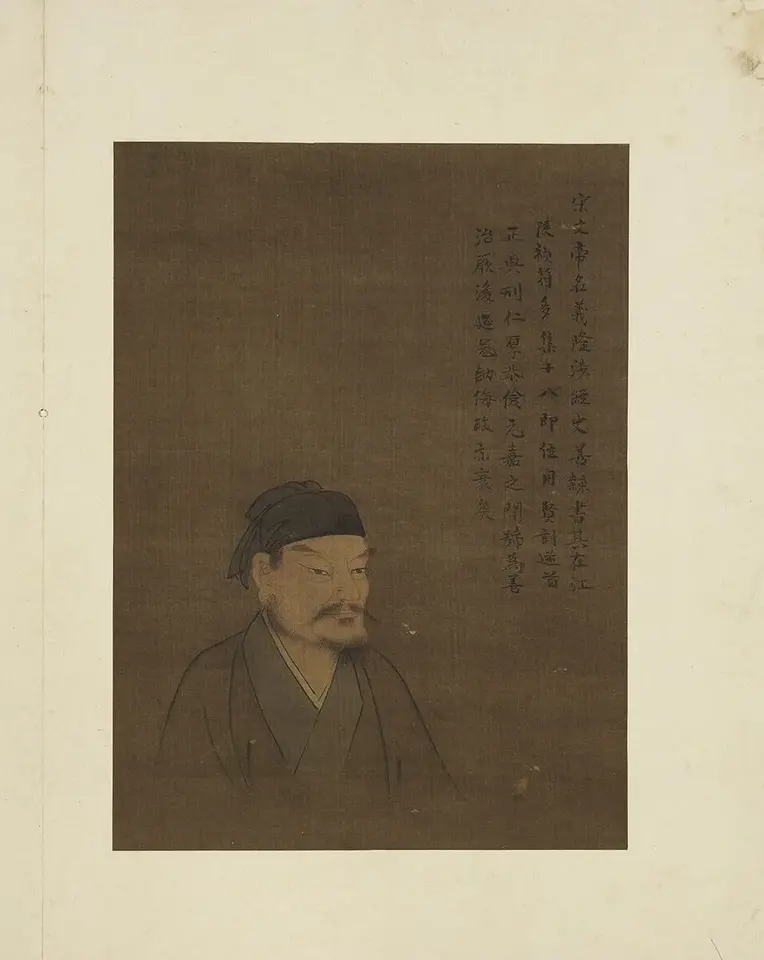
The Commentary on the Records of the Three Kingdoms (Sanguozhi Zhu, 三国志注) is a monumental historiographical work compiled by the eminent historian Pei Songzhi under imperial decree during the sixth year of the Yuanjia reign (429) of the Liu Song dynasty. While Chen Shou's Records of the Three Kingdoms (Sanguozhi) had long been recognized as standard official history, its narrative was heavily condensed and missing numerous substantial facts regarding the turbulent political, military, and social currents of the Three Kingdoms era. To remedy these deficiencies, Emperor Wen of Song formally commissioned Pei Songzhi, then serving as Palace Secretariat Attendant, to gather all available historical materials and compose an exhaustive annotation. Over more than a year of intense scholarly labor, Pei Songzhi meticulously consulted over one hundred and forty distinct Wei and Jin archival records, family memoirs, regional gazetteers, and private collections. His annotations totaled more than 300,000 Chinese characters, exceeding the length of Chen Shou's original text by nearly threefold. Pei not only rectified extensive omissions in the original work and juxtaposed conflicting accounts, but also systematically scrutinized historical absurdities and offered incisive historical judgments. The work inaugurated a brand-new paradigm for Chinese historical commentary and preserved vast amounts of otherwise lost medieval records, earning universal recognition from later generations of scholars.
Emperor Wen of Song decrees that Palace Secretariat Attendant Pei Songzhi compile an exhaustive commentary on the concise Records of the Three Kingdoms.
Pei Songzhi consults the imperial library and gathers over 140 private histories, family memoirs, and gazetteers across southern aristocratic collections.
Applying his principles of supplementing, recording variants, correcting errors, and evaluating, Pei completes over 300,000 characters of annotations.
Pei Songzhi submits the completed Sanguozhi Zhu alongside his formal memorial to Emperor Wen of Song.
Emperor Wen praises the work as an immortal historical enterprise and decrees its archival storage and empire-wide dissemination.
Compiled in sixty-five fascicles by the Western Jin historian Chen Shou, the Records of the Three Kingdoms was divided into the Book of Wei (thirty fascicles), the Book of Shu (fifteen fascicles), and the Book of Wu (twenty fascicles). Chen Shou was widely praised for his meticulous prose style and rigorous historical judgment. However, constrained by political sensitivities under the ruling Sima clan of Western Jin, alongside the widespread dispersion of official archives, the original work exhibited significant narrative limitations. Shu Han had never instituted official court historians, leaving scarce documentation and forcing Chen Shou to write a remarkably brief Book of Shu.
Although Wei and Wu maintained court historians, their preserved accounts reflected divergent political biases and frequently contradicted one another. Furthermore, Chen Shou focused primarily on macro-political turning points, frequently skipping the familial lineages, strategic deliberation, tactical maneuvers, and institutional intricacies of major figures. Consequently, later scholars and readers often found the text discontinuous and excessively brief compared to the Records of the Grand Historian, making it arduous to reconstruct a comprehensive picture of the complex era bridging the end of the Eastern Han dynasty and the Western Jin reunification.
During the Wei and Jin periods, private historiographical writing blossomed across the realm, producing an immense corpus of unofficial histories, clan biographies, genealogies, regional treatises, and personal literary anthologies. Works such as Wang Shen's Book of Wei, Yu Huan's Brief Account of Wei (Weilüe), Wei Zhao's Book of Wu, Yu Fan's Account of the River Lands (Jiangbiao Zhuan), and Sima Biao's Continuation of the Book of Han preserved vibrant firsthand testimonies.
However, following the Disaster of Yongjia and the subsequent division between North and South, frequent warfare in the Central Plains caused catastrophic destruction of ancient libraries and private archives. Although aristocratic families who migrated southward across the Yangtze attempted to rescue texts, archival survivals remained precariously fragile. Without centralized imperial patronage to systematically collect, categorize, and collate these scattered works, vast portions of invaluable historical testimony from the third and fourth centuries faced total extinction.
Following the founding of the Liu Song dynasty, Emperor Wen (Liu Yilong) launched a series of domestic reforms remembered as the "Reign of Yuanjia." Placing high priority on cultural revival and the preservation of classical learning, Emperor Wen sought to consolidate the cultural legitimacy of his southern dynasty through the compilation of official dynastic records and the commentary of classical histories. Perceiving Chen Shou's Sanguozhi as overly laconic, the emperor issued an imperial decree in the fifth year of Yuanjia (428), charging Palace Secretariat Attendant Pei Songzhi with compiling an exhaustive historical annotation.
Hailing from the prominent aristocratic Pei family of Hedong, Pei Songzhi possessed formidable classical erudition and extensive administrative experience. Embracing this commission as a solemn duty to rescue historical memory, he initiated one of the most magnificent historical annotation projects in Chinese history.
Upon assuming his imperial commission, Pei Songzhi immediately gained access to the imperial secret archives and actively borrowed private manuscripts preserved by prominent southern scholar-gentry clans. The consulted literature encompassed imperial daily diaries, standard dynastic biographies, family genealogies, stone inscriptions, and literary collections of Han and Wei scholars. In his memorial presented upon the completion of the commentary, Pei outlined four fundamental methodologies: supplementing omissions, recording divergent accounts, rectifying falsehoods, and providing critical evaluations.
Supplementing omissions entailed providing comprehensive documentation for significant events and historical figures omitted by Chen Shou, thereby restoring structural continuity to the historical narrative. Recording divergent accounts meant that when various historical sources contradicted each other regarding a single event, Pei did not arbitrarily discard conflicting testimonies; instead, he cited them side by side for critical comparison. Rectifying falsehoods involved disproving absurd claims or fabricated tales through chronological alignment and textual evidence. Finally, providing critical evaluations involved offering incisive moral and historiographical judgments on political ethics and historical conduct.
During the Qing dynasty, the chief editor Ji Yun further categorized Pei Songzhi's editorial methods into six operational dimensions in the Annotated Catalog of the Complete Library of the Four Treasuries: citing diverse theories to distinguish right from wrong, collating varied accounts to examine discrepancies, detailing the full narrative of events present in the base text, supplying unrecorded events, expanding the biographies of recorded figures, and appending biographies of previously omitted individuals. This analytical framework accurately reflects Pei's thorough and multi-layered empirical scholarship.
Throughout the drafting process, Pei Songzhi dedicated immense energy to rectifying the brevity of Chen Shou's base text. Constrained by space and limited sources, Chen Shou had left many biographies deficient in genealogical background and political context. By systematically citing texts like the Weilüe, Dianlun, Jiuzhou Chunqiu, and Jiangbiao Zhuan, Pei supplied rich biographical details for prominent rulers, generals, and strategists across the three realms.
In annotating the biographies of Cao Cao's early campaigns, Pei drew extensively from the Chronicles of the Wei Clan and the Biography of Cao Man, revealing the intricate challenges confronting Cao Cao, the secret deliberations of strategists like Xun Yu and Guo Jia, and the political propaganda surrounding the usurpation of the Han throne. Especially regarding Xun Yu's tragic death, Pei gathered various conflicting sources to illustrate the moral agony of early medieval intellectuals caught between dynastic loyalty and political pragmatism.
Furthermore, Pei investigated the pivotal transition of power under late Wei rule. In documenting Sima Yi's Incident at Gaoping Tombs, the purge of Cao Shuang, and the Three Rebellions in Shouchun, Pei cited Gan Bao's Records of the Jin and Xi Zuochi's Chronicles of Han and Jin, capturing the delicate psychological shifts and institutional transformations that paved the way for the rise of the Western Jin.
Chen Shou's Book of Shu spanned merely fifteen fascicles, suffering from a severe scarcity of official archival records due to the lack of court historians in the Shu Han regime. Pei Songzhi carried out exhaustive investigations to recover lost Shu records and rectify this disproportionate brevity.
In the biography of Zhuge Liang in the Book of Shu, Pei cited Guo Chong's Five Anecdotes on Zhuge Liang alongside Zhuge Liang's own memorials, tactical directives, and personal letters. Pei detailed Zhuge Liang's strict legal administration, military discipline, and technological innovations such as the wooden ox and repeating crossbow. Significantly, Pei deployed chronological and geographic scrutiny to disprove the popular legend of the "Empty City Stratagem," demonstrating that Sima Yi was garrisoned far away in Wancheng at that time and could not have encountered Zhuge Liang at Xixian.
For the monarchs and generals of Shu, Pei supplied pivotal historical verifications. He confirmed the birth year of Emperor Liu Shan as the twelfth year of Jian'an (207), resolving a long-standing chronological ambiguity. By incorporating the Zhao Yun Biezhuan, Pei preserved legendary episodes of General Zhao Yun, including his solitary rescue of Liu Shan at Changban slope and his interception of Lady Sun on the Yangtze River. Pei also expanded upon Guan Yu's loss of Jing Province, Zhang Fei's assassination, and Ma Chao's allegiance to Shu.
The state of Eastern Wu occupied Jiangnan, and Chen Shou's twenty fascicles on Wu had been constrained by northern perspectives and limited access to southern materials. Working in Jiankang, the ancient capital of Wu, Pei Songzhi was ideally situated to access aristocratic family archives, such as Yu Fan's Jiangbiao Zhuan, Wei Zhao's Book of Wu, and Zhang Bo's Wulu.
Pei restored the arduous rise of Sun Jian and Sun Ce in Jiangdong. He recorded Sun Jian's campaigns against Dong Zhuo, his defeat of Hua Xiong and Lü Bu, his entry into Luoyang, and his restoration of the Han imperial ancestral tombs, rectifying common distortions in later historical romances. Pei also highlighted Sun Ce's close partnership with Zhou Yu and his diplomatic maneuvers to win over southern aristocratic lineages.
In military campaigns and political struggles, Pei provided unprecedented depth. He documented Zhou Yu's strategic deliberations during the Battle of Red Cliffs, Huang Gai's tactical deception, and Lu Xun's patient defense and fire attack at the Battle of Yiling. Furthermore, Pei exposed the ferocious factional conflict known as the "Two Palaces Rivalry" between Sun He and Sun Ba, illustrating the deep tensions between indigenous Jiangdong clans and immigrant military elites.
Given the stark political polarization of the Three Kingdoms era, accounts of major figures and turning points in opposing contemporary histories were frequently contradictory. Confronting this bewildering array of divergent claims, Pei Songzhi demonstrated remarkable impartiality and scholarly restraint. For contentious issues such as Cao Cao's assassination attempt on Dong Zhuo, Guan Yu's defeat at Maicheng, Liu Bei's deathbed testament at Baidi City, and Sima Yi's purge of Cao Shuang, Pei routinely transcribed opposing accounts in full.
Pei believed that genuine historical reality could only be approached through the rigorous comparison of opposing perspectives, and that future scholars needed to see the precise divergences among early accounts. Alongside documenting contradictions, Pei applied rigorous chronological methods, methodically exposing chronological fallacies and logical inconsistencies in works such as Sun Sheng's Chronicles of the Wei Clan and Gan Bao's Records of the Jin.
Pei also maintained an uncompromisingly rational attitude toward the supernatural omens and apocryphal legends popular during the Han and Jin eras. Whenever sources claimed demonic interventions or celestial portents, Pei explicitly rejected them in his commentary, declaring that unsubstantiated marvels held no place in serious historical inquiry, thereby safeguarding the empirical integrity of historical discourse.
In the transmission and manual copying of ancient manuscripts, proper names, bureaucratic titles, and calendrical cyclical dates were exceptionally prone to textual corruption. Well-versed in Han and Jin calendrical astronomy and institutional evolution, Pei dedicated extensive labor to collating textual corruptions and correcting inverted chronologies.
In terms of chronology, Pei cross-referenced the official calendars and regnal eras across the Han and Wei dynasties, rectifying numerous instances where events of one year had been erroneously assigned to another. Geographically, because commanderies and counties underwent frequent reorganizations during the third century, Pei integrated Western Jin regional treatises to map the exact locations of iconic battlefields, including Guandu, Red Cliffs, Hefei, Ruxukou, Jieting, and Wuzhang Plains.
Institutionally, Pei supplemented detailed administrative records regarding the Nine-Rank System, the agricultural colony (tuntian) system, land tax regulations in Wei, state iron and salt monopolies in Shu, and hereditary troop commands in Wu. These additions effectively remedied the structural limitation of the original text, which lacked independent institutional treatises.
During the Three Kingdoms era, the competing regimes actively expanded their diplomatic and commercial connections with surrounding border peoples and foreign polities. While Chen Shou included brief accounts of the Wuhuan, Xianbei, and eastern tribes, his records of Central Asia and the Western Regions were almost entirely non-existent. Recognizing this major void, Pei systematically extracted vast portions of Yu Huan's Weilüe: Account of the Western Rong.
This priceless interpolation meticulously recorded the Southern, Central, and Northern Silk Road routes extending west of Dunhuang across the Pamir Mountains, documenting the urban structures, local customs, and trade goods of over thirty oasis states, including Khotan, Kucha, Kashgar, and Fergana. Most remarkably, Pei preserved extensive descriptions of Daqin (the Roman Empire), detailing its political administration, royal capitals, and maritime trade routes with Han and Wei China.
Furthermore, Pei supplemented Sun Wu's maritime expeditions to Yizhou (Taiwan) and the diplomatic missions of Kang Tai and Zhu Ying to Funan (in modern Cambodia). These records expanded the geographical horizons of early Chinese official historiography to encompass maritime Southeast Asia and the broader Eurasian world.
During the Wei and Jin periods, aristocratic clans frequently authored private genealogies and funerary inscriptions, which routinely exaggerated ancestral achievements or fabricated illustrious lineages. In his commentary, Pei applied rigorous genealogical scrutiny to evaluate these clan accounts.
Pei thoroughly investigated the lineages of prominent families such as the Xun, Sima, Zhuge, Lu, and Gu clans. In annotating the biographies of Zhuge Jin and Zhuge Dan, Pei compared the careers of Zhuge clan members across Wei, Shu, and Wu, illustrating how great families dispersed their loyalties across rival courts to guarantee family survival.
Moreover, Pei directed scholarly attention toward technical innovators and medical practitioners who had been marginalized in early records. In the section on technical masters, Pei supplemented detailed clinical cases of Hua Tuo, mechanical inventions of Ma Jun, and physiognomic practices of Zhu Jianping, providing modern historians of science with indispensable evidence on early medieval Chinese technology and medicine.
Pei Songzhi was not merely a textual collator, but also a historian gifted with profound ethical and political insight. Throughout the commentary, he contributed over one hundred independent editorial essays prefixed with the phrase "Your servant Songzhi observes." These critiques offered penetrating analyses of political ethics, strategic calculations, and Chen Shou's own historiographical prejudices.
In assessing Cao Cao, Pei acknowledged his exceptional military brilliance in unifying northern China and his pragmatism in appointing talent, while unsparingly condemning his brutal massacres in Xuzhou and his political executions of prominent intellectuals such as Kong Rong and Xun Yu. In analyzing the tragic demise of Xun Yu, Pei delved into the profound inner conflict between Xun's residual loyalty to the Han dynasty and his role as chief strategist for Cao Cao, dissecting the conflicting accounts of Xun's death with such analytical depth that his essay became a foundational text for medieval Chinese political history.
When evaluating Chen Shou's original text, Pei maintained exemplary scholarly objectivity, directly pointing out where Chen Shou's writing was compromised by personal grudges or political discretion, such as in the biography of Ding Yi. Pei insisted that a true historian must balance accounts like an impartial scale. Through his own detailed annotations, Pei successfully restored the broader socio-political evolution connecting the fall of the Han with the rise of the aristocratic clans under Western Jin.
During the compilation of the commentary, Pei Songzhi cited more than one hundred and forty historical works from the third and fourth centuries. Virtually all of these independent texts were lost during the catastrophic wars of the Tang and Song dynasties. However, because Pei frequently transcribed extensive excerpts and entire chapters into his annotations, substantial portions of these lost classics survived intact within the pages of the Sanguozhi Zhu.
Yu Huan's Weilüe, the most detailed private history of the Wei period, perished early in the Song dynasty, but the tens of thousands of characters preserved by Pei provide invaluable data on Cao Cao's bureaucratic institutions, northwestern frontier diplomacy, and military intelligence assessments regarding Shu Han. Similarly, fragments from southeastern texts such as the Jiangbiao Zhuan, Wuli, and Wushu remain the sole surviving documentary foundation for modern scholars investigating the maritime trade, canal network, and aristocratic dynamics of Sun Wu.
Furthermore, Pei transcribed numerous official memorials, private letters, and imperial edicts, including Cao Cao's Manifesto of Personal Intent and intimate correspondence between Zhuge Liang and Li Yan. These archival documents not only enriched historical details but also preserved authentic literary masterpieces of the Jian'an and Zhengshi eras, transforming the commentary into an indispensable treasury of medieval Chinese historiography and literature.
Following more than a year of relentless scholarship, Pei Songzhi brought his grand project to completion in the seventh month of the sixth year of Yuanjia (429). He presented the compiled text to Emperor Wen alongside his celebrated memorial, Memorial on Presenting the Commentary to the Records of the Three Kingdoms. In his memorial, Pei modestly described his efforts as a humble attempt to rescue historical fragments and supplement omissions for imperial reference.
Emperor Wen personally examined the commentary in the imperial library. Greatly impressed by Pei's exhaustive documentation, rigorous critical acumen, and luminous writing style, the emperor proclaimed that Pei had accomplished an "immortal enterprise" worthy of the greatest ancient historians. Emperor Wen commanded the imperial secretariat to produce official duplicates, store the master copy in the imperial archives, and distribute copies throughout provincial academies. From that moment forward, Chen Shou's base text and Pei's commentary circulated as an inseparable whole, forever altering the standard format of Chinese dynastic histories.
Pei Songzhi's year-long endeavor integrated materials from over one hundred and forty distinct Wei and Jin historical sources, adding over 300,000 characters of annotations that tripled the size of the original work. His commentary systematically filled major lacunae regarding institutional regulations, military operations, geographical administration, and clan genealogies, transforming Chen Shou's laconic account into an expansive, multi-vocal history of the third century.
In terms of historiographical structure, Pei broke decisively with the traditional Han commentary format that focused exclusively on phonetic and semantic glosses, establishing the innovative model of documentary commentary that expanded, collated, and verified historical records using primary sources. This technique profoundly influenced subsequent masterworks such as Li Daoyuan's Commentary on the Water Classic, Liu Xiaobiao's Commentary on A New Account of the Tales of the World, and Li Shan's Commentary on the Selections of Refined Literature. Documentarily, the work served as a sanctuary for early medieval literature; over one hundred lost historical writings survived exclusively through Pei's extensive citations, providing modern historians with an irreplaceable foundation for studying early medieval China.