Promulgation of Relocation Decree
Prince Hailing issues the relocation edict, appointing Zhang Hao and Su Baoheng to supervise the construction of the new capital
Jin Dynasty · HISTORICAL EVENT
金中都
Jin Zhongdu (金中都) refers to the momentous capital construction and relocation undertaking initiated by Emperor Wanyan Liang (Prince Hailing) of the Jin Dynasty in 1151 (the third year of the Tiande era), which culminated in 1153 (the first year of the Zhenyuan era) with the formal transfer of the imperial seat to the expanded metropolitan center in modern Beijing. Following the founding of the Jin Dynasty, the imperial seat was initially situated at…
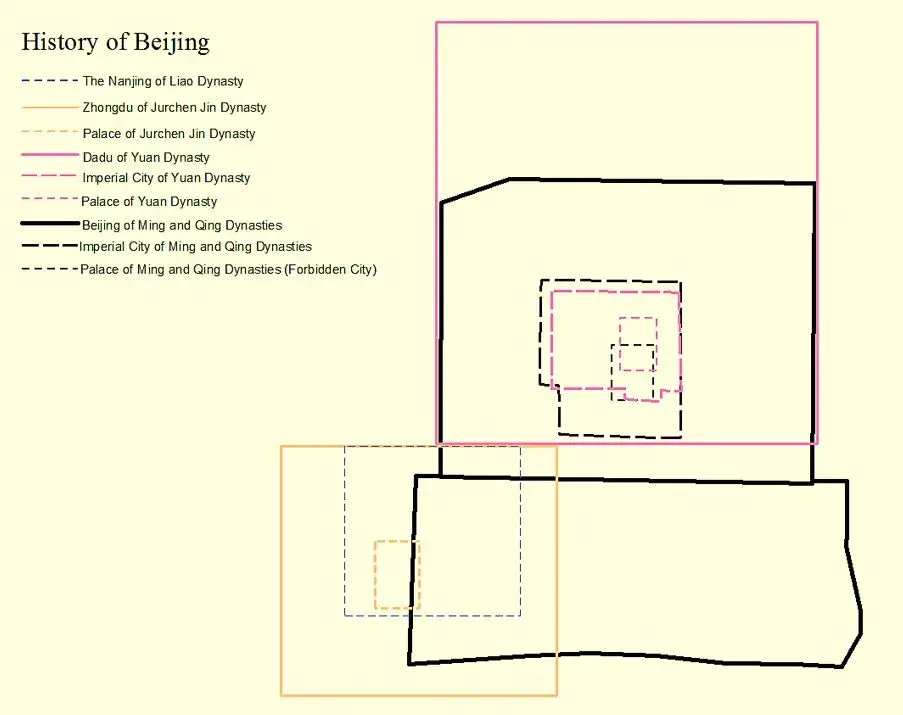
Jin Zhongdu (金中都) refers to the momentous capital construction and relocation undertaking initiated by Emperor Wanyan Liang (Prince Hailing) of the Jin Dynasty in 1151 (the third year of the Tiande era), which culminated in 1153 (the first year of the Zhenyuan era) with the formal transfer of the imperial seat to the expanded metropolitan center in modern Beijing. Following the founding of the Jin Dynasty, the imperial seat was initially situated at Shangjing Huining Prefecture in the far northeast. As Jin forces annexed northern China, the remote geographical location of Shangjing severely impaired logistical transit, taxation collection, and administrative responsiveness across the central plains. In April 1151, Prince Hailing promulgated an imperial edict decreeing the relocation of the capital to Yanjing, simultaneously stripping Huining of its imperial preeminence. He appointed Assistant Director of the Department of State Affairs Zhang Hao and Grand Commandant Su Baoheng to direct the civil engineering works. Conscripting 1.2 million civilian laborers and military recruits, the Jin government expanded the former Liao southern capital on three sides, constructing magnificent triple walls, imperial gates, and the Grand Peace Hall (Da'an Hall). In March 1153, the court officially established Zhongdu Daxing Prefecture, razing the old palaces in Shangjing to deter reactionary nobles. The creation of Jin Zhongdu fundamentally reconfigured the geopolitical landscape of northern China and marked Beijing's historic transition into an imperial capital.
Prince Hailing issues the relocation edict, appointing Zhang Hao and Su Baoheng to supervise the construction of the new capital
1.2 million laborers and soldiers expand the ramparts and build concentric palace enclosures modeled after Northern Song's Bianjing
Prince Hailing arrives in Yanjing, formally names it Zhongdu Daxing Prefecture, and destroys the old palaces at Shangjing
Following Emperor Xuanzong's southward flight to Kaifeng, Mongol troops storm and destroy the metropolis
From the establishment of the dynasty by Wanyan Aguda, the Jin court governed from Shangjing Huining Prefecture (modern Acheng District, Harbin, Heilongjiang). Following successful military campaigns that annihilated the Liao Dynasty and captured Northern Song's capital Bianjing (Kaifeng), Jin territory rapidly encompassed the entire North China plain up to the Huai River.
However, Shangjing Huining was remote, situated deep within the northern river valleys with harsh, protracted winters and difficult transport routes. As the imperial population multiplied and regional affairs grew intricate, Shangjing's peripheral location created immense delays in grain transport, tax transit, and nationwide military command. It became increasingly unsuited to serve as the administrative nerve center of a massive multi-ethnic empire.
In 1149, Prince Hailing (Wanyan Liang) staged a bloody palace coup, assassinating Emperor Xizong and seizing the throne. At Shangjing, conservative Jurchen clans and entrenched royal princes wielded immense tribal influence, resisting Prince Hailing's radical centralization policies and institutional Sinicization reforms.
To shatter aristocratic resistance and emancipate imperial rule from the surveillance of conservative clan elders, Prince Hailing resolved to move the dynasty's center of gravity to Yanjing (modern Beijing). Located at the pivotal convergence of central agricultural basins and northern trade arteries, Yanjing offered an ideal strategic springboard for royal centralization and future military campaigns aimed at unifying the entire realm.
In April 1151, Prince Hailing issued the official decree ordering the relocation of the imperial capital to Yanjing. He formally abolished the capital designation of Huining Prefecture and declared the strategic imperative of establishing a unified metropolitan center.
To oversee this gargantuan undertaking, Prince Hailing appointed highly competent administrators, including Assistant Director of the Department of State Affairs Zhang Hao, Grand Commandant and Central Secretariat Chief Su Baoheng, and Prefect of Daming Lu Yanlun. A dedicated metropolitan construction directorate was established to coordinate nationwide resources, architectural designers, and procurement channels.
The scale of the construction of Jin Zhongdu was vast. The imperial government mobilized 800,000 Han and Jurchen civilian laborers along with 400,000 regular troops, creating a mobilized workforce of 1.2 million men. Working under grueling schedules, laborers endured harsh seasonal climates to expedite construction.
In design, Zhongdu synthesized the urban layout of Northern Song's capital Bianjing and ancient classical guidelines from the Rites of Zhou: Artificer's Record (Kao Gong Ji). Expanding outward from the existing footprint of Liao's Southern Capital (Xijin), walls were extended substantially to the east, west, and south. The newly completed perimeter measured thirty-six Chinese leagues, featuring thirteen fortified city gates, deep moats, and stone culverts. The city featured concentric enclosures consisting of an Outer City, an Imperial City, and an Inner Palace City. The palace precinct housed thirty-six majestic ceremonial structures, including the central Da'an Hall and Renzheng Hall, while the Imperial City accommodated the Department of State Affairs, the Six Ministries, and the Imperial Ancestral Temple.
After two years of non-stop construction, the main palace halls and defensive perimeters were largely completed by early 1153. Prince Hailing marshaled the entire civil administration and elite imperial guard units on a grand march southward.
On the twenty-sixth day of the third lunar month in 1153 (April 21, 1153), Prince Hailing entered the new capital and declared the era name Zhenyuan. Yanjing was officially designated as Zhongdu, and the surrounding metropolitan region was established as Daxing Prefecture. To extinguish any hopes among conservative Jurchen nobles of returning to their northern ancestral lands, Prince Hailing ordered the systematic demolition and burning of all palaces, royal estates, and ancestral temples in Shangjing Huining. Simultaneously, imperial relatives and noble families of the Jurchen military units (meng'an-mouke) were compulsorily relocated to Zhongdu under close imperial watch.
With the royal family settled in Zhongdu, the Jin Dynasty instituted a Five Capitals framework centered on Zhongdu, establishing dedicated transport commissions and municipal courts to oversee trade and governance. The crown granted a ten-year exemption from corvee labor to all immigrants settling in Zhongdu, triggering an influx of merchants and artisans from across the empire and transforming the city into a metropolis of nearly one million inhabitants.
From Prince Hailing's entry in 1153 until Emperor Xuanzong was compelled by Mongol pressure to flee south to Kaifeng in 1214, Jin Zhongdu served as the supreme political seat of the Jin Dynasty for sixty-one years. In May 1215 (the third year of Zhenyou), invading Mongol armies under Genghis Khan breached and burned the city, leveling its palaces and reducing the once-glorious capital to ashes.
Within two years, the Jin empire established a colossal metropolis spanning thirty-six leagues, protected by thirteen gates and organized around concentric palace enclosures. The formal transfer of the royal court and central ministries effectively concluded the era of governance from Shangjing Huining, shifting the core of political authority firmly into northern China.
The construction and establishment of Jin Zhongdu represents a landmark in Chinese urban and political history. It ended Beijing's historical role as merely a regional frontier bastion or subsidiary capital under previous dynasties, elevating it for the first time to the formal imperial capital of a major dynasty. The symmetrical axial layout, imperial avenue network, and royal water reservoirs pioneered in Jin Zhongdu profoundly influenced the design of subsequent capitals, directly laying the spatial foundations for Yuan Dadu and Ming-Qing Beijing.