Destruction of Zhizhi Chanyu
Chen Tang and Gan Yanshou execute Zhizhi Chanyu, securing Huhanye's dominance
Western Han (西汉) · HISTORICAL EVENT
昭君出塞
Wang Zhaojun Departs for the Frontier (昭君出塞) refers to the historic political alliance marriage in 33 BCE during the Jingning era of the Western Han, wherein Emperor Yuan bestowed the palace maiden Wang Zhaojun upon Huhanye Chanyu of the Southern Xiongnu. During the early Han dynasty, the imperial court was compelled to offer humiliating tribute marriages under severe nomadic military pressure. Following decisive counter-offensives under Emperor Wu, the…
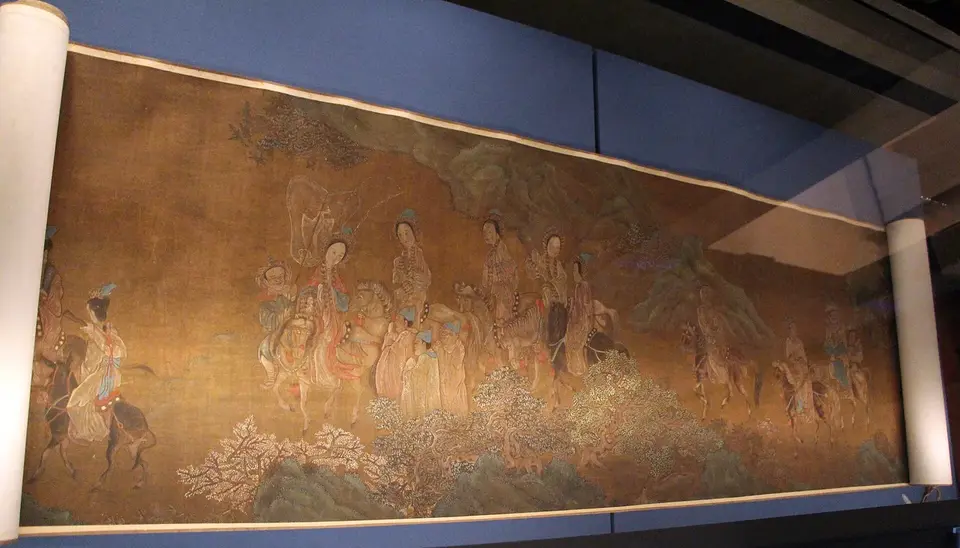
Wang Zhaojun Departs for the Frontier (昭君出塞) refers to the historic political alliance marriage in 33 BCE during the Jingning era of the Western Han, wherein Emperor Yuan bestowed the palace maiden Wang Zhaojun upon Huhanye Chanyu of the Southern Xiongnu. During the early Han dynasty, the imperial court was compelled to offer humiliating tribute marriages under severe nomadic military pressure. Following decisive counter-offensives under Emperor Wu, the Xiongnu suffered devastating casualties and fragmented into internecine civil war, leading Huhanye Chanyu to seek Han vassalage. In 33 BCE, following Han campaigns that extinguished the rival Zhizhi Chanyu, Huhanye journeyed to Chang'an to formally petition for an imperial matrimonial alliance. Wang Zhaojun voluntarily answered the summons to depart for the frontier. Deeply gratified, Huhanye conferred upon her the title Ninghu Yanzhi, or Hu-Pacifying Queen. On the steppes, she fostered agrarian and textile arts, bore offspring, and remarried Diaotaomogao in accordance with nomadic custom. Her descendants actively upheld cross-cultural harmony, securing over sixty years of northern frontier tranquility and establishing a timeless exemplar of multi-ethnic integration.
Chen Tang and Gan Yanshou execute Zhizhi Chanyu, securing Huhanye's dominance
Huhanye pays his third imperial visit to Chang'an, requesting an alliance marriage to cement peace
Palace lady Wang Zhaojun volunteers to depart for the frontier, appearing in beauty before Weiyang Palace
Huhanye names her Ninghu Yanzhi; Emperor Yuan inaugurates the Jingning era as the convoy departs
Zhaojun arrives at the Monan court, where she introduces spinning, weaving, and crop cultivation techniques
Zhaojun gives birth to a son who is later invested as the Right Ruzhu King, consolidating bilateral ties
Huhanye passes away; Emperor Cheng decrees that Zhaojun must conform to nomadic levirate custom
Zhaojun submits to nomadic custom, marrying the new Chanyu and subsequently bearing two daughters
Zhaojun passes away on the steppes; mourning nomads erect the revered Green Mound
Her daughters visit Chang'an as envoys, preserving over sixty years of border peace without conflict
During the transition between the Qin and Han dynasties, the Xiongnu nomadic confederation expanded rapidly under Modu Chanyu, commanding hundreds of thousands of mounted archers and dominating the northern Eurasian steppes. Confronted by severe domestic exhaustion following the Chu-Han contention, the Western Han suffered the Siege of Baideng, compelling Emperor Gaozu to institute defensive marriage alliances and tribute grain payments. Although Emperors Wen and Jing maintained these accommodations, nomadic raiding parties repeatedly breached frontier passes, plundering northern settlements and posing an existential threat to agrarian civilization.
Upon ascending the throne, Emperor Wu mobilized the accumulated economic reserves of the empire to launch comprehensive strategic counter-offensives under legendary marshals Wei Qing and Huo Qubing. Major campaigns in 127 BCE, 121 BCE, and 119 BCE culminated in the decisive Battle of Mobei, crushing elite nomadic cavalry columns and forcing the Chanyu courts beyond the northern wastes. This strategic reversal reasserted Han control over the Ordos Loop and secured the Hexi Corridor.
The campaigns of Emperor Wu severely fractured the nomadic pastoral economy, precipitating intense domestic instability. During the reign of Emperor Xuan, the Xiongnu erupted into catastrophic civil war known as the War of the Five Chanyus, pitting rival aristocratic houses against one another. This internal devastation resolved into a binary contest between two fraternal rivals: Huhanye Chanyu and Zhizhi Chanyu.
Decisively defeated by Zhizhi, Huhanye retreated southward toward the Han frontier. Guided by councilors such as Zuo Yizhizi, Huhanye resolved to seek imperial vassalage and military protection from the Han court. In 51 BCE, Huhanye formally arrived at the Han border to pledge feudal submission. Emperor Xuan received him at Weiyang Palace in Chang'an with unprecedented diplomatic honors ranking above imperial feudatories, dispatching veteran general Han Zeng with grain convoys to sustain his starving tribesmen. Consequently, the Southern Xiongnu became a formal protectorate of the Han Empire.
Apprehensive of Huhanye's growing strength under Han patronage, Zhizhi Chanyu migrated westward to Kangju, executing Han imperial envoys and fortifying a fortress in central Asia. In 36 BCE, Han commanders Chen Tang and Gan Yanshou mobilized forty thousand imperial troops and allied central Asian levies on an audacious expedition across thousands of kilometers, storming Zhizhi Fortress and beheading Zhizhi Chanyu.
The elimination of Zhizhi extinguished Huhanye's paramount rival. Overwhelmed by both gratitude for imperial backing and awe of Han martial potency, Huhanye determined to display absolute loyalty. In 33 BCE, Huhanye traveled to Chang'an to make his third imperial submission, formally petitioning Emperor Yuan to become an imperial son-in-law to cement an eternal covenant of peace between the two realms.
In the first month of 33 BCE, Huhanye Chanyu arrived in Chang'an accompanied by tribal nobility and kin to attend the New Year imperial assembly before Emperor Yuan. The emperor hosted lavish state banquets in the Weiyang Palace, bestowing tens of thousands of bolts of fine silk, imperial gold seals, embroidered robes, and ceremonial carriages upon the nomadic ruler.
During the formal audience, Huhanye stepped forward and knelt before the throne, declaring his devotion to imperial protection: "The Xiongnu desire to serve as the northern gateway of the Han for generations. I respectfully request an imperial daughter in marriage to enter the imperial house as a son-in-law, sealing our kinship and perpetual peace." Delighted by this submission, Emperor Yuan consented and instructed the court palace superintendents to select five suitable maidens of reputable lineage from the imperial rear quarters.
Wang Zhaojun, named Qiang, originated from a respectable freeholder family in Zigui, Nan Commandery (modern Xingshan County, Hubei). Selected during the Jianzhao era for her exemplary moral virtue and exquisite beauty, she entered the imperial palace as an attendant maiden. Due to the thousands of concubines housed within the secluded court, Emperor Yuan seldom inspected candidates directly, instead choosing consorts based on portrait scrolls produced by court artists.
Popular historical records, notably the Miscellaneous Records of the Western Capital, recount that court painter Mao Yanshou solicited extortionate bribes from candidates. Confident in her natural beauty and unwilling to indulge corrupt practices, Wang Zhaojun refused to offer financial gifts. In retaliation, the painter added a sorrowful blemish to her depiction, leaving her neglected in the secluded palace halls for years. When the decree arrived announcing that maidens were needed for a diplomatic marriage in the northern wastes, other court ladies shrank from the prospect in tears. In contrast, Wang Zhaojun exhibited extraordinary courage and civic resolution, stepping forward to volunteer for the frontier mission.
In the late first month of 33 BCE, Emperor Yuan convened a ceremonial farewell audience at Weiyang Palace to present the selected maidens to Huhanye Chanyu. As Wang Zhaojun entered the imperial hall adorned in magnificent court vestments, the entire assembly of imperial officials and foreign dignitaries was left breathless in astonishment. The History of the Later Han describes the moment: "Zhaojun appeared in radiant splendor, illuminating the Han palace; as she moved gracefully forward, the onlookers were stirred to their depths."
Beholding her peerless grace and dignified composure, Emperor Yuan experienced profound regret and wished to retain her in the imperial court. However, since diplomatic faith had been solemnly pledged before foreign envoys, the emperor could not revoke his word. He honored the agreement and bestowed Wang Zhaojun upon Huhanye. To commemorate the advent of profound peace secured by this diplomatic union, Emperor Yuan declared a general amnesty throughout the realm and inaugurated the era name Jingning, signifying "Enduring Tranquility Across the Frontiers."
Overjoyed by the gift of such an exceptional consort, Huhanye Chanyu bowed in gratitude before the throne, renewing his sacred oath that the Xiongnu would remain loyal guardians of the northern march. Huhanye conferred upon her the supreme title Ninghu Yanzhi. In the nomadic language, Yanzhi designated the Chanyu's queen consort, while Ninghu proclaimed that her arrival would bring enduring tranquility and prosperity to the northern steppes.
In the spring of 33 BCE, Wang Zhaojun departed the Han capital alongside Huhanye's grand retinue. The Han court dispatched a large diplomatic escort conveying immense quantities of ceremonial silks, gold, silver, bronze mirrors, iron agrarian implements, grain seed stocks, and medicinal stores. Departing Chang'an, the convoy traversed the loess plateaus of northern Shaanxi, passed through Wuyuan Fortress along the northern Great Wall, and crossed the Yellow River into the Monan Chanyu Court.
Upon her arrival at the Monan court, Wang Zhaojun was welcomed by the nomadic population with celebratory festivities. Nomadic herders ignited bonfires and slaughtered oxen and sheep to honor their new queen. Confronting harsh steppe climates and unfamiliar nomadic customs, Wang Zhaojun displayed immense resilience and broad cultural tolerance. She set aside delicate Han robes to adopt traditional nomadic furs, mastered the steppe dialect, and fostered close relations with nomadic women.
Throughout her residence, Wang Zhaojun actively utilized the artisans and seeds brought from the Central Plains to disseminate advanced production technologies. She instructed steppe women in the crafts of spinning, weaving, and embroidery, reducing reliance on untreated hides. Furthermore, she guided herders in clearing fertile riverbank plots to cultivate grain crops and vegetables, introducing storage techniques for winter livestock preservation. This diffusion of Han agriculture and handicraft significantly enhanced the material wellbeing of nomadic society.
Late in 33 BCE, Wang Zhaojun gave birth to a son named Yituzhiyashi, whom Huhanye Chanyu designated as the Right Ruzhu King. News of the birth delighted the court in Chang'an, prompting Emperor Yuan to disburse further gifts, deepening the kinship ties between both dynasties. However, two years later in 31 BCE, Huhanye Chanyu succumbed to illness and passed away.
Huhanye's death provoked an acute crisis of succession. In accordance with traditional Xiongnu agnatic norms, his eldest son Diaotaomogao by his senior queen ascended the throne as Fuzhulei Ruodi Chanyu. Under the customary levirate marriage tradition of the steppes, the new Chanyu was obligated to take his father's secondary queens as his wives. This custom clashed violently with traditional Confucian moral tenets, subjecting Wang Zhaojun to immense personal anguish.
Faced with profound cultural tension, Wang Zhaojun acted with diplomatic prudence. Rather than openly defying nomadic law, she dispatched swift couriers with a formal memorial to Chang'an, beseeching newly crowned Emperor Cheng of Han for permission to return to her homeland. However, Emperor Cheng and the imperial council deliberated that frontier peace depended upon her continued presence on the steppes, warning that her departure would fracture relations with the new Chanyu.
Emperor Cheng issued an unequivocal imperial rescript: "Conform to nomadic custom." Prioritizing national peace and the lives of millions of border inhabitants over personal desire, Wang Zhaojun submitted to the imperial order. She married Fuzhulei Chanyu in accordance with steppe customs. Fuzhulei treated her with profound honor. Over their eleven-year marriage, she bore him two daughters: Xubu Juci (the elder princess) and Dangyu Juci (the younger princess).
In 20 BCE, Fuzhulei Chanyu passed away, succeeded by Cheya Chanyu. Soon thereafter, Wang Zhaojun succumbed to illness on the northern steppes in her thirties. Nomadic herdsmen from thousands of li gathered to mourn her passing, carrying soil in sheepskins to construct a towering burial mound on the southern bank of the Black River. Legend relates that while steppe grasses withered to brown each autumn, her tumulus remained perennially verdant, earning the enduring designation of the Green Mound (Qingzhong).
Following her death, her daughters and extended kin continued her legacy of cross-border peace. Xubu Juci married the powerful Xiongnu noble Xubu Dang, mastering Han literature and visiting Chang'an as an accredited ambassador. Her sister Dangyu Juci likewise mediated diplomatic affairs. Furthermore, Wang Zhaojun's nephews Wang Xi and Wang Yi were commissioned as Han envoys, traveling between the capital and the desert as emissaries of peace. Three successive generations preserved the diplomatic bridge forged by her sacrifice.
For more than sixty years following Wang Zhaojun's alliance marriage, the Han and Xiongnu strictly observed their peace covenants. The History of the Han records: "The border towns kept their gates open; cattle and horses roamed across the pastures, and for three generations there was no sound of barking watchdogs, as the populace forgot the horrors of war." The once-devastated frontier transformed into vibrant trading markets.
The Han dynasty opened official frontier markets, through which grain, textiles, iron tools, and silk flowed into the steppes, while horses, cattle, and hides entered the Central Plains. Both garrisons and civilians laid down their arms to pursue peaceful livelihood, fostering deep socio-economic integration that laid the historical groundwork for the eventual integration of the Southern Xiongnu into the multi-ethnic Chinese civilization.
Wang Zhaojun's alliance marriage replaced punitive tributary extractions with genuine diplomatic fraternity, consolidating a durable alliance between the Western Han and the Southern Xiongnu. The Southern Xiongnu served as a natural northern rampart protecting the Central Plains, allowing the Han court to drastically reduce garrison deployments and redirect fiscal resources into internal agricultural recovery.
Civilizationally, the mission accelerated the diffusion of advanced iron technology, agricultural methods, and textile arts throughout the Eurasian steppes, guiding nomadic society toward semi-agrarian modes of production. Diplomatically, it fostered an unprecedented sixty-year golden age of frontier tranquility, recorded as three generations without military alarms. The legacy of Wang Zhaojun and her descendants endures as a timeless cultural emblem of multi-ethnic integration in Chinese history.