Seven Great Grievances
Nurhaci proclaims open war against the Ming Empire and captures Fushun, initiating the conflict
Ming Dynasty (明朝) · HISTORICAL EVENT
萨尔浒之战
The Battle of Sarhu (萨尔浒之战) was a pivotal military campaign fought in the spring of 1619 between the Later Jin dynasty, led by Nurhaci, and the Ming dynasty, commanded by Military Commissioner Yang Hao, supported by allied contingents from the Yehe Jurchen tribe and Joseon Korea. Prior to the confrontation, Nurhaci unified the Jurchen tribes, established the Later Jin regime, and in 1618 issued his famous manifesto of the Seven Great Grievances against…
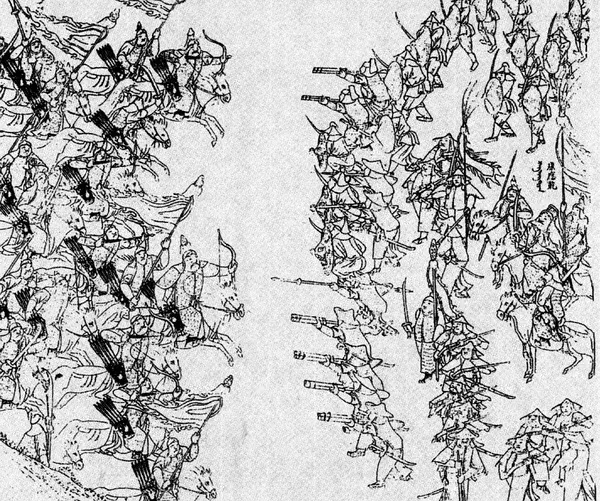
The Battle of Sarhu (萨尔浒之战) was a pivotal military campaign fought in the spring of 1619 between the Later Jin dynasty, led by Nurhaci, and the Ming dynasty, commanded by Military Commissioner Yang Hao, supported by allied contingents from the Yehe Jurchen tribe and Joseon Korea. Prior to the confrontation, Nurhaci unified the Jurchen tribes, established the Later Jin regime, and in 1618 issued his famous manifesto of the Seven Great Grievances against the Ming, subsequently seizing critical frontier outposts such as Fushun and Qinghe. In response, the Ming imperial court mobilized nearly one hundred thousand elite troops from the northern garrisons, styling the force as an army of four hundred and seventy thousand, and launched a converging four-pronged offensive targeting the Later Jin capital of Hetu Ala. Exploiting the mountainous terrain that separated the advancing Ming columns, Nurhaci adopted the operational doctrine of "concentrating on a single route regardless of how many routes the enemy advances along." Within five days, the Eight Banners cavalry successively crushed the Ming western column under Du Song, the northern column under Ma Lin, and the eastern column under Liu Ting, while the southern column under Li Rubai retreated in panic. The battle permanently shifted the balance of power in Northeast Asia, granting Later Jin complete strategic superiority in Liaodong.
Nurhaci proclaims open war against the Ming Empire and captures Fushun, initiating the conflict
Later Jin overruns Qinghe Fortress, prompting the Wanli Emperor to appoint Yang Hao as Military Commissioner
Yang Hao inaugurates the four-route converging offensive aimed at capturing Hetu Ala with 100,000 troops
Du Song's western column is ambushed and wiped out at Sarhu and Jilin Cliff; Du Song is killed in action
Nurhaci storms Ma Lin's camp at Shangjian Cliff; Pan Zongyan dies fighting heroically at Feifen Mountain
Liu Ting is lured into a forested ambush at Abudali Ridge and slain; Gang Hong-rip surrenders with Joseon troops
Li Rubai's army panics during its retreat at Hulan Ridge, ending the campaign in complete Ming defeat
During the late Wanli era, the Ming imperial government was severely paralyzed by factional struggles within the central court. Longstanding political confrontation between the Grand Secretariat, the eunuch faction, and censorate officials depleted state administrative efficiency. In the northeastern frontier of Liaodong, military readiness deteriorated rapidly, with garrison soldiers fleeing in large numbers due to corruption and logistical arrears, reducing actual troop strengths to less than half of their statutory quotas. Furthermore, the dispatch of imperial mining tax commissioners incited widespread civil unrest, worsening economic destitution across the borderland.
Simultaneously, the Jianzhou Jurchen chieftain Nurhaci rose rapidly in the Changbai Mountains region. Beginning his military career with only thirteen sets of family armor, Nurhaci combined diplomatic alliances, marriages, and military subjugation to gradually conquer competing Jurchen confederations. In 1616, Nurhaci formally proclaimed himself Khan at Hetu Ala, founding the Later Jin dynasty and declaring the Tianming reign era. Through the establishment of the Eight Banners system, which integrated military command with civil governance, Nurhaci forged a highly disciplined, mobile, and lethal army composed primarily of armored heavy cavalry and mounted archers.
In the fourth month of 1618, Nurhaci assembled his tribal chieftains and announced an open rebellion against the Ming Empire by proclaiming the Seven Great Grievances. The manifesto accused the Ming government of repeatedly violating frontier boundaries, killing his father and grandfather, harboring the hostile Yehe tribe, and aiding enemies of Jianzhou. Immediately following the declaration, Nurhaci led twenty thousand cavalry in a surprise attack against Fushun. Through subterranean infiltration and defection orchestrated by local commanders, Fushun fell with minimal resistance, and Ming commander Li Yongfang surrendered.
Alarmed by the fall of Fushun, Ming authorities dispatched Guanning Regional Commander Zhang Chengyin with ten thousand troops to mount a counterattack. However, Zhang was ambushed near the Hun River by Eight Banners cavalry and killed in action alongside several senior officers. In the seventh month of the same year, Later Jin forces struck Qinghe Fortress, overpowering the garrison commanded by Vice Regional Commander Zou Chuxian after fierce hand-to-hand fighting. The loss of Fushun and Qinghe stripped away the defensive shield protecting Shenyang and Liaoyang, sending shockwaves throughout Beijing.
Recognizing the existential threat posed by Later Jin expansion, the Wanli Emperor recalled Yang Hao, an experienced administrator who had previously overseen operations during the Imjin War, appointing him Vice Minister of War and Military Commissioner of Liaodong. Ming authorities allocated large sums from the central treasury to hire mercenaries and muster crack cavalry and infantry from the Nine Northern Garrisons, including Xuanfu, Datong, Jizhou, and Yansui. Elite firearm units from Zhejiang and Sichuan infantry armed with polearms were also summoned, alongside auxiliary troops provided by the Yehe Jurchens and King Gwanghaegun of Joseon Korea.
By early 1619, an allied army numbering roughly one hundred thousand men was concentrated in Liaodong, which Ming propagandists exaggerated as four hundred and seventy thousand. Sitting at his headquarters in Shenyang, Yang Hao devised an ambitious converging offensive. The plan called for four separate armies to march simultaneously from west, north, east, and south, converging on Hetu Ala on the second day of the third month to encircle and annihilate the Eight Banners in a decisive encounter.
In late February 1619, Commissioner Yang Hao formally inaugurated the campaign at Shenyang. The western route army was commanded by Shanhaiguan Regional Commander Du Song, supported by Vice Commanders Wang Xuan and Zhao Menglin, with Military Intendant Zhang Quan overseeing operations. Du Song led thirty thousand seasoned troops advancing eastward along the Hun River valley through Fushun Pass, designated as the principal striking force. The northern route army was led by Kaiyuan Regional Commander Ma Lin, assisted by Vice Commander Ma Yan and Intendant Pan Zongyan, comprising twenty-five thousand soldiers advancing south from Sanchaer Fortress, accompanied by two thousand Yehe cavalry under Chieftain Gintaisi.
The eastern route army was entrusted to veteran general Liu Ting, paired with Intendant Kang Yingqian, commanding fifteen thousand Ming border troops alongside thirteen thousand Joseon infantry and musketeers led by General Gang Hong-rip, advancing northwest through the rugged mountains from Kuandian. The southern route army was commanded by Liaodong Regional Commander Li Rubai, supported by Vice Commander He Shixian and Intendant Yan Mingtai, leading twenty thousand troops north from Qinghe through Yahu Pass. Yang Hao remained at Shenyang with a small strategic reserve, intending to coordinate operations remotely via dispatch riders.
Before operations commenced, Yang Hao publicized the campaign itinerary through official proclamations, enabling Later Jin scouts to intercept detailed intelligence regarding Ming routes and schedules. Analyzing the tactical situation, Nurhaci observed that towering mountain ridges and frozen rivers separated the four Ming columns, rendering mutual communication and mutual support impossible. Exploiting his central position, Nurhaci decided to deploy light skirmishers to distract the southern and eastern columns while massing his entire Eight Banners strike force of sixty thousand cavalry to intercept and destroy the most dangerous threat first, which was Du Song's western column.
On the morning of the first day of the third month, Ming forces crossed the frontier boundary. Driven by personal arrogance and an eager desire to claim sole credit for the conquest, Du Song refused to coordinate his pace with neighboring columns. He forced his troops through a blistering forced march of over one hundred li in heavy snow. Upon reaching the Hun River, the spring thaw had rendered the ice unstable, yet Du Song ordered his vanguard to wade across immediately without waiting for pontoons. Hundreds of pack animals and soldiers drowned in the frigid torrent, and countless powder charges and firearms were rendered unusable.
After crossing the river, Du Song learned that Later Jin forces were constructing defensive fortifications at Jiefan City near Mount Sarhu. Prematurely assuming that the Later Jin main army had not yet arrived, Du Song committed the fatal error of dividing his command. He posted Vice Commanders Wang Xuan and Zhao Menglin with twenty thousand men on the flat heights of Sarhu Mountain to construct an entrenched supply camp, while he personally led ten thousand cavalry across the river to mount an immediate assault on Jilin Cliff. This ill-judged division left both wings isolated and vulnerable to destruction.
On the morning of the first day of the third month, Du Song's detachment reached the foot of Jilin Cliff. The terrain was exceptionally rugged, bordered by deep rivers and sheer palisades. A small Later Jin garrison of several hundred warriors occupied the mountain crest, rolling heavy boulders and shooting arrows to repulse Ming charges. Du Song personally led wave after wave of assaults up the slopes, suffering heavy casualties while making no progress. In the meantime, Nurhaci arrived at the scene with his four senior sons and nephews, directing the main Eight Banners cavalry into position.
Surveying the battlefield from an elevated ridge, Nurhaci noticed that the Ming camp at Mount Sarhu was poorly fortified, disorganized, and situated on low-lying ground. He immediately ordered Prince Daišan and Hong Taiji to take two banners to reinforce Jilin Cliff and pin down Du Song from above, while Nurhaci personally led six banners of armored cavalry to assault the main Ming camp at Sarhu.
Around midday, a sudden squall blanketed the valley in thick fog and darkness. Exploiting the poor visibility and driving winds, the Eight Banners cavalry surged across the river and overran the Ming perimeter trenches. Damp conditions disabled many Ming cannon and matchlocks, preventing them from maintaining effective rolling volleys. The Jurchen heavy cavalry broke through the timber palisades and engaged in brutal hand-to-hand combat, slaughtering the disorganized defenders. The Sarhu camp collapsed into total panic, resulting in the annihilation of twenty thousand men and the deaths of Vice Commanders Wang Xuan and Zhao Menglin.
With the Sarhu camp eliminated, Nurhaci turned his entire force toward Jilin Cliff, subjecting Du Song's stranded detachment to a coordinated converging attack from both the mountain heights and the river flats. As dusk deepened, Du Song ordered his men to ignite torches to identify targets and direct cannon fire. However, the illumination backfired disastrously, casting the Ming soldiers in sharp silhouette while leaving the attacking Jurchen archers cloaked in complete darkness.
The Eight Banners archers unleashed devastating volleys into the illuminated Ming ranks, followed by a fierce cavalry charge across the shallows that severed the Ming line of retreat. Du Song fought desperately in the vanguard, sustaining multiple arrow wounds to his chest and face before an archer struck him through the throat, killing him on the spot. Following their commander's death, the remnants of the western column broke into a disorganized rout, with thousands cut down by pursuing cavalry or drowning in the icy river. Intendant Zhang Quan was captured and subsequently hanged himself after refusing to surrender. Within a single day, the primary Ming column of thirty thousand elite soldiers was completely wiped out.
Following the destruction of the western column, Nurhaci granted his troops no rest. During the night of the first day of the third month, he directed the Eight Banners northward to intercept Ma Lin's northern army, which was advancing through Sanchaer Fortress. Having learned of Du Song's catastrophic defeat upon reaching Shangjian Cliff, approximately thirty li northeast of Sarhu, Ma Lin halted his march in sheer terror, abandoning the offensive to adopt an entrenched defensive posture.
Aware that his twenty-five thousand troops could not match the Eight Banners in an open cavalry engagement, Ma Lin attempted to establish a layered defense. However, he committed the disastrous mistake of dividing his forces into three uncoordinated positions. Ma Lin established his main encampment at Shangjian Cliff, surrounding it with three concentric trenches flanked by artillery wagons and matchlock infantry, with cavalry positioned in the rear. Vice Commander Ma Yan held an auxiliary outpost on Feifen Mountain to guard the flank, while Intendant Pan Zongyan and Officer Gong Niansui commanded ten thousand troops stationed several li away at the base of Tiebei Mountain, forming an isolated wagon fort.
On the morning of the second day of the third month, Nurhaci's advance vanguard appeared before Shangjian Cliff. Assessing the separated Ming dispositions, Nurhaci resolved to eliminate the weakest outpost first. The Eight Banners bypassed the fortified perimeter of Shangjian Cliff and launched a concentrated cavalry charge against Gong Niansui's wagon train. Gong's infantry was overwhelmed before they could form coherent lines, and the wagon fort was rapidly overrun, resulting in Gong's death and the total rout of his men.
Nurhaci then redirected his assault toward Ma Lin's primary position at Shangjian Cliff. The trenches were deep and bristled with firearms, presenting a formidable obstacle to direct cavalry assault. Observing an elevated ridge directly east of Ma Lin's camp, Nurhaci immediately led his personal retinue to seize the high ground, preparing to charge downhill into the heart of the Ming camp.
Inside the fortifications, Ma Lin noticed the Jurchen troops moving across the slopes and mistakenly concluded that their main body had not yet arrived. Seeking to repel them before they consolidated, Ma Lin ordered his infantry to exit the trenches and form offensive ranks on the open field. Before the Ming soldiers could dress their lines, Nurhaci unleashed his armored horsemen down the slopes like an avalanche, crashing directly into the exposed Ming vanguard. The Ming musketeers managed only a single ragged volley before the Jurchen warriors closed the distance with heavy sabers and halberds.
At that crucial moment, the remaining banners arrived on the battlefield and struck the Ming flanks. Caught outside their defenses, the northern column disintegrated into utter chaos. Ma Lin fled the field with a handful of personal guards, abandoning his army to slaughter, and the main camp was plundered.
Meanwhile, at Feifen Mountain, Intendant Pan Zongyan and Vice Commander Ma Yan mounted a heroic stand. Renowned for his strict discipline and courage, Pan ordered his musketeers to maintain continuous fire, inspiring his men to resist repeated Jurchen charges. Nurhaci concentrated several banners around Feifen Mountain, utilizing wooden shield-carts to advance up the steep slopes against Ming projectiles. When their gunpowder was exhausted, the defenders fought on with daggers and broken spears until the camp was overwhelmed by sheer numbers.
Pan Zongyan was struck by multiple arrows, his robes soaked in blood, yet he continued to wield his sword and urge his men forward until he fell dead among his troops. Vice Commander Ma Yan was likewise slain in the melee. The northern army was completely destroyed, and the two thousand Yehe cavalry allied with Ma Lin retreated back to their homelands upon witnessing the catastrophe.
By the evening of the second day of the third month, the northern Ming army had ceased to exist. At that time, veteran commander Liu Ting, leading the eastern column, was entirely unaware of the twin disasters that had unfolded to the west and north. Liu Ting, famously nicknamed "Liu of the Great Blade" for his battlefield prowess, was advancing through deeply forested defiles where transport wagons could barely pass, slowing his progress to a crawl. By the third day of the third month, Liu Ting had reached Abudali Ridge, approximately seventy li south of Hetu Ala.
Having secured Shangjian Cliff, Nurhaci left a small cavalry screen toward Shenyang and marched his battle-tested Eight Banners south at top speed. To prevent Liu Ting from learning of the previous defeats and retreating into the safety of the frontier passes, Nurhaci devised a ruse. He clothed Jurchen scouts in captured Ming uniforms and banners belonging to Du Song's detachment, sending them to Liu Ting's camp with Du Song's forged command arrows. The messengers falsely claimed that the western column had already reached the outskirts of Hetu Ala and urgently requested Liu Ting to advance rapidly to share in the glory of the final assault.
Deceived by the counterfeit orders, Liu Ting ordered his troops to shed heavy armor and baggage, accelerating their march through the narrow valleys. On the morning of the fourth day of the third month, the Ming vanguard entered a deep, wooded gorge at Abudali Ridge. The mountain path was so narrow that soldiers could only advance in single file, stretching the column out over several miles. Prince Daišan and Hong Taiji had already concealed several banners of heavy shock troops among the forested cliffs overlooking the ravine.
Once half of the Ming column had filed into the valley floor, the concealed Jurchen archers loosed heavy volleys while hidden infantry rolled massive timber and boulders down upon the trapped soldiers, slicing the marching column into disjointed fragments. Armored Jurchen cavalry then charged simultaneously from both ends of the gorge, throwing the Ming ranks into complete pandemonium. Fighting at the head of his men, Liu Ting wielded his massive saber with lethal skill, cutting down dozens of enemy warriors in hand-to-hand combat.
By midday, Daišan led a final downhill charge that overwhelmed the Ming perimeter. Although shot through the face and suffering numerous spear thrusts, Liu Ting continued to fight on foot after his warhorse was killed, until he was finally surrounded and slain. Following the fall of their general, the eastern column broke completely, and thousands of trapped soldiers were slaughtered within the ravine.
Following behind the Ming advance guard, the Joseon contingent commanded by General Gang Hong-rip and Vice Commander Kim Gyeong-seo had halted and formed defensive squares at Fuchejiao, deploying musketeers behind timber barriers. After crushing Liu Ting, the Eight Banners encircled the Joseon encampment. Recognizing that Joseon was not the primary enemy, Nurhaci sent emissaries offering quarter if they surrendered peacefully. Confronted with the total annihilation of the Ming army and suffering from critical food shortages, Gang Hong-rip accepted the terms, and the remaining Joseon troops laid down their weapons. The eastern coalition of twenty-eight thousand men was entirely eliminated.
While three Ming field armies were being systematically destroyed, Commissioner Yang Hao remained at his headquarters in Shenyang, completely cut off from real-time operational reports. It was not until the early hours of the fifth day of the third month that panicked messengers arrived carrying news of the total obliteration of Du Song's and Ma Lin's commands. Paralyzed with grief and panic, Yang Hao feared for the safety of the final surviving column.
At that moment, the southern route army under Regional Commander Li Rubai had only reached Hulan Ridge south of Qinghe Fortress, having made sluggish progress through steep mountainous tracks without encountering the main Later Jin force. Fearing that Li Rubai would walk into another fatal ambush, Yang Hao dispatched emergency couriers ordering him to abort the mission and retreat to Liaoyang immediately.
Upon receiving the frantic order, Li Rubai realized that his sister armies had perished and that the victorious Eight Banners could appear on his flanks at any moment. Panicked, he failed to organize an orderly rearguard withdrawal and simply ordered an immediate general retreat. Sensing the movement, Later Jin scouts concealed in the surrounding hills beat war drums and blew conch horns to simulate an imminent mass cavalry assault.
Believing that the entire Eight Banners cavalry was descending upon them, Li Rubai's soldiers panicked completely. In their desperate rush to navigate the narrow mountain defiles, Ming soldiers trampled one another, and hundreds fell into deep ravines and rocky precipices. Over one thousand soldiers died in the stampede without ever engaging the enemy. Li Rubai managed to limp back to Qinghe Fortress with his battered survivors, but the army was thoroughly demoralized and ineffective.
Thus ended the five-day Battle of Sarhu. The grand campaign orchestrated by the Ming Empire resulted in an unmitigated catastrophe. More than three hundred and ten military and civilian officials perished in battle, over forty-five thousand soldiers were killed, and twenty-eight thousand horses and pack animals were lost, alongside twenty thousand pieces of firearms and artillery. The sophisticated defense perimeter maintained by the Ming in Liaodong for decades was shattered, setting the stage for the collapse of Ming authority north of the Great Wall.
The Battle of Sarhu ended in a complete triumph for Later Jin and a catastrophic defeat for the Ming allied forces. The Ming Empire lost over forty-five thousand combatants, along with more than three hundred senior civil officials and military commanders. Enormous quantities of equipment, including twenty-eight thousand horses and mules and twenty thousand firearms, fell into Jurchen hands or were abandoned in the wilderness.
Three of the four Ming armies were thoroughly liquidated, while the allied Joseon corps was neutralized and compelled to surrender. In contrast, Later Jin losses were minimal, not exceeding a few thousand casualties. The victory demonstrated the lethal effectiveness of the Eight Banners cavalry and exposed the institutional corruption, tactical rigidity, and logistical bankruptcy of the late Ming military apparatus.
Sarhu represented a watershed moment in the history of Northeast Asia. Before the battle, the Ming Empire retained strategic dominance and maintained an offensive posture designed to encircle and crush the young Jurchen state. Following the disaster, the Ming lost all capability to mount strategic offensives outside the Great Wall and was forced onto the permanent strategic defensive behind fortified city walls.
Capitalizing on his triumph, Nurhaci launched immediate offensive operations to consolidate his rear. Within months, Later Jin seized Kaiyuan and Tieling, extinguished the Yehe confederation, and incorporated all surviving Jurchen clans under the Eight Banners banner. Over the following three years, Nurhaci captured the provincial capitals of Shenyang and Liaoyang, followed by Guangning, expelling Ming administration entirely from the territory east of the Liao River and confining Ming defenses to the narrow Liaoxi corridor and Shanhaiguan.
The military catastrophe at Sarhu triggered profound socioeconomic convulsions across the Ming Empire. To finance replacement armies and reconstruct the collapsed northeastern border, the imperial court levied exorbitant supplementary land surtaxes known as the "Liaodong Surtax." These taxes were continually escalated over subsequent decades, extracting millions of silver taels from an impoverished agrarian population already suffering from widespread famines and natural disasters.
The crushing tax burden ignited massive peasant rebellions across northern China, most notably led by Li Zicheng and Zhang Xianzhong. As the central government exhausted its remaining resources trying to fight a two-front war against peasant rebels in the interior and Manchu invasions in the north, the Ming dynasty was pushed irreversibly toward its ultimate collapse in 1644.