Full Canal Navigation
The completion of the Jiangnan Canal concludes the construction of the continuous Sui Grand Canal network.
Sui Dynasty / Tang Dynasty / Northern Song Dynasty · HISTORICAL EVENT
隋唐大运河贯通沿用
The Continued Operation of the Sui-Tang Grand Canal (隋唐大运河贯通沿用) denotes the long-term hydraulic maintenance, sluice-gate engineering, and grain tribute management of the national canal network spanning more than five centuries from its completion in 610 (the sixth year of the Daye era of Sui) until the fall of the Northern Song in 1127 (the second year of the Jingkang era). Following its excavation, the canal system traversed silt-heavy alluvial…
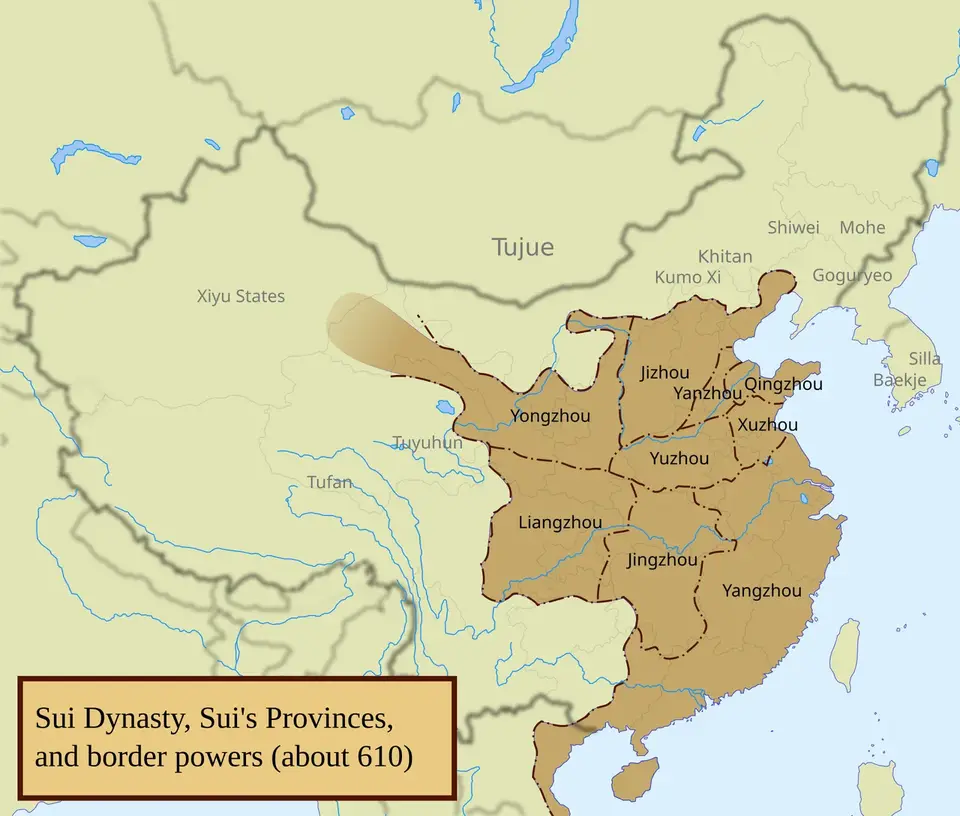
The Continued Operation of the Sui-Tang Grand Canal (隋唐大运河贯通沿用) denotes the long-term hydraulic maintenance, sluice-gate engineering, and grain tribute management of the national canal network spanning more than five centuries from its completion in 610 (the sixth year of the Daye era of Sui) until the fall of the Northern Song in 1127 (the second year of the Jingkang era). Following its excavation, the canal system traversed silt-heavy alluvial plains where sedimentation constantly elevated riverbeds into perilous perched streams, compounded by volatile seasonal water levels. Concurrently, imperial capitals in the Central Plains and northwest depended entirely on grain and textile revenues transported from the Jianghuai region, rendering unhindered canal operations vital to imperial dynastic survival. The Tang dynasty instituted staged relay transport systems under Chancellor Pei Yaoqing and comprehensive commercialized tribute reforms under Liu Yan, creating professionalized flotillas and state granary reserves. Under the Northern Song dynasty, four canals intersected at the imperial seat of Kaifeng, where the Directorate of Waterways mobilized tens of thousands of military corvée troops for systematic annual winter dredging, elevating annual tribute grain deliveries to unprecedented volumes exceeding eight million piculs. This five-hundred-year operational continuity underpinned imperial stability and socioeconomic integration until Jurchen invasions and Yellow River avulsions redirected imperial waterways.
The completion of the Jiangnan Canal concludes the construction of the continuous Sui Grand Canal network.
Chancellor Pei Yaoqing establishes relay granaries and staged transshipment, standardizing Yellow-Bian river traffic.
Financial statesman Liu Yan reorganizes tribute transport, deploying professional flotillas and salt monopoly funds to restore southern grain supply.
Northern Song founds its capital at Kaifeng, positioning the Bian River as the primary strategic artery of the empire.
The Directorate of Waterways refines hydraulic engineering statutes, elevating annual grain shipments to historic heights.
The fall of Northern Song and military devastation during Jurchen incursions cause the Bian River to fall into disuse.
The Tongji Canal of the Grand Canal network (known as the Bian River during the Tang and Song eras) diverted muddy waters from the Yellow River southeastward into the Huai River. Because the Yellow River carried massive silt loads, fine sediment accumulated rapidly once water entered the gentle gradients of the artificial channels, continually raising riverbeds above adjacent plains and causing frequent breaches and seasonal navigation stoppages. Furthermore, the canal crossed distinct ecological zones, creating drastic disparities between winter droughts and summer floods. Without systematic water diversion sluices, stone weirs, and routine dredging, uninterrupted commercial and imperial transit was impossible to sustain.
From the mid-Tang onward, agrarian productivity across Guanzhong and Henan proved wholly inadequate to sustain the expanding imperial court, the central bureaucracy, and massive standing armies. Imperial state finance shifted toward absolute dependence on southern revenues, encapsulated in the contemporary maxim: "All state needs depend upon Jianghuai." Following the devastating An Lushan Rebellion, tax receipts across northern provinces plummeted, leaving the southern river basins as the sole economic foundation of the crown. Whether sustaining imperial guards in Chang'an or the million-strong population of Northern Song Kaifeng, daily urban survival relied entirely on canal shipments. A disruption of canal transport directly triggered metropolitan famine and mutiny, making the maintenance of the canal the primary administrative priority of consecutive dynasties.
During the early Tang dynasty, imperial authorities followed Sui procedures by sailing grain barges directly from Jianghuai waterways all the way to Chang'an. These vessels had to navigate drastically disparate aquatic environments—the Yangtze, Huai, Bian, Yellow, and Wei rivers—resulting in high capsizing rates and exorbitant shipping costs. In 734 (the twenty-second year of the Kaiyuan era), Emperor Xuanzong adopted the proposals of Chancellor Pei Yaoqing to inaugurate the staged transit system. Pei established the Heyin Granary at the confluence of the Yellow and Bian rivers, along with the Jijin and Sanmen granaries flanking the treacherous Sanmenxia gorge. Southern barges transferred grain into Heyin Granary, from which experienced river boatmen conducted relay transshipment upstream, substantially curbing logistical losses and saving vast fiscal expenditures.
Following the An Lushan Rebellion, northern canal links were disrupted. Emperor Daizong appointed financial administrator Liu Yan to oversee the Salt and Iron Monopoly and the Transport Commission. Liu Yan introduced forward-looking commercialized management, replacing forced peasant corvée with recruited professional boatmen organized into ten coordinated transport brigades. He constructed major shipyards at Yangzhou to manufacture more than two thousand standardized vessels, established regional transit hubs along the Huai River, and utilized salt monopoly profits to fund ongoing fleet construction and channel maintenance. Under Liu Yan's system, over a million piculs of southern grain arrived safely in the capital each year without loss, stabilizing central finances during a perilous political epoch.
In 960, the Northern Song dynasty made Kaifeng its imperial capital, strategically situated where four major artificial waterways converged—the Bian, Huimin, Wuzhang, and Jinshui canals. Among these, the Bian River functioned as the foremost imperial lifeline. The Song court established the central Directorate of Waterways (Du Shuijian) to manage national hydraulic engineering and created the Regional Transport Commission (Fayunsi) to supervise grain shipments across southeastern circuits.
The Northern Song institutionalized an elaborate annual winter dredging system (suixiu). Each year in the tenth lunar month, when grain shipping paused for winter, the government mobilized tens of thousands of specialized ditch-digging military troops to erect temporary cofferdams, drain designated canal sectors, excavate accumulated silt, and reinforce stone dikes. Engineers installed stone sluice gates, pound locks, and overflow weirs to regulate water levels and stream velocity with precision. Through these advanced engineering standards, annual grain deliveries along the Bian River peaked at more than eight million piculs, sustaining Kaifeng's position as a vibrant metropolis.
The continued operation of the Sui-Tang Grand Canal for over five centuries established one of the most sophisticated inland navigation networks in antiquity. Archaeological discoveries of carbonized grain in the Hanjia Granary, alongside the bustling river traffic depicted in Zhang Zeduan's scroll Along the River During the Qingming Festival, demonstrate the canal's enduring role in metropolitan life and interregional trade.
The long-term operation of the Grand Canal generated profound historical legacies. Politically, it maintained the administrative coherence of the Sui, Tang, and Northern Song dynasties, preventing geographic balkanization between the north and south. Economically, the waterway stimulated urbanization, transforming river ports like Luoyang, Kaifeng, Yangzhou, and Hangzhou into thriving manufacturing and trade centers, which facilitated China's transition from localized manorial self-sufficiency toward an integrated commercial economy. Finally, hydraulic innovations perfected along the Bian River—including pound locks, double gates, and seasonal desiltation protocols—served as the direct engineering templates for the subsequent Yuan-Ming-Qing Grand Canal.