Dutch Occupation of Taiwan
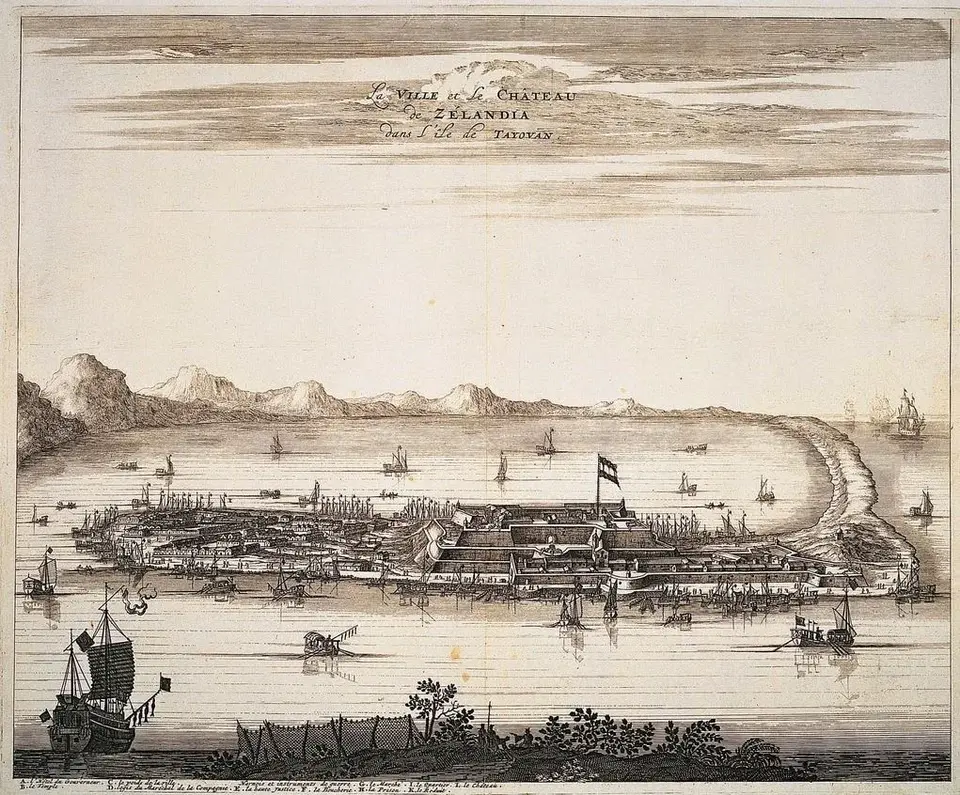
The Dutch East India Company established outposts in southern Taiwan, constructing Fort Zeelandia.
Qing Dynasty (Southern Ming) · HISTORICAL EVENT
郑成功收复台湾
The Zheng Chenggong's Recovery of Taiwan (郑成功收复台湾) was a historic military campaign from 1661 to 1662 (the fifteenth to sixteenth years of the Yongli era of Southern Ming and the eighteenth year of Shunzhi to the first year of Kangxi of Qing) in which Grand General Zheng Chenggong (Koxinga) expelled the Dutch East India Company to restore Chinese sovereignty over the island of Taiwan. In 1624, Dutch colonists seized southern Taiwan, erecting Fort…
The Zheng Chenggong's Recovery of Taiwan (郑成功收复台湾) was a historic military campaign from 1661 to 1662 (the fifteenth to sixteenth years of the Yongli era of Southern Ming and the eighteenth year of Shunzhi to the first year of Kangxi of Qing) in which Grand General Zheng Chenggong (Koxinga) expelled the Dutch East India Company to restore Chinese sovereignty over the island of Taiwan. In 1624, Dutch colonists seized southern Taiwan, erecting Fort Zeelandia and Fort Provintia to direct thirty-eight years of mercantile exploitation and severe taxation over indigenous and Han settlers. Following the setback of his northern campaign against Nanjing in 1659, Zheng Chenggong faced brutal coastal clearance edicts imposed by the Qing court. Guided by intelligence and nautical charts supplied by former Dutch interpreter He Bin, Zheng mobilized twenty-five thousand veteran troops from Kinmen in March 1661. Exploiting spring high tides, the armada bypassed heavy Dutch coastal batteries through the Lu'ermen channel, landed at Heliaogang, defeated Dutch naval forces, and captured Fort Provintia. After a nine-month siege of Fort Zeelandia and the repulsion of Dutch naval reinforcements from Batavia, Zheng battered down the strategic Utrecht redoubt with artillery, compelling Dutch Governor Frederick Coyett to sign formal articles of surrender on February 1, 1662. The victory eradicated Western colonial rule from the island and established the Prefecture of Chengtian, inaugurating an enduring era of institutional governance and cultural flourishing on Taiwan.
The Dutch East India Company established outposts in southern Taiwan, constructing Fort Zeelandia.
Zheng Chenggong mobilized 25,000 troops and hundreds of vessels at Liaoluo Bay, crossing the Taiwan Strait.
Exploiting spring high tides, Zheng's fleet crossed the Lu'ermen shallows and landed at Heliaogang.
After destroying the galleon Hector and routing Dutch musketeers, Ming forces compelled Fort Provintia to surrender.
Zheng's coastal batteries and fire squadrons shattered a Dutch naval relief fleet arriving from Batavia.
Ming artillery battered down the Utrecht bastion, securing the elevated position overlooking Fort Zeelandia.
Dutch Governor Coyett formally signed the surrender treaty, ending Dutch rule and restoring Taiwan to Chinese sovereignty.
In 1624, naval expeditions of the Dutch East India Company exploited the declining authority of the late Ming Dynasty to occupy the southwestern coast of Taiwan. The Dutch colonial administration established administrative headquarters at Fort Zeelandia (modern Anping Fort) and Fort Provintia (modern Chikan Tower) in Tainan. Over thirty-eight years, the company subjected indigenous Austronesian tribes and Han Chinese immigrants to harsh economic exploitation, imposing oppressive head taxes, fishing duties, and deer-hunting fees while monopolizing profitable transshipment trade in cane sugar and deerskins. In 1652, impoverished farmers led by Guo Huaiyi rose in a major insurrection, which was violently suppressed by Dutch colonial soldiers and allied native levies. Suffering under foreign oppression, the inhabitants of Taiwan longed for liberation by mainland forces.
In 1659, Zheng Chenggong's ambitious naval expedition up the Yangtze River suffered defeat outside Nanjing, compelling the Ming loyalist forces to retreat to their maritime bases on Kinmen and Xiamen. Sensing the persistent naval threat, the Qing imperial government enacted the Great Clearance (Qianjie Ling) in 1660, forcibly depopulating coastal settlements across thirty to fifty li inland from Shandong to Guangdong and burning villages to cut off all civilian commerce with Zheng's fleet.
The limited resources of the offshore islands of Kinmen and Xiamen could not sustain ten thousand soldiers and hundreds of thousands of civilian dependents over the long term. At this juncture, He Bin, an educated Han patriot who had served as a tax collector and interpreter for the Dutch East India Company in Taiwan, escaped to Xiamen. He presented detailed topographic and hydrographic charts of Taiwan to Zheng Chenggong, describing the island as a fertile paradise capable of supporting an independent kingdom. Zheng realized that liberating Taiwan would erase foreign colonial encroachment while securing an expansive, self-sustaining base for prolonged resistance against the Qing empire.
On April 21, 1661 (the twenty-third day of the third month of the fifteenth year of the Yongli era), Prince of Yanping Zheng Chenggong held an imperial sacrifice at Liaoluo Bay on Kinmen, embarking with 25,000 veteran troops and several hundred war junks. The armada traversed the turbulent Taiwan Strait, briefly staging at the Penghu Islands to wait out seasonal ocean gales.
At dawn on April 29, 1661 (the first day of the fourth month), Zheng Chenggong capitalized on exceptionally high spring tides. Guided by He Bin, the fleet bypassed the southern deep-water channel guarded by the heavy cannons of Fort Zeelandia, navigating instead through the shallow, treacherous northern channel of Lu'ermen. Hundreds of war junks glided smoothly across the shoals into the inner Lu'ermen lagoon, executing an amphibious landing at Heliaogang. Thousands of joyful Han settlers and indigenous villagers greeted the troops with food and supplies, while Dutch outposts reported that Chinese soldiers appeared to have fallen from the heavens.
Confronted by the sudden landing, Dutch Governor Frederick Coyett dispatched ground and naval forces in an immediate counterattack. On the water, the Dutch deployed four powerful warships, including the 54-gun galleon Hector, to bombard the Ming landing craft. Zheng Chenggong directed over sixty agile war boats armed with fire-pots and grappling hooks to encircle the Dutch warships. Concentrated artillery fire detonated the powder magazine of the Hector, sinking the vessel, while another Dutch ship was boarded and burned, granting Zheng control of the inland waterways.
On land, Dutch Captain Thomas Pedel marched with 240 European musketeers in tight infantry formations to halt the advance. Ming vanguard commander Chen Ze executed a double envelopment: advancing behind protective shields, his archers and musketeers delivered close-range volleys before charging with massive broadswords, routing the Dutch force and killing Captain Pedel. Ming divisions rapidly invested Fort Provintia, cutting off its freshwater aqueducts. On May 4, 1661, Dutch commander Valentyn surrendered the fortress, securing the interior gateway for the Ming army.
Following the fall of Fort Provintia, Governor Coyett concentrated nearly one thousand soldiers, merchants, and colonial officials inside Fort Zeelandia. Constructed of massive stone and kiln-baked brick with multiple bastions mounted with heavy naval cannons, the fortress proved impervious to direct frontal assault. After a costly initial probe, Zheng Chenggong modified his operational strategy to a strict siege combined with agricultural self-sufficiency. He ringed the fortress with redoubts while dispersing his regiments across northern and southern Taiwan to establish military agricultural settlements (Tuntian).
In July 1661, a relief fleet of twelve warships carrying 725 veteran soldiers arrived from the Dutch colonial capital of Batavia under Commander Jacob Caeuw. On September 16, the Dutch fleet launched a combined naval and amphibious assault to break the siege. Zheng Chenggong personally directed coastal artillery and fireship squadrons, repulsing the Dutch fleet, destroying two vessels, and forcing the remaining ships to withdraw in defeat.
By January 1662, after nearly nine months of continuous blockade, the defenders inside Fort Zeelandia suffered from scurvy, dysentery, depleted ammunition, and a complete absence of fresh water. On January 25, 1662, Zheng Chenggong ordered a general assault against the Utrecht redoubt, an elevated brick fortress commanding the high ground above Fort Zeelandia. Zheng concentrated twenty-eight heavy siege cannons against the position, discharging over two thousand rounds in a single day and reducing the ramparts to rubble. Ming shock troops stormed and captured the redoubt, mounting cannons that fired directly down into the interior of Fort Zeelandia.
Recognizing that further defense was impossible, Governor Coyett raised the white flag on January 27. Zheng Chenggong exhibited magnanimous statesmanship, negotiating an eighteen-clause treaty of surrender that permitted Dutch officials, soldiers, and civilians to depart peacefully with their personal possessions and flags flying. On February 1, 1662, Frederick Coyett signed the capitulation documents and evacuated Taiwan with his surviving troops, ending thirty-eight years of Dutch colonial occupation.
Prince of Yanping and supreme commander of the Southern Ming forces, revered as a great national hero. Exhibiting supreme maritime strategic acumen, he planned and executed the amphibious recovery of Taiwan, established civilian administration, and initiated large-scale agricultural and cultural development.
A patriotic Chinese scholar who served as an official interpreter and tax collector for the Dutch East India Company in Taiwan. Risking execution, he escaped to Xiamen with nautical maps, provided crucial intelligence, and navigated the fleet through the Lu'ermen shoals.
A distinguished vanguard general in Zheng Chenggong's army. Commanding Ming forces at the Heliaogang beachhead, he outmaneuvered and destroyed Captain Pedel's elite Dutch infantry square, securing the amphibious foothold.
The Swedish-born twelfth and final Dutch Governor of Formosa. A capable administrator who organized a stubborn nine-month defense inside Fort Zeelandia, he ultimately signed the instrument of surrender and published 't Verwaarloosde Formosa (Neglected Formosa) recounting his defeat.
The Dutch commander of Fort Provintia (Chikan Tower). Severed from marine support and deprived of drinking water by Zheng's siege, he negotiated the honorable surrender of his garrison, yielding central Tainan to Ming forces.
Zheng Chenggong's recovery of Taiwan represented one of the earliest and most decisive victories scored by an Asian maritime power against a European colonial empire. The campaign crushed the Dutch East India Company's ambitions to convert Taiwan into an imperial colonial station, demonstrating the superiority of Chinese amphibious warfare and naval logistics, while restoring Chinese territorial sovereignty over the island.
Following the recovery, Zheng Chenggong established the Prefecture of Chengtian alongside the counties of Tianxing and Wannian, renaming Fort Zeelandia as Anping. The Ming administration distributed cattle and iron plows, settled soldiers in frontier agricultural hamlets, and welcomed over one hundred thousand mainland immigrants fleeing Qing despotism. The establishment of Confucian academies, civil service examinations, and legal codes rooted Chinese culture permanently across Taiwan, charting its course as an integral part of the Chinese cultural and political sphere.