Departure from Chang'an
Troubled by scriptural inconsistencies, Xuanzang slips out of the capital alongside famine refugees
· HISTORICAL EVENT
玄奘西天取经
Xuanzang's Pilgrimage to India for Buddhist Scriptures (玄奘西天取经) was an epic seventeen-year religious and cultural odyssey undertaken by the renowned Buddhist master Xuanzang during the Zhenguan era of the Tang dynasty. During the Sui and early Tang periods, Chinese Buddhist communities were fractured by irreconcilable doctrinal disputes stemming from incomplete or corrupt translations of canonical Sanskrit scriptures, particularly regarding…
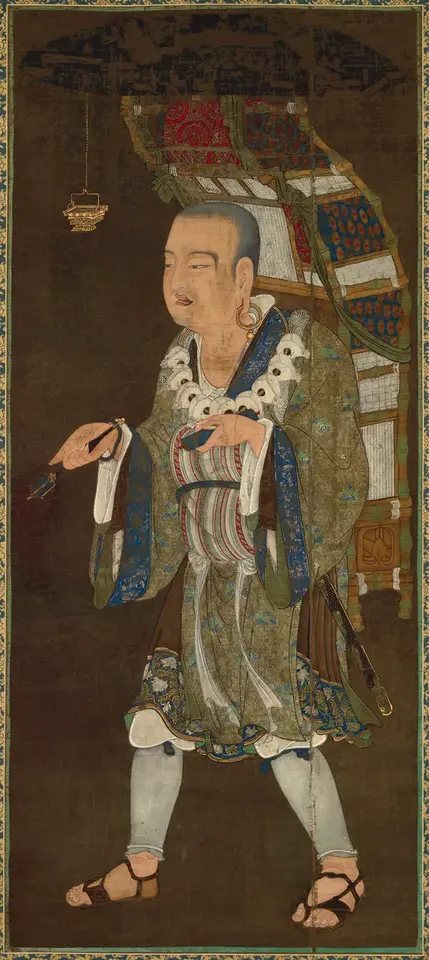
Xuanzang's Pilgrimage to India for Buddhist Scriptures (玄奘西天取经) was an epic seventeen-year religious and cultural odyssey undertaken by the renowned Buddhist master Xuanzang during the Zhenguan era of the Tang dynasty. During the Sui and early Tang periods, Chinese Buddhist communities were fractured by irreconcilable doctrinal disputes stemming from incomplete or corrupt translations of canonical Sanskrit scriptures, particularly regarding Consciousness-Only philosophy and the nature of enlightenment. Driven by a resolve to clarify these doctrinal ambiguities, Xuanzang resolved to journey to India to acquire the original Sanskrit text of the Yogacarabhumi-sastra. Defying strict imperial border bans in 627, Xuanzang slipped out of Chang'an alongside famine refugees. Traveling alone through the hazardous Gobi Desert, he secured the alliance of King Qu Wentai of Gaochang, crossed the snowy Pamir mountains, and traversed Central Asia to arrive in northern India. Xuanzang spent five years studying at Nalanda Monastery under the venerable master Silabhadra, mastering the ultimate depths of Yogacara doctrine. Following extensive travels across the Indian subcontinent, he presided over the grand Kanauj debate organized by King Harsha in 642, subduing thousands of scholars and receiving the title Mahayanadeva. In 645, Xuanzang returned triumphantly to Chang'an bearing 657 Sanskrit scriptures, receiving an imperial welcome from Emperor Taizong and commencing decades of monumental translation endeavors.
Troubled by scriptural inconsistencies, Xuanzang slips out of the capital alongside famine refugees
Xuanzang survives the waterless desert and forms a fraternal pact with King Qu Wentai of Gaochang
Xuanzang crosses the snowy Pamir mountains, traverses Central Asia, and enters the Indus basin
Reaching Magadha, Xuanzang studies Yogacara philosophy under Abbot Silabhadra for five years
King Harsha hosts the Kanauj assembly; Xuanzang defends his thesis for 18 days, honored as Mahayanadeva
Xuanzang returns to the Tang capital with 657 Sanskrit texts, received in triumph by Emperor Taizong
Event Name: Xuanzang's Pilgrimage to India for Buddhist Scriptures (玄奘西天取经); Alternative Name: Tang Monk's Pilgrimage (唐僧取经), Xuanzang's Quest for the Dharma in India (玄奘天竺求法), Pilgrimage to the Western Heavens (西天取经); Event Type: Religious and Cultural Pilgrimage (宗教文化求法远行); Dynasty: Tang (唐代); Location: Chang'an to Five Indies (Modern India, Pakistan, Nepal), centered at Nalanda Monastery; Time Period: 627 (First Year of Zhenguan) - 645 (Nineteenth Year of Zhenguan); Parties Involved: Tang Buddhist Pilgrim Xuanzang, Western Regions Kingdoms (Gaochang, etc.), Indian Kingdoms (Harsha's Empire, etc.); Key Figures: Xuanzang (Chen Yi), Emperor Taizong of Tang, Qu Wentai, Silabhadra, King Harsha; Cause: Competing doctrinal interpretations and translation deficiencies in Chinese Buddhism, motivating Xuanzang to retrieve original Sanskrit texts of the Yogacarabhumi-sastra; Outcome: Xuanzang studied in India for seventeen years, mastered Mahayana and Hinayana doctrines, triumphed at the Kanauj debate, and returned with 657 Sanskrit texts; Impact: Enriched Chinese Mahayana Yogacara philosophy, fostered deep cross-cultural exchanges between China and India, and became an enduring symbol of spiritual devotion;
Following centuries of Buddhist propagation across northern and southern China, numerous monastic traditions flourished, including the Nirvana, She-lun, Cheng-shi, and Kosa schools. However, because early canonical texts were brought piecemeal by traveling Central Asian monks, diverse translations contained conflicting vocabularies and theological contradictions. After taking monastic vows at Pure Land Monastery in Luoyang, Xuanzang traveled to major Buddhist centers across Chang'an, Chengdu, Jingzhou, and Xiangzhou, studying under thirteen eminent masters. He observed profound disagreements concerning whether all beings possessed Buddha-nature and the structural stages of spiritual cultivation. Above all, scholars lacked the complete hundred-fascicle text of Asanga's Yogacarabhumi-sastra, relying solely on partial digests translated by Paramartha. Convinced that ideological clarity could only be attained by examining original Sanskrit manuscripts and learning from direct lineage masters in India, Xuanzang vowed to travel to the cradle of Buddhism.
In the early Zhenguan era, newly ascendant Emperor Taizong maintained rigid frontier curfews along the northwestern corridors due to existential military threats from the Eastern Turkic Khaganate. Imperial officials strictly forbade private citizens from crossing imperial borders. Xuanzang and several companion monks petitioned the throne for travel passports, but regional administrative offices summarily rejected their applications. While his companions abandoned the quest in despair, Xuanzang swore that he would rather die advancing toward the West than take one backward step toward the East. In the autumn of 627, following widespread frost damage and famine in the capital region, the court permitted citizens to travel westward in search of food. The twenty-eight-year-old Xuanzang mingled among the migrating refugees, quietly departing Chang'an to embark on his perilous trek along the Hexi Corridor.
Arriving in Liangzhou and Guazhou, local authorities received imperial warrants commanding the apprehension of monks illegally exiting the realm. Fortunately, devout regional officials recognized Xuanzang's extraordinary spiritual sincerity and covertly destroyed the arrest orders. Assisted by an indigenous guide named Shi Pantuo, Xuanzang slipped past Yumen Pass by night, skirting five manned frontier beacon towers. When his guide grew terrified and turned back, Xuanzang ventured alone into the blistering Moheyanqi Desert, an eight-hundred-li expanse of shifting sands devoid of animal life.
Deep in the wilderness, Xuanzang accidentally overturned his water bladder, losing his entire supply. Facing agonizing dehydration, he pressed forward while chanting the Heart Sutra and praying to Avalokiteshvara. After five days and four nights without water, his veteran desert horse guided him to a hidden oasis, saving his life. Emerging from the sands into Hami, Xuanzang was escorted to the court of King Qu Wentai of Gaochang. The king initially attempted to detain the master permanently as royal chaplain, but relented after Xuanzang conducted an unyielding hunger strike. Deeply moved, Qu Wentai swore a fraternal pact with the master, equipping him with gold, silver, silk bolts, twenty-four royal letters of introduction to Central Asian rulers, and a dedicated retinue to ensure safe transit.
Guided by royal escorts and backed by the Western Turkic Khagan, Xuanzang negotiated the precipitous Iron Gate pass and scaled the glaciated summits of the Pamir and Hindu Kush ranges. Despite blizzards claiming the lives of several porters, Xuanzang journeyed through Suyab, Samarkand, and Gandhara, absorbing the diverse cultures of the Silk Road.
In 629, Xuanzang crossed the upper Indus River into northern India. He spent several years visiting pilgrimage shrines and studying Buddhist logic in Kashmir under venerable septuagenarian scholars. Journeying southeast along the Ganges River, he paid tearful homage to the sacred sites of the Buddha's life: the garden of Vaishali, the Sal grove at Kushinagar where the Buddha attained Parinirvana, the deer park at Sarnath, and the Bodhi tree at Bodh Gaya. These profound encounters deepened his determination to master the sacred scriptures and transmit the true Dharma to the East.
In 631, Xuanzang reached Nalanda Monastery in the kingdom of Magadha, the preeminent Buddhist university of ancient Asia, housing over ten thousand resident scholars. The monastic community was presided over by the hundred-year-old abbot Silabhadra, the supreme living authority on Yogacara metaphysics. Legend records that Silabhadra had previously suffered from debilitating illness and intended to end his life through fasting, but was restrained by visions of Manjusri, Avalokiteshvara, and Maitreya promising the imminent arrival of a brilliant Chinese disciple.
Upon learning that Xuanzang had journeyed thousands of miles from the East, Silabhadra wept with joy and accepted him as his primary direct disciple. Over the next five years, Xuanzang engaged in intensive study of the hundred-fascicle Yogacarabhumi-sastra, alongside treatises on Buddhist epistemology, linguistics, and the diverse philosophies of the Eighteen Schools. Mastering Sanskrit, Pali, and local vernacular dialects, Xuanzang proved himself one of only ten masters within Nalanda capable of expounding fifty distinct scriptural treatises, winning universal acclaim across the five regions of India.
After completing his curriculum at Nalanda, Xuanzang spent several years journeying through eastern, southern, and western India, surveying sacred monuments, interviewing reclusive masters, and collecting rare scriptural variants. Returning to Magadha, he authored the three-thousand-verse Treatise on the Harmony of the Teachings, brilliantly harmonizing the philosophical rift between the Madhyamaka emptiness doctrine and Yogacara consciousness theory. Furthermore, he composed sixteen hundred verses in the Treatise Demolishing Heretical Views, refuting southern Indian critiques leveled against Mahayana doctrine.
King Harsha, the paramount sovereign of northern India, formed an immense reverence for Xuanzang's intellectual genius. In 642, Harsha convened a grand assembly of theological debate at Kanauj. Eighteen client monarchs, over three thousand Mahayana and Hinayana scholars, and two thousand Brahmin philosophers assembled to witness the intellectual contest. Serving as supreme disputant, Xuanzang exhibited his philosophical treatises on towering placards, challenging any adversary to alter a single syllable of his argument under pain of decapitation. For eighteen consecutive days, no scholar could overturn his premises. At the conclusion of the assembly, Mahayana followers acclaimed Xuanzang as Mahayanadeva, while Hinayana adherents honored him as Moksadeva, cementing his legendary status across the Indian world.
Declining generous entreaties from King Harsha to remain permanently in India, Xuanzang commenced his homeward journey in 643, transporting 657 Sanskrit palm-leaf manuscripts, one hundred and fifty sacred relics, and seven gilded statues. Journeying back across the Pamir plateau, Khotan, and Dunhuang, he traveled along the southern Silk Road route.
In the first month of 645, after an absence of seventeen years, Xuanzang arrived at the southern gates of Chang'an. Under royal decree from Emperor Taizong, Grand Chancellor Fang Xuanling organized a magnificent state procession featuring imperial guards, civil dignitaries, and hundreds of thousands of citizens who blanketed the avenues in fragrant incense. Emperor Taizong personally received Xuanzang at his traveling palace in Luoyang, conversing with him for days and ordering the establishment of imperial translation bureaus at Hongfu and Da Cien Monasteries to support the master's lifelong translation of the sacred texts.
Xuanzang successfully executed one of the most remarkable religious expeditions in world history, traversing over fifty thousand li across seventeen years. He retrieved 657 Sanskrit texts spanning the Sutra, Vinaya, and Abhidharma corpora of both Mahayana and Hinayana traditions. Emperor Taizong authorized the creation of imperial translation bureaus at Hongfu and Da Cien Monasteries, where Xuanzang directed the translation of 75 canonical works comprising 1,335 fascicles over the subsequent nineteen years, introducing unprecedented accuracy and philosophical rigor to Chinese Buddhist scholarship.
Xuanzang's pilgrimage exerted profound historical and cultural ramifications across Eurasia. Intellectually, he inaugurated the New Translation era, founded the Faxiang Yogacara school, and elevated Chinese Buddhist epistemology to unprecedented analytical heights. Historically, his Great Tang Records on the Western Regions, compiled by disciple Bianji, preserved precise geographical, institutional, and social descriptions of 138 kingdoms, serving as an indispensable archaeological map for modern researchers reconstructing ancient Indian history. Culturally, his heroic adventures entered popular folklore, inspiring the celebrated Ming masterpiece Journey to the West and cementing Xuanzang's position as an enduring cultural archetype of spiritual perseverance.