Appointment as Prefect of Shangfang
Cai Lun is appointed Prefect of the Shangfang Workshops, supervising imperial armaments and craftsmanship
Eastern Han Dynasty (东汉) · HISTORICAL EVENT
蔡伦改进造纸术
Cai Lun's improvement of papermaking (蔡伦改进造纸术) was a transformative milestone in the history of science and technology achieved around 105 during the Eastern Han dynasty, wherein Prefect of the Shangfang Workshops Cai Lun synthesized prior artisan experiences to develop high-quality, inexpensive plant-fiber paper known as "Cai Hou Paper." Prior to this breakthrough, written records in ancient China were inscribed primarily on heavy wooden or bamboo slips…
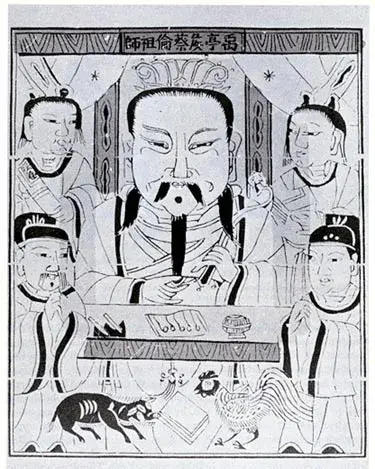
Cai Lun's improvement of papermaking (蔡伦改进造纸术) was a transformative milestone in the history of science and technology achieved around 105 during the Eastern Han dynasty, wherein Prefect of the Shangfang Workshops Cai Lun synthesized prior artisan experiences to develop high-quality, inexpensive plant-fiber paper known as "Cai Hou Paper." Prior to this breakthrough, written records in ancient China were inscribed primarily on heavy wooden or bamboo slips or brushed onto expensive silk rolls. Although crude hemp fiber paper existed during the Western Han dynasty, its uneven texture and poor ink absorption prevented it from becoming an official medium for bureaucratic records. In 102, Empress Deng Sui embraced frugality and decreed that provincial commanderies cease sending luxury tributes, requesting only paper and ink for official use. Serving as Prefect of the Shangfang Workshops, Cai Lun oversaw imperial manufacturing and initiated comprehensive technical experiments. He broadened raw materials by incorporating mulberry tree bark, hemp waste, worn rags, and discarded fishing nets. Through a standardized sequence of steeping, boiling in lye, pounding, pulping, screening, pressing, and drying, he produced smooth, flexible, and resilient paper. In 105, Cai Lun presented his perfected paper to Emperor He of Han, who praised his ingenuity and decreed its adoption across imperial administration. This achievement established papermaking as an independent craft and revolutionized the preservation and global transmission of human knowledge.
Cai Lun is appointed Prefect of the Shangfang Workshops, supervising imperial armaments and craftsmanship
Empress Deng Sui bans luxury tributes from commanderies, requesting only paper and ink for annual court use
Cai Lun experiments with tree bark, rags, and fishing nets at the Shangfang workshops, pioneering alkaline boiling
Cai Lun presents his perfected plant-fiber paper to Emperor He, who decrees its adoption throughout the bureaucracy
Empress Dowager Deng creates Cai Lun Marquis of Longting; the new medium is universally acclaimed as Cai Hou Paper
Cai Hou Paper achieves complete dominance across official and private sectors, establishing papermaking as an independent craft
Before the widespread adoption of paper, ancient Chinese civilization relied primarily on bamboo tablets, wooden slips, and woven silk as writing media. Bamboo and wood were abundant, yet their substantial physical weight and bulk imposed severe operational constraints. Transcribing philosophical treatises or historical chronicles required dozens of heavy bundles, creating logistical bottlenecks for scholars and imperial messengers alike. Historical records note that the First Emperor of Qin personally weighed and reviewed one hundred and twenty pounds of official bamboo documents every day, illustrating the physical burdens imposed on imperial administration.
Conversely, fine woven silk provided a supple, lightweight, and durable writing surface with excellent ink absorption. However, sericulture and textile weaving required immense labor and financial investment, rendering silk an exclusive luxury reserved for the imperial throne, aristocratic households, and solemn state covenants. The chronic dilemma of slips being too heavy and silk being too costly severely restricted mass education, literacy, and administrative efficiency throughout early imperial China.
Archaeological discoveries in modern times have confirmed that early forms of plant-fiber paper existed in China during the Western Han period. Fragmentary specimens dating to the reigns of Emperors Wen, Jing, and Wu have been unearthed at sites including Fangmatan in Tianshui, Baqiao in Xi'an, Xuanquanzhi in Dunhuang, and Lop Nor in Xinjiang, with some fragments bearing traces of drawn maps or brushed characters.
However, these Western Han specimens were rudimentary by-products derived from washing and settling scrap fibers from silk and hemp textile processing. They suffered from coarse, irregular fibers, thick and uneven textures, porous surfaces, and poor ink retention, frequently causing ink to bleed uncontrollably. Consequently, primitive hemp paper was relegated to wrapping commodities, packing fragile goods, or lining garments, remaining incapable of displacing bamboo slips and silk in formal government and literary archives.
Cai Lun, courtesy name Jingzhong, hailed from Leiyang in Guiyang Commandery (modern Leiyang, Hunan Province). In 88, following the accession of Emperor He, Cai Lun was appointed Prefect of the Shangfang Workshops, an imperial agency subordinate to the Chamberlain for the Palace Revenues responsible for manufacturing imperial blades, ceremonial regalia, and fine instruments. Renowned for rigorous craftsmanship and organizational skill, Cai Lun supervised the production of weapons and tools that were celebrated for their peerless durability and precision.
In 102, Emperor He created Deng Sui his empress. Highly cultured and deeply devoted to classical studies, Empress Deng was famous for her personal austerity. She abolished the traditional presentation of foreign gemstones, rare birds, and embroidered fabrics from tributary commanderies, decreeing that local authorities supply only paper and ink annually. As head of the Shangfang Workshops, Cai Lun enjoyed access to seasoned imperial craftsmen, abundant fiscal subsidies, and constant supplies of regional paper samples, providing an ideal experimental platform to overcome technical hurdles in papermaking.
Recognizing that the expense of hemp textiles was the principal barrier to mass paper production, Cai Lun resolved to revolutionize the source of raw materials. He looked beyond textile scraps to explore renewable, low-cost plant resources found throughout the natural environment.
Cai Lun pioneered the systematic utilization of tree bark, especially the tough bast fibers of the paper mulberry and common mulberry trees. Simultaneously, he organized the collection of urban waste materials, including worn hemp ends, tattered rags, and discarded fishing nets. By converting valueless refuse and abundant wild bark into high-grade fiber pulp, Cai Lun decoupled paper manufacturing from the sericulture and textile economies, dramatically slashing production costs while securing an inexhaustible supply of raw materials.
Leading imperial artisans at the Shangfang workshops in Luoyang, Cai Lun conducted methodical experiments over several years, refining an integrated physical and chemical manufacturing sequence. This seven-stage process comprised:
First, soaking and cutting, where raw bark, rags, and nets were washed in clean stone basins and chopped into short, uniform strands; second, lime boiling, in which the chopped fibers were simmered in large cauldrons with alkaline wood ash and lime solutions, chemically dissolving lignins, pectins, and oily resins to isolate pure cellulose; third, pounding and maceration, where boiled fibers were transferred to stone mortars and pulverized with water-powered or manual pestles until individual fibers were completely separated; fourth, pulping and suspension, wherein the macerated pulp was transferred to large vats of fresh water and stirred to form a homogeneous suspension; fifth, sheet forming, where skilled craftsmen dipped bamboo screening frames into the vat, lifting them with a gentle rocking motion to weave a uniform, interlocking layer of wet fibers across the screen; sixth, press dewatering, where damp sheets were couched into stacks and pressed with heavy stones to remove excess water; and seventh, drying and finishing, where wet sheets were brushed onto heated masonry drying walls, peeled off once dry, and burnished smooth.
This standardized technological sequence established the foundational principles of modern papermaking, yielding paper that was thin, remarkably strong, smooth-textured, and exceptionally absorbent without ink bleeding.
In 105, during the first year of the Yuanxing reign era, Cai Lun successfully manufactured the first batch of perfected plant-fiber paper. The finished sheets were pure white, lightweight, flexible, and ideal for calligraphy, matching the functional qualities of fine silk at a fraction of the cost.
Cai Lun formally presented this paper to Emperor He alongside a comprehensive memorial documenting the manufacturing methodology and economic benefits. Emperor He inspected the paper, tested its writing qualities, and issued an imperial decree commending Cai Lun's technical genius. The emperor ordered central ministries and provincial commanderies to adopt the new paper for all state documents, inaugurating an irreversible administrative transition from bamboo and silk to paper across the empire.
Following Emperor He's demise, Empress Deng Sui assumed the regency as Empress Dowager Deng. A lifelong advocate of administrative economy, she accelerated the institutional adoption of paper across imperial bureaus, Confucian academies, and judicial courts. In 114, during the first year of the Yuanchu reign, Empress Dowager Deng rewarded Cai Lun for his decades of loyal service and technological contributions by enfeoffing him as Marquis of Longting, granting him a hereditary estate of three hundred households.
Following his ennoblement, scholar-officials and common citizens across China affectionately christened the new medium "Cai Hou Paper" in honor of the Marquis. With enthusiastic imperial sponsorship and burgeoning private demand, state and commercial paper mills multiplied rapidly across Luoyang, Henan, and the eastern commanderies, spreading advanced papermaking technology throughout the Chinese world.
Cai Lun's technical breakthroughs emancipated papermaking from its historic status as an incidental byproduct of textile processing, establishing it as an autonomous, large-scale handicraft industry. His seven-stage standardized production sequence established the operational paradigm that guided traditional manual papermaking worldwide for over two millennia.
Inexpensive, durable, and highly portable, Cai Hou Paper rapidly supplanted cumbersome wooden slips and costly silk textiles, permanently resolving the ancient dilemma of material scarcity in written communication. This material transformation catalyzed the greatest communication revolution in pre-modern history.
The availability of cheap paper drastically lowered the socioeconomic threshold for acquiring books and pursuing scholarly education. In 121, scholars utilized paper to standardize and recopy the Five Classics, preserving thousands of ancient historical and philosophical texts that would otherwise have perished during the turmoil of the late Han and Three Kingdoms eras.
Simultaneously, lightweight paper documents accelerated imperial postal communication, enabling central ministries in Luoyang to dispatch directives, census rolls, and tax assessments to distant border commanderates with unprecedented speed, thereby reinforcing the administrative cohesion of the imperial state.
Originating in the imperial workshops of Luoyang, Cai Lun's papermaking methodology diffused across continents over subsequent centuries. The technique reached Korea and Japan during the third and fourth centuries, arrived in Central Asia and the Islamic world following the Battle of Talas in 751, and spread via Moorish Spain and Sicily to medieval Europe by the twelfth century.
By replacing animal parchment and Egyptian papyrus with cheap, durable plant-fiber paper, Cai Lun's invention drastically reduced book production costs in Europe. It provided the indispensable material foundation for Gutenberg's printing press, the European Renaissance, the Protestant Reformation, and the Scientific Revolution, earning universal recognition as one of the Four Great Inventions of ancient China that fundamentally reshaped human civilization.