Rebellion Erupts
An Lushan rebels in Fanyang, sweeping through the Central Plains and marching on Chang'an.
Tang Dynasty (唐朝) · HISTORICAL EVENT
马嵬之变
The Mawei Mutiny (马嵬之变) was a pivotal palace revolt and military rebellion that erupted in July 756 (the fifteenth year of the Tianbao era) at Mawei Courier Post in Xingping, Shaanxi, during Emperor Xuanzong's flight to Sichuan following the fall of Tongguan to An Lushan's rebel armies. After imperial defenses collapsed at Lingbao, Xuanzong abandoned the capital of Chang'an with his consort Yang Yuhuan, Chancellor Yang Guozhong, and Crown Prince Li…
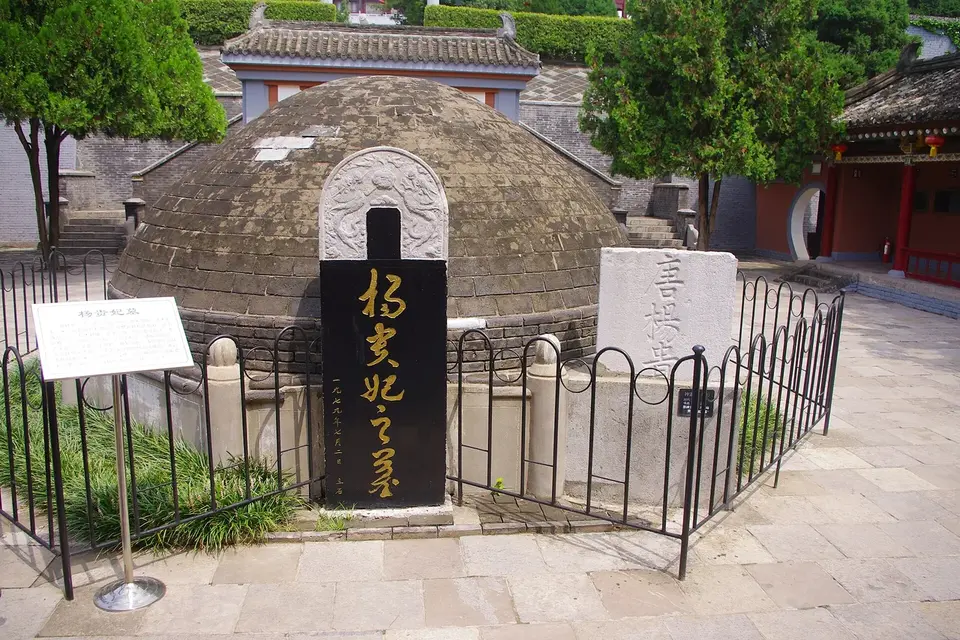
The Mawei Mutiny (马嵬之变) was a pivotal palace revolt and military rebellion that erupted in July 756 (the fifteenth year of the Tianbao era) at Mawei Courier Post in Xingping, Shaanxi, during Emperor Xuanzong's flight to Sichuan following the fall of Tongguan to An Lushan's rebel armies. After imperial defenses collapsed at Lingbao, Xuanzong abandoned the capital of Chang'an with his consort Yang Yuhuan, Chancellor Yang Guozhong, and Crown Prince Li Heng, escorted by several thousand elite imperial guards under General Chen Xuanli. Suffering from hunger and exhaustion under summer heat, the soldiers blamed Yang Guozhong's corrupt administration for provoking the rebellion. When Tibetan emissaries addressed Yang Guozhong outside the post, the guards surrounded and dismembered him. The soldiers subsequently surrounded the imperial quarters, demanding the execution of Consort Yang. Pressured by his officers and advised by chief eunuch Gao Lishi, the sovereign ordered Consort Yang strangled in a nearby Buddhist chapel. Following the mutiny, Crown Prince Li Heng broke away from Xuanzong's entourage and marched north to Lingwu, where he ascended the throne as Emperor Suzong. The mutiny destroyed the Yang clan, transferred operational command to Suzong's counter-offensive, and marked the turning point of the An Lushan Rebellion.
An Lushan rebels in Fanyang, sweeping through the Central Plains and marching on Chang'an.
Geshu Han is routed at Lingbao, opening the mountain passes to the rebel cavalry.
Emperor Xuanzong, Consort Yang, and Yang Guozhong flee the capital for Sichuan.
Imperial guards revolt at Mawei Post, executing Yang Guozhong and his kin.
Pressured by the army, Xuanzong orders Gao Lishi to execute Consort Yang, quelling the mutiny.
Crown Prince Li Heng departs for Lingwu, mounting the throne as Emperor Suzong to direct the counter-offensive.
During the late reign of Emperor Xuanzong, the emperor withdrew from administrative duties, indulging in palace pleasures with his consort Yang Yuhuan while entrusting state finances and civil governance to her corrupt cousin, Chancellor Yang Guozhong. In November 755, military governor An Lushan rebelled at Fanyang under the pretext of overthrowing Yang Guozhong, sweeping across Henan and capturing the eastern capital of Luoyang. In June 756, suspicious of general Geshu Han, Yang Guozhong forced imperial garrison armies to abandon their mountain defenses at Tongguan. The army was ambushed and destroyed at Lingbao, opening the gateway to the capital. Facing imminent capture, Emperor Xuanzong and Yang Guozhong secretly fled Chang'an at dawn on July 13, accompanied by the imperial family and imperial cavalry under General Chen Xuanli, abandoning the capital's population to the rebels.
Escorting the imperial court west along the Wei River under scorching summer heat, the imperial guards faced desperate privations. Local magistrates had fled, leaving government storehouses empty and food supplies exhausted. Marching in heavy mail with insufficient water, the soldiers grew bitter over the destruction of their families and the loss of the capital. The rank-and-file blamed Yang Guozhong's nepotism and reckless provocations for plunging the empire into catastrophe. Sensing mutinous sentiment, General Chen Xuanli communicated secretly with Crown Prince Li Heng's confidential eunuch Li Fuguo, planning to eliminate the chancellor to restore military discipline.
At midday on July 15, 756, the imperial procession reached Mawei Post (west of modern Xingping, Shaanxi). The soldiers were starving and on the verge of open revolt. At that moment, over twenty Tibetan envoys blocked Yang Guozhong's horse outside the post gates, demanding provisions. Seeing this encounter, imperial cavalrymen shouted: "Yang Guozhong is conspiring with the Tibetans to commit treason!"
The cry triggered an immediate uprising. Mounted archers fired upon the chancellor, who fled in terror toward the western gate of the post. Imperial cavalry overtook him, cutting him down and displaying his severed head on a lance. The soldiers then stormed the post hostel, killing his son, Vice Minister of Revenue Yang Xuan, along with Consort Yang's elder sisters, the Duchess of Han and the Duchess of Guo. When Grandee Secretary Wei Fangjin attempted to intervene, he was cut down by the mutineers. Armed cavalrymen encircled the imperial residence, their drawn blades sealing all exits.
Having eliminated the chancellor, the mutinous troops refused to disarm, demanding further concessions. Over seventy years old, Emperor Xuanzong emerged supporting himself with a walking stick to address the assembly, urging the soldiers to return to their ranks. General Chen Xuanli bowed in full armor, declaring: "Yang Guozhong committed treason and has been executed; yet the Lady Yang still attends your imperial bed. How can the soldiers feel secure? We beg Your Majesty to sacrifice personal affection to satisfy the army!"
Horrified, Emperor Xuanzong protested that Consort Yang resided in the inner chambers and bore no guilt in Guozhong's crimes. As silence fell over the court, the emperor withdrew inside the courtyard. Recognizing that the soldiers would not disperse, chief eunuch Gao Lishi prostrated himself, urging: "The soldiers have slain Guozhong; if the Consort survives, how can they rest in safety? If the army mutinies further, how will Your Majesty preserve your own person? Only by severing personal love can the realm be saved!" Weeping openly, Xuanzong consented. Gao Lishi led Consort Yang to a Buddhist chapel beside the post, where she was strangled with a white silk cord at the age of thirty-eight. Her body was carried outside for Chen Xuanli and senior officers to inspect. Satisfied, the officers removed their helmets and prostrated themselves, shouting "Long live the Emperor!" Restoring order, the caravan continued south toward Sichuan.
The Mawei Mutiny dismantled the political machine of the Yang family. Consort Yang was buried in a shallow roadside grave, and her kin were eliminated. Following the mutiny, the imperial convoy divided: Emperor Xuanzong continued south into the redoubt of Shu (Sichuan), while Crown Prince Li Heng yielded to local appeals to march north to Lingwu, where he ascended the throne on August 12, 756, inaugurating the Zhide era and elevating Xuanzong to Retired Emperor.
The mutiny altered the trajectory of the Tang dynasty. Politically, it ended Emperor Xuanzong's forty-four-year reign and purged the court of corrupt favorites. Militarily, Emperor Suzong's installation at Lingwu mobilized northern frontier forces under generals Guo Ziyi and Li Guangbi, integrating Uighur allied cavalry into a unified counter-offensive that recaptured Chang'an and Luoyang. Culturally, the tragedy of Xuanzong and Consort Yang became an enduring literary theme, inspiring masterpieces such as Bai Juyi's Song of Everlasting Sorrow and cementing Mawei as a universal symbol of political vanity and human grief.