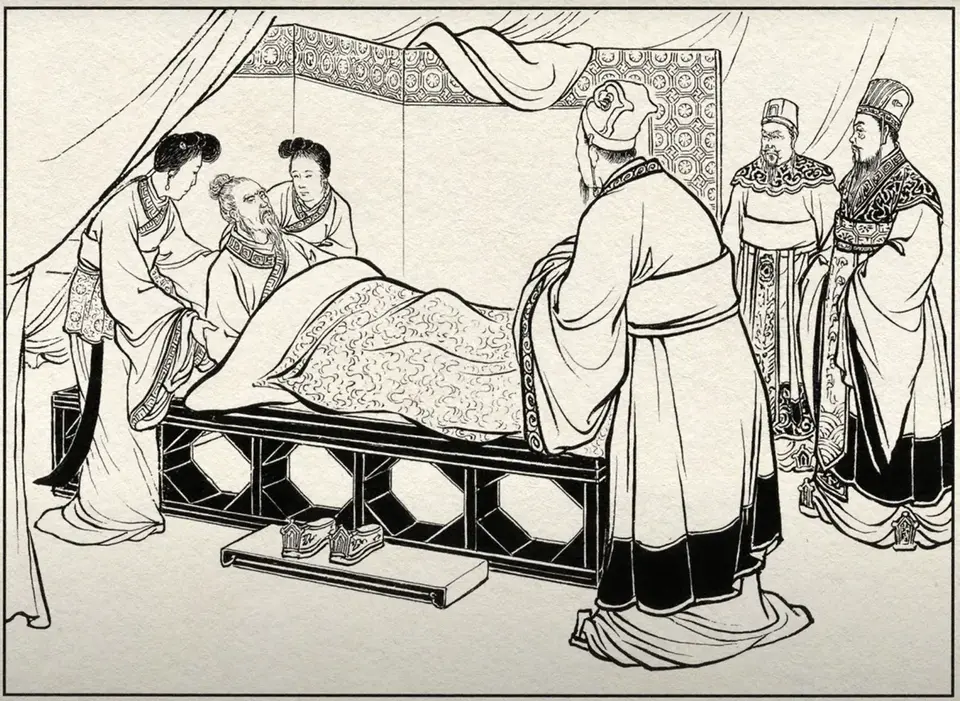
Imperial Deathbed Entrustment
Emperor Ming of Wei entrusts the young heir Cao Fang jointly to regent Cao Shuang and commander Sima Yi.
Cao Wei (曹魏) · HISTORICAL EVENT
高平陵之变
The Incident at Gaoping Tombs (高平陵之变) took place in the first lunar month of 249 AD (the tenth year of the Zhengshi era) in Luoyang, marking a decisive palace coup that completely overturned the ruling authority of the Cao Wei imperial family. Following the death of Emperor Ming (Cao Rui), regent Cao Shuang monopolized power, stripped Grand Tutor Sima Yi of military authority, and altered government institutions. In response, Sima Yi feigned terminal…
The Incident at Gaoping Tombs (高平陵之变) took place in the first lunar month of 249 AD (the tenth year of the Zhengshi era) in Luoyang, marking a decisive palace coup that completely overturned the ruling authority of the Cao Wei imperial family. Following the death of Emperor Ming (Cao Rui), regent Cao Shuang monopolized power, stripped Grand Tutor Sima Yi of military authority, and altered government institutions. In response, Sima Yi feigned terminal illness while secretly training three thousand private retainers. When Cao Shuang escorted young Emperor Cao Fang out of the capital to visit Gaoping Tombs, Sima Yi launched a surprise rebellion, seized the imperial armory, secured Empress Dowager Guo's decree to dismiss Cao Shuang, and swore an oath by the Luo River promising Cao Shuang safety upon surrender. After Cao Shuang yielded, Sima Yi violated his oath and exterminated Cao Shuang's three branches of kinship and core allies. This coup liquidated imperial clan influence, concentrated state power within the Sima family, and initiated the transition toward the founding of the Western Jin dynasty.
Emperor Ming of Wei entrusts the young heir Cao Fang jointly to regent Cao Shuang and commander Sima Yi.
Cao Shuang monopolizes state authority; Sima Yi retires on grounds of infirmity while secretly organizing armed retainers.
Emperor Cao Fang and Cao Shuang exit Luoyang for Gaoping Tombs; Sima Yi mobilizes loyalists to capture the capital armory.
Huan Fan flees to Gaoping Tombs urging resistance from Xuchang; Cao Shuang wavers and agrees to capitulate.
Sima Yi repudiates the Luo River oath, executing Cao Shuang, his brothers, and their inner circle alongside their clans.
In 239 AD (the third year of Jingchu), Emperor Ming of Wei passed away prematurely. On his deathbed, he entrusted the eight-year-old heir Cao Fang to General-in-Chief Cao Shuang and Grand Commandant Sima Yi as joint regents. Initially, the two leaders maintained nominal parity. However, Cao Shuang soon recruited ambitious young scholars including He Yan, Deng Yang, Ding Mi, Bi Gui, and Li Sheng as his chief strategists, adopting their proposal to promote Sima Yi to the prestigious yet powerless rank of Grand Tutor, thereby stripping him of operational military commands.
Simultaneously, Cao Shuang appointed his brothers Cao Xi, Cao Xun, and Cao Yan to command the imperial guard divisions in Luoyang. Cao Shuang's faction governed with overbearing arrogance, unilaterally altering administrative statutes, installing partisan cronies throughout government ministries, and seizing control of official appointments and imperial treasuries. Cao Shuang even appropriated palace musicians and imperial treasures for personal diversion, provoking profound indignation and alarm among prominent veteran founding ministers such as Jiang Ji and Gao Rou.
Confronted with relentless political encroachment, Sima Yi adopted a strategy of patience and dissimulation. In 247 AD (the eighth year of Zhengshi), Sima Yi pleaded severe illness and retired entirely from active governance, remaining secluded within his private residence. Suspecting subterfuge, Cao Shuang sent his confidant Li Sheng to visit Sima Yi under the pretext of paying respects prior to Li Sheng's assumption of the governorship of Jingzhou.
During the meeting, Sima Yi intentionally appeared senile and physically decrepit. He wore disheveled garments, allowed rice porridge to dribble down his chin onto his robes, and pretended to mishear Li Sheng's assignment, confusing Jingzhou with Bingzhou. Convinced that the old general was on the verge of death, Li Sheng reported back, leading Cao Shuang and his faction to discard all vigilance. In reality, Sima Yi and his eldest son Sima Shi had covertly recruited and trained three thousand elite retainers who lived quietly among ordinary Luoyang citizens, waiting for the signal to strike.
On the sixth day of the first lunar month in 249 AD, Emperor Cao Fang departed the imperial palace to perform sacrificial rites at Gaoping Tombs, where Emperor Ming was buried. Believing the capital secure, Cao Shuang and his brothers accompanied the imperial retinue without suspicion, leaving Luoyang entirely defenseless. Recognizing this optimal opportunity, Sima Yi initiated his long-planned coup.
Sima Yi and Sima Shi mobilized their three thousand clandestine retainers, gathering at the palace gates within minutes and capturing the primary royal armory to distribute weapons. Sima Yi promptly entered the palace and presented a petition to Empress Dowager Guo, denouncing Cao Shuang for betraying ancestral regency instructions, ruining dynastic statutes, and plotting treason. Under pressure, Empress Dowager Guo issued an edict dismissing Cao Shuang from his commands. Sima Yi assigned Sima Shi to guard the palace gates, dispatched Sima Zhao to secure strategic city avenues, ordered Grand Commandant Gao Rou to assume control of Cao Shuang's main military camp, and directed Wang Guan to take over Cao Xi's guard encampment, sealing off the capital completely.
Observing the sudden insurrection, Grand Minister of Agriculture Huan Fan escaped Luoyang by rope from Pingchang Gate, carrying the official ministerial seals as he galloped toward the imperial encampment at Gaoping Tombs. Upon arrival, Huan Fan vigorously urged Cao Shuang to escort the emperor to Xuchang, where imperial edicts could summon provincial commanders from across the empire to suppress Sima Yi. Huan Fan noted that with the agricultural seal in hand, grain supplies would be limitless.
However, Cao Shuang, accustomed to opulence and indecisive by nature, fell into paralyzing panic and vacillated throughout the night. Recognizing his rival's irresolution, Sima Yi dispatched Palace Attendant Xu Yun, Minister Chen Tai, and the revered elder statesman Jiang Ji to deliver terms of surrender. Sima Yi swore an oath beside the Luo River, pledging before heaven that Cao Shuang would only lose official rank while keeping his marquisate and personal estates completely intact. Craving security and tranquility, Cao Shuang ultimately surrendered his military seal, stating resignation with the words that he would still remain a wealthy gentleman.
Upon the imperial party's return to Luoyang, Sima Yi immediately breached his pledge. Armed detachments were deployed to surround the private residences of Cao Shuang and his brothers, constructing surveillance watchtowers overlooking their courtyards. Shortly thereafter, the legal commissioner formally charged Cao Shuang's faction with treason.
Sima Yi ordered the public execution of Cao Shuang, Cao Xi, Cao Xun, and their principal associates—He Yan, Ding Mi, Deng Yang, Bi Gui, Li Sheng, and Huan Fan—at the capital marketplace. Furthermore, their three familial lines were liquidated down to the last relative, resulting in thousands of deaths. The imperial clan was devastated. Overcome with shame and guilt for his role in guaranteeing the false oath, Grand Commandant Jiang Ji fell ill and died soon after. Through this ruthless purge, complete military and administrative authority over the Wei realm passed irreversibly into the hands of the Sima clan.
The Incident at Gaoping Tombs thoroughly decimated the political and military standing of the Cao imperial lineage. The downfall of Cao Shuang not only eliminated the branch of Cao Zhen but also purged hundreds of allied officials, scholars, and retainers. Surviving imperial princes were placed under strict surveillance in designated cities like Ye, completely forfeiting any capacity to influence central governance or mount regional resistance.
Following the purge, Sima Yi exercised supreme dictatorial power, reducing Emperor Cao Fang to a figurehead. Upon Sima Yi's death, his sons Sima Shi and Sima Zhao maintained uninterrupted dominance over armed forces and civilian appointments. By crushing subsequent military uprisings in Shouchun during the Three Rebellions in Huainan, the family eradicated remaining armed opposition, establishing an unobstructed avenue toward the usurpation of the throne and the founding of the Western Jin dynasty.