Golden Plaques
Following victories at Yancheng and Yingchang, Gaozong and Qin Hui issued twelve golden plaques forcing Yue Fei to abort the northern campaign
Southern Song Dynasty (南宋) · HISTORICAL EVENT
绍兴和议
The Treaty of Shaoxing (绍兴和议) was a landmark armistice concluded between the Southern Song Dynasty and the Jurchen Jin Dynasty between 1141 (the eleventh year of the Shaoxing era of Emperor Gaozong of Song) and 1142. In 1140, Jin commander-in-chief Wanyan Zongbi broke the previous peace and launched a massive invasion, only to be routed by Liu Qi at Shunchang and crushed by Yue Fei's elite army at Yancheng and Yingchang, enabling Song forces to recapture…
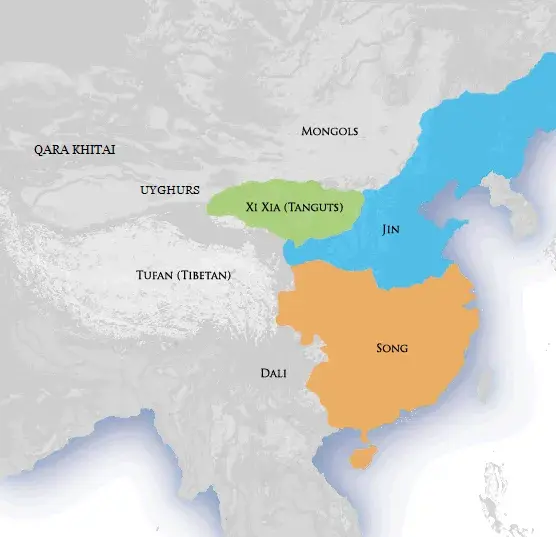
The Treaty of Shaoxing (绍兴和议) was a landmark armistice concluded between the Southern Song Dynasty and the Jurchen Jin Dynasty between 1141 (the eleventh year of the Shaoxing era of Emperor Gaozong of Song) and 1142. In 1140, Jin commander-in-chief Wanyan Zongbi broke the previous peace and launched a massive invasion, only to be routed by Liu Qi at Shunchang and crushed by Yue Fei's elite army at Yancheng and Yingchang, enabling Song forces to recapture Zhengzhou and Luoyang. However, Emperor Gaozong and Grand Councilor Qin Hui, fearing that powerful generals would become uncontrollable and that recapturing the two captive Northern Song emperors would threaten Gaozong's legitimacy, issued twelve golden plaques commanding Yue Fei to abandon the campaign. To appease the Jurchen court and satisfy Wanyan Zongbi's secret ultimatum that peace could only be achieved upon Yue Fei's death, Gaozong and Qin Hui stripped Yue Fei, Han Shizhong, and Zhang Jun of their commands. On New Year's Eve 1142, Yue Fei, his son Yue Yun, and general Zhang Xian were murdered on fabricated charges of high treason. The subsequent treaty established the boundary along the Huai River and Dasanguan, compelled the Song emperor to acknowledge vassalage and kneel before Jin envoys, and imposed an annual tribute of 250,000 ounces of silver and 250,000 bolts of silk, fixing the long-term division between northern and southern China.
Following victories at Yancheng and Yingchang, Gaozong and Qin Hui issued twelve golden plaques forcing Yue Fei to abort the northern campaign
Gaozong abolished regional pacification commissions, promoting Han Shizhong, Yue Fei, and Zhang Jun to empty civilian defense posts
Acting on Jin ultimatums, Qin Hui orchestrated fabricated charges of treason, imprisoning Yue Fei, Yue Yun, and Zhang Xian
Song envoys submitted peace petitions; Jin delegates arrived in Lin'an, where Gaozong pledged eternal vassal status to the Jurchen crown
Gaozong decreed the execution of Yue Fei in the Wind and Waves Pavilion, while Yue Yun and Zhang Xian were beheaded
The Treaty of Shaoxing was promulgated, ceding all lands north of the Huai River and Dasanguan and imposing heavy annual indemnities
Jin commissioner Liu Kuo delivered the patent of investiture; Gaozong performed full kowtow rituals to receive the patent of vassalage
The coffin of Emperor Huizong and Empress Dowager Wei returned to Lin'an, bringing all treaty ceremonies to formal conclusion
In the fifth month of the tenth year of the Shaoxing era (1140), Jin commander Wanyan Zongbi tore up the Tianjuan peace agreement and advanced southward with overwhelming forces. Southern Song armies responded with formidable resilience. Liu Qi achieved an upset victory at Shunchang, decimating elite Jurchen iron cavalry. In the seventh month, Yue Fei launched a northern counteroffensive, smashing the dreaded Iron Pagoda heavy cavalry and Ruche Wings cavalry at Yancheng and Yingchang, liberating Zhengzhou and Luoyang, and advancing to Zhuxian Town, pushing panicked Jurchen commanders to contemplate a full retreat north of the Yellow River.
Yet these brilliant victories provoked profound terror within the Southern Song inner court. Emperor Gaozong was haunted by the prospect that recovering the northern territories would result in the repatriation of his captive elder brother, Emperor Qinzong, destabilizing his own imperial legitimacy. Furthermore, the Song royal house had harbored deep institutional paranoia toward warlords ever since the founding emperor's coup at Chenqiao. Fearing that victorious generals like Yue Fei and Han Shizhong would eclipse imperial authority, Gaozong conspired with appeasement-minded prime minister Qin Hui, commanding an immediate frontline ceasefire and dispatching twelve golden tallies in a single day to force Yue Fei's retreat, squandering a decade of military gains.
To eliminate internal opposition to appeasement and signal unconditional submission to the Jin, Emperor Gaozong and Qin Hui initiated a ruthless administrative purge to strip frontline generals of their commands. In the fourth month of the eleventh year of the Shaoxing era (1141), the court summoned Han Shizhong, Yue Fei, and Zhang Jun to the imperial capital of Lin'an under the guise of distributing imperial honors.
At court, Gaozong issued imperial edicts appointing Zhang Jun as Military Commissioner, and elevating Han Shizhong and Yue Fei to Vice Commissioners, formally revoking their governorships. The regional pacification commissions were abolished, and their elite field corps were subordinated directly to the Bureau of Military Affairs. Eager for wealth and titles, Zhang Jun surrendered his forces willingly, leaving Han and Yue powerless to resist. With command authority concentrated in the hands of Qin Hui and Zhang Jun, the military backbone of the anti-Jin resistance was effectively dismantled from within.
Following the disarmament of the generals, Qin Hui established clandestine diplomatic backchannels with Wanyan Zongbi. Aware that Yue Fei's army remained an existential barrier to Jurchen expansion, Wanyan Zongbi sent a confidential ultimatum to Qin Hui: "You speak incessantly of peace, yet Yue Fei aims to reclaim the north; you must execute Yue Fei before peace can be granted!" Gaozong and Qin Hui resolved to destroy him.
Qin Hui enlisted the avaricious Zhang Jun to bribe disloyal officers within Yue's camp, fabricating treason charges alleging that subordinate commander Zhang Xian had conspired to seize Xiangyang in armed rebellion. On the thirteenth day of the tenth month, Zhang Xian and Yue Fei's eldest son, Yue Yun, were thrown into prison, and Yue Fei was arrested and cast into the dungeons of the Court of Judicial Review. Censors He Zhu and Zhou Sanwei investigated the case, finding no evidence of treason; He Zhu was deeply moved when Yue Fei bared his back to display the four characters Jing Zhong Bao Guo (Serve the Country with Utmost Loyalty) tattooed by his mother. Enraged by their reluctance to convict, Qin Hui reassigned the case to his henchman Moqi Xie, who subjected the prisoners to brutal torture. Confronting his tormentors, Yue Fei wrote eight characters on his testimony: "The heavens shine bright! The heavens shine bright!" When Han Shizhong confronted Qin Hui demanding evidence of treason, Qin Hui famously replied: "The matter is mo xu you (it may not be impossible)." On New Year's Eve 1142, Gaozong decreed Yue Fei's execution by poison in the Wind and Waves Pavilion, while Yue Yun and Zhang Xian were beheaded in the marketplace.
Simultaneously with the purge of the loyalists, Southern Song diplomats pursued humiliation at the peace table. In October 1141, the court dispatched Vice Minister of Works Wei Liangchen and Censor He Zhu to Wanyan Zongbi's military camp. Wei groveled before the Jurchen marshal, conveying Gaozong's pledge that his descendants would preserve vassal status and pay endless tribute. Satisfied that the Song court had eliminated Yue Fei and surrendered military initiative, Wanyan Zongbi presented his non-negotiable terms of territorial cession and vassalage.
In November, Jin envoys Xiao Yi and Xing Juchan accompanied Wei Liangchen to Lin'an. Gaozong hosted the envoys in the imperial Daqing Hall, treating them with the deference due to imperial superiors. The two sides finalized draft treaty terms; in his sworn memorial to Emperor Xizong of Jin, Gaozong wrote: "Your servant Gou states: Having received imperial grace permitting peace through territorial cession, your servant shall preserve vassal duties for endless generations." Qin Hui signed the draft pact, sealing the dynasty's capitulation.
In February 1142, the terms of the Treaty of Shaoxing were formally published and executed, encompassing four humiliating dimensions:
First, formal vassalage. The Southern Song abandoned parity, with Gaozong submitting as a vassal to Emperor Xizong of Jin, who invested him as ruler of Song. Imperial communications from Song were styled as humble petitions from a subordinate ruler.
Second, extensive territorial cessions. The frontier was fixed along the midline of the Huai River in the east and Dasanguan (modern southwest Baoji, Shaanxi) in the west. The northern commanderies of Tangzhou, Dengzhou, Shangzhou, and Kuozhou, which had been recaptured by Yue Fei's troops, were ceded to the Jin, forcing Song garrisons to withdraw south. Local civilians wept along the roads as Song troops pulled back, lamenting their abandonment to Jurchen conquerors.
Third, exorbitant annual tribute. Beginning in 1142, the Southern Song was required to deliver an annual tribute of 250,000 ounces of pure silver and 250,000 bolts of fine silk to the border markets of Sizhou, with penalties for any delays. This fiscal burden was extracted directly from the commoners of the southern provinces.
Fourth, repatriation of the royal remains and Empress Dowager. The Jin agreed to return the coffin of Emperor Huizong, Empress Zheng, and Gaozong's biological mother, Consort Wei. However, the captive Emperor Qinzong was retained in the north as political leverage, an arrangement silently endorsed by Gaozong to safeguard his throne.
In March 1142, Jin imperial commissioner Liu Kuo arrived in Lin'an carrying the golden seal and imperial patent of investiture. Arrogantly demanding full protocol, Liu Kuo required Emperor Gaozong to don vassal robes and perform the three kneelings and nine kowtows before the imperial desk. Despite private tears among loyal officials, Gaozong performed the full kowtow ceremony without hesitation, formally accepting his status as a crowned vassal.
In May, Jin escorts departed with the imperial remains and Consort Wei, arriving in Lin'an in August. Gaozong welcomed his mother into the Cining Palace and interred Emperor Huizong's coffin at the Yongyou Mausoleum in Shaoxing. With these ceremonies complete, the Treaty of Shaoxing took full effect, concluding sixteen years of warfare through absolute capitulation.
The Treaty of Shaoxing established a twenty-year armistice on terms of absolute humiliation. Possessing military parity, the Southern Song abandoned northern territories reclaimed through blood, surrendering all regions north of the Huai River and Dasanguan. By accepting formal vassalage and requiring the emperor to kowtow before foreign envoys, the treaty established an unprecedentedly servile status for a major Chinese dynasty, inflicting deep trauma on Chinese collective consciousness.
Domestically, the accord destroyed the patriotic faction at court. The execution of Yue Fei and the exile of upright ministers extinguished political integrity, enshrining appeasement and moral compromise as official orthodoxy. Qin Hui dominated the cabinet for the next fourteen years, deploying secret police, banning private historical writing, and purging dissidents. This autocratic climate crippled the state's strategic vitality, cementing the Southern Song's geopolitical vulnerability until its ultimate destruction.