Outbreak of War
Britain bombarded Guangzhou using the Arrow Incident as a pretext, while France joined citing the Father Chapdelaine Incident
Qing Dynasty (清朝) · HISTORICAL EVENT
第二次鸦片战争
The Second Opium War (第二次鸦片战争) was a major war of colonial aggression launched jointly by Britain and France with the diplomatic connivance of Russia and the United States from 1856 to 1860 (the sixth to tenth years of the Xianfeng era). Representing an armed extension of the First Opium War, the conflict aimed to force China into wider market opening. The war was sparked by Britain's concocted Arrow Incident and France's pretext of the Father Chapdelaine…
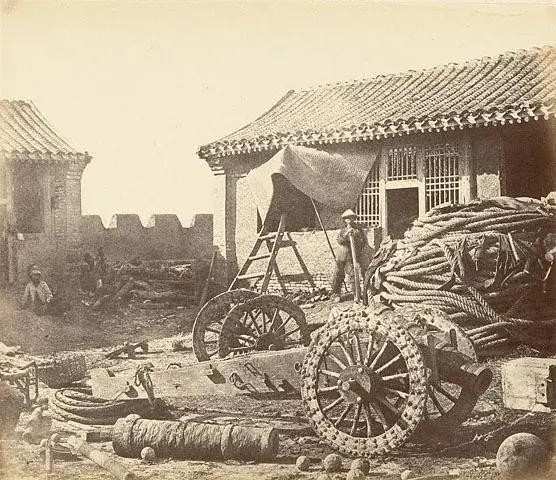
The Second Opium War (第二次鸦片战争) was a major war of colonial aggression launched jointly by Britain and France with the diplomatic connivance of Russia and the United States from 1856 to 1860 (the sixth to tenth years of the Xianfeng era). Representing an armed extension of the First Opium War, the conflict aimed to force China into wider market opening. The war was sparked by Britain's concocted Arrow Incident and France's pretext of the Father Chapdelaine Incident in Guangxi. In October 1856, British warships bombarded Guangzhou, inaugurating hostilities. In late 1857, allied forces stormed Guangzhou, capturing Viceroy Ye Mingchen, before sailing north to capture the Dagu Forts near Tianjin in 1858, forcing the Qing court to sign the humiliating Treaties of Tianjin while Russia coerced the signing of the Treaty of Aigun. Hostilities resumed in summer 1859 during the treaty ratification dispute when General Sengge Rinchen's artillery repelled an Anglo-French naval assault at Dagu. In 1860, Britain and France mobilized twenty-five thousand troops in a massive retaliatory expedition, landing at Beitang, capturing Dagu and Tianjin, and shattering the Qing cavalry at Baliqiao. The Xianfeng Emperor fled to the Mountain Resort in Chengde, leaving the allied forces to occupy Beijing, where they systematically pillaged and incinerated the Old Summer Palace (Yuanmingyuan). Prince Gong was compelled to sign the Conventions of Beijing, while Tsarist Russia extorted the Treaty of Beijing to annex all territory east of the Ussuri River. The war severely undermined Chinese sovereignty and catalyzed the Self-Strengthening Movement.
Britain bombarded Guangzhou using the Arrow Incident as a pretext, while France joined citing the Father Chapdelaine Incident
Anglo-French forces stormed Guangzhou, capturing Viceroy Ye Mingchen and exiling him to Calcutta
Allied fleets seized Dagu and advanced to Tianjin, forcing the Qing court to sign the Treaties of Tianjin while Russia coerced the Treaty of Aigun
Anglo-French fleets forced passage at Dagu; Sengge Rinchen's artillery repelled the assault, sinking and crippling over ten enemy gunboats
The allies landed twenty-five thousand troops at Beitang, capturing Dagu and Tianjin, leading to the collapse of peace negotiations
Sengge Rinchen's Mongol cavalry was annihilated by modern allied rifle and artillery fire at Baliqiao, opening the road to Beijing
The Xianfeng Emperor fled to Chengde Mountain Resort, leaving Prince Gong in the capital to negotiate peace
Allied troops looted Yuanmingyuan; Lord Elgin ordered its total destruction, burning the vast complex for three days and nights
The Qing court signed the Conventions of Beijing with Britain, France, and Russia, ceding Kowloon and vast northeastern territories
Following the First Opium War, Western imperialist powers breached China's coastal barriers through the Treaty of Nanking, the Treaty of Wanghia, and the Treaty of Whampoa, opening five treaty ports. However, as the Industrial Revolution surged across Europe, Western manufactured exports failed to generate anticipated windfall profits. British merchants concluded after detailed investigations that sluggish sales stemmed from insufficient treaty ports, domestic transit taxes (likin), the continued prohibition of the opium trade, and restrictions barring foreign merchants from traveling freely into China's vast interior provinces.
In 1854, invoking the twelve-year treaty revision clauses in the American and French treaties, Britain, France, and the United States formally demanded comprehensive renegotiation from the Qing court. The powers demanded the opening of all inland cities to foreign commerce, unimpeded navigation of the Yangtze River, permanent diplomatic legations in Beijing, legalization of the opium trade, and exemption of foreign goods from inland tariffs. Steeped in traditional tributary concepts, the Xianfeng Emperor and conservative grandees viewed permanent foreign embassies and inland navigation as existential threats to imperial sovereignty, flatly rejecting the demands. Thwarted in their commercial ambitions, the Western powers resolved to employ military force.
To manufacture moral justifications for warfare, Britain and France orchestrated provocations in southern China. In early October 1856, Guangdong river patrols intercepted the Chinese pirate smuggling vessel Arrow at Huangpu, detaining several suspect Chinese crewmen. British consul Harry Parkes mendaciously asserted that the Arrow was a British-registered craft and that Chinese marines had insulted the British flag, demanding formal apologies and the immediate return of the suspects from Viceroy Ye Mingchen. Despite the fact that the vessel's registration had expired and no British flag had been flown, Ye returned the sailors to avert escalation; Parkes nevertheless used the manufactured incident to open hostilities.
Simultaneously, French Catholic missionary Auguste Chapdelaine had entered Xilin County in Guangxi without authorization, colluding with local bandits and committing widespread abuses against villagers. In February 1856, newly appointed magistrate Zhang Mingfeng arrested and executed Chapdelaine in accordance with Qing legal codes, an episode labeled the Father Chapdelaine Incident. Emperor Napoleon III seized upon this religious dispute to protect French prestige, aligning with Britain in a punitive expedition. With the conclusion of the Crimean War in Europe, both powers were able to redirect substantial veteran naval and ground formations toward the Far East.
On October 23, 1856, British Rear Admiral Sir Michael Seymour directed his squadron to bombard the Bogue Forts before steaming up the Pearl River toward Guangzhou, formally initiating the Second Opium War. British artillery relentlessly shelled the governor-general's yamen and civilian residential districts, destroying commercial avenues. Throughout this opening campaign, Viceroy Ye Mingchen adopted a policy of passive avoidance. Ye neither organized coastal fortifications nor permitted batteries to return fire, relying instead on spirit-writing divination that falsely predicted the barbarians would withdraw within fifteen days. Operating under his notorious doctrine of refusing to fight, make peace, defend, die, surrender, or flee, Ye barred local militia from counterattacking, leaving Guangzhou completely vulnerable.
In December 1857, an allied expedition of over five thousand British and French troops assembled at the Pearl River estuary under Lord Elgin and Baron Gros, delivering an unanswered ultimatum. At dawn on December 28, dozens of allied warships commenced a continuous bombardment with hundreds of heavy guns, setting the city ablaze. Allied naval landing parties scaled the walls at Guanyin Mountain under cover of artillery. Governor Bo-gui fled in panic, while the defending general died in combat. On January 5, 1858, allied infantry stormed the inner city, discovering and capturing Ye Mingchen hiding in a rear garden pavilion. Ye was placed aboard a British warship and exiled to Calcutta, India, where he starved himself to death. The allies established China's first colonial puppet organ, the Allied Commission, ruling Guangzhou through Bo-gui for three years.
Refusing to confine their ambitions to Guangdong, the British and French expeditionary fleet sailed north in April 1858 under Elgin and Gros to strike the Dagu Forts, the maritime gateway to the capital, accompanied by Russian and American envoys acting as deceptive mediators. The court dispatched Grand Secretary Gui Liang and Minister Hua Shana to negotiate. On May 20, allied warships opened fire on the Dagu Forts. Suffering from obsolete cannon and poor coordination, defending troops broke, and Commander Zhang Guolun fled, causing northern and southern batteries to fall within hours.
Following the fall of Dagu, allied gunboats steamed up the Hai River to Sanchakou in Tianjin, placing the imperial capital within immediate striking distance. Terrified, the Xianfeng Emperor ordered his negotiators at the Haiguang Temple to accept all allied demands. In late June, the Qing court signed the Treaties of Tianjin with Russia, the United States, Britain, and France. The treaties opened ten new ports including Niuzhuang, Dengzhou, Taiwan, Chaozhou, Qiongzhou, Hankou, Jiujiang, Nanjing, and Zhenjiang; granted foreign envoys permanent residence in Beijing; authorized foreign warships and merchantmen to navigate the Yangtze; permitted foreigners to travel and proselytize in the interior; and exacted massive war indemnities. Concurrently, Russian governor-general Nikolay Muravyov threatened Heilongjiang General Yishan with military force, compelling the Treaty of Aigun, which seized over six hundred thousand square kilometers of Chinese territory north of the Amur River.
Following the conclusion of the 1258 Treaties of Tianjin, the Xianfeng Emperor was deeply disturbed by clauses mandating foreign embassies in Beijing and navigation rights on the Yangtze, offering to abolish all tariffs in exchange for revoking diplomatic entry into the capital. The powers categorically refused, insisting on proceeding to Beijing in the summer of 1859 for formal treaty ratifications. The Qing court appointed Mongol prince Sengge Rinchen to oversee Zhili maritime defense. Learning from earlier errors, Sengge Rinchen reconstructed hidden bastions, mounted hundreds of heavy artillery pieces, and obstructed the harbor entrance with five tiers of heavy iron chains, wooden stockades, and iron stakes.
On June 25, 1859, British envoy Frederick Bruce and French envoy Alphonse de Bourboulon arrived off Dagu escorted by a fleet of over twenty gunboats. Flouting local directives to land at Beitang, British gunboats severed the iron chains and fired on the fortifications. Sengge Rinchen held his fire until the enemy gunboats were stranded in the low-tide mudflats, whereupon hundreds of masked shore guns opened a devastating concentrated barrage. Over a day and night of fierce combat, Qing batteries sank or crippled over ten allied vessels, inflicting nearly five hundred casualties and severely wounding British admiral James Hope. American Commodore Josiah Tattnall violated international neutrality by intervening with armed tenders to haul wounded British sailors and tow stranded gunboats, famously declaring that blood is thicker than water. The brilliant victory at Dagu delivered a shattering blow to allied maritime arrogance.
Humiliated by the Dagu disaster, Britain and France resolved on massive military retaliation. In the spring of 1860, both parliaments approved emergency naval and army budgets, assembling twenty-five thousand veteran troops equipped with modern Armstrong rifled breech-loading cannon and Enfield rifled muskets under Lord Elgin, General Hope Grant, Baron Gros, and General Charles de Montauban.
On August 1, 1860, the allied expedition avoided a frontal assault on Dagu, executing an uncontested amphibious landing at Beitang. Allied divisions circled behind the Dagu Forts, attacking their vulnerable landward rear. Commander Leshan and his garrison fought hand-to-hand in the mud until every defender was killed, leading to the collapse of the forts. On August 24, the allies occupied Tianjin. The court dispatched Prince Zaiyuan to Tongzhou to negotiate, but when allied emissary Harry Parkes demanded an armed escort into Beijing to present credentials, talks collapsed, and Zaiyuan arrested Parkes and thirty-eight members of his delegation.
At dawn on September 21, the decisive Battle of Baliqiao commenced. Sengge Rinchen deployed over ten thousand elite Mongol cavalry alongside Shengbao's infantry, totaling thirty thousand troops along the canal defenses at Baliqiao. Charging across the open plain, the Mongol horsemen exhibited awe-inspiring bravery, riding directly into sheets of rifled canister and minié ball volleys, with Shengbao wounded in the face. The cavalry charged to within paces of the French infantry squares, prompting General Montauban to later record admiration for the enemy's bravery. Yet confronting disciplined modern artillery and infantry fire, the traditional cavalry was annihilated. Concentrated French cannon pulverized the ancient bridge, shattering Qing lines, leaving Tongzhou lost and the road to Beijing wide open.
News of the catastrophe at Baliqiao paralyzed the imperial court. At daybreak on September 22, the Xianfeng Emperor fled the Forbidden City on the pretext of an autumn hunting tour, taking his empress, Consort Yi (Cixi), and court grandees on a humiliating flight to the Mountain Resort in Chengde, leaving his younger brother Prince Gong (Yixin) to manage the ruined capital and seek terms.
On October 6, allied advance units bypassed Beijing's walls and stormed the northwestern suburban imperial palace of Yuanmingyuan (the Old Summer Palace). Palace custodian Wen Feng drowned himself in the Fuhai Lake. Entering the palatial complex, allied officers and soldiers were stunned by the monumental splendor accumulated over five imperial reigns. The soldiers immediately initiated an uncontrolled orgy of looting, tearing down tapestries, stealing gold ingots, priceless jade, porcelain, imperial jade seals, and the bronze zodiac heads of the Haiyantang. The Wenyuange edition of the Complete Library of the Four Treasuries was trampled and scattered, while clocks, vases, and sculptures too heavy to haul away were smashed with axes and iron bars.
On October 13, allied columns seized the Anting Gate, securing control over the city ramparts. To retaliate for the detention of Parkes and psychological trauma inflicted on captives, Lord Elgin issued the command to burn Yuanmingyuan to the ground. On October 18, thousands of British soldiers ignited the structures. For three days and nights, monstrous firestorms consumed the palaces, reducing hundreds of classical pavilions to smoking ruins and incinerating over three hundred maidens and eunuchs trapped within the burning pavilions.
With the smoke of Yuanmingyuan hanging over the capital, Prince Gong surrendered all diplomatic resistance. On October 24 and 25, 1860, Prince Gong exchanged ratifications of the Treaties of Tianjin and signed the bilateral Conventions of Beijing with Elgin and Gros in the Ministry of Rites. The treaties confirmed the validity of the Tianjin accords, opened Tianjin as an international treaty port, legalized the recruitment of Chinese indentured laborers (the coolie trade), ceded the southern tip of the Kowloon Peninsula to Great Britain, and increased military indemnities to eight million taels of silver each to Britain and France.
Following the allied withdrawal, Russian diplomat Nikolay Ignatiev threatened the defenseless Qing court by claiming credit for halting allied troop movements, coercing Prince Gong on November 14 into signing the Treaty of Beijing. Russia validated the unratified Treaty of Aigun and annexed all territories east of the Ussuri River, including the deep-water harbor of Vladivostok (Haishenwai), severing China's maritime access to the Sea of Japan. Through the conflict, Tsarist Russia acquired over 1.5 million square kilometers of Chinese territory without firing a single shot.
The Second Opium War inflicted catastrophic damage on Chinese territorial sovereignty. Great Britain annexed the southern tip of the Kowloon Peninsula, while Tsarist Russia extorted over one million square kilometers of land in the northeast through the Treaties of Aigun and Beijing, depriving China of its Sea of Japan coastline. The opening of eleven new treaty ports allowed foreign capital to penetrate deep into the Yangtze and Yellow River valleys. The establishment of permanent foreign embassies in the capital and foreign gunboat navigation on inland rivers dismantled traditional Qing coastal and river defenses, transforming China into a deeply semicolonized society.
The catastrophe obliterated the Qing dynasty's illusions of celestial superiority. Confronting Western rifled artillery and gunboats, open-minded Qing statesmen such as Prince Gong, Zeng Guofan, Li Hongzhang, and Zuo Zongtang recognized that China was facing an unprecedented historical crisis. The Qing court founded the Zongli Yamen to manage modern diplomatic affairs and initiated the Self-Strengthening Movement under the doctrine of learning Western techniques to build domestic strength. Through this painful transformation, modern military industries, modern naval squadrons, and Western scientific education were introduced into China.