Mobilization Following the Taiping March
Inspired by the Taiping Northern Expedition, Zhang Lexing and Su Tianfu lead Huaibei Nian groups into open armed rebellion.
Qing Dynasty (清朝) · HISTORICAL EVENT
捻军起义
The Nian Rebellion (捻军起义, also known as the Nian War) was a massive fifteen-year anti-Qing peasant rebellion fought from 1853 to 1868 across the central plains of China. In the mid-19th century, systemic neglect of Yellow River dikes culminated in catastrophic avulsions, devastating Anhui, Henan, and Shandong. Bankrupt smallholders and contraband salt merchants organized mutual-defense networks called Nian. When the Taiping Heavenly Kingdom dispatched…
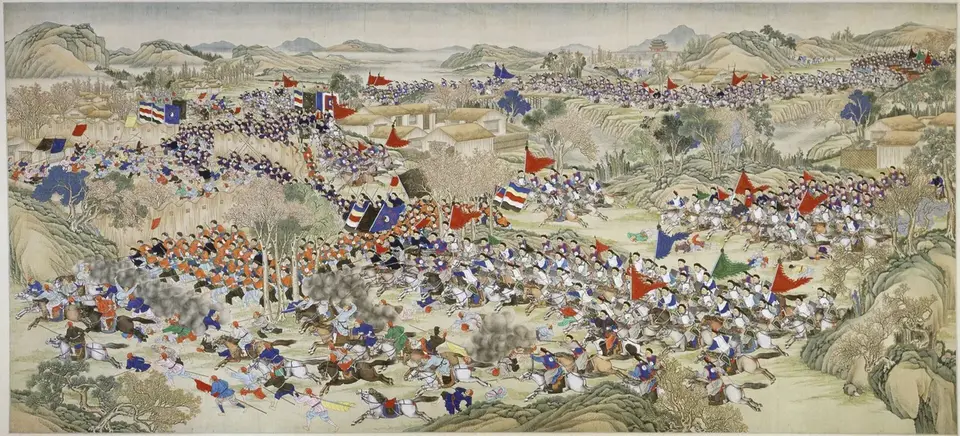
The Nian Rebellion (捻军起义, also known as the Nian War) was a massive fifteen-year anti-Qing peasant rebellion fought from 1853 to 1868 across the central plains of China. In the mid-19th century, systemic neglect of Yellow River dikes culminated in catastrophic avulsions, devastating Anhui, Henan, and Shandong. Bankrupt smallholders and contraband salt merchants organized mutual-defense networks called Nian. When the Taiping Heavenly Kingdom dispatched its Northern Expedition through the Huai basin in 1853, Nian chieftains led by Zhang Lexing launched a coordinated regional insurrection. In 1855, Nian leaders assembled at Zhiheji in Bozhou, electing Zhang Lexing as alliance lord and establishing the disciplined Five-Banner military structure. Utilizing mobile cavalry tactics, the Nian raided across eight provinces. In May 1865, Nian cavalry trapped and destroyed the Qing imperial reserve at the Battle of Gaolouzhai, killing imperial commander Prince Sengge Rinchen. Subsequently merging with surviving Taiping forces, the movement split into Eastern and Western Nian armies. To counter their mobility, imperial commanders Zeng Guofan and Li Hongzhang constructed fortified ditch lines along the Grand Canal and regional rivers while walling off rural villages. By 1868, both insurgent armies were trapped against flooded waterways and eradicated, delivering an enduring shock to late Qing imperial rule.
Inspired by the Taiping Northern Expedition, Zhang Lexing and Su Tianfu lead Huaibei Nian groups into open armed rebellion.
Nian chieftains assemble at Zhiheji, electing Zhang Lexing as alliance lord and establishing the Five-Banner organization.
Nian cavalry join forces with Chen Yucheng's Taiping army at Sanhe, annihilating Li Xubin's elite Hunan Army detachment.
Prince Sengge Rinchen storms Zhiheji; Zhang Lexing is betrayed and executed; Lai Wenguang reorganizes the cavalry force.
Nian cavalry ambush and annihilate the imperial Mongol corps at Gaolouzhai, killing Prince Sengge Rinchen.
Zeng Guofan assumes command, establishing fortified village networks and river barriers along the Jialu River.
Nian leaders split into Eastern (under Lai Wenguang) and Western (under Zhang Zongyu) armies to bypass containment lines.
The Eastern Nian defeats the Huai Army at Yinlonghe, but top cavalry commander Ren Huabang is assassinated at Shouguang.
Trapped against the Jiaolai Canal, the Eastern Nian is eradicated; Lai Wenguang is captured and executed in Yangzhou.
The Western Nian is destroyed along the flooded Tuohai River; Zhang Zongyu drowns himself, ending the rebellion.
During the Daoguang and Xianfeng reigns, bureaucratic corruption paralyzed hydraulic governance throughout the northern floodplains. River conservancy funds were systematically embezzled by imperial officials, leaving retaining dikes along the lower Yellow River dangerously neglected. In 1855, the Yellow River breached its dikes at Tongwaxiang in Henan, shifting its entire course northward to the Bohai Sea. The catastrophic flooding drowned hundreds of thousands of acres of fertile farmland, displacing millions of peasants across northern Anhui, eastern Henan, and western Shandong into destitute vagrancy.
To survive marauding bandits, corrupt tax collectors, and state grain levies, displaced villagers organized mutual-defense cooperatives based on clan and village networks. Deriving their name from the local custom of twisting paper wicks (nian) to burn oil lamps during religious temple fairs, these societies were termed Nian. Operating under the popular adage "farmers by day, raiders by night," Nian members engaged in smallholder farming during harvest seasons while mobilizing armed caravans during droughts to smuggle illicit salt and raid official granaries.
In 1851, the Jintian Uprising erupted in Guangxi, giving birth to the Taiping Heavenly Kingdom, which swept across the central Yangtze basin and established its capital at Tianjing (Nanjing) in 1853. Soon afterward, Taiping commanders Lin Fengxiang and Li Kaifang led a large-scale Northern Expedition toward Beijing.
The passage of the Taiping army across the Huai River basin galvanized the Nian groups. Local salt-smuggling chieftains, notably Zhang Lexing, Su Tianfu, and Gong Deshu, mobilized armed followers to attack local Qing garrisons, seize government granaries, and liberate imprisoned peasants, transforming sporadic rural banditry into an overt anti-dynastic insurgency.
In the autumn of 1855, recognizing that lack of central coordination rendered disparate bands vulnerable to localized suppression, Zhang Lexing convened a historic congress of nineteen major Nian leaders at Zhiheji (modern Guoyang County, Anhui). The council elected Zhang Lexing as "Great Han King of the Mandate of Ming" and supreme alliance lord, with Gong Deshu as chief strategist and Su Tianfu as field general. The congress promulgated strict military statutes forbidding wanton looting and established the Five-Banner military system: Yellow (commanded by Zhang Lexing), White (Gong Deshu), Black (Su Tianfu), Red (Hou Shiwei), and Blue (Han Qifeng). The Zhiheji Covenant transformed fragmented rural vigilantes into an organized peasant army.
Following the Zhiheji Alliance, Zhang Lexing unleashed offensive campaigns across the Huaibei plains. Possessing intimate knowledge of local terrain, Nian forces organized fast-moving cavalry units mounted on sturdy northern horses. The insurgents fortified Zhiheji with concentric moats, earthwork ramparts, and artillery bastions, turning it into a formidable revolutionary base area.
From Zhiheji, Nian forces repelled multiple encirclement campaigns by Qing provincial garrisons, storming prefectural administrative centers including Bozhou, Mengcheng, Fuyang, and Yingzhou. In their liberated territory, the Nian abolished imperial taxes, punished predatory landlords, and established equitable agricultural markets. Tens of thousands of impoverished peasants, deserters, and local craftsmen joined the ranks, expanding the insurgent forces to over one hundred thousand active combatants.
In the autumn of 1856, Taiping Wing King Shi Dakai marched into Anhui. Zhang Lexing dispatched envoys across the Yangtze to forge a formal military alliance with the Taiping Heavenly Kingdom. Taiping Heavenly King Hong Xiuquan ennobled Zhang Lexing as King Wo and Su Tianfu as King Li, conferring official banners, seals, and military titles.
The alliance reshaped military dynamics across central China. In late 1858, Zhang Lexing led tens of thousands of Nian cavalry south to coordinate with Taiping armies under Chen Yucheng and Li Xiucheng at the Battle of Sanhe. The allied forces completely annihilated the premier Hunan Army detachment under Li Xubin, killing over six thousand veteran troops and halting the Qing offensive against Anqing.
However, operating as unanchored cavalry across vast plains, the Nian lacked deep institutional roots. In early 1863, imperial commander Prince Sengge Rinchen mobilized thousands of elite Mongol cavalry alongside provincial armies to encircle Zhiheji. The stronghold fell after bitter fighting. Escaping westward, Zhang Lexing was betrayed by turncoat Li Zhaoshou near Xisipo and was executed. Surviving leaders, including Zhang Lexing's nephew Zhang Zongyu and Taiping general Lai Wenguang (King Zun), rallied the scattered remnants, merging them with veteran Taiping units into a reconstituted cavalry force.
The reconstituted Nian army abandoned fixed fortifications entirely, adopting a pure doctrine of fluid cavalry warfare. Each insurgent warrior was provided with two or three horses, enabling formations to travel up to a hundred miles a day across the open plains of Henan, Shandong, and Hubei.
Qing imperial strategy relied entirely upon Mongol Prince Sengge Rinchen, whose heavy cavalry pursued the Nian incessantly. Sengge Rinchen was arrogant and rash, convinced that aggressive pursuit would break insurgent morale. Exploiting his overconfidence, commanders Lai Wenguang and Zhang Zongyu executed an operational deception: deliberately feigning panic and leading Sengge Rinchen's cavalry on an exhausting, meandering march of thousands of miles across muddy river basins. Exhausted and deprived of rations, the imperial troopers suffered mounting fatigue, with soldiers unable to dismount due to festering saddle sores.
In May 1865, the Nian baited Sengge Rinchen into an ambush at Gaolouzhai (northwest of Caozhou, modern Heze, Shandong). Hiding thousands of dismounted spearmen and musketeers within dense willow groves and wheat fields, Zhang Zongyu spring the trap on May 18. As the exhausted Mongol cavalry advanced into the defile, Nian horsemen charged from four directions. The imperial cavalry was cut down in the marshes. Wounded, Sengge Rinchen fled to a deserted farmhouse, where he was discovered and killed in a wheat furrow by sixteen-year-old Nian fighter Zhang Pigeng. The battle annihilated the imperial Mongol corps, slaying dozens of high-ranking Manchu-Mongol nobles and sending shockwaves through the Forbidden City.
Following the death of Sengge Rinchen, the Qing court lacked reliable Manchu-Mongol military reserves. The court appointed Viceroy of Liangjiang Zeng Guofan as Imperial Commissioner overseeing military affairs across Zhili, Shandong, and Henan, deploying the Xiang and Huai armies to suppress the rebellion.
Recognizing that pursuing the Nian on horseback was futile, Zeng Guofan formulated the strategy of "fortifying villages, depopulating the countryside, and containing with river barriers." He forced rural populations into fortified earthwork villages (tuxu) to deny food to the insurgents, while constructing defensive palisades along the Jialu River and the Grand Canal to bottle up the rebellion.
To neutralize Zeng Guofan's containment strategy, Nian commanders convened a council of war at Zhongmu, Henan, in October 1866, deciding to divide their forces into two operational wings. Lai Wenguang and Ren Huabang retained sixty thousand troops to wage mobile warfare in the Central Plains as the Eastern Nian. Zhang Zongyu led forty thousand veteran horsemen westward across the Yellow River at Fenglingdu to invade Shaanxi, forming the Western Nian to coordinate with the ongoing Muslim insurrections and threaten the northern capital.
The Western Nian outmaneuvered imperial garrisons in Shaanxi, inflicting severe defeats upon Governor Liu Rong's forces. In late 1867, Zhang Zongyu executed an audacious eastward thrust across the Taihang Mountains, breaking through southern Zhili. His vanguard cavalry reached Lugouqiao outside Beijing, placing the imperial capital under direct military alarm.
Confronted by insurgent breakthroughs, the Qing court relieved Zeng Guofan and appointed Li Hongzhang as Imperial Commissioner, directing Zuo Zongtang to suppress the Western Nian. Li Hongzhang deployed veteran Huai Army infantry equipped with modern Western rifles and breech-loading cannons, supported by gunboats patrolling key waterways.
In early 1867, the Eastern Nian defeated Liu Mingchuan's Huai Army at the Battle of Yinlonghe in Hubei, killing thousands of government soldiers. However, Huai Army rifle formations rallied, and Eastern Nian general Ren Huabang was assassinated by a turncoat during the Battle of Shouguang in Shandong. Exploiting this setback, Li Hongzhang constructed continuous earthen ramparts and barbed barriers along the Jiaolai Canal and the Yellow River, trapping the Eastern Nian within a narrow coastal peninsula. In January 1868, the Eastern Nian was shattered at Wayaopu near Shouguang. Supreme Commander Lai Wenguang escaped to Yangzhou, where he was captured and executed, bringing the Eastern Nian to an end.
Meanwhile, Zhang Zongyu's Western Nian became marooned in southern Zhili and western Shandong. Unprecedented summer downpours flooded the northern plains, turning agricultural terrain into impassable quagmires that immobilized insurgent cavalry. Imperial forces under Li Hongzhang and Zuo Zongtang trapped the Western Nian between the Grand Canal and the flooding Tuohai River.
On August 16, 1868 (the 28th day of the 6th lunar month in the 7th year of Tongzhi), allied Qing forces launched a final converging assault against the exhausted Western Nian at Chiping, Shandong. Out of ammunition and facing overwhelming artillery fire, the remaining insurgent regiments were destroyed. Commander Zhang Zongyu broke through the perimeter alone and drowned himself in the swollen waters of the Tuohai River. After fifteen years of warfare spanning eight provinces, the Nian Rebellion was fully suppressed.
The Nian Rebellion ended with the annihilation of both insurgent armies and the restoration of Qing authority across northern China. Over fifteen years of continuous campaigning across eight provinces, the imperial government spent tens of millions of taels of silver and mobilized hundreds of thousands of provincial troops. Nearly all major Nian leaders—including Zhang Lexing, Lai Wenguang, Ren Huabang, and Zhang Zongyu—died in battle or were executed. However, the conflict ravaged the socioeconomic fabric of the Yellow and Huai river plains, depopulating hundreds of rural counties and turning agricultural regions into desolate waste.
The Nian Rebellion permanently reshaped the institutional and political architecture of late imperial China. First, the total destruction of Sengge Rinchen's army at Gaolouzhai broke the military backbone of the traditional Manchu-Mongol banner forces, leaving the Qing throne completely dependent upon regional Han armies for security. Second, the campaigns consolidated the rise of powerful Han scholar-general viceroys, notably Zeng Guofan, Li Hongzhang, and Zuo Zongtang, who took control of provincial civil administration, military commands, and regional customs revenues (Likin), giving birth to decentralized regionalism. Third, the acute necessity of countering mobile cavalry with modern artillery and steam-powered gunboats directly accelerated Li Hongzhang's establishment of the Jiangnan Arsenal and modern naval academies, transforming the Nian campaigns into the primary military impetus behind China's Self-Strengthening Movement.