Background
Political Turmoil of the Five Dynasties and the Crisis of Lost Historical Records
Between Zhu Quanzhong's usurpation of the Tang throne to establish the Later Liang in 907 CE and Zhao Kuangyin's accession following the Chenqiao mutiny to establish the Northern Song in 960 CE, the Central Plains witnessed rapid successions of five short-lived dynasties—Later Liang, Later Tang, Later Jin, Later Han, and Later Zhou—spanning only fifty-four years and involving thirteen monarchs across eight distinct imperial surnames. Coinciding with these violent dynastic transitions in northern China, the southern and northwestern territories fractured into regional separatist regimes known historically as the Ten Kingdoms: Wu, Southern Tang, Former Shu, Later Shu, Wuyue, Chu, Min, Southern Han, Nanping (Jingnan), and Northern Han, while nomadic empires such as the Khitan Liao rose in martial prominence along the northern frontiers.
Throughout this chaotic era, endless warfare, repeated military coups, and chronic administrative instability plagued the Central Plains. Regional warlords seized power through armed violence, dynasties collapsed prematurely, and civil officials drifted between successive rulers. Successive military upheavals consumed imperial capitals, and vast libraries inherited from the Tang dynasty were ravaged by fires and looting, creating severe cultural discontinuities. Nevertheless, even during the most tumultuous crises, rulers of each ephemeral regime adhered to Tang administrative precedents by maintaining imperial historiography bureaus to record daily imperial decrees and edicts, sequentially compiling Court Diaries of Activity and Repose, Daily Calendars, and imperial Veritable Records (Shilu) to legitimize their claims to the Mandate of Heaven.
Although these veritable records preserved indispensable primary documentation, they were severely compromised by contemporary political biases. Hostile regimes fought each other mercilessly, and court historians were frequently coerced by their patrons into falsifying records, slandering fallen adversaries, and fabricating excessive flattery for reigning monarchs. Furthermore, relentless warfare dispersed state archives, leaving private manuscripts riddled with conflicting variations and exposing the entire documentary legacy to permanent extinction. Without a comprehensive, state-sponsored initiative to rescue, collate, and objectively synthesize these fragile archives at the advent of Song unification, the historical reality of this pivotal half-century risked being completely forgotten as eyewitnesses died off.
Survival of the Veritable Records and the Foundation Laid by Fan Zhi's Wudai Tonglu
When the Northern Song dynasty was founded, Emperor Taizu orchestrated a peaceful transition from the Later Zhou, allowing central administrative ministries, state treasuries, and government archives to be inherited intact. Consequently, the veritable records of all five dynasties—Later Liang, Later Tang, Later Jin, Later Han, and Later Zhou—were safely assembled within the Historiography Institute of the Chongwen Academy, with only minor gaps in the earliest years of the Later Liang. This centralized repository constituted an unparalleled treasury of primary documentation for the compilation of a definitive standard history.
Prior to the formal launch of the state compilation project, Grand Councilor Fan Zhi (911–964 CE) had already made a foundational scholarly contribution. Aware that the individual veritable records of the five dynasties were excessively voluminous, stylistically disparate, and cumbersome to consult, Fan Zhi had used his administrative authority since the Xiande era of the Later Zhou to gather government documents and draft a harmonized chronicle. In 960 CE (Song Jianlong 1st year), Fan Zhi presented to Emperor Taizu his 65-volume chronological masterpiece, the Jianlong Wudai Tonglu (Jianlong Comprehensive Records of the Five Dynasties, commonly known as Wudai Tonglu).
Fan Zhi's Wudai Tonglu utilized an annalistic structure organized strictly by year and month, verifying the chronology of the five dynasties and untangling complex political crises, major military engagements, and ministerial successions into a coherent narrative. The appearance of this chronological compilation provided a meticulously calibrated chronological framework and factual backbone. For Xue Juzheng and his colleagues, the Wudai Tonglu served as an indispensable guide, drastically reducing the time required for basic textual collation and chronological verification.
Early Song Policy of Prioritizing Civil Culture and Legitimizing Dynastic Succession
The Northern Song was founded through the Chenqiao mutiny, when Zhao Kuangyin accepted the abdication of the boy emperor of the Later Zhou. Drawing profound lessons from late Tang and Five Dynasties warlordism, where military commanders casually seized the imperial throne based solely on physical force, Emperor Taizu and his chief strategist Zhao Pu formulated the grand state policy of strengthening the trunk and weakening the branches: gradually curbing warlord authority, centralizing fiscal administration, and consolidating elite military forces under central command. Simultaneously, the court enacted a profound civilian transformation, vigorously elevating civil officials (youwen) while restraining military magnates.
The Song government restored and expanded the civil service examinations, nurtured the scholar-bureaucrat elite, and established the Chongwen Academy, Zhaowen Hall, Academy of Scholarly Worthies, and the Historiography Institute. The compilation of dynastic histories and vast imperial encyclopedias became central pillars of state cultural governance. Through official historiography, the imperial court demonstrated its patronage of Confucian learning, rallied intellectual elites around the new regime, and directed bureaucratic energies toward the preservation and canonization of cultural heritage.
Most crucially, compiling the history of the Five Dynasties fulfilled an urgent ideological imperative: establishing the historical legitimacy and moral mandate of the Song dynasty. Although the Song had brought order to the Central Plains and pacified southern regional states such as Jingnan, Hunan, Later Shu, and Southern Han, the court needed to articulate its dynastic lineage to the empire. Was Song rule legitimate? Why had the chaotic Five Dynasties collapsed? And why was the ultimate reunification of China under the House of Zhao inevitable?
Emperor Taizu sought to validate an orthodox succession running through the five Central Plains regimes—Later Liang, Later Tang, Later Jin, Later Han, and Later Zhou—culminating legitimately in the Song's receipt of the mandate from the Later Zhou. Concurrently, by recording the moral corruption, insubordination, and human tragedies of the Five Dynasties, the court intended to construct a cautionary mirror for contemporary ministers and regional commanders. In 973 CE, with territorial unification largely accomplished, conditions were ripe for launching the official compilation of the Five Dynasties history.
Course of the Event
Imperial Decree to Open the Bureau and Grand Councilor Xue Juzheng Appointed Chief Supervisor
On the wushen day of the fourth month in 973 CE (Kaibao 6th year), Emperor Taizu officially issued an imperial decree ordering the Historiography Institute to open a dedicated bureau to compile the standard history of the Five Dynasties, titled Wudai Shi (History of the Five Dynasties). To guarantee the moral authority, political orientation, and historiographical caliber of this monumental endeavor, Emperor Taizu appointed Xue Juzheng, Grand Councilor of the Right and Supervisor of National Historiography, to oversee the entire project.
Xue Juzheng (courtesy name Ziping, 912–981 CE), a native of Junyi in Kaifeng, was a founding statesman and celebrated scholar-official. Having passed the jinshi examination during the Qingtai era of the Later Tang, he had continuously served across five successive dynasties: Later Tang, Later Jin, Later Han, Later Zhou, and Northern Song. Under the Later Zhou, he had served as Vice Minister of Punishments and Drafter of Imperial Edicts; under the Song, he gained the deep trust of Emperor Taizu, rising to Hanlin Academician, Participant in Determining Governmental Matters, and ultimately Grand Councilor.
Xue Juzheng was renowned for his integrity, gravity, and erudition. Having witnessed the administrative developments, political crises, and institutional evolutions of the five previous courts firsthand, he possessed unparalleled knowledge of contemporary precedents. His appointment as chief supervisor guaranteed that the bureau enjoyed full administrative authority to requisition secret state archives from all government ministries and ensured an equitable, balanced historical perspective untainted by partisan bias.
Formation of the Editorial Team and Rigorous Division of Scholarly Labor
To assemble a premier historiographical team, Emperor Taizu and Xue Juzheng selected leading literary figures and historical scholars from the civil bureaucracy. The appointed co-compilers included Hanlin Academician Lu Duoxun, Drafter of Imperial Edicts Hu Meng, Left Omissioner Zhang Dan, Vice Director in the Ministry of Merit Assessment and Auxiliary Academician of the Historiography Institute Liu Jian, Vice Director in the Ministry of Waterways and Historiography Institute Compiler Li Mu, and Auxiliary Academician Li Jiuling. The eminent scholar Li Fang, who later became grand councilor, also contributed to administrative coordination.
Most of these scholars had been born during the Later Jin, Later Han, or Later Zhou dynasties, granting them direct familiarity with the social landscape of the era. Under Xue Juzheng's leadership, the bureau established an efficient collaborative workflow:
Lu Duoxun, possessing photographic memory and swift intellect, served as chief executive compiler. Having supervised the state compilation of the Kaibao Bencao (Kaibao Pharmacopoeia), he brought valuable experience in managing large-scale official editorial projects. He designed the organizational framework, directed scheduling, and personally drafted key imperial annals and comprehensive evaluations.
Hu Meng, celebrated alongside his cousin Hu Zi as the Two Hus, had passed the jinshi examination during the Later Jin and served the Later Han, Later Zhou, and Song. Deeply versed in court ritual, ceremonial protocols, and administrative ordinances, Hu Meng drafted the basic annals of the Later Zhou and other crucial reigns, ensuring imperial narratives adhered strictly to dynastic ritual decorum.
Li Mu, celebrated for his unyielding integrity and commitment to truthful recording, was assigned to cross-examine primary documents and review personal biographies, rigorously exposing and correcting partisan flatteries embedded in earlier veritable records.
Zhang Dan, Liu Jian, and Li Jiuling each took responsibility for specific dynasties, examining raw records, excerpting draft materials, and composing the initial drafts for the Later Liang, Later Tang, Later Jin, and Later Han. This rigorous division of labor—wherein the chief supervisor determined general principles, senior compilers directed operational sections, and junior compilers verified factual minutiae—ensured exceptional scholarly productivity.
Operations of the Historiography Institute and State-Level Resource Allocation
Emperor Taizu prioritized the project by providing premier official logistics. The compilation bureau was housed within the Historiography Institute of the Chongwen Academy inside the Kaifeng imperial palace precinct. This secluded location connected directly to the Imperial Archives, Zhaowen Hall, and Academy of Scholarly Worthies, concentrating all historical manuscripts, court registries, and central archives inherited from the Later Zhou, allowing compilers instant access to classified records.
To sustain continuous day-and-night writing, the Song court allocated generous funding. Scholars received daily official banquets and night candles. Furthermore, several dozen skilled scribes were seconded from the Directorate of Education and government offices to transcribe documents, prepare index slips, collate preliminary drafts, and execute clean final copies. This administrative support freed scholars to concentrate entirely on historical evaluation and prose composition.
Emperor Taizu maintained close personal oversight, frequently dispatching palace attendants to inspect progress, inquiring about editorial developments during court audiences, and encouraging Xue Juzheng and his colleagues, which maintained high morale throughout the project.
Archival Foundation: Dual Support from the Veritable Records of Five Dynasties and Fan Zhi's Compendium
The remarkable speed and factual density of the compilation rested primarily upon two comprehensive documentary pillars: the complete imperial veritable records of the Five Dynasties and Fan Zhi's Jianlong Wudai Tonglu.
The primary foundation consisted of the imperial veritable records of each sovereign across the five dynasties. Despite the chronic warfare of the Tenth Century, every Central Plains ruler had compiled veritable records to establish dynastic legitimacy. From the records of Later Liang Taizu and Emperor Modi, Later Tang Zhuangzong, Mingzong, Min, and Fei, Later Jin Gaozu and Chudi, Later Han Gaozu and Yindi, to Later Zhou Taizu, Shizong, and Gongdi, court historians had recorded daily administrative decrees, ministerial appointments, regional tributes, and military deployments chronologically. These veritable records preserved thousands of primary edicts, policy memorials, and military dispatches. Although colored by contemporary taboos, they provided an authentic chronological, biographical, and geographical archive unmatched by any private work.
The secondary foundation was Fan Zhi's 65-volume Wudai Tonglu. Compiled during the Later Zhou and early Song, this annalistic history had already harmonized contradictory chronologies, excised rhetorical redundancies, and verified conflicting narratives. It served as a comprehensive index and factual blueprint, saving the bureau years of preliminary chronological collation.
In addition, the compilers extensively collected private biographical memoirs (xingzhuang), family lineages, spirit-way steles, epitaphs, and collected literary works. Because dynastic transition was recent, many high officials serving at the Kaibao court were direct sons and grandsons of founding generals, regional military commissioners, or privy councilors of the Five Dynasties. Compilers acquired ancestral epitaph rubbings and family records directly from these elite houses, incorporating vibrant firsthand biographical details that lent the biographies remarkable depth.
Collaborative Editorial Workflow: Excerpting Source Drafts, Reconciling Discrepancies, and Cross-Verification
The compilation proceeded through four systematic editorial stages:
First, dynastic excerpting and long draft assembly. Scholars such as Zhang Dan, Liu Jian, and Li Jiuling dismantled the veritable records of the five dynasties chronologically and biographically, extracting imperial affairs, astronomical phenomena, and foreign tributary missions into annalistic long drafts, while synthesizing ministerial records, obituaries, and family memoirs into initial biographical sketches.
Second, factual collation and discrepancy reconciliation. Li Mu and Hu Meng reviewed draft texts to resolve contradictions. Because veritable records were compiled by rival regimes, they frequently exhibited hostile biases. For instance, Later Liang records denounced Li Keyong and Li Cunxu as bandits, whereas Later Tang records reviled Zhu Quanzhong as a treacherous usurper; similarly, Later Jin and Later Han records offered conflicting versions of Liu Zhiyuan's rebellion. Compilers resolved these disputes by consulting Fan Zhi's compendium and primary court diaries, eliminating partisan vitriol and reconstructing objective historical chronologies.
Third, stylistic unification and literary polishing. Lu Duoxun synthesized the drafts into a consistent historiographical register, smoothing narrative discrepancies among different authors and ensuring institutional uniformity.
Fourth, final review and composition of evaluative commentaries. Once clean transcripts were prepared, Chief Supervisor Xue Juzheng read the entire manuscript, finalizing ideological interpretations of major political crises and composing the closing historical appraisals (shi chen lun zan) to articulate the moral lessons of the chaotic era.
Structural Historiographical Innovation: Dynastic Division into Separate Books
In establishing the architectural framework of the history, the compilers confronted an unprecedented historiographical challenge: the fifty-four years of the Five Dynasties comprised five distinct dynasties with no genealogical or familial continuity, each enduring for only a short span (Later Liang: 16 years; Later Tang: 14 years; Later Jin: 11 years; Later Han: 4 years; Later Zhou: 10 years). Forcing the five dynasties into a single chronological imperial line would obscure the independent sovereignty of each regime, while treating each dynasty as an entirely separate official history would fracture the organic historical causality of the era.
Xue Juzheng and his colleagues innovated a structural compromise: dividing the five dynasties into separate books while uniting them into a single macro-history. The 150-volume corpus was partitioned into five autonomous dynastic sections: 24 volumes for the Book of Liang, 50 volumes for the Book of Tang, 24 volumes for the Book of Jin, 11 volumes for the Book of Han, and 22 volumes for the Book of Zhou. Each section featured dedicated imperial annals and collective biographies. This structural innovation preserved the political completeness of each sovereign regime while maintaining structural coherence across the broader epoch.
Design of Comprehensive Treatises: Synthetic Historiographical Coverage of Institutional Evolution
In sharp contrast to the dynastic separation of the annals and biographies, the compilers established unified, cross-dynastic Treatises (Zhi). The compilation contained ten thematic treatises across twelve volumes covering the entire half-century: Astronomy, Calendrical Systems, Five Elements, Rites (two volumes), Music (two volumes), Food and Money, Penal Law, Civil Examinations, Official Posts, and Commanderies and Counties.
This cross-dynastic format was chosen because institutional systems, fiscal structures, legal codes, and bureaucratic ranks under the short-lived Five Dynasties were adaptations of Tang precedents, modified pragmatically to survive military exigencies. Because each regime inherited and modified its predecessor's statutes, compiling separate treatises for every dynasty would have resulted in repetitive duplication of legal texts and official rosters. Integrating fifty years of institutional change into single thematic treatises lucidly illuminated how Tang institutions decayed, mutated under warfare, and evolved into early Song state structures.
Treatment of Peripheral Separatist Regimes: Political Considerations Behind Hereditary, Illegitimate, and Foreign Biographies
For regional regimes outside the Central Plains, the compilers formulated a nuanced categorization reflecting imperial legitimacy and diplomatic hierarchy. Rather than excluding the Ten Kingdoms, the history classified them into three distinct biographical categories:
First, Hereditary Biographies (Shixi Liezhuan, volumes 131–133), reserved for regional states that acknowledged Central Plains supremacy, accepted imperial calendar era names, and refrained from adopting imperial titles. This included the Gao clan of Nanping (Jingnan), the Qian clan of Wuyue, the Ma clan of Chu, and the Tangut chieftains of the northwest. The Song court treated these regimes as loyal hereditary vassals.
Second, Illegitimate Biographies (Jianwei Liezhuan, volumes 134–136), covering regimes that arrogated imperial titles, established independent era names, and challenged Central Plains orthodoxy. This included Yang Wu, Southern Tang, Min, Southern Han, Former Shu, Later Shu, and Northern Han. While condemning their illicit assumption of imperial rank, compilers recorded their domestic administrations, court appointments, and regional economies in detail, preserving invaluable primary records of the southern states.
Third, Foreign Biographies (Waiguo Liezhuan, volumes 137–138), detailing peripheral ethnic polities and foreign states, including the Khitan, Tubo, Uyghurs, Goryeo, Balhae, Silla, and Tanguts. The narrative detailing the rise of the Khitan Liao, Yelü Abaoji, and Yelü Deguang's southern invasion that destroyed the Later Jin represents one of the most comprehensive surviving primary accounts of early Liao history.
Factors Behind Rapid Completion Within Eighteen Months: Institutional Efficiency and Scholarly Erudition
Beginning with the imperial decree on the wushen day of the fourth month in 973 CE and concluding with the presentation of the completed manuscript on the jiazi day of the leap tenth month in 974 CE, the compilation of this massive 150-volume standard history required only eighteen months. This extraordinary pace remains virtually unprecedented in Chinese official historiography.
This swift completion resulted from four key factors:
First, supreme commitment from Emperor Taizu and efficient state mobilization, providing elite scholars, complete access to the imperial library, and extensive clerical manpower.
Second, the pristine condition of primary sources; veritable records of the five dynasties had been preserved intact in the Kaifeng capital archives, sparing scholars years of archival searches across the empire.
Third, the foundation laid by Fan Zhi's 65-volume Wudai Tonglu, which had already executed the most arduous chronological collation and factual indexing.
Fourth, the profound scholarship and personal experience of Xue Juzheng, Lu Duoxun, Hu Meng, and Li Mu, who had lived through the Five Dynasties and wrote with intimate familiarity.
Transcription and Imperial Presentation: Emperor Taizu's Personal Review and Commendation at the Chongzheng Hall
On the jiazi day of the leap tenth month in 974 CE, Supervisor of National Historiography Xue Juzheng, accompanied by Lu Duoxun and Hu Meng, formally presented the completed 150-volume Wudai Shi (accompanied by a two-volume table of contents, totaling 152 volumes) to Emperor Taizu. The compilers submitted the official memorial Memorial on Presenting the History of the Five Dynasties (Jin Wudai Shi Biao), recounting the editorial scope, architectural principles, and statecraft lessons embedded within the work.
Emperor Taizu personally examined the monumental volumes at the Chongzheng Hall in the Kaifeng palace. Impressed by the calligraphy, structural coherence, and thorough historical lessons regarding good governance, the emperor praised the editorial achievement. He awarded Xue Juzheng, Lu Duoxun, Hu Meng, and Li Mu gold, silver, silk textiles, and saddled horses, and hosted an imperial banquet to reward all participating scholars and scribes.
Promulgation to Academies Across the Realm and Scholarly Study in the Early Northern Song
Following the imperial inspection, Emperor Taizu ordered the new history deposited in the secret archives of the Chongwen Academy and the imperial treasury as the definitive dynastic history. To maximize its educational utility in warning civil and military officials against warlord insubordination, Emperor Taizu instructed the Directorate of Education to engrave woodblocks and print copies for distribution to government schools and official academies across all prefectures and counties.
Throughout the first century of the Northern Song, the Wudai Shi served as the authoritative textbook for scholar-officials examining the transition from Tang to Song. The court used its narratives to remind civil officials and military commanders of their duty to the crown, and Five Dynasties history became a frequent topic in imperial civil service examinations. Its nationwide dissemination played a vital role in reconstructing Confucian moral order and consolidating early Song centralized authority.
Results and Impact
Consolidation of Song Dynastic Legitimacy and Institutional Reflection on Prioritizing Civil Culture
The completion, imperial presentation, and nationwide distribution of the Old History of the Five Dynasties represented a milestone in early Song civilian governance. Ideologically, the text formally established the orthodox dynastic succession running through Later Liang, Later Tang, Later Jin, Later Han, Later Zhou, and Song. Through this authoritative standard history, the Song court proclaimed that it had received the legitimate mandate of Heaven from the Later Zhou, consolidating the political legitimacy of the unified empire.
Even more significantly, the history documented the catastrophic consequences of military coups, warlord arrogance, and widespread human suffering during the five decades of division. This chronicle of ruin served as a profound mirror for Emperor Taizu, Emperor Taizong, and their founding ministers. By exposing unrestrained military power as the root cause of dynastic collapse, the text helped build a broad consensus among civil elites. This consensus provided the ideological justification for state reforms that dismantled regional military garrisons, centralized fiscal revenue, and established the foundational policy of governing the realm through civil scholar-officials.
Creation of a Historiographical Model Combining Separate Dynastic Books with Unified Treatises
Historiographically, the Old History of the Five Dynasties established an enduring structural paradigm for writing standard histories of fragmented eras. Confronted by five brief regimes lacking linear dynastic continuity, the compilers invented a dual architectural format: separate dynastic books for each regime, combined with continuous, cross-dynastic thematic treatises.
The twelve volumes of treatises covering astronomy, calendrical science, five elements, ritual, music, economics, penal law, civil service examinations, official bureaucracy, and administrative geography bridged the transition between Tang and Song. Simultaneously, the inclusion of Hereditary Biographies, Illegitimate Biographies, and Foreign Biographies maintained the primacy of the Central Plains while incorporating the southern states and northern nomadic polities. This inclusive structural design served as an important structural prototype for later standard histories dealing with multi-state eras, such as the History of Liao, History of Jin, History of Song, and History of Ming.
Salvage and Preservation of Primary Veritable Records and Exceptional Archival Value
The foremost academic achievement of the Old History of the Five Dynasties resides in its salvage of primary Tenth-Century archives. When Xue Juzheng and his colleagues compiled the work, the imperial archives contained complete sets of veritable records and court diaries. Because compilation was swift, the historians incorporated extensive verbatim transcripts of imperial edicts, ministerial memorials, and official administrative files that subsequently vanished during the mid-to-late Song.
The work preserves primary texts of accession proclamations, era-name changes, tax and military decrees, as well as family memoirs and funerary inscriptions of eminent figures, detailing official appointments, familial alliances, and battlefield tactics. Sima Guang relied heavily on Xue's history while composing the Five Dynasties narrative in his Zizhi Tongjian, and Hu Sanxing utilized it extensively for his commentary. Scholars such as Shen Kuo, Hong Mai, and Wang Yinglin quoted Xue's text as an authentic authority on the Tenth Century. In terms of factual completeness, documentary freshness, and historical objectivity, Xue's work provides an irreplaceable foundation that no subsequent recreation could supplant.
Ascendancy of Ouyang Xiu's New History and the Eclipse of Xue's Old History in the Jin, Yuan, and Ming
Despite its archival merits, the Old History of the Five Dynasties underwent a turbulent transmission. Because it was assembled rapidly, compilers failed to weed out all contemporary political evasions, and its unadorned prose was perceived as cumbersome and deficient in profound moral philosophy by later generations of Neo-Confucian scholars.
During the reign of Emperor Renzong, literary master Ouyang Xiu found Xue's history stylistically verbose. Adopting the strict moral praise-and-blame principles of Confucius's Spring and Autumn Annals, Ouyang independently composed the 74-volume Wudai Shiji (Historical Records of the Five Dynasties). Following Ouyang's death, the Song court printed and circulated his work nationwide. Ouyang's prose was classical, terse, and morally incisive, castigating rebellious ministers and appealing strongly to the emerging Neo-Confucian ethos. Scholars preparing for civil service examinations embraced Ouyang's history, casting Xue's detailed work aside. Ouyang's compilation became known as the New History of the Five Dynasties, while Xue's text was relegated to the status of the Old History of the Five Dynasties.
During the confrontation between the Southern Song and the Jin dynasty, Emperor Zhangzong of Jin decreed in 1207 CE (Taihe 7th year) that official schools and imperial examinations must use only Ouyang Xiu's history. This policy stripped Xue's history of its official academic status. Across the subsequent Yuan and Ming dynasties, neither imperial nor commercial printing houses re-carved Xue's printing blocks, and surviving copies decayed in warfare. By mid-Ming, complete editions had disappeared, preserved only in rare manuscript fragments within the imperial Wenyuan Pavilion and select private collections. Early Qing thinker Huang Zongxi possessed an incomplete set, which was subsequently lost to fire, leaving Xue's history virtually extinct by the early Qing period.
Epochal Reconstruction Achievement: Shao Jinhan's Recovery of the Lost Canon from the Yongle Dadian
In 1772 CE (Qianlong 37th year), the Qing court inaugurated the Siku Quanshu Bureau to gather rare literature across the empire. While examining the colossal Ming collectanea Yongle Dadian, imperial editors discovered that Ming scribes had transcribed extensive passages of Xue Juzheng's original history into various rhyme categories directly from the early Ming imperial library copy.
Confronted with this scattered textual treasure, Qing historian Shao Jinhan undertook the task of reconstructing the lost work. Supported by chief editors Ji Yun and Lu Xixiong, Shao Jinhan and Zhou Yongnian spent years combing through more than 20,000 volumes of the Yongle Dadian, extracting scattered entries line by line.
Utilizing surviving Song-dynasty bibliographic indices, Shao Jinhan reassembled the fragments according to the original five dynastic divisions, collating them against parallel passages in the Cefu Yuangui, Zizhi Tongjian Kaoyi, Zizhi Tongjian Zhu, Wudai Huiyao, Taiping Yulan, and contemporary epigraphic rubbings. Through exhaustive evidential scholarship, Shao restored 150 volumes (61 volumes of Annals, 12 volumes of Treatises, and 77 volumes of Biographies), recovering roughly seventy to eighty percent of the original Song text.
In the seventh month of 1775 CE (Qianlong 40th year), the reconstructed manuscript was presented to the Qianlong Emperor, who praised the achievement, composed a dedicatory poem, and ordered the work typeset with movable wooden type at the Wuying Palace. The Qing court restored the Old History of the Five Dynasties alongside Ouyang Xiu's New History into the official canon of Standard Histories, expanding the Twenty-Three Histories into the renowned Twenty-Four Histories. This endeavor stands as one of the most brilliant textual reconstruction achievements in Chinese bibliographic history.
Modern Critical Textual Scholarship and Transmission of Textual Editions
Following its recovery, critical textual studies of the history continued. Scholars discovered that the Qing Wuying Palace movable-type edition had omitted Shao Jinhan's original citation notes and altered terminology regarding northern ethnic groups to conform to Qing imperial censorship. In 1921, Xiong Luoxiu published a photographic facsimile of the preliminary Siku presentation manuscript, and in 1925 Liu Chenggan's Jiaye Hall printed the Lu family manuscript, restoring Shao's original citation references.
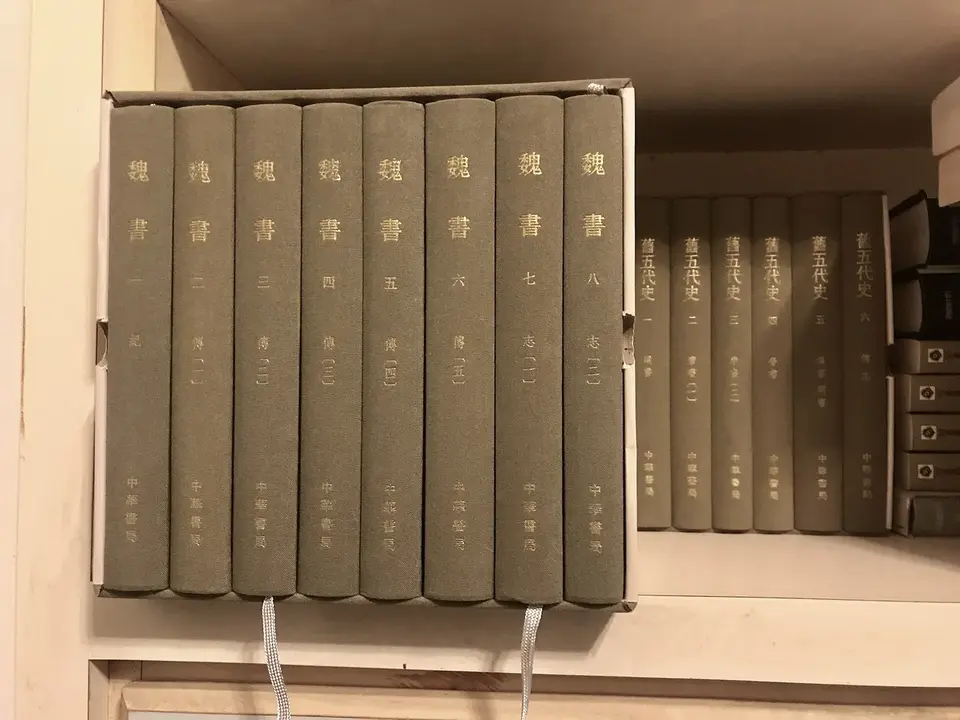
Eminent modern historian Chen Yuan published his three-volume study Uncovering the Textual Recoveries of the Old History of the Five Dynasties (Jiu Wudai Shi Jiben Fafu), applying modern scientific collation to expose Qing imperial censorship and corruptions. In 1976, Zhonghua Book Company released the punctuated, critical edition of the Old History of the Five Dynasties, which became the definitive standard edition for academic research worldwide. In 2005, Professor Chen Shangjun of Fudan University published the 7,000,000-character magnum opus New Collation and Verification of the Old History of the Five Dynasties (Jiu Wudai Shi Xinji Huizheng), incorporating newly excavated Tenth-Century epitaphs and Song encyclopedias, adding sixty newly recovered biographies, and correcting thousands of errors, revitalizing Xue Juzheng's official history through modern philological scholarship.