Sima Cuo's Court Debate
Ba and Ju petition Qin for aid; King Huiwen adopts Sima Cuo's strategy to invade Shu over Zhang Yi's plan to attack Han.
· HISTORICAL EVENT
秦灭巴蜀与经营西南
Qin's Conquest of Ba-Shu and Southwest Expansion (秦灭巴蜀与经营西南) was an epochal geopolitical strategy executed by the State of Qin during the mid-Warring States period. In 316 BCE, conflict erupted between the ancient kingdoms of Ba, Ju, and Shu in the Upper Yangtze. In the Qin court, Prime Minister Zhang Yi advocated attacking the central Han state to intimidate the Zhou king, while General Sima Cuo argued that conquering Ba-Shu would enrich Qin without…
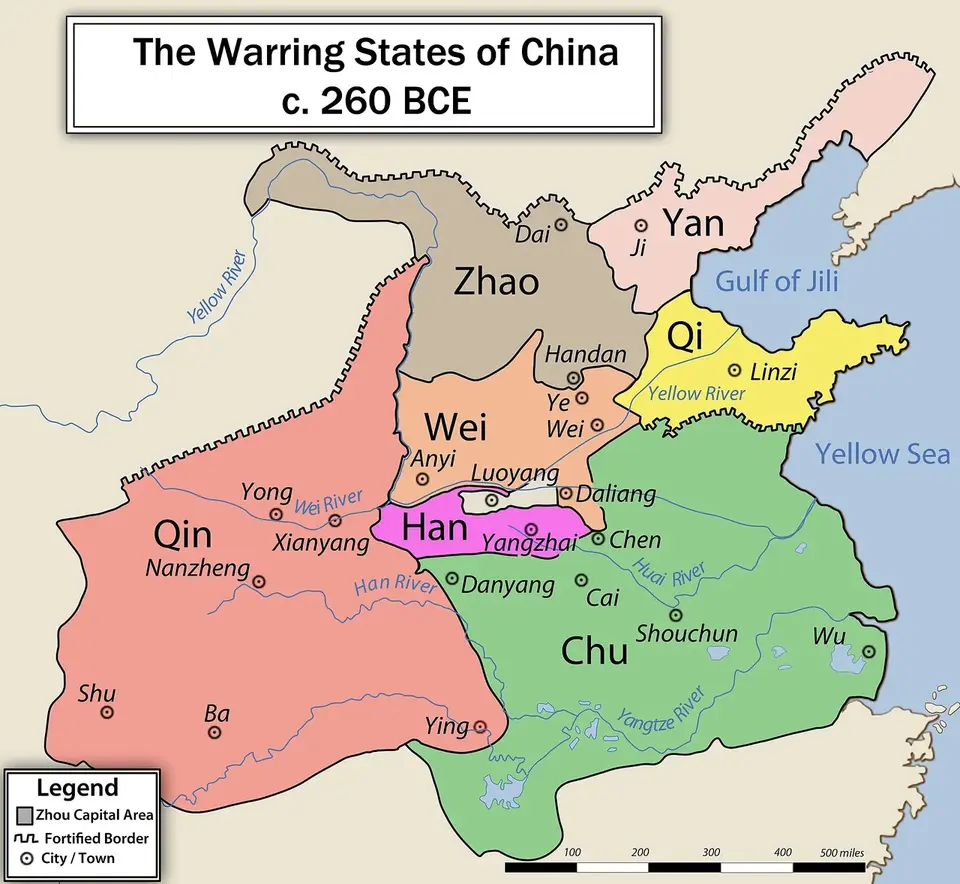
Qin's Conquest of Ba-Shu and Southwest Expansion (秦灭巴蜀与经营西南) was an epochal geopolitical strategy executed by the State of Qin during the mid-Warring States period. In 316 BCE, conflict erupted between the ancient kingdoms of Ba, Ju, and Shu in the Upper Yangtze. In the Qin court, Prime Minister Zhang Yi advocated attacking the central Han state to intimidate the Zhou king, while General Sima Cuo argued that conquering Ba-Shu would enrich Qin without antagonizing rival states: "Securing Shu ensures the fall of Chu; when Chu falls, the realm will be united." King Huiwen adopted Sima Cuo's advice, dispatching an army along the Golden Ox Road that annexed Shu, Ju, and Ba within ten months. Qin established Ba and Shu commanderies, organized large-scale resettlement, constructed Chengdu, and under Governor Li Bing completed the Dujiangyan irrigation system. This transformed the Chengdu Plain into a granary and provided a naval launchpad down the Yangtze River to conquer Chu.
Ba and Ju petition Qin for aid; King Huiwen adopts Sima Cuo's strategy to invade Shu over Zhang Yi's plan to attack Han.
Sima Cuo and Zhang Yi advance along the Golden Ox Road, defeating the Shu army and killing King Kaiming XII.
Qin forces conquer Ba and Ju, establishing Shu Commandery and Ba Commandery under Governor Zhang Ruo.
Qin transfers ten thousand Guanzhong households to settle in Shu; Zhang Yi constructs the Great and Lesser cities of Chengdu.
Sima Cuo crushes regional aristocratic revolts, abolishing the Marquis of Shu and instituting direct commanderies.
Sima Cuo mobilizes naval forces in Shu, sailing down the Yangtze to capture Chu's Qianzhong Commandery.
Governor Li Bing designs and constructs the Dujiangyan irrigation system, transforming the Chengdu Plain into the Land of Abundance.
Qin opens the Five-Foot Road into Yunnan and Guizhou, integrating southwestern tribes into the unified imperial frontier.
Enclosed by mountains and blessed with fertile alluvial soils and a mild climate, the Sichuan Basin was home to the ancient civilizations of Shu and Ba. By the late fourth century BCE, the Kaiming Dynasty ruled Shu from the Chengdu Plain, boasting substantial agricultural wealth and copper resources. To the east, the State of Ba commanded the mountainous valleys of Chongqing and the Three Gorges, possessing powerful riverine fleets. Between them lay the small buffer principality of Ju, situated near Jiameng Pass.
In 316 BCE, King Kaiming XII of Shu attacked his younger brother, the Marquis of Ju. Outmatched, Ju appealed to Qin for military assistance, while Ba joined Ju in dispatching envoys to Xianyang to solicit Qin intervention.
Having enacted the Legalist reforms of Shang Yang, Qin had achieved administrative discipline and military strength, but remained geographically confined within the rugged Guanzhong region. The crisis in the southwest offered Qin an opportunity to secure vast fertile territories and control the headwaters of the Yangtze River.
The appeal triggered a historic strategic debate in the Qin court between Prime Minister Zhang Yi and General Sima Cuo.
Zhang Yi argued for an eastward offensive: "We should attack the Han Kingdom, advance to the outskirts of Luoyang, intimidate the Son of Heaven, and seize the imperial sacrificial vessels to command the realm! Ba and Shu are isolated barbarian lands, mountainous and barren. Conquering them will not enrich the state, nor will conscripting their populace strengthen our armies; invading them merely exhausts our forces."
Sima Cuo countered from systemic geopolitical principles: "Those who seek renown contend in the court; those who seek profit contend in the market. Qin's territory is small and our populace impoverished. Attacking Han and threatening the Zhou king would panic the eastern states into a grand anti-Qin coalition, inviting simultaneous invasions from Chu, Zhao, and Wei. In contrast, Shu is torn by internal dissension and misruled by a decadent king. Dispatching our veteran troops against them is like setting wolves upon sheep! Annexing their lands will expand our domain; seizing their wealth will enrich our treasury; drilling troops there will secure southwestern resources without being condemned as tyrants. Most crucially, securing Shu ensures the defeat of Chu; when Chu falls, the entire realm will be united! Constructing fleets in Shu and sailing down the Yangtze will bypass Chu's mountain fortresses, collapsing their defenses from within."
Persuaded by Sima Cuo's analysis, King Huiwen approved the southern expedition.
In the autumn of 316 BCE, King Huiwen appointed Sima Cuo, Zhang Yi, and Zhang Ruo to lead an expeditionary army across the Qinling and Daba mountain ranges, guided by local scouts from Ba and Ju.
According to ancient lore, Qin had carved five stone cattle with gold behind their tails, deceiving the gullible King of Shu into believing they defecated gold. The Shu king ordered five giants to cut a road through the mountains, creating the steep Golden Ox Road (Jinniudao). Qin divisions advanced along this plank road into the Shu heartland.
Qin forces engaged the Shu army at Jiameng Pass (modern Guangyuan, Sichuan). Employing heavy crossbow infantry and disciplined shock cavalry, Qin crushed the Shu formations. King Kaiming fled south to Wuyang (modern Pengshan), where he was overtaken and killed, extinguishing the Kaiming Dynasty.
Following the collapse of Shu, Qin turned upon its allies. Recognizing that leaving Ba and Ju independent would expose its new southern flank to Chu, Zhang Yi and Sima Cuo executed a rapid maneuver, capturing the Marquis of Ju and advancing into the eastern valleys to conquer Ba. The King of Ba was captured and sent to Xianyang.
Within ten months, Qin had conquered Shu, Ba, and Ju, incorporating the entire Sichuan Basin into the Qin domain.
To consolidate control, King Huiwen combined indirect rule with centralized bureaucratic administration. He demoted the Shu royal heir to "Marquis of Shu" to placate local clans, while establishing Shu Commandery (governed from Chengdu) and Ba Commandery (governed from Jiangzhou, modern Chongqing) under civil governors appointed directly by Xianyang, with Zhang Ruo serving as the first Governor of Shu.
In 314 BCE, the Qin court initiated a massive resettlement initiative, transferring over ten thousand civilian households from Guanzhong into the Chengdu Plain. These settlers introduced advanced iron implements, ox-driven plowing, and sophisticated irrigation techniques, intermarrying with native populations.
Simultaneously, Zhang Yi and Zhang Ruo oversaw the urban design and construction of Chengdu. Modeled after the architectural layout of Xianyang, they erected dual walled enclaves—the Great City and Lesser City—establishing Chengdu as the administrative capital and commercial hub of southwestern China.
Between 311 BCE and 285 BCE, descendants of the Shu royal house revolted three times (Marquis Tong, Marquis Yun, and Marquis Wan). Qin systematically suppressed these insurrections, executing the rebel leaders. In 285 BCE, the throne abolished the title of Marquis of Shu, converting the territory fully into regular imperial commanderies.
In 256 BCE (the fifty-first year of King Zhaoxiang), the court appointed master hydraulic engineer Li Bing as Governor of Shu. Confronting the seasonal flooding of the Min River, Li Bing designed and constructed the Dujiangyan irrigation system. Comprising three non-dam elements—the Fish Mouth Water-Dividing Dike, the Flying Sand Weir, and the Baopingkou Intake—the project tamed the river while channeling water to irrigate millions of acres of farmland. This transformed the Chengdu Plain into the "Land of Abundance" (Tianfu zhi Guo).
With Ba-Shu secured, Qin pushed its administrative frontiers into the Yunnan-Guizhou plateau.
During King Zhaoxiang's reign, Qin dispatched officials led by Chang E to construct the "Five-Foot Road" (Wuchidao), a paved military track extending from Yibin across the Wumeng Mountains into modern Zhaotong and Qujing, Yunnan. Qin stationed administrative overseers among the Dian and Yelang tribes, integrating the southwestern tribal networks into the imperial commercial orbit.
Qin absorbed the vast Sichuan Basin within ten months, doubling its agricultural domain and population. With the completion of Dujiangyan, Chengdu developed into an agricultural powerhouse that insulated Qin from grain shortages.
First, the acquisition of Ba-Shu provided Qin with an impregnable logistical rear. The limitless agricultural grain and timber supplies of the Sichuan Basin funded Qin's protracted campaigns during the Battle of Changping and the final wars of unification. Second, controlling the Upper Yangtze gave Qin absolute operational superiority over Chu. In 280 BCE, Sima Cuo mobilized thousands of transport vessels in Shu, sailing down the Yangtze River to strike Chu's Qianzhong Commandery, setting the stage for General Bai Qi to sack the Chu capital of Ying in 278 BCE. Third, the opening of the Five-Foot Road and the establishment of commanderies broke centuries of isolation in southwestern China, initiating the cultural and economic integration of Han, Ba, Shu, and southwestern tribal peoples into the unified Chinese civilization.
In the Records of the Grand Historian (Shiji), Sima Qian recorded: "Sima Cuo and Zhang Yi debated before King Huiwen... Sima Cuo petitioned to attack Shu, and the king listened, conquering Shu within ten months. Having secured Shu, Qin grew wealthier and stronger, looking down upon the feudal lords."
In the Treatise on Canals, Sima Qian wrote of Li Bing: "Governor Bing of Shu cut through the Lidui promontory, averting floods and digging two rivers through Chengdu. These canals allowed navigation and irrigated ten thousand qing of farmland, freeing the populace from famine."
The Chronicles of Huayang (Huayang Guozhi) praised: "Water and drought responded to human will; famine was unknown, and harvests never failed. The realm celebrated it as the Land of Abundance."
Philosopher Wang Fuzi concluded in On the Comprehensive Mirror: "Qin's unification of all under heaven began with the acquisition of Shu. Securing Shu brought immense wealth and opened the downstream path to overturn Chu. Sima Cuo's strategy was indeed a calculation for ten thousand generations."