Xuanwu Gate Incident
Li Shimin stages a coup against Crown Prince Jiancheng, taking military control of the dynasty.
Tang Dynasty (唐朝) · HISTORICAL EVENT
渭水之盟
The Alliance of the Wei River (渭水之盟), also known as the Bian Bridge Treaty, was a critical military confrontation and diplomatic settlement that occurred in September 626 between the newly enthroned Emperor Taizong of Tang and the Eastern Turkic Khaganate. Less than three weeks after Taizong ascended the throne in the aftermath of the bloody Xuanwu Gate Incident, Illig Qaghan and Tolis Qaghan led over one hundred thousand nomadic horsemen deep into the…
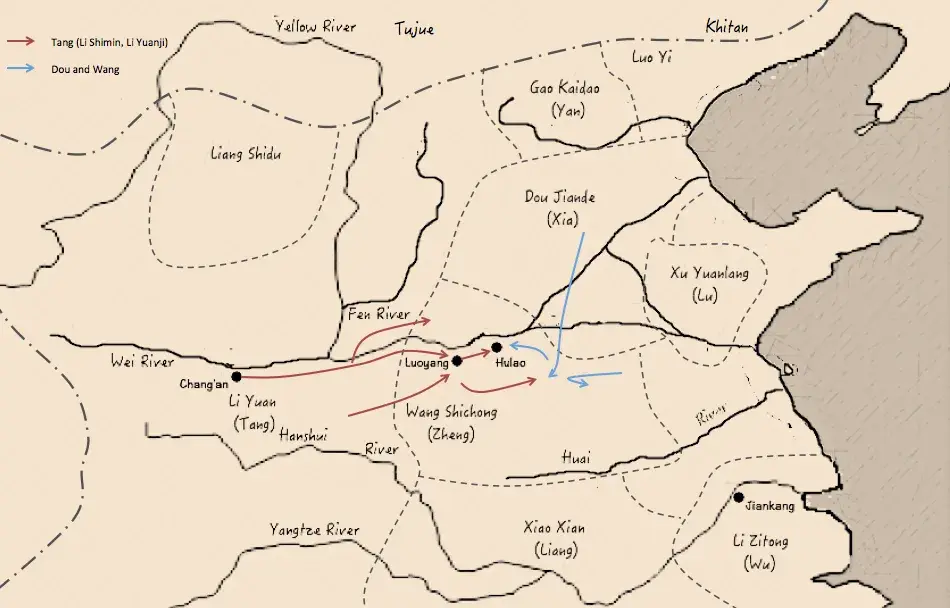
The Alliance of the Wei River (渭水之盟), also known as the Bian Bridge Treaty, was a critical military confrontation and diplomatic settlement that occurred in September 626 between the newly enthroned Emperor Taizong of Tang and the Eastern Turkic Khaganate. Less than three weeks after Taizong ascended the throne in the aftermath of the bloody Xuanwu Gate Incident, Illig Qaghan and Tolis Qaghan led over one hundred thousand nomadic horsemen deep into the Guanzhong plain, reaching the northern banks of the Wei River within sight of Chang'an. Faced with overwhelming numerical superiority and a dangerously vulnerable capital, Taizong executed an audacious psychological bluff. He detained the arrogant Turkic envoy Zhishi Sili and rode out directly to the bridge with only six trusted courtiers, openly castigating Illig Qaghan for breaking past treaties. As following Tang banners deployed ostentatiously on the southern plains, Taizong sowed distrust between the two khagans. Convinced that Tang forces were laying an ambush, Illig Qaghan relented and sued for peace. The leaders sacrificed a white horse on the bridge to seal the treaty, and after receiving substantial diplomatic gifts, the Turkic army withdrew, preserving the burgeoning Tang Empire.
Li Shimin stages a coup against Crown Prince Jiancheng, taking military control of the dynasty.
Li Shimin formally ascends the imperial throne as the second emperor of the Tang Dynasty.
Eastern Turkic Khagans lead over one hundred thousand cavalry across the border, sacking Jingzhou.
Turkic horsemen reach the northern banks of the Wei River; Taizong arrests envoy Zhishi Sili.
Emperor Taizong confronts Illig Qaghan at the Bian Bridge while staging an imposing military bluff.
Illig Qaghan, fearing an imperial trap and split by internal discord, sues for peace.
Taizong and Illig sacrifice a white horse to swear an oath of peace; gifts of silk are distributed.
General Li Jing launches a massive winter offensive, shattering the Eastern Turks and capturing Illig Qaghan.
In July 626, Prince of Qin Li Shimin ambushed and killed his elder brother Crown Prince Li Jiancheng and younger brother Li Yuanji at the Xuanwu Gate in Chang'an. Shortly thereafter, his father Emperor Gaozu abdicated, and Li Shimin formally ascended the throne on September 4, 626. The sudden transition left the imperial court politically fragile: partisans of the deceased princes remained disaffected, bureaucratic administration was undergoing chaotic reorganization, and veteran Tang armies were widely dispersed across frontier garrisons, leaving the capital garrisoned by only a skeleton force.
Taking advantage of the widespread civil wars that accompanied the collapse of the Sui Dynasty, the Eastern Turkic Khagans had expanded their hegemony across the northern steppes, reducing multiple warlord regimes to vassalage. Even Gaozu had paid tribute to secure his northern border during his initial uprising. As Tang forces unified China, Illig Qaghan viewed the rising southern empire as an existential challenge. Receiving intelligence of the internal coup and military vulnerability in Chang'an, Illig decided to launch an all-out offensive to capture the capital and dismantle the Tang state.
On September 19, 626, Illig Qaghan joined forces with his nephew Tolis Qaghan, leading over one hundred thousand mounted archers across the frontier defenses. Sweeping through defenseless border posts, the Turkic vanguard overwhelmed Jingzhou and surged across the Guanzhong basin, advancing unchecked toward the capital.
On September 21, Turkic cavalry vanguards reached the northern shore of the Wei River, encamping just miles from the northern walls of Chang'an. Illig Qaghan dispatched his senior chieftain Zhishi Sili into the imperial palace as an envoy to gauge Tang resolve. In the imperial audience hall, Zhishi Sili arrogantly boasted: "The two great Khagans approach with an army of one million warriors!" seeking to coerce immediate submission.
Far from being intimidated, Emperor Taizong saw through the bluster. He harshly rebuked Zhishi Sili for violating peace pacts and ordered his immediate detention within the palace gates, depriving the Turkic commanders of critical intelligence regarding the capital's actual defensive weakness.
Taizong recognized that retreating behind city walls would embolden the invaders and invite a destructive siege. Deciding on an extraordinary gamble of psychological warfare, on September 23 Taizong ordered the palace gates opened and rode out toward the Wei River accompanied by only six companions, including civil officials Fang Xuanling and Gao Shilian.
Reaching the southern bridgehead of the Bian Bridge, Taizong addressed Illig Qaghan directly across the waters, enumerating the khagan's violations of past treaties and challenging the nomadic leadership with calm defiance. Taken aback by the lone emperor's fearless demeanor, the Turkic tribal chieftains were unnerved, many dismounting to offer respect.
Moments later, Tang infantry and cavalry formations commanded by Xiao Yu marched out from the suburbs and deployed along the southern plains, their armor glistening and battle flags stretching for miles across the horizon. As drums rolled, Taizong signaled his troops to hold ranks while he remained stationary at the bridge. This display convinced Illig Qaghan that Tang forces were well-prepared and had concentrated an immense strike force to trap the nomadic raiders.
Simultaneously, Taizong exploited the long-standing political rivalry between Illig Qaghan and his subordinate Tolis Qaghan. Aware that Tolis had harbored secret communications with the Tang, imperial agents secretly conveyed messages to Tolis, dissuading him from supporting a full assault. Facing wavering allies, an unreturned envoy, and what appeared to be an overwhelming Tang defensive army, Illig Qaghan concluded that a costly battle deep in enemy territory risked total annihilation.
On September 24, Illig Qaghan dispatched emissaries to request a formal peace conference. On September 25, Emperor Taizong met Illig on the Bian Bridge. Following ancient steppe traditions of solemn oaths, they sacrificed a pristine white horse and swore a covenant of non-aggression before Heaven. Taizong ordered generous quantities of silk and bullion distributed from the imperial treasury to appease the nomadic chieftains. Satisfied with their booty and chastened by Taizong's martial firmness, Illig ordered his hundred-thousand-strong host to decamp and commence their northward withdrawal on September 26.
The Alliance of the Wei River was a landmark diplomatic and military victory for the fledgling Tang Empire. By dispensing imperial treasury silk and bullion, Taizong preserved the civilian population of Chang'an from catastrophic destruction and protected the nascent Zhenguan reign from premature extinction. The truce granted Taizong three vital years to implement equal-field agricultural reforms, replenish fiscal revenues, reorganize imperial administration, and intensively train elite frontier cavalry units.
Though successful, Taizong regarded the Treaty of the Wei River as a deep national humiliation, constantly practicing archery and urging his generals to prepare for retribution. In late 629, Taizong unleashed General Li Jing with one hundred thousand cavalry. In a lightning winter campaign, Tang armies captured Dingxiang, routed the Turks at Mount Yin, and captured Illig Qaghan alive. The Eastern Turkic Khaganate was dismantled, and nomadic chieftains traveled to Chang'an to proclaim Taizong the Heavenly Qaghan, establishing Tang China as the undisputed hegemon of Eurasia.