Demise of Emperor Gaozong and Testamentary Regency
Emperor Gaozong dies in Luoyang; his will ordains Prince Li Xian to succeed him while delegating major state affairs to Empress Wu.
Tang Dynasty (唐朝) · HISTORICAL EVENT
武则天称制与酷吏政治
Wu Zetian's Regency and Reign of Cruel Officials (武则天称制与酷吏政治) denotes the historical period spanning from the accession of Emperor Zhongzong in 683 to the execution of chief torturer Lai Junchen in 697, during which Wu Zetian exercised autocratic court regency and extensively mobilized ruthless judicial henchmen to conduct secret police purges. In late 683, Emperor Gaozong passed away, issuing a testamentary edict leaving vital decisions to Empress…
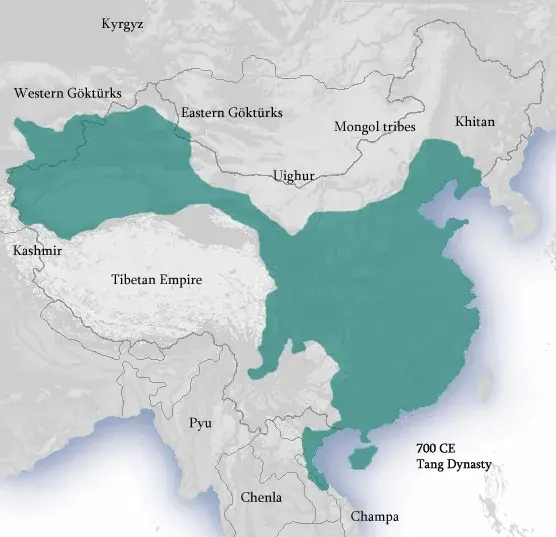
Wu Zetian's Regency and Reign of Cruel Officials (武则天称制与酷吏政治) denotes the historical period spanning from the accession of Emperor Zhongzong in 683 to the execution of chief torturer Lai Junchen in 697, during which Wu Zetian exercised autocratic court regency and extensively mobilized ruthless judicial henchmen to conduct secret police purges. In late 683, Emperor Gaozong passed away, issuing a testamentary edict leaving vital decisions to Empress Dowager Wu. In 684, utilizing Emperor Zhongzong's rash attempt to empower his father-in-law Wei Xuanzhen as a pretext, Wu Zetian decisively deposed Zhongzong to the rank of Prince of Luling and enthroned her youngest son Li Dan as Emperor Ruizong, formally commencing her regency. Faced with deep resentment and military rebellions from Tang loyalists and royal princes, Wu Zetian crushed Xu Jingye's Yangzhou rebellion and the uprisings of Princes Li Chong and Li Zhen. She then erected copper petition boxes to encourage empire-wide secret denunciations, promoting notorious inquisitors such as Suo Yuanli, Zhou Xing, and Lai Junchen to oversee special judicial tribunals in Luoyang. These cruel officials fabricated charges, authored the notorious Manual of Entrapment, and executed thousands of royal family members and senior statesmen. After crowning herself emperor in 690, Wu Zetian strategically eliminated her inquisitors once their political utility was exhausted, executing Zhou Xing in 691 and Lai Junchen in 697 to restore public order.
Emperor Gaozong dies in Luoyang; his will ordains Prince Li Xian to succeed him while delegating major state affairs to Empress Wu.
Wu Zetian deposes Emperor Zhongzong for favoring consort kin, instates Emperor Ruizong, and officially assumes autocratic regency.
Xu Jingye and Luo Binwang launch an armed rebellion in Yangzhou; General Li Xiaoyi suppresses it, and Chancellor Pei Yan is executed.
Wu Zetian stages an offer to return rule to Ruizong, who refuses; bronze mailboxes are erected to solicit universal secret denunciations.
Suo Yuanli is appointed to oversee treason trials, joined by Zhou Xing and Lai Junchen in constructing the secret police apparatus.
Princes Li Chong and Li Zhen rise in revolt and perish; cruel officials prosecute a sprawling treason trial that exterminates the Tang imperial princes.
Wu Zetian accepts universal petitions, formally usurping the imperial throne, founding the Wu Zhou Dynasty, and establishing Shendu Luoyang.
Lai Junchen tricks Zhou Xing into recommending the hot jar torture and uses it to convict him; Zhou Xing is murdered en route to exile.
Lai Junchen attempts to purge imperial princesses and is exposed by a cross-faction alliance; he is executed in public, ending the reign of terror.
During his later years, Emperor Gaozong suffered from chronic dizziness and failing eyesight, leaving daily bureaucratic petitions to be arbitrated by Empress Wu and fostering a joint dual-sovereign governance. In the twelfth month of the Hongdao first year (683), Emperor Gaozong died in the Zhenguan Hall of Luoyang. His testamentary decree instructed Crown Prince Li Xian to ascend the throne before the imperial coffin, while explicitly establishing that critical military and state affairs incapable of immediate decision must be submitted to Empress Dowager Wu for final approval. Four days later, Li Xian was formally enthroned as Emperor Zhongzong, honoring Wu Zetian as Empress Dowager and commissioning Pei Yan as Director of the Chancellery to assist the administration.
Within two months of his coronation, Emperor Zhongzong sought to break free from his mother's tutelage and establish an autonomous inner power base by promoting his father-in-law Wei Xuanzhen to the high post of Vice Director of the Chancellery and bestowing fifth-rank offices upon the sons of his wet nurse. When Chancellor Pei Yan remonstrated vigorously against conferring unearned high honors upon consort kin, Zhongzong reacted furiously, declaring that he had full authority to surrender the entire empire to Wei Xuanzhen if he so chose. Pei Yan immediately reported this reckless outburst to Empress Dowager Wu. In the second month of 684, Wu Zetian convened civil and military officials in the Qianyuan Hall, had Pei Yan announce the decree of deposition, banished Zhongzong as the Prince of Luling, and elevated her youngest son Prince of Yu Li Dan as Emperor Ruizong. Confined to separate halls without administrative authority, Ruizong watched as Empress Dowager Wu formally assumed regency, altered the reign title to Wenming, and grasped total state sovereignty.
Empress Dowager Wu's overt monopolization of central authority and renaming of Luoyang to Shendu (Divine Capital) alienated both the Tang royal family and the veteran Guanlong aristocratic elite. In the ninth month of 684, Li Jingye (Xu Jingye), grandson of the revered founding general Li Shiji, allied with dismissed literary figures such as Luo Binwang, Tang Zhiqi, and Du Qiuren to launch an armed insurrection from Yangzhou under the banner of restoring Emperor Zhongzong. Luo Binwang authored the celebrated Declaration on Behalf of Xu Jingye Against Wu Zhao, castigating Wu's imperial ambitions and alleged transgressions, rapidly gathering over one hundred thousand soldiers across the Huai River valley.
Demonstrating cold political resolve, Wu Zetian appointed General Li Xiaoyi as Commander-in-Chief of the Yangzhou Circuit, dispatching three hundred thousand imperial expeditionary troops south to quell the insurrection. After several months of hard fighting, imperial forces routed the rebels in the eleventh month, and Xu Jingye was killed by his own subordinate while fleeing. Capitalizing on the crisis, Wu Zetian accused Chancellor Pei Yan and top border general Cheng Wuting of colluding with the rebels, executing both senior officials and initiating a sweeping purge against any high minister suspected of wavering loyalty.
In the aftermath of the Yangzhou rebellion and Pei Yan's downfall, Wu Zetian realized that the civil bureaucracy and imperial princes remained privately loyal to the House of Li. To circumvent standard bureaucratic reporting and directly monitor the entire populace, she resolved to construct an unprecedented state surveillance apparatus. In the first month of 686, Wu Zetian orchestrated a ceremonial proclamation offering to return sovereign governance to Emperor Ruizong. Knowing her true intent, Ruizong submitted earnest petitions adamantly declining the offer, enabling Wu Zetian to continue her autocratic regency with enhanced moral legitimacy.
In the third month of 686, acting on a design by Yu Baojia, Wu Zetian had four bronze mailboxes cast and erected outside the palace gates in Shendu Luoyang. The boxes were divided into four specialized conduits: "Extending Grace" for office seekers and literary submissions, "Inviting Remonstrance" for policy critiques, "Vindicating Wrongs" for civil appeals, and "Penetrating the Mysterious" for celestial omens and secret denunciations of subversion. The court mandated that local magistrates throughout the realm were strictly forbidden from interrogating or obstructing prospective informants; instead, they were required to provide official relay post horses and daily five-rank official food rations to escort informants directly to the capital. Even peasant farmers and woodcutters were granted immediate private audiences with Empress Wu. Informants whose allegations aligned with imperial objectives received instantaneous official appointments, while those whose allegations proved entirely false faced no punitive consequences for perjury, igniting an empire-wide wave of malicious secret denunciations.
Amidst the hysteria of universal denunciation, a cadre of depraved individuals adept at framing political opponents rose to prominence. Suo Yuanli, a Sogdian foreigner, gained Wu Zetian's patronage through secret informing and was appointed as a guerrilla general tasked with prosecuting imperial treason cases. Suo was exceptionally brutal, routinely coercing one prisoner into implicating hundreds of alleged conspirators. Soon, petty clerk Zhou Xing and capital ruffian Lai Junchen followed in his footsteps, appointed as investigative censors to steer the machinery of judicial terror.
These cruel officials established special torture chambers inside the Lijing Gate of Luoyang, grimly dubbed by the public as the "Exhaustion Gate," signifying that whoever entered would inevitably leave as a corpse. The inquisitors invented dozens of sophisticated torture devices bearing terrifying pseudonyms such as "Shattering Hundred Pulses," "Ground Roar," "Dying Swine Sorrow," "Desiring Family Ruin," and "Fairy Ascending the Ladder," subjecting defendants to unbearable physical agony until confession was secured. Lai Junchen and his associates even compiled the Manual of Entrapment (Luo Zhi Jing), a systematic technical manual detailing methodology for fabricating evidence, coercing perjury, and implicating innocent scholars in phantom conspiracies. Bureaucrats departing home each morning wept and bid farewell to their wives and children, uncertain whether they would survive the workday without being abducted into the torture chambers.
Empress Wu's obvious preparations to usurp the throne drove Tang princes into desperate resistance. In the eighth month of 688, Li Chong, Prince of Langye and Prefect of Bozhou, raised troops in Bozhou calling on all royal princes to assemble and overthrow the regent. His father Li Zhen, Prince of Yue and Prefect of Yuzhou, mobilized his garrison in coordination. However, lacking military experience and mutual coordination, the insurrection collapsed swiftly. Wu Zetian deployed Generals Qiu Shenji and Cen Changqian; Li Chong was defeated and killed within seven days, while Li Zhen committed suicide following the defeat of his forces.
The abortive insurrection provided Wu Zetian with the ultimate pretext for an exhaustive annihilation of the Tang imperial family. Cruel officials Zhou Xing and Lai Junchen were directed to extract sweeping confessions implicating all prominent dynastic princes. Senior princes Li Yuanjia (Prince of Han) and Li Lingkui (Prince of Lu) were forced to commit suicide, while Li Yuangui (Prince of Huo) perished during exile to Qianzhou. Over dozens of senior princes, including Li Zhuan, Li Ai, Li Xu, and Li Rong, were systematically executed, and their ancestral surnames were stripped and degraded to "Hui" (Viper). The male lines of Emperors Gaozu and Taizong were almost entirely extinguished, their surviving minors banished to the malarial wastelands of Lingnan, and hundreds of related elite families wiped out, completely crushing the royal clan's capacity for resistance.
In the ninth month of 690, following coordinated mass petitions by more than sixty thousand officials, monks, and citizens, Wu Zetian ascended the imperial throne, proclaimed the Zhou Dynasty, and assumed the supreme imperial title. Having attained absolute power and stabilized court administration, the female emperor recognized that the continued employment of lawless inquisitors posed a severe threat to dynastic legitimacy and had aroused universal public hatred. The cruel officials had begun fabricating charges against Wu's own nephews and imperial princesses, exhausting their political utility.
In 691, when an informant denounced Zhou Xing for plotting rebellion, Empress Wu secretly instructed Lai Junchen to conduct the interrogation. Lai hosted Zhou Xing at a luxurious banquet and casually inquired: "Many prisoners refuse to confess; what method would you advise?" Zhou Xing boastfully replied: "Take a huge earthen jar, surround it with burning charcoal, and place the prisoner inside; how could anyone not confess?" Lai Junchen immediately ordered attendants to fetch a huge jar and stoke the coals, standing up and announcing coldly to Zhou: "A secret denunciation has accused you of treason. Pray, step into your own jar, my friend!" Paralyzed with terror, Zhou Xing prostrated himself and confessed all charges. Empress Wu commuted his death sentence to exile in Lingnan, where he was slain along the road by relatives of his former victims.
By 697, Lai Junchen's hubris grew boundless, attempting to frame the Wu clan princes, Princess Taiping, and even imperial heirs Li Dan and Li Xian for treason. Terrified by his unchecked malice, the Wu princes and Princess Taiping formed an alliance with court chancellors to expose Lai's monstrous crimes and corrupt treason before Empress Wu. Recognizing the political imperative, Wu Zetian approved his public execution in the Western Market of Luoyang. Jubilant crowds rushed upon his corpse, stomping on his remains and tearing away pieces of his flesh until only bare bones remained. Wu Zetian promptly issued decrees abolishing the secret denunciation apparatus and exonerating surviving victims, bringing an end to over a decade of judicial terror.
The direct political outcome of Wu Zetian's regency and the reign of terror was the total destruction of the Tang royal house's monopoly on sovereign authority. From the death of Gaozong through the 690s, the vast majority of male descendants of Emperors Gaozu and Taizong, alongside prominent aristocratic statesmen, were systematically liquidated on trumped-up treason charges. Surviving women and minor children were exiled to the subtropical wilderness of Lingnan, permanently depriving the imperial clan of its political and military counterweight against the supreme monarch.
Simultaneously, the traditional aristocratic hegemony of the Guanlong and Guandong lineages over the imperial bureaucracy was definitively broken. By utilizing the terrors of the secret tribunals, Wu Zetian concentrated all executive, military, and judicial powers directly within the inner palace. This unbending autocratic apparatus removed the final societal and institutional barriers to the founding of the Wu Zhou Dynasty in 690, producing the singular female imperial sovereign in Chinese history.
The universal informant network and the cruel officials inflicted profound damage upon traditional Chinese jurisprudence and social morality. The introduction of the bronze mailboxes and guaranteed rewards for unverified accusations turned daily civic life into a landscape of paranoia and betrayal. The grotesque tortures practiced within the Lijing Gate and the systematic framing codified in the Manual of Entrapment subverted the venerable legal procedures established under the Zhenguan and Yonghui codes.
This pervasive fear induced a climate of terror throughout officialdom, where ministers dared not converse in public, communicating only through fearful glances on the avenues. Bureaucrats departed their homes each morning anticipating arrest and demise. Tens of thousands of innocent civil officers, generals, and commoners were tortured into false confessions and executed alongside their entire lineages, leaving scars upon medieval Chinese society that took generations to heal.
Despite the horrific nature of the judicial persecutions, the destruction of the entrenched hereditary aristocracy inadvertently created a structural vacuum that empowered lower-class gentry and non-aristocratic scholars. In tandem with the purges, Wu Zetian vigorously expanded the imperial examination system, inaugurating the Palace Examination and Military Examination, and instituted policies permitting lower officials and commoners to recommend themselves for administrative office.
Once her dynastic foundation was secure, Wu Zetian decisively discarded the cruel officials and elevated incorruptible, highly capable statesmen such as Di Renjie, Yao Chong, Song Jing, Zhang Jianzhi, and Li Zhaode to steer state governance. This fundamental policy shift from autocratic execution to benevolent and pragmatic administration not only stabilized the Wu Zhou realm and reinforced border security, but also cultivated the administrative talent and institutional framework that culminated in Emperor Xuanzong's illustrious Kaiyuan Golden Age.