Death of Shizong
Chai Rong passes away; seven-year-old Chai Zongxun ascends the throne, and Zhao Kuangyin takes command of the Palace Corps
Later Zhou / Northern Song · HISTORICAL EVENT
陈桥兵变
The Chenqiao Mutiny (陈桥兵变) was a momentous military coup and dynastic transition occurring in January 960 (the seventh year of the Xiande era of Later Zhou and the first year of the Jianlong era of Song), in which Commander-in-Chief of the Palace Corps Zhao Kuangyin was invested with the imperial yellow robe by his troops at Chenqiao Station and supplanted the Later Zhou Dynasty to found the Song Dynasty. In 959, the vigorous ruler Emperor Shizong (Chai…
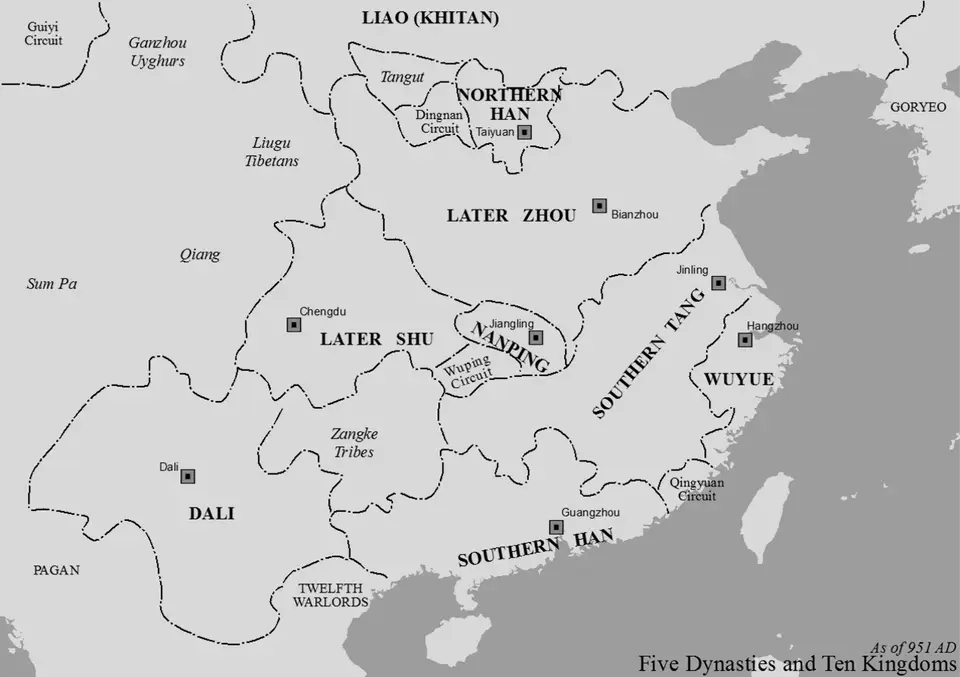
The Chenqiao Mutiny (陈桥兵变) was a momentous military coup and dynastic transition occurring in January 960 (the seventh year of the Xiande era of Later Zhou and the first year of the Jianlong era of Song), in which Commander-in-Chief of the Palace Corps Zhao Kuangyin was invested with the imperial yellow robe by his troops at Chenqiao Station and supplanted the Later Zhou Dynasty to found the Song Dynasty. In 959, the vigorous ruler Emperor Shizong (Chai Rong) passed away prematurely, leaving seven-year-old child emperor Chai Zongxun under the regency of Empress Dowager Fu. On New Year's Day of 960, false reports arrived claiming that the Khitan Liao and Northern Han were launching a joint southern invasion. Chancellor Fan Zhi hastily dispatched the supreme commander of the imperial guards, Zhao Kuangyin, to march north without verifying the intelligence. Zhao Kuangyin, his strategist Zhao Pu, his younger brother Zhao Guangyi, and trusted commanders orchestrated a secret plot. On January 2, the expeditionary host camped at Chenqiao Station, forty li northeast of Kaifeng. At dawn on January 3, armed officers surrounded Zhao's tent shouting imperial acclamations and threw a pre-sewn yellow robe over his shoulders. Zhao accepted the acclamation while strictly commanding his men under pain of death not to harm the imperial family, mistreat civil ministers, or plunder the capital. The army marched into Kaifeng with exemplary discipline. On January 4, Emperor Gong abdicated peacefully, and Zhao Kuangyin ascended the throne, establishing the Song Dynasty with Kaifeng as its capital. The coup ended the endemic pattern of warlord usurpation that had plagued China since late Tang.
Chai Rong passes away; seven-year-old Chai Zongxun ascends the throne, and Zhao Kuangyin takes command of the Palace Corps
Border reports claim joint Khitan-Han invasions; the court hastily orders Zhao Kuangyin to march north
Zhao Kuangyin bivuouacs at Chenqiao; Zhao Pu and Zhao Guangyi organize the mutiny among the officers
Troops drape Zhao in the imperial robe; Zhao imposes strict discipline and marches peacefully into Kaifeng
Chai Zongxun abdicates; Zhao Kuangyin ascends the throne, establishing the Song Dynasty
During the Five Dynasties period, regional warlords seized power through armed mutiny, establishing the cynical adage that "the Son of Heaven is merely whoever has the strongest armor and fiercest horses." Emperor Shizong of Later Zhou (Chai Rong) had proven to be a brilliant and reformist sovereign, expanding his domain and laying the groundwork for imperial reunification. However, in the summer of 959, he suddenly succumbed to illness during his northern campaign against the Khitans.
Chai Rong was succeeded by his seven-year-old crown prince Chai Zongxun (Emperor Gong), with Empress Dowager Fu acting as regent. While Chancellors Fan Zhi and Wang Pu were respected Confucian scholars, they lacked the military prestige necessary to control hardened generals. With a child sovereign on the throne, the Later Zhou court appeared dangerously fragile against external foes and domestic military magnates.
Shortly before his death, Emperor Shizong had relieved Zhang Yongde of command over the elite Palace Command (Dianqian Si), appointing the decorated and popular general Zhao Kuangyin as Commander-in-Chief (Dianqian Dujian). This appointment placed the finest shock troops of the imperial bodyguard entirely under Zhao's personal command.
Zhao had cultivated deep bonds with senior officers through sworn brotherhoods known as the "Ten Brothers of the Righteous Society," including Shi Shouxin, Gao Huaide, and Wang Shenqi. Supported by his astute younger brother Zhao Guangyi and veteran political strategist Zhao Pu, the conspirators closely monitored the political landscape. In Kaifeng, clandestine rumors were actively circulated that "on the day the army departs, the Commander-in-Chief shall be made Son of Heaven," preparing public opinion for dynastic change.
On January 1, 960, during the formal New Year audience in Kaifeng, emergency couriers arrived from Zhenzhou and Dingzhou reporting that Khitan cavalry and Northern Han divisions were advancing south across the border.
Panicked by the reports, Chancellors Fan Zhi and Wang Pu made the impetuous decision to mobilize the entire imperial strike force under Zhao Kuangyin without dispatching scouts to verify the threat. Zhao seized the opportunity to march the elite Palace Corps out of Kaifeng, leaving trusted allies Shi Shouxin and Wang Shenqi in command of the city garrison. On January 2, Zhao led the main army out of the capital.
On the evening of January 2, the northern expedition halted at Chenqiao Courier Station, approximately twenty kilometers northeast of Kaifeng. As night fell, army astrologer Miao Xun pointed to an atmospheric halo around the sun, predicting that heavenly mandate was shifting to the Zhao family.
Zhao Guangyi and Zhao Pu circulated among the officers' tents, orchestrating grievances: "The sovereign is an infant! What use is it for us to shed blood against the Khitans when nobody will recognize our sacrifices? Better to proclaim the Commander-in-Chief as Emperor before marching north!" At dawn on January 3, thousands of fully armored guards surrounded Zhao Kuangyin's headquarters shouting "Ten Thousand Years!" Emerging from his tent feigning groggy surprise from wine, Zhao was immediately draped in a golden imperial robe. The assembled officers prostrated themselves, chanting imperial salutations and demanding he assume the throne.
Zhao Kuangyin accepted the investiture, but drew his sword before the army to impose rigid discipline: "The Empress Dowager and the young sovereign are my rulers; they must not be molested. The civil ministers are my colleagues; they must not be insulted. The public treasuries and private citizens must not be plundered. Those who obey shall be richly rewarded; those who disobey shall be executed with all their kin!"
The troops cheered in assent. Zhao directed the army in an orderly counter-march back toward Kaifeng, enforcing immaculate discipline. By noon, the vanguard reached Kaifeng's gates, which were promptly swung open by Shi Shouxin. Only Deputy Military Commander Han Tong attempted to organize armed resistance, but he was pursued and slain by cavalry officer Wang Yansheng.
Zhao Kuangyin entered the capital and summoned the chancellors to his headquarters. Overwhelmed by the accomplished coup, Chancellor Wang Pu knelt in submission, followed by a weeping Fan Zhi.
On January 4, Zhao entered the Palace of Supreme Origin. Scholar Tao Gu produced an abdication edict pre-drafted for the occasion, and seven-year-old Chai Zongxun formally surrendered the throne. Zhao Kuangyin was proclaimed Emperor, establishing the Song Dynasty with the era name Jianlong. Honoring his pledge, Emperor Taizu conferred the princely title of King of Zheng upon the deposed child emperor, granted an iron pledge protecting the Chai family from execution for generations, and retained former Zhou ministers, executing an extraordinarily peaceful transfer of imperial power.
The Chenqiao Mutiny transferred state power from the Later Zhou to the newly established Song Dynasty with minimal casualties. Aside from the death of Han Tong, the capital was preserved from looting. Zhao Kuangyin treated the fallen Chai clan with dignity, setting a precedent of imperial magnanimity.
The Chenqiao Mutiny was the monumental pivot that brought an end to two centuries of regional fragmentation beginning with the An Lushan Rebellion. By terminating the cycle of warlord regicides, Zhao Kuangyin stabilized northern China. Having seized power through a military mutiny, Emperor Taizu systematically dismantled warlord power through famous reforms such as "relieving generals of military commands over a cup of wine," centralizing provincial tax revenues, and instituting the supreme supremacy of civilian scholar-officials over the military. This established the foundational institutional character of the Song Dynasty, fostering an era of unmatched economic vitality, urban development, and Neo-Confucian intellectual renaissance.