Tartar Defiance and Annihilation of Qiu Fu
Bunyashiri executes envoy Guo Ji; General Qiu Fu's force of one hundred thousand is destroyed at the Kherlen River.
Ming Dynasty (明朝) · HISTORICAL EVENT
永乐北征
Emperor Yongle's Northern Expeditions (永乐北征) designates the five major strategic military campaigns between 1410 and 1424 in which the Yongle Emperor (Zhu Di) personally commanded the main forces of the Ming Dynasty into the Mongolian Plateau against the Eastern Mongols (Tartars) and Western Mongols (Oirats). Following the decisive Ming victory at Lake Buir in 1388, Northern Yuan remnants fragmented into the Tartar, Oirat, and Uriankhai factions,…
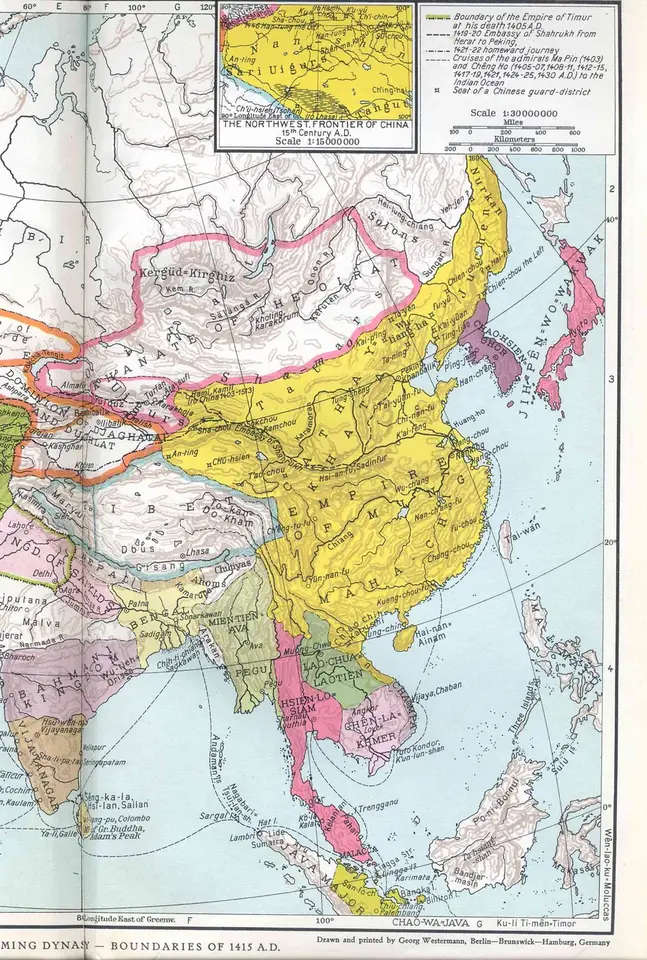
Emperor Yongle's Northern Expeditions (永乐北征) designates the five major strategic military campaigns between 1410 and 1424 in which the Yongle Emperor (Zhu Di) personally commanded the main forces of the Ming Dynasty into the Mongolian Plateau against the Eastern Mongols (Tartars) and Western Mongols (Oirats). Following the decisive Ming victory at Lake Buir in 1388, Northern Yuan remnants fragmented into the Tartar, Oirat, and Uriankhai factions, continuing cross-border raids that threatened frontier trade routes. In 1409, the Tartar court executed a Ming imperial envoy and routed an army of one hundred thousand under General Qiu Fu at the Kherlen River. In response, Emperor Yongle resolved to lead personal military expeditions. Over the next fourteen years, Zhu Di mounted five expeditions into the steppe: in the first, he crushed Khagan Bunyashiri along the Onon River and forced Chancellor Arughtai into submission; in the second, he routed Oirat chieftain Mahmud at Khulan Khashiun; and in the subsequent three campaigns, he conducted mobile search-and-destroy operations against the elusive Arughtai. On August 12, 1424, Emperor Yongle died at Yumuchuan during his return from the fifth campaign. His expeditions weakened Mongol military power, compelling them to maintain tributary relations and securing the northern frontier of the Ming Dynasty.
Bunyashiri executes envoy Guo Ji; General Qiu Fu's force of one hundred thousand is destroyed at the Kherlen River.
Emperor Yongle commands five hundred thousand troops, routing Bunyashiri on the Onon River and compelling Arughtai to submit.
Zhu Di campaigns against the Oirats; the Firearm Division and heavy cavalry break Mahmud's army in a pitched battle.
Arughtai rebels and captures the Ming fortress at Xinghe, threatening defenses around the new capital Beijing.
The emperor leads troops to the Quler River as Arughtai flees; the Ming army pacifies the Uriankhai Commanderies.
Ming forces sweep the desert; Oirat leader Esen Tugan surrenders with his clan, receiving the title Prince of Zhongyong.
Zhu Di leads his fifth campaign to the Dalan Nemurge River; he dies on the return march at Yumuchuan on August 12.
In 1368, Ming forces seized the Yuan capital Dadu, driving the Mongol court into the northern steppe, where they were termed the "Northern Yuan." Over the subsequent two decades, Emperor Hongwu launched eight campaigns into the steppe. In 1388, General Lan Yu achieved a victory at Lake Buir, capturing tens of thousands of Northern Yuan royals and destroying their centralized administrative apparatus. Following this catastrophe, the steppe fragmented into the Eastern Mongols (Tartars), Western Mongols (Oirats), and the southern Uriankhai Three Commanderies.
By the early fifteenth century, Tartar power re-emerged under Grand Preceptor Arughtai and Khagan Bunyashiri, who asserted imperial descent from the Genghis Khan lineage. Rejecting Ming diplomatic initiatives, they mobilized raiding parties across the Great Wall into Shanxi, Hebei, and Shaanxi, pillaging Kaiping, Datong, and Xuanfu and posing a direct threat to Ming frontier defenses.
In early 1409, Emperor Yongle sent envoy Guo Ji to the Tartar court to propose tributary peace. Defiant, Bunyashiri executed the envoy. Enraged, Zhu Di appointed Qiu Fu, Duke of Qiguo, as Commander-in-Chief, assigning veterans Wang Cong, Huo Zhen, Wang Zhong, and Li Yuan to lead an army of one hundred thousand cavalry into the steppe.
Disregarding the counsel of his commanders, Qiu Fu advanced recklessly toward the Kherlen River. Tartar forces staged feigned retreats, drawing the Ming vanguard into a trap. Encircled by Tartar cavalry, the entire Ming vanguard was destroyed, and Qiu Fu and his four general officers were killed. The annihilation of the expedition shook the capital. Convinced that subordinate generals lacked the strategic skill to pacify the steppe, Emperor Yongle stripped Qiu Fu of his posthumous titles and resolved to personally lead an imperial expedition across the Great Wall, beginning the Five Northern Campaigns.
In February 1410, Emperor Yongle departed Beijing at the head of five hundred thousand imperial troops. The expedition moved across the Great Wall toward the Kherlen River, which Zhu Di renamed the Xuanzhen River. Alarmed by the scale of the imperial host, Bunyashiri and Arughtai disagreed on tactical response, dividing their forces: Bunyashiri fled northwest toward the Onon River, while Arughtai retreated northeast.
Adopting the strategy of isolating the main leadership, Zhu Di commanded the cavalry vanguard in pursuit of Bunyashiri. On June 15, the Ming vanguard caught Bunyashiri along the Onon River. Personally directing the charge, Zhu Di ordered flanking movements that shattered the Tartar lines, killing thousands. Bunyashiri fled westward to the Oirats with only seven attendants. Wheeling east, Zhu Di encountered Arughtai's forces along the Wumu River in early July, crushing his lines and capturing herds. Arughtai sent emissaries submitting to the Ming, concluding the first campaign.
Following the defeat of the Tartars, the Western Mongol Oirats expanded eastward under chieftain Mahmud. Mahmud executed the fleeing Bunyashiri, elevated Delbeg as a puppet khagan, and claimed dominance over the steppe. Oirat raiding parties crossed the borders, killing Ming trade emissaries and raiding frontier garrisons.
In February 1414, Emperor Yongle initiated his second northern campaign, leading an imperial army into the Tuul River basin. In early June, the Ming vanguard encountered Mahmud's army of thirty thousand cavalry deployed along the ridges of Khulan Khashiun (east of modern Ulaanbaatar). Mahmud launched coordinated cavalry charges against the Ming center. Zhu Di deployed the Shenjiying (Firearm Division) in the vanguard, unleashing volleys of firearms and rockets as the Oirats closed within range. Disrupted by explosive firepower, the Oirats fell into confusion, allowing Ming heavy cavalry to charge both flanks. The Oirat army collapsed, suffering thousands of casualties, and Mahmud fled into the northern forests. Mahmud subsequently sent emissaries to offer tribute, stabilizing the northwestern frontier.
Following the defeat of the Oirats, Arughtai reconstituted his Tartar confederation in the eastern steppe. Revoking his tributary pledges, Arughtai launched an offensive in winter 1421, besieging the Ming garrison at Xinghe. This aggression threatened the new northern capital Beijing, to which the court had relocated.
In March 1422, the sixty-two-year-old Yongle Emperor took the field on his third northern campaign, advancing through Kaiping toward Arughtai's base. Learning of the emperor's advance, Arughtai burned his camps, abandoned herds, and fled into the northern desert. The Ming army pursued as far as the Quler River (southwest of Lake Buir). Finding no enemy forces to engage, Zhu Di turned south on his return march to suppress the Uriankhai Three Commanderies, who had supported Arughtai, neutralizing threats along the Liaodong frontier.
In 1423, reports indicated that Arughtai was preparing renewed incursions into Datong and Wanquan. In August, despite failing health, Emperor Yongle embarked upon his fourth campaign.
In September, as Ming forces advanced past Shangzhuangbao into Shaling, scouting parties captured Tartar deserters who revealed that Arughtai had been defeated in internal combat by Oirat chieftain Esen Tugan, scattering his followers into the northern desert. Ming vanguards pursued and dispersed the remaining Tartar camps. In October, Esen Tugan surrendered with his entire clan and thousands of followers. Delighted by the capitulation, Emperor Yongle invested Esen Tugan as the Prince of Zhongyong, granting him the imperial Chinese name Jin Zhong and concluding the campaign without major casualties.
In early 1424, Arughtai's raiding parties crossed the border near Datong and Kaiping. Despite entreaties from court ministers urging him to remain in the capital due to ill health, the emperor declared, "The barbarians are arrogant; they must not go unpunished." In April, Zhu Di departed Beijing on his fifth northern campaign, traversing Feihu Pass toward the northern steppes.
In June, the expedition crossed the Gobi Desert to the Dalan Nemurge River in search of Tartar forces. However, Arughtai retreated into mountain ranges, leaving no trace. Ming scouting parties ranged hundreds of miles without locating enemy formations. Confronting summer heat and logistical strain, the emperor ordered a withdrawal in July. On August 12, 1424, during the return march, the emperor died in his military pavilion at Yumuchuan (northwest of modern Duolun, Inner Mongolia) at the age of sixty-four. Chancellor Yang Rong and Duke Zhang Fu kept his death secret, encasing the body in a sealed tin casket while marching the army back to Beijing, where Crown Prince Zhu Gaochi ascended the throne.
The military result of Emperor Yongle's northern campaigns was the neutralization of the Northern Yuan leadership. By taking the offensive across the Gobi Desert, the Ming army destroyed the military formations of both the Tartars and Oirats in pitched battles, eliminating their capacity to mount large-scale invasions across the Great Wall.
Furthermore, the campaigns justified the relocation of the imperial capital to Beijing. Under the principle of "the Son of Heaven guarding the frontier gate," the emperor's presence in the north established a strategic buffer that shielded the Central Plains from invasion. This security enabled the agricultural recovery of the early Ming, creating the foundation for the prosperous "Rule of Ren and Xuan."
In steppe diplomacy, Emperor Yongle implemented a balance-of-power strategy. When Tartar power expanded, the Ming court favored the Oirats; when the Oirats challenged the frontier, Ming armies targeted them while incorporating Tartar leaders.
This policy deepened tribal rivalries across the steppe, preventing the unification of the Mongol tribes under a single charismatic leader. Bound by Ming military strength and the economic benefits of frontier market trade, steppe leaders accepted Ming titles and presented regular tribute, preserving security along the northern frontier.
In military history, the northern campaigns established combined-arms doctrines integrating firearms, cavalry, and infantry. Emperor Yongle established the Shenjiying (Firearm Division), deploying musket and rocket volleys in the vanguard to disrupt enemy charges before launching heavy cavalry counter-attacks supported by infantry units.
This tactical doctrine provided the standard combat manual for Ming armies over subsequent generations, influencing the development of artillery tactics and military engineering in early modern East Asia.