Otrar Massacre
Governor Inalchuq executes a 450-man Mongol trade caravan; Shah Muhammad executes the Mongol envoy
Mongol Empire · HISTORICAL EVENT
蒙古第一次西征
The First Mongol Western Campaign (蒙古第一次西征) was a transcontinental military expedition between 1219 and 1225 commanded by Genghis Khan against the Khwarazmian Empire, the Caucasus, and the Pontic steppes, launched in retaliation for the massacre of a Mongol caravan and ambassadors at Otrar. In 1218, a peaceful commercial caravan of four hundred and fifty Muslim merchants dispatched by Genghis Khan was murdered at Otrar by Governor Inalchuq, who…
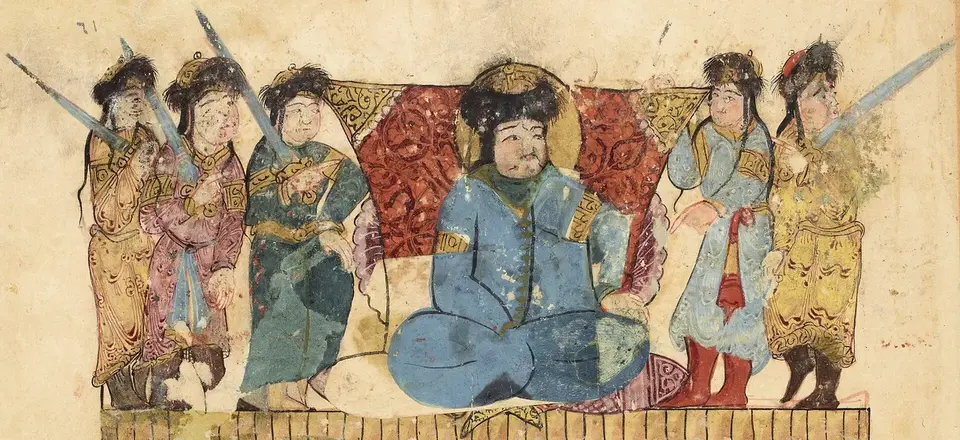
The First Mongol Western Campaign (蒙古第一次西征) was a transcontinental military expedition between 1219 and 1225 commanded by Genghis Khan against the Khwarazmian Empire, the Caucasus, and the Pontic steppes, launched in retaliation for the massacre of a Mongol caravan and ambassadors at Otrar. In 1218, a peaceful commercial caravan of four hundred and fifty Muslim merchants dispatched by Genghis Khan was murdered at Otrar by Governor Inalchuq, who confiscated their immense wealth. When Genghis Khan demanded redress, Shah Ala ad-Din Muhammad II executed the chief Mongol envoy and shaved the beards of the surviving delegates. In response, Genghis Khan ascended Burkhan Khaldun to pray to Tengri, entrusted the campaign against the Jin dynasty to Marshal Mukali, and mobilized an allied host of over one hundred thousand seasoned warriors. During the invasion, Genghis Khan executed a masterclass in operational mobility and psychological warfare. Splitting his forces into four columns, the Mongols bypassed defensive fortresses, traversed the Kyzylkum Desert, and successively stormed Otrar, Bukhara, Samarkand, and the ancient capital of Urgench. Shah Muhammad fled to an isolated island in the Caspian Sea, where he died in destitution. Generals Jebe and Subutai pursued the fugitive shah across thousands of miles, crossed the Caucasus, and crushed a massive Rus'-Kipchak allied army at the Battle of the Kalka River. Simultaneously, Genghis Khan defeated the new Sultan Jalal al-Din at the Indus River. The campaign established Mongol hegemony across Central Asia and inaugurated the emergence of a transcontinental world empire.
Governor Inalchuq executes a 450-man Mongol trade caravan; Shah Muhammad executes the Mongol envoy
Genghis Khan prays at Mount Burkhan Khaldun, delegates the Jin campaign to Mukali, and mobilizes his host
Jebe's vanguard feints into Fergana; Genghis Khan launches a four-pronged converging offensive across the Syr Darya
Chagatai and Ögedei storm Otrar, capturing Inalchuq and executing him by pouring molten silver into his eyes
Genghis Khan crosses the Kyzylkum Desert, surprising Bukhara and capturing the city within four days
The four Mongol columns unite before Samarkand; the city falls and thirty thousand craftsmen are spared
Ögedei unifies command, diverts the river, and storms Urgench after seven days of brutal street fighting
Jebe and Subutai pursue Shah Muhammad thousands of miles to an island in the Caspian Sea, where he dies
Genghis Khan crushes Jalal al-Din's army on the banks of the Indus; the prince plunges into the river and escapes
Genghis Khan meets Daoist Master Qiu Chuji in the Hindu Kush, receiving counsel on governance and restraint
Subutai and Jebe destroy an eighty-thousand-strong Rus'-Kipchak allied army on the Kalka River in southern Russia
Genghis Khan returns to Mongolia after six years, having partitioned the western conquests among his four sons
In 1206, Temüjin unified the pastoral nomadic tribes of the Mongolian plateau, establishing the Mongol Empire under the title of Genghis Khan. Following his victory over the Jin dynasty that forced the Jurchen court to abandon its northern capital of Zhongdu, Genghis Khan annexed the remnants of the Qara Khitai Khanate under Kuchlug. This victory extended Mongol borders directly to the frontiers of the Khwarazmian Empire in Transoxiana.
At that time, the Khwarazmian Empire under Shah Ala ad-Din Muhammad II was at the zenith of its territorial expansion. Dominating modern Uzbekistan, Turkmenistan, Tajikistan, Iran, and Afghanistan, Muhammad styled himself the "Second Alexander." Recognizing the mutual economic benefits of transcontinental commerce, Genghis Khan dispatched cordial diplomatic missions to Muhammad, stating that while he ruled the lands of the rising sun, Muhammad governed the domains of the setting sun, and urged the preservation of open caravan trade across the ancient Silk Road.
In the spring of 1218, Genghis Khan organized an official state trade caravan consisting of four hundred and fifty Muslim merchants accompanied by five hundred laden camels. The caravan carried immense treasures of raw silver, gold ingots, silk textiles, white felt, and rare furs. Upon arriving at the frontier citadel of Otrar on the Syr Darya River, Governor Inalchuq, known by his title Qadir Khan and uncle to the Shah's influential mother Terken Khatun, coveted the caravan's wealth. Inalchuq falsely accused the merchants of espionage and imprisoned them, seeking imperial authorization from Shah Muhammad.
Without investigating the charges, Muhammad authorized the execution of the merchants. Inalchuq murdered the entire caravan and auctioned their merchandise. A single camel driver escaped the slaughter and traversed the desert to deliver the devastating news to Genghis Khan. Exercising extraordinary diplomatic restraint, Genghis Khan dispatched a formal embassy headed by a Muslim dignitary named Baqra alongside two Mongol companions, demanding that Inalchuq be extradited to face justice.
Disdaining Genghis Khan's diplomatic overtures and regarding the title of "son" in the diplomatic correspondence as an unbearable insult, Muhammad executed the chief ambassador and shaved off the beards of the two surviving envoys before expelling them. This flagrant violation of the ancient immunity granted to diplomatic heralds extinguished all possibility of peaceful negotiation, triggering a war of total annihilation.
Upon learning of the murder of his envoys, Genghis Khan was overcome with profound sorrow and wrath. According to the Secret History of the Mongols, he climbed to the summit of the sacred mountain Burkhan Khaldun, removed his headgear and belt, draped the belt across his neck, and wept barefoot for three days and nights, imploring the Eternal Blue Sky: "I did not seek this conflict; the rulers of Otrar have murdered my innocent merchants and messengers. Grant me the strength to avenge this injustice!"
To protect his eastern rear, Genghis Khan demonstrated profound strategic foresight. He invested Marshal Mukali with the supreme rank of King and Grand Preceptor, bestowing upon him the Nine-tailed White Banner and absolute command of seasoned Mongol, Khitan, Jurchen, and northern Han divisions to pin down the Jin dynasty in northern China. In the ancestral homelands, he appointed his youngest brother Temüge Otchigin to manage the imperial ordos and ensure domestic order.
In the summer of 1219, Genghis Khan assembled an allied host on the Upper Irtysh River. The expeditionary force comprised roughly one hundred thousand to one hundred and twenty thousand elite troops, including the main Mongol imperial cavalry, auxiliary detachments provided by the Uyghur Idiq-qut Barchuq Art Tegin, Karluk warriors under Arslan Khan, and forces from Almalik.
In the autumn of 1219, the Mongol host advanced through the Tien Shan mountain passes. To allow siege engines and baggage trains to navigate the precipitous canyons, Genghis Khan ordered his second son Chagatai to supervise pioneering engineering corps. Chagatai's troops blasted pathways through cliffs and erected forty-eight broad timber bridges across torrential rivers, permitting siege trebuchets, carts, and horse columns to pass without interruption.
Inside Transoxiana, Shah Muhammad possessed a theoretical field army numbering up to four hundred thousand soldiers. However, he was paralyzed by factional distrust between his loyal Persian subjects and the powerful Kangly Turkic military aristocracy loyal to his mother Terken Khatun. Fearing that concentrating his armies under a single general would incite a domestic coup, Muhammad rejected the advice of his son Jalal al-Din to mass the imperial cavalry along the Amu Darya for a decisive field battle. Instead, Muhammad fragmented his forces into static garrisons across dozens of walled fortresses along the Syr Darya and in major administrative cities, intending to exhaust the Mongols through prolonged sieges.
Genghis Khan exploited Muhammad's fragmented defense through a bold strategic feint. He ordered his eldest son Jochi and General Jebe to take twenty-five thousand light horsemen from Kashgar across the treacherous Alai Range in midwinter. Crossing snow-covered glacial passes at altitudes exceeding five thousand meters, Jebe's vanguard descended unexpectedly into the fertile Fergana Valley.
Believing that the main Mongol army was advancing from Fergana to sever his lines of communication with Afghanistan, Muhammad panicked and diverted his strategic mobile reserves from the Syr Darya defense lines to reinforce the southeastern approaches. This fatal miscalculation left the northern frontier vulnerable, precisely as Genghis Khan had calculated.
Having lured the Khwarazmian reserves away from the northern river lines, Genghis Khan led his main army across the frontier, arriving before the walls of Otrar in late 1219. Outside the fortress, Genghis Khan executed a four-pronged enveloping strategy:
The first column, commanded by Princes Chagatai and Ögedei, was assigned to besiege Otrar and capture Inalchuq alive; the second column, commanded by Jochi, marched north along the Syr Darya to capture Signaq, Jand, and Yangikent, severing communications with the Aral Sea; the third column, under Generals Alaq and Sugtu, moved south along the upper Syr Darya to take Benaket and Khujand, containing hostile garrisons in Fergana; while the fourth column, commanded by Genghis Khan and his youngest son Tolui, disappeared into the desert wastes.
At Otrar, Governor Inalchuq commanded eighty thousand elite defenders. For five months, Chagatai and Ögedei subjected the fortress to relentless bombardments using counterweight trebuchets and flaming naphtha. The outer defenses were stormed when a treacherous commander opened a water gate. Inalchuq retreated into the elevated inner citadel, resisting for another month from rooftops by hurling bricks when his arrows were exhausted. Eventually overwhelmed and captured beneath thrown nets, Inalchuq was brought before the princes. Fulfilling the vow of vengeance, Genghis Khan ordered molten silver poured into his eyes and ears, and the fortifications of Otrar were erased from the earth.
While the frontier garrisons along the Syr Darya were locked in desperate combat, Genghis Khan executed one of the most astonishing maneuvers in military history. Rather than marching along the fortified highway toward Samarkand, Genghis Khan guided a strike force of fifty thousand men into the Kyzylkum Desert. Known as the Red Sands, this vast expanse of shifting dunes had always been deemed impenetrable by large armies.
Guided by local nomads, the Mongols traveled by night to avoid the blistering heat, rationing dried curds and horse blood. After traversing hundreds of miles of waterless wilderness, Genghis Khan emerged without warning on the outskirts of Bukhara in February 1220. The appearance of an entire hostile army deep inside their territory utterly stunned the garrison and populace.
Bukhara was defended by twenty thousand veteran Kangly cavalry. Terrified of encirclement, the garrison cavalry attempted a midnight breakout toward the Amu Darya, but were ambushed and annihilated by Mongol screening patrols along the riverbank. Abandoned by their garrison, the civil judges, scholars, and elders of Bukhara surrendered on the fourth day.
Genghis Khan rode his horse into the courtyard of the grand Friday Mosque, ascended the pulpit, and addressed the assembled notables, declaring: "You have committed immense sins! If you had not committed great sins, God would not have sent a punishment like me upon you!" He ordered the city's treasuries confiscated, conscripted thousands of craftsmen and laborers to serve as auxiliary siege levies, and burned the citadel after subduing the last holdouts. By capturing Bukhara, Genghis Khan severed the highway between Samarkand and the western provinces, cutting the Khwarazmian Empire in two.
Following the fall of Bukhara, Genghis Khan advanced eastward along the fertile Zeravshan River valley toward the imperial capital of Samarkand. Simultaneously, Jochi's northern column, fresh from capturing Signaq and Jand, and the victorious armies of Chagatai and Ögedei from Otrar converged upon the metropolis. Over one hundred thousand Mongol and allied warriors encircled the capital in May 1220.
Samarkand was among the most heavily fortified cities in the Islamic world, defended by towering walls, deep moats, and a garrison of one hundred thousand troops, including twenty thousand elite Kangly cavalry and twenty war elephants. However, Shah Muhammad had abandoned the city weeks earlier, fleeing westward with his personal retinue and leaving his capital to its fate.
On the third day of the siege, the garrison staged a massive sally of fifty thousand infantry and cavalry. The Mongol vanguard feigned retreat, luring the defenders into an open plain where concealed cavalry wings enveloped and slaughtered them. Demoralized by the disaster, the chief Qadi, Islamic jurists, and civic leaders opened the turquoise gates on the fifth day to surrender the city.
The inner citadel held out for several days until Mongol siege engines battered down the gatehouses, leading to the execution of the remaining Kangly defenders. Genghis Khan preserved the city's libraries, selected thirty thousand skilled craftsmen and engineers to be distributed among his sons for transfer to Mongolia, drafted thirty thousand able-bodied men into the vanguard levies, and leveled the defensive walls to the ground.
Following the capture of Samarkand, Genghis Khan dispatched Jochi, Chagatai, and Ögedei northward with a massive army to besiege Urgench, the ancient dynastic capital situated on the Amu Darya delta near the Aral Sea. Urgench was a sprawling metropolis defended by the matriarch Terken Khatun's faction and over one hundred thousand determined soldiers who resolved to resist to the death.
During the initial months of the siege, severe friction erupted between Jochi and Chagatai. Urgench fell within the territorial appanage promised to Jochi, who wished to preserve its infrastructure, palatial architecture, and commercial tax revenues through a negotiated settlement. In contrast, Chagatai insisted on total destruction. The divided command produced tactical paralysis and resulted in a disastrous failed assault where thousands of Mongol soldiers were killed in a counterattack.
Informed of his sons' quarrel, Genghis Khan stripped Jochi of supreme command and placed Ögedei in charge. Ögedei immediately restored strict discipline and ordered the diversion of the Amu Darya River, constructing a massive dyke to cut off the city's water supply. When the outer ramparts were breached, the defenders retreated into the densely packed residential neighborhoods, fighting for every street, courtyard, and mosque.
The Mongols were compelled to engage in ferocious hand-to-hand combat, clearing fortified houses room by room. To overcome the defenders, the Mongols hurled pots of burning naphtha and ignited entire city blocks. After seven days and nights of continuous urban warfare, the city fell in April 1221. The Mongols destroyed the dyke, releasing the waters of the Amu Darya to flood the ruined streets and wash away the foundations. Urgench, the jewel of Khwarazmian culture, was reduced to mud and ashes.
While the siege of Samarkand was underway, Genghis Khan learned that Shah Muhammad had fled westward. Determined to prevent him from rallying regional armies, Genghis Khan detached his premier generals, Jebe and Subutai, with twenty thousand crack horsemen, instructing them to pursue the fugitive monarch relentlessly until he was captured or killed.
Jebe and Subutai conducted an astonishing pursuit covering thousands of miles across northern Iran, Rayy, Hamadan, and Azerbaijan. Switching mounts without dismounting, the Mongol riders pressed Muhammad so closely that he frequently escaped through city gates hours before their arrival. Broken in spirit and suffering from acute pleurisy, Muhammad sought refuge on the desolate island of Abaskun in the Caspian Sea, dying in rags in late 1220.
Following the death of the Shah, Jebe and Subutai received authorization to conduct a reconnaissance expedition into the lands north of the Black Sea. The two generals crossed the Caucasus Mountains in midwinter, defeating the Christian Kingdom of Georgia and breaking through the Darial Gorge onto the Pontic Steppe.
The arriving Mongols routed the Kipchak nomadic confederation. Kipchak Khan Kotyan fled westward to the court of his son-in-law, Prince Mstislav the Bold of Galich, warning the Rus' rulers that their turn would come next. In response, a grand coalition of eighteen princes from Kiev, Chernigov, Galich, and Smolensk assembled an army of eighty thousand men to repel the invaders.
In May 1223, the armies met at the Kalka River near the Sea of Azov. Employing their signature feigned retreat, Jebe and Subutai withdrew for nine days, stringing out the overconfident Rus' forces over dozens of miles. When the allied lines were disorganized, Subutai turned his cavalry and unleashed an overwhelming assault. The Rus' coalition was annihilated, with six sovereign princes and seventy high boyars slain, and over fifty thousand soldiers killed. The Grand Prince of Kiev surrendered on terms, but was placed beneath a heavy wooden victory platform where the Mongol generals feasted, suffocating him to death. The expeditionary force then rode around the northern shore of the Caspian Sea, rejoining Genghis Khan in Central Asia after completing a historic circular raid of over five thousand miles.
Following his father's death, Crown Prince Jalal al-Din assumed leadership of the Khwarazmian resistance. Moving south to Ghazni in eastern Afghanistan, Jalal al-Din rallied sixty thousand Afghan, Turkic, and Persian warriors, surprising several isolated Mongol outposts.
Genghis Khan dispatched his adopted brother, Supreme Judge Shigi Qutuqu, with thirty thousand horsemen to confront the prince. In the autumn of 1221, the armies clashed in the narrow valley of Parwan north of Kabul. Jalal al-Din dismounted his cavalry to fight as disciplined archers from behind stone barricades, repelling repeated Mongol cavalry charges. On the second day, Jalal al-Din recognized that the reinforcements Shigi Qutuqu simulated by placing straw dummies on spare horses were a ruse, launched a general counterattack, and routed the Mongol army, killing over half of them. Parwan was the only major tactical defeat suffered by the Mongols during the western campaign.
Upon receiving news of the defeat, Genghis Khan personally rode to the battlefield of Parwan to inspect the terrain, coolly analyzing Shigi Qutuqu's tactical errors for his commanders. He then led his main army south to engage Jalal al-Din. Fractured by quarrels over captured loot between his commanders, Jalal al-Din retreated rapidly toward the Indus River, hoping to cross into northern India.
In November 1221, Genghis Khan cornered Jalal al-Din on the western bank of the Indus. With the roaring river at his back, Jalal al-Din deployed his twenty thousand remaining soldiers in a desperate crescent. When the Khwarazmians mounted a fierce attack against the Mongol center, Genghis Khan deployed his elite kheshig royal guards through a steep cliff path, striking Jalal al-Din's rear flank.
Trapped on three sides, the Khwarazmian army was completely wiped out. Seeing all hope lost, Jalal al-Din stripped off his heavy armor, took his broadsword and quiver, spurred his warhorse, and plunged off a forty-foot cliff into the raging torrent of the Indus River, swimming safely to the opposite bank under an arching volley of arrows. Standing on the precipice, Genghis Khan restrained his archers from shooting, turning to his sons in profound admiration: "Every father would rejoice to have a son like him!"
Following the Battle of the Indus, Genghis Khan assigned Prince Tolui to pacify the province of Khorasan in eastern Iran, where several cities had rebelled upon hearing rumors of the defeat at Parwan. Tolui deployed sophisticated siege engines against Nishapur, Herat, and Merv, crushing all resistance and establishing absolute Mongol military authority across the region.
To govern the vast territories conquered during the war, Genghis Khan implemented administrative systems recommended by his Khitan chancellor Yelü Chucai. He appointed resident military governors known as "Darughachi" in every major urban center, supervised local Muslim tax commissioners, and established the renowned Yam postal relay system across the continent. Thousands of post stations, staffed with fresh mounts and provisions, linked the steppes of Karakorum to the banks of the Amu Darya, allowing imperial couriers to cover hundreds of miles per day.
In the autumn of 1222, Genghis Khan received the Daoist patriarch Qiu Chuji (Master Changchun) at his military encampment in the Hindu Kush. Genghis Khan addressed the venerable sage with high honors, seeking wisdom on longevity and sound governance. Qiu Chuji seized the occasion to urge the conqueror to curb unnecessary slaughter and practice benevolence, prompting Genghis Khan to exempt all Daoist establishments throughout his empire from taxes and corvée labor.
In 1223, Genghis Khan convened a grand assembly of princes and generals on the Talas River to organize the division of the newly acquired realms among his four sons. Jochi received the western steppes from the Irtysh River to the Aral Sea (the future Golden Horde); Chagatai received the former Qara Khitai territories and Transoxiana (the Chagatai Khanate); Ögedei received northwestern Xinjiang and western Mongolia; while Tolui received the ancestral Mongolian heartland.
In the spring of 1225, after six years of relentless campaigning across thousands of miles, Genghis Khan returned triumphantly to his base along the Tuul River in Mongolia. The First Western Campaign shattered the political structure of the Islamic east, permanently linked the trade corridors of Asia and Europe, and announced the undisputed arrival of the Mongol Empire as a dominant global power.
The First Mongol Western Campaign resulted in the total eradication of the Khwarazmian Empire, the preeminent military power in the eastern Islamic world. Within three years, an empire spanning from the Euphrates to the Indus was dismantled, and its core territories in Transoxiana, Khorasan, and northern Iran were incorporated into the Mongol imperial administrative sphere. Genghis Khan established the institution of the Darughachi to oversee civil administration and taxation, while the division of appanages among his four sons created the geopolitical framework for the subsequent Golden Horde, Ilkhanate, and Chagatai Khanate.
By dismantling the fortified borders between the Far East, the Islamic world, and Eastern Europe, the campaign created a secure transcontinental communication network. Through the establishment of the Yam postal relay system, diplomatic envoys, merchants, and scholars traversed Eurasia with unprecedented speed and security. Chinese printing, gunpowder technology, and engineering skills flowed westward, while Islamic astronomy, pharmacology, mathematics, and geography were introduced to East Asia, inaugurating an era of profound cross-cultural integration.
The war inflicted unprecedented demographic and infrastructural damage across the ancient urban civilizations of Central Asia. Renowned commercial metropolises such as Urgench, Bukhara, Samarkand, Merv, and Nishapur were thoroughly destroyed, and their sophisticated irrigation canals were breached, precipitating agricultural desertification that persisted for generations. Simultaneously, tens of thousands of skilled artisans, scholars, and captives were forcibly relocated to northern China and the Mongolian plateau, where their cultural integration contributed directly to the emergence of the Hui Muslim minority in China.