Fall of Zhenjiang
On July 21, British forces capture Zhenjiang, cutting the Grand Canal and severing imperial supply lines.
Qing Dynasty (清朝) · HISTORICAL EVENT
中英南京条约
The Treaty of Nanjing (中英南京条约), also termed the Treaty of Nanking, signed on August 29, 1842 aboard the British 74-gun warship HMS Cornwallis anchored off Xiaguan near Nanjing, was the foundational unequal treaty of modern Chinese history. In July 1842, British expeditionary forces captured the Grand Canal junction of Zhenjiang, severing northern grain and tax supplies and sailing up the Yangtze River to train heavy naval broadsides upon the ancient…
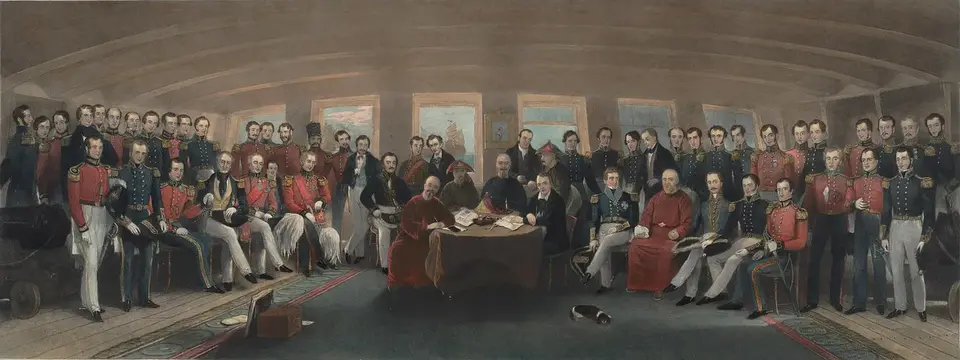
The Treaty of Nanjing (中英南京条约), also termed the Treaty of Nanking, signed on August 29, 1842 aboard the British 74-gun warship HMS Cornwallis anchored off Xiaguan near Nanjing, was the foundational unequal treaty of modern Chinese history. In July 1842, British expeditionary forces captured the Grand Canal junction of Zhenjiang, severing northern grain and tax supplies and sailing up the Yangtze River to train heavy naval broadsides upon the ancient city walls of Nanjing. Paralyzed by panic and fiscal exhaustion, the Daoguang Emperor granted Imperial Commissioners Qiying and Yilibu plenipotentiary authority to accept all British ultimatums without reservation. Comprising thirteen articles, the treaty forced China to cede Hong Kong Island in perpetuity, pay an exorbitant indemnity of 21 million silver dollars, abolish the Cohong merchant monopoly, and open five coastal ports—Guangzhou, Xiamen, Fuzhou, Ningbo, and Shanghai—to British residence and commerce. Crucially, it established the principle of 'conventional tariffs', stripping China of sovereign customs authority. Amplified by the 1843 Treaty of the Bogue which introduced consular extraterritoriality and most-favored-nation status, the Treaty of Nanking permanently shattered imperial China's historic isolation, inaugurating a century of national humiliation and transforming the empire into a semi-colonial and semi-feudal society.
On July 21, British forces capture Zhenjiang, cutting the Grand Canal and severing imperial supply lines.
In early August, HMS Cornwallis anchors at Xiaguan, training heavy artillery on the city walls.
From August 12 to 15, preliminary negotiations at Jinghai Temple result in total Qing capitulation.
On August 29, Qiying, Yilibu, and Pottinger sign the Treaty of Nanking aboard HMS Cornwallis.
On September 15, the Daoguang Emperor ratifies the treaty, designating it the 'Treaty of Eternal Peace.'
In July and October, the Supplementary Treaty of the Bogue grants consular jurisdiction and most-favored-nation status.
On June 26, ratifications are exchanged in Hong Kong, and Pottinger is inaugurated as the first Governor.
On July 21, 1842, British expeditionary forces stormed Zhenjiang, the strategic intersection of the Grand Canal and the Yangtze River. Despite heroic house-to-house resistance by sixteen hundred Manchu Banner troops under Lieutenant-General Hai Ling, the city fell. The seizure of Zhenjiang severed the vital economic artery connecting southern agricultural grain stores with Beijing, trapping the imperial capital in acute logistical starvation.
Following the capture of Zhenjiang, British warships sailed westward along the Yangtze unopposed, dropping anchor off Xiaguan outside Nanjing on August 4. Flanked by forty-eight armed vessels, Pottinger deployed artillery upon Lion Mountain, threatening an immediate bombardment unless all demands were accepted. Confronted with military collapse, the Daoguang Emperor dispatched Qiying and Yilibu with absolute authority to conciliate the British, accepting total surrender to halt the invasion.
In early August 1842, the Yangtze River estuary witnessed an unprecedented concentration of naval force. British Plenipotentiary and Expeditionary Commander Sir Henry Pottinger commanded a combined naval armada comprising dozens of Royal Navy first-rate ships of the line, steam-powered iron gunboats, and armed transports, sailing upriver from Zhenjiang to drop anchor off Xiaguan near Nanjing. The 74-gun flagship HMS Cornwallis led the battle line, training heavy artillery directly on the Yifeng and Zhongfu gates.
Nanjing was the historic administrative capital of Jiangnan's vast fiscal resources, yet its garrison was in a state of terminal collapse. Defending the ramparts were only seven thousand demoralized provincial soldiers with obsolete iron cannons possessing less than one-third the range of British naval guns. Landing marine units on Lion Mountain, Pottinger issued an uncompromising ultimatum: unless the Qing authorities surrendered and accepted all British financial and territorial terms without alteration, British artillery would level the ancient city on August 14.
During the standoff at Xiaguan, Pottinger applied relentless psychological pressure. Royal Navy gunboats continuously shifted positions along the river, firing blank charges day and night to test acoustic ranges and fortress elevations. British marines occupied Lion Mountain, raising the Union Jack and training field glasses on residential wards. Terrified by the spectacle, municipal authorities and wealthy merchants evacuated en masse, completely breaking the local administration's resolve before combat commenced.
Facing imminent bombardment, Viceroy of Liangjiang Niu Jian dispatched messengers under a flag of truce to plead for an extension. In Beijing, the Daoguang Emperor panicked, dreading that the loss of Nanjing would leave the interior provinces open to invasion. On August 6, the emperor issued urgent decrees granting Imperial Commissioners Qiying and Yilibu full plenipotentiary authority to negotiate a cessation of hostilities at all costs.
Having witnessed British firepower in Zhejiang, Qiying and Yilibu suffered from acute defeatism, resolving to capitulate rather than organize urban defenses. Reaching Nanjing, they suppressed local anti-British resistance and dispatched confidential aides Zhang Xi and Huang Entong aboard British warships. Presenting luxurious gifts, Chinese envoys informed Pottinger that the Qing court was prepared to yield to every British demand in exchange for an immediate ceasefire.
Throughout the negotiations, Qiying and Yilibu exhibited a profound lack of diplomatic resolve. Well aware that Chinese coastal artillery was technologically centuries behind Western naval ordnance, they made no effort to address military deficiencies, choosing instead to magnify British invulnerability to coerce Beijing into submission. In his correspondence with Pottinger, Qiying engaged in obsequious flattery, praising the British admiral as a 'true hero' and framing the surrender of sovereignty as imperial benevolence.
Before the formal treaty signing, Chinese and British delegates conducted three critical preliminary negotiating sessions at Jinghai Temple near the Shancha River in Xiaguan. Built by Ming Emperor Yongle to commemorate Admiral Zheng He's maritime expeditions, this historic temple ironically became the setting for the surrender of Chinese maritime sovereignty. On August 12, Huang Entong and Zhang Xi met British Chinese Secretary John Robert Morrison and Robert Thom to review the British draft.
The British delegation took a domineering stance, presenting a thirteen-article ultimatum drafted by Lord Palmerston and declaring that its core provisions were non-negotiable under threat of immediate bombardment. Although Chinese delegates raised minor objections regarding indemnity payment schedules and treaty port selections, British threats to terminate talks forced absolute submission, culminating on August 15 in total Qing acquiescence to all territorial, commercial, and tariff concessions.
The preliminary discussions at Jinghai Temple laid bare the absolute impotence of a declining empire before industrial gunboat diplomacy. Morrison and Thom were fluent in Mandarin and adept at exploiting Chinese bureaucratic timidity, repeatedly threatening to resume the bombardment whenever Chinese envoys hesitated. Chinese delegates Huang Entong and Zhang Xi conceded every territorial and financial point, begging merely for minor semantic adjustments while capitulating on all substantive matters of national sovereignty.
On August 29, 1842 (the twenty-fourth day of the seventh month of Daoguang), under sweltering skies, the signing ceremony convened aboard HMS Cornwallis. Royal Marines and Scottish Highland infantry lined the decks in ceremonial dress as the ship's band played martial anthems. At one o'clock in the afternoon, Imperial Commissioners Qiying, Yilibu, and Viceroy Niu Jian boarded the flagship.
In the Great Cabin, Pottinger sat at the center of the mahogany table while Morrison read the English and Chinese texts. Surrounded by British officers, the trembling Chinese plenipotentiaries affixed their signatures and imperial seals to the thirteen articles of the Treaty of Nanking. Pottinger signed for Great Britain. The Qing imperial dragon flag was raised alongside the Union Jack as a twenty-one gun salute boomed across the Yangtze, concluding the war in absolute imperial capitulation.
The signing ceremony aboard HMS Cornwallis was an orchestrated display of Western imperial dominance designed to humiliate the ancient empire. As Qiying affixed the imperial seals to the thirteen articles, hundreds of British sailors erupted into cheers along the decks. Pottinger raised a champagne glass in triumph, while the defeated Manchu grandees feigned composure amidst acute disgrace. The scene was commemorated in oil paintings by British artists, becoming an iconic symbol of the Victorian empire's subjugation of the Far East.
Article III of the Treaty of Nanking mandated the perpetual alienation of Chinese territory: 'It being obviously necessary and desirable that British subjects should have some port whereat they may careen and refit their ships... His Majesty the Emperor of China cedes to Her Majesty the Queen of Great Britain the Island of Hong Kong, to be possessed in perpetuity by Her Britannic Majesty, Her Heirs and Successors.'
Situated along the eastern Pearl River approaches, Hong Kong Island possessed Victoria Harbour, one of the finest natural deep-water anchorages in the world. British merchants and Charles Elliot had long coveted the island as an impregnable naval stronghold and free-trade entrepot for Far Eastern expansion. The diplomatic excuse of 'careening ships' was a transparent fiction designed to conceal naked territorial conquest, establishing a colonial enclave that sundered Chinese territorial integrity for over a century and a half.
The loss of Hong Kong permanently reconfigured the maritime geopolitics of East Asia. The British rapidly established Hong Kong as a free port, constructing military garrisons, deep-water drydocks, and merchant warehouses. The island was transformed from a barren fishing community into the primary naval stronghold and commercial entrepot of the British Empire in the Far East. In subsequent decades, Hong Kong served as the forward staging base for expeditionary invasions during the Second Opium War and the Sino-French War.
Articles IV through VII extorted a colossal financial indemnity totaling 21 million Spanish silver dollars (approximately 14.7 million Qing treasury taels). This sum encompassed three separate categories: six million dollars for the opium destroyed by Lin Zexu at Humen in 1839; three million dollars to settle debts owed by insolvent Cohong merchants; and twelve million dollars to cover the military expenses incurred by the British Crown in waging the war.
The treaty stipulated that payments be rendered in pure silver coin over four strict annual installments, levying a five percent annual interest penalty on overdue accounts. Equal to more than one-third of the Qing state's total annual budget, this indemnity placed a ruinous fiscal burden on the Chinese people, forcing the imperial treasury to levy surcharges across the provinces and causing severe currency depreciation.
The extortionate 21-million-dollar indemnity drained late Qing public finances for generations. With imperial vaults exhausted by the war, the Ministry of Revenue imposed heavy fiscal quotas upon Jiangsu, Zhejiang, and Guangdong, passing the burden directly onto the peasant land tax and salt gabelle. The resulting silver drain doubled domestic currency conversion rates, bankrupting rural smallholders and creating the desperate socioeconomic conditions that fueled the Taiping Rebellion.
Article II of the treaty abolished the century-old 'Canton System' of foreign trade, opening five coastal cities to British residence and commerce: Guangzhou, Xiamen, Fuzhou, Ningbo, and Shanghai. British subjects and their dependents were granted the legal right to reside without molestation, establish commercial factories, and construct warehouses.
These five ports represented the commercial core of southeastern China: Guangzhou anchored historic trade with Southeast Asia; Xiamen controlled the Taiwan Strait; Fuzhou commanded the inland tea districts of the Min River; Ningbo dominated Zhejiang commerce; and Shanghai occupied the confluence of the Grand Canal and the Yangtze River. The opening of these treaty ports dismantled China's protective maritime cordon, allowing Western commercial capital to penetrate deeply into the domestic economy.
The opening of the five treaty ports dissolved the traditional spatial barriers of feudal China. Thanks to its position at the mouth of the Yangtze River, Shanghai rapidly surpassed Guangzhou within a decade to become China's premier commercial metropolis. Western merchant houses, foreign consulates, and banks proliferated along the Bund, while foreign steamships operated along coastal routes with total impunity, collapsing the traditional maritime defense network.
Article V eliminated the guild monopoly of the Cohong merchants in Guangzhou: 'The Emperor of China agrees to abolish that practice, which has hitherto existed at Canton, of obliging British merchants to deal only with the licensed Hong merchants; and Her Britannic Majesty's subjects shall be permitted to carry on their mercantile transactions with whatever persons they please.'
Established under Emperor Qianlong, the Cohong guild held exclusive monopolies over foreign export commodities, managed customs duties, and served as diplomatic intermediaries between foreign traders and imperial magistrates. By terminating this institutional barrier, British merchants gained direct access to Chinese domestic producers and independent compradors, depriving the Qing government of its traditional regulatory oversight over maritime trade.
The abolition of the Cohong monopoly dismantled the historic institutional firewall that had shielded domestic markets from direct foreign penetration. Bankrupting the hereditary merchant dynasties of Guangzhou, the clause empowered a new class of domestic compradors who acted as commercial brokers for Western firms. These compradors facilitated the inland distribution of foreign manufactures and the extraction of tea and silk, profoundly restructuring the socioeconomic landscape of southeastern China.
Article X established the fatal principle of 'conventional tariffs' (xie ding guan shui): 'His Imperial Majesty agrees to establish at all the ports open to British merchants a fair and regular tariff of export and import customs, and other dues, which tariff shall be publicly notified and promulgated for general information.'
Tariff autonomy is an inalienable right of sovereign states to protect domestic industries through independent duty rates. Under this article, the Qing government forfeited the legal authority to adjust customs duties without the explicit concurrence of the British Crown. In subsequent tariff schedules, Chinese import duties were pegged at a nominal five percent ad valorem, leaving the country with one of the lowest customs barriers in the world and exposing nascent domestic handicraft industries to devastating competition from cheap foreign machine-made textiles.
The conventional tariff clause inflicted fatal damage upon China's economic sovereignty by stripping the state of its natural right to protect infant domestic industries through protective duties. In subsequent tariff schedules, import duties on foreign cotton textiles were pegged at a nominal five percent ad valorem, while transit dues were minimized. This exposed domestic peasant cottage industries to devastating competition from British industrial mills, driving millions of rural weavers into ruin.
Article XI transformed the ceremonial protocols governing official correspondence between the two empires: 'It is agreed that Her Britannic Majesty's Chief High Officer in China shall correspond with the Chinese High Officers, both at the capital and in the provinces, under the term "Communication" [zhaohui]; the Subordinate British Officers and Chief Chinese High Officers shall correspond under the terms "Statement" [shenchen] and "Declaration" [yihui].'
Under the traditional East Asian tributary matrix, the Qing Emperor reigned as the universal Son of Heaven, treating all foreign monarchs as outer barbarians required to submit humble petitions and perform the full kowtow. The Treaty of Nanking abolished this tributary nomenclature, compelling imperial viceroys to treat British plenipotentiaries as diplomatic equals. While ending archaic diplomatic condescension, the clause signaled the violent overthrow of the traditional East Asian international order by Western gunboat diplomacy.
The clause mandating official diplomatic equality superficially mirrored modern international protocols, yet operated as a vehicle for imperialist hegemony. For centuries, the Qing court had maintained an anachronistic tributary delusion of universal supremacy; Britain violently shattered this matrix through gunboat warfare, compelling imperial viceroys to treat Western envoys as sovereign equals. This enforced parity legitimized coercive diplomatic ultimatums, opening China to direct diplomatic intimidation.
Articles VIII and IX demanded the unconditional release of all British military prisoners and granted sweeping legal amnesty to Chinese subjects who had assisted British forces. The Qing government was compelled to repatriate all captured British soldiers, naval ratings, and Indian sepoys without delay.
More humiliatingly, Article IX mandated: 'The Emperor of China agrees to publish and proclaim an entire amnesty and act of oblivion to all Chinese subjects who may have resided with, or have had dealings with, or may have entered the service of, Her Britannic Majesty of British subjects.' This provision deprived Chinese judicial authorities of jurisdiction over domestic spies, smugglers, and collaborators who had facilitated the British invasion, establishing an insulting precedent of foreign diplomatic protection for domestic treason.
The amnesty clause provoked widespread domestic moral outrage by granting immunity to treasonous elements. During the war, numerous local smugglers and collaborators had served British naval forces as harbor pilots, spies, and provisioning agents. The treaty barred Qing judicial magistrates from prosecuting these individuals, granting foreign diplomatic protection to domestic collaborators and fatally compromising the moral authority of the imperial legal code.
Article XII institutionalized the strategic occupation of Chinese territory as collateral for financial compliance: 'The British forces will hold the Islands of Chusan [Dinghai] and Kulangsu [Gulangyu] until the whole amount of the indemnity shall have been paid, and until all the treaty ports shall have been opened to British merchants.'
Under this clause, British garrison troops occupied Dinghai—guarding the southern approaches to the Yangtze—and Gulangyu in Xiamen for nearly four years. These fortified naval footholds functioned as an ever-present sword hanging over the Qing court, ensuring that Beijing would not repudiate treaty concessions and forcing imperial magistrates to expedite indemnity remittances.
The four-year military occupation of Dinghai and Gulangyu functioned as coercive territorial collateral to guarantee indemnity payments. Positioned at the entrances to the Yangtze River and the Taiwan Strait, these fortified islands served as constant operational springboards for British gunboats. Constrained by the presence of foreign garrisons on domestic soil, the Qing administration was forced to remit indemnity installments with punctual subservience.
Following the signing of the Treaty of Nanking, British negotiators moved swiftly to formalize secondary privileges. In July and October 1843, Qiying and Pottinger concluded the General Regulations for Foreign Trade and the Supplementary Treaty of the Bogue (Humen Tiaoyu).
In the Treaty of the Bogue, Great Britain secured 'consular jurisdiction' (extraterritoriality): British subjects accused of civil or criminal offenses in China were tried solely by British consular courts according to British law, entirely exempt from Chinese magistrates. This infringed upon Chinese judicial sovereignty, granting foreign nationals de facto legal immunity on Chinese soil and undermining the territorial authority of the imperial legal code.
The formalization of consular jurisdiction in the 1843 Treaty of the Bogue fractured Chinese judicial sovereignty. Under extraterritoriality, British subjects committing crimes in treaty ports—including smuggling, assault, and homicide—were immune from arrest and trial by Chinese magistrates, answerable solely to British consular courts. British consuls routinely exonerated their countrymen, establishing a privileged regime of foreign legal immunity on Chinese territory.
The Treaty of the Bogue also introduced the 'unilateral most-favored-nation' clause: 'If the Emperor shall hereafter grant any new privileges or immunities to other foreign nations, the same shall be enjoyed by British subjects in common with others.' This unilateral mechanism enabled Britain to automatically harvest every concession extorted by other Western powers without offering reciprocal benefits to China.
Furthermore, the supplementary treaty allowed foreign merchants to lease land and construct residences within designated port districts. In 1845, British Consul George Balfour and Shanghai Daotai Gong Mujiu formulated the Shanghai Land Regulations, carving out the first foreign 'concession' in modern Chinese history. These enclaves evolved into independent jurisdictions operating beyond Chinese administrative law, serving as forward bases of imperialist commercial expansion.
The unilateral most-favored-nation clause turned Great Britain into an automatic beneficiary of every future imperialist predation. Whenever other Western powers extorted new privileges—such as naval basing or missionary rights—Britain harvested identical concessions without reciprocal compensation. Coupled with the creation of foreign concessions in Shanghai, this established independent colonial enclaves operating entirely outside Chinese administrative sovereignty.
Dispatched by express courier from Xiaguan, the text of the Treaty of Nanking reached the Forbidden City in early September. Confronted with treasury deficits and military collapse, the Daoguang Emperor formally ratified the treaty with the vermilion pencil on September 15, 1842, self-deludingly hoping that total capitulation would 'extinguish hostilities forever' and naming it the 'Treaty of Eternal Peace.'
On June 26, 1843, Qiying and Pottinger exchanged ratified treaty copies in Hong Kong. On that day, Pottinger was formally inaugurated as the first British Governor of Hong Kong. The capitulatory peace purchased by the Qing court proved fleeting: within fifteen years, British and French imperialists launched the Second Opium War to extract further concessions, proving that appeasement only invited escalated colonial predation.
The Daoguang Emperor's uncritical ratification of the treaty reflected the profound delusion of the Qing ruling elite. Comforting himself with the vain belief that the 'Treaty of Eternal Peace' had settled foreign troubles forever, Daoguang ordered the pact archived and avoided further military introspection. The dynasty squandered two vital decades of peace, failing to reform its institutions until the Second Opium War inflicted another catastrophic military defeat.
The enforcement of the Treaty of Nanking inflicted catastrophic economic trauma upon late Qing society. The outflow of 21 million dollars in reparations, coupled with the unchecked expansion of foreign opium trafficking, drained over ten million taels of silver from China annually. The resulting monetary crisis caused silver prices to double against domestic copper coinage, effectively doubling the real tax burdens borne by ordinary agricultural households.
Across the five treaty ports, British factory-spun cotton yarn flooded coastal markets, undermining rural household spinning and dislocating hand-loom weavers. Thousands of river boatmen, porters, and transport laborers along the traditional overland routes through Jiangxi were thrown into destitution as trade shifted to maritime steamers. Crushed by fiscal extortions and bureaucratic corruption, millions of impoverished peasants turned to rebellion, providing the combustible social foundation that erupted in the Taiping Heavenly Kingdom uprising in 1851.
The macroeconomic dislocations catalyzed by the Treaty of Nanking ultimately recoiled upon the dynasty with revolutionary fury. The combination of indemnity payments and unchecked opium trafficking drained over ten million taels of silver annually, destabilizing the rural economy. In Guangxi, Guangdong, and Hunan, millions of displaced boatmen, miners, and impoverished peasants mobilized under Hong Xiuquan's God-Worshipping Society, launching the massive Taiping Rebellion just eight years after the treaty's signature.
The Treaty of Nanking and its supplementary conventions shattered China's status as a sovereign, self-governing empire. The cession of Hong Kong fractured territorial integrity; the 21-million-dollar indemnity drained the national treasury; the opening of the five treaty ports embedded foreign enclaves along the coast; conventional tariffs stripped the state of economic self-defense; and consular extraterritoriality placed foreigners above Chinese law. China was relegated across political, judicial, fiscal, and diplomatic dimensions to a semi-colonial vassal of Western capitalism.
Following the treaty, foreign industrial commodities flooded the coastal markets under the umbrella of low tariffs. Machine-made textiles undersold hand-spun cotton across the southern provinces, driving millions of peasant artisans into destitution and dissolving the self-sufficient agrarian economy. Concurrently, a domestic comprador class arose in Shanghai and Guangzhou, serving as middleman agents for foreign merchant houses in extracting raw materials and distributing foreign manufactures, profoundly reshaping Chinese class dynamics.
The Treaty of Nanking represents the definitive structural turning point in modern Chinese history. It shattered China's historical seclusion, violently integrating an independent empire into the global colonial order dominated by Western capitalism. Deprived of sovereign legal and economic autonomy while retaining a decadent feudal monarchy, China entered the painful, century-long historical epoch of a semi-colonial and semi-feudal society.
In The Chinese Revolution and the Chinese Communist Party, Mao Zedong observed: "From the Opium War of 1840 to the Eight-Nation Alliance invasion of 1900, the imperialist powers forced China to sign a series of unequal treaties. The Treaty of Nanking, signed after the First Opium War, was the beginning of these unequal treaties, gradually transforming China from an independent feudal state into a semi-colonial and semi-feudal country."
The modern Chinese historian Fan Wenlan wrote in History of Modern China: "The Treaty of Nanking was a capitulatory contract in which the Manchu court surrendered national sovereignty to preserve its decaying throne. The cession of Hong Kong, the vast indemnity, the treaty ports, and tariff surrenders were paid for in the blood of the Chinese people. It tore away the illusion of imperial grandeur, opening a century of national humiliation."
The historian John King Fairbank remarked in The Cambridge History of China: "The Treaty of Nanking established the 'treaty system', the foundational matrix through which Western powers dominated China for a century. It was not merely a military conclusion, but a legal architecture of imposed privileges that forcibly integrated China into the modern international system on deeply humiliating terms."