Chronological Benchmark
Construction of the Baqiao tomb; hemp fiber Baqiao Paper is interred as padding for a bronze mirror.
Eastern Han Dynasty (东汉) · HISTORICAL EVENT
灞桥纸与造纸源流
Baqiao Paper and the Origins of Papermaking (灞桥纸与造纸源流) designates the landmark 1957 archaeological excavation of the world's oldest surviving paper specimen—Baqiao Paper—in an early Western Han tomb in Xi'an, and the subsequent scientific revolution in understanding the chronological genesis, technological evolution, and historical role of Cai Lun in ancient Chinese papermaking. For nearly two millennia, classical Chinese records such as Fan Ye's *Book…
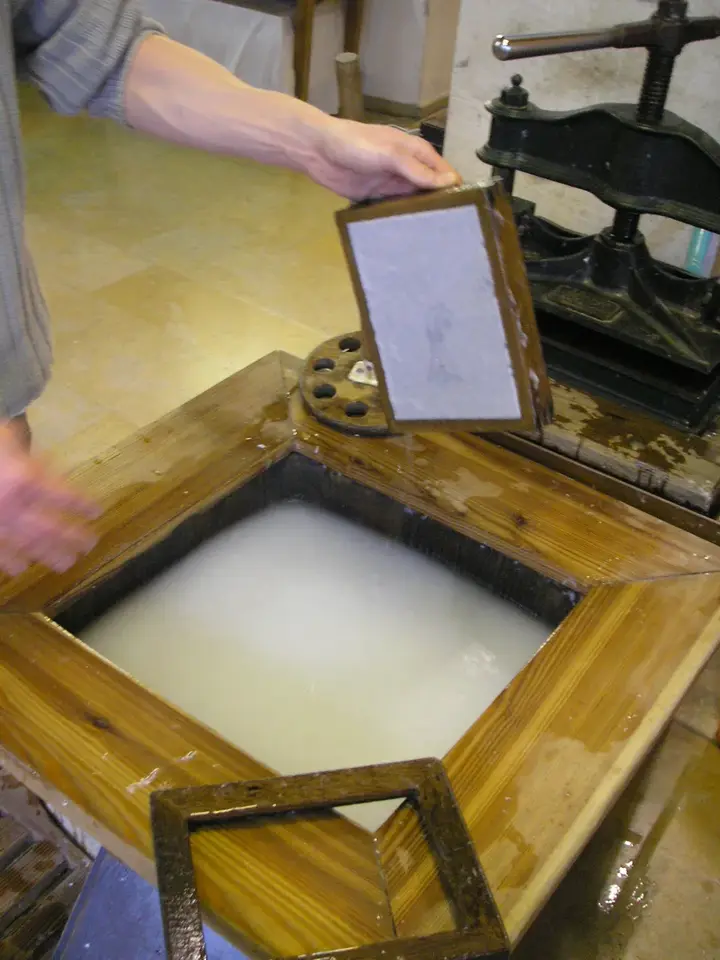
Baqiao Paper and the Origins of Papermaking (灞桥纸与造纸源流) designates the landmark 1957 archaeological excavation of the world's oldest surviving paper specimen—Baqiao Paper—in an early Western Han tomb in Xi'an, and the subsequent scientific revolution in understanding the chronological genesis, technological evolution, and historical role of Cai Lun in ancient Chinese papermaking. For nearly two millennia, classical Chinese records such as Fan Ye's Book of the Later Han attributed the invention of paper exclusively to the eunuch official Cai Lun in 105 CE, asserting that true paper emerged only when he presented improved sheets to Emperor He of Han. In May 1957, archaeologists excavating a Western Han tomb dating to the reign of Emperor Wu (circa 140-118 BCE) at Baqiao near Xi'an uncovered a corroded bronze mirror cushioned by several layers of plant fiber sheets. Microscopic examination revealed they were manufactured from beaten hemp and ramie fibers, creating a sensation in international science history. Supported by subsequent discoveries of Western Han paper at Juyan, Xuanquanzhi, and Fangmatan, historians established that ordinary Chinese artisans invented plant fiber paper during the early Western Han, while Cai Lun's enduring historical contribution lay in standardizing industrial production, utilizing tree bark and rags, and promoting paper as a universal writing medium.
Construction of the Baqiao tomb; hemp fiber Baqiao Paper is interred as padding for a bronze mirror.
Western Han folk papermaking advances, yielding cartographic and inscribed paper found across Gansu.
Chamberlain Cai Lun presents refined bark-and-net paper to Emperor He of Han, achieving imperial adoption.
Archaeologist Huang Wenbi uncovers the first Western Han hemp paper fragment in Xinjiang.
Ancient hemp fiber sheets are recovered from the Western Han tomb at Baqiao, Xi'an.
Chinese Academy of Sciences confirms Baqiao Paper as genuine artificially manufactured plant fiber paper.
Excavation of an inked paper map at Fangmatan, Gansu, proving practical Western Han cartographic use.
Hundreds of Western Han written paper slips are excavated near Dunhuang, cementing academic consensus.
Prior to the proliferation of paper, ancient Chinese scribes recorded official annals and administrative decrees upon heavy bamboo slips, wooden tablets, and costly woven silk fabrics. In the Book of the Later Han, historian Fan Ye recorded: "From antiquity, documents were predominantly written on bamboo slips, while those written on silk were termed paper. Silk was expensive and bamboo heavy, proving inconvenient. Cai Lun conceived the idea of using tree bark, hemp waste, worn rags, and fishing nets to make paper. In the first year of Yuanxing, he presented it to the throne. The Emperor commended his ability, and thereafter it came into universal use, wherefore the world termed it Marquis Cai's Paper." For centuries, this authoritative chronicle cemented the global perception that paper was invented ex nihilo by Cai Lun in the early second century CE.
In the early twentieth century, pioneering desert archaeology across northwestern China unearthed organic artifacts preserved in hyper-arid soils. In 1933, archaeologist Huang Wenbi excavated coarse hemp paper fragments at a Han beacon tower in Lop Nor, Xinjiang, dating to the reign of Emperor Xuan of Han. However, due to a lack of precise chemical and microscopic testing methods at the time, international scholars remained skeptical regarding whether plant fiber paper genuinely predated the Eastern Han. Conclusive physical proof demanded unambiguous tomb stratigraphy and rigorous scientific fiber verification.
On May 8, 1957, workers digging foundations at a municipal brickworks in Baqiao Town, east of Xi'an, uncovered an ancient brick-chambered tomb. Archaeologists from the Shaanxi Provincial Cultural Relics Management Committee conducted an emergency salvage excavation. By evaluating the tomb's architectural masonry, earthenware burial figurines, and bronze coinage (specifically Western Han Ban Liang and early Wu Zhu coins), experts firmly dated the burial to the early reign of Emperor Wu of Han, between 140 and 118 BCE.
While examining the funerary furnishings beside the deceased, excavators lifted an oxidized bronze mirror. Beneath the mirror lay a thin, fibrous padding. Upon delicate cleaning, researchers revealed multiple overlapping layers of brownish-yellow sheets exhibiting distinct intertwined fiber meshes. The largest fragment measured approximately ten centimeters in width and length, retaining remarkable softness and flexibility. The specimen was transferred to the Chinese Academy of Sciences for forensic analysis and formally cataloged as Baqiao Paper.
Following the discovery, eminent historians of technology, including Professor Pan Jixing, subjected samples of Baqiao Paper to rigorous metallographic microscopy, polarizing optical analysis, and chemical reagent tests. The laboratory examination revealed that the sheets consisted of intentionally mashed, interwoven single fibers of Cannabis sativa (hemp) and Boehmeria nivea (ramie). The surface exhibited clear evidence of mechanical pressing and water-slurry felting. This proved scientifically that Baqiao Paper was not a felted residue of silk cocoon waste, but genuine, artificially processed vegetable fiber paper created through soaking, cutting, pounding, and screen-lifting.
The discovery precipitated intense scholarly debate over the subsequent two decades. Skeptics, including scholar Qu Wanli, questioned whether the fragile sheets were suitable for writing or whether they might represent later Eastern Han intrusions caused by tomb looting.
These doubts were systematically resolved by a succession of corroborating archaeological discoveries: in 1973, Western Han hemp paper was found at the Jian Shui Jin Guan beacon site in Juyan; in 1978, early Han paper was unearthed at Zhongyan Village in Fufeng; in 1986, a paper map depicting mountains and rivers dating to the Wen-Jing era was recovered from a tomb at Fangmatan, Gansu; and between 1990 and 1992, hundreds of inked Western Han paper slips were unearthed at the Xuanquanzhi postal station near Dunhuang. This chain of physical evidence settled the academic controversy, confirming that Chinese artisans had mastered papermaking early in the second century BCE.
Through the systematic examination of Baqiao Paper and its companion artifacts, historians reached a definitive consensus regarding the genesis of papermaking: China was the undisputed birthplace of paper, with primitive techniques emerging in the early Western Han Dynasty (2nd century BCE). The technological discovery originated organically among washerwomen who observed silk fibers adhering to washing screens, inspiring artisans to substitute cheap hemp fibers to pound into pulp and mold into sheets. Baqiao Paper represents the earliest surviving material manifestation of this nascent technological stage.
Within this historical framework, Eastern Han Chamberlain Cai Lun was not the sole inventor of paper, but rather a brilliant technological reformer and industrial modernizer. Drawing upon centuries of folk experimentation, Cai Lun utilized imperial workshop facilities to introduce varied, cost-effective raw materials such as mulberry bark, worn clothing, and discarded fishing nets. By refining boiling, pulping, and bleaching methods, Cai Lun drastically reduced manufacturing expenses while enhancing sheet strength, whiteness, and ink absorption, transforming paper from a crude packaging material into the primary recording medium of imperial civilization.
The excavation and scientific authentication of Baqiao Paper constituted an epochal milestone in world technological historiography. It dismantled the entrenched belief in a single genius inventor, pushing back the verified history of human plant-fiber papermaking by more than two hundred years to the second century BCE. It demonstrated that papermaking evolved through continuous empirical experimentation by ordinary working artisans across generations, restoring historical truth to technological evolution.
The comprehensive tracing of papermaking origins established a continuous evolutionary lineage: from textile rinsing in the Warring States, to coarse hemp sheets in the Western Han, to Cai Lun's refined bark paper in the Eastern Han, and onward to full maturation during the Six Dynasties and Tang Dynasty. As the most consequential of the Four Great Inventions of ancient China, paper spread along the Silk Road to the Islamic world and Europe, replacing cumbersome clay tablets, fragile papyrus, and expensive parchment, functioning as the premier material catalyst for the renaissance of global knowledge and literacy.