Domestic Pacification
The suppression of the Three Feudatories frees Qing military attention to focus on Russian border incursions.
Qing Dynasty (清朝) · HISTORICAL EVENT
雅克萨之战
The Battles of Albazin (雅克萨之战) occurred from 1685 to 1686 (the twenty-fourth and twenty-fifth years of the Kangxi reign), representing a series of defensive military counterattacks undertaken by the Qing Empire to repel the colonial expansion of Tsarist Russian Cossack forces in the Amur River basin. In the mid-seventeenth century, Russian adventurers crossed the Stanovoy Mountains, seized the native Daur settlement of Yaksa on the northern bank of…
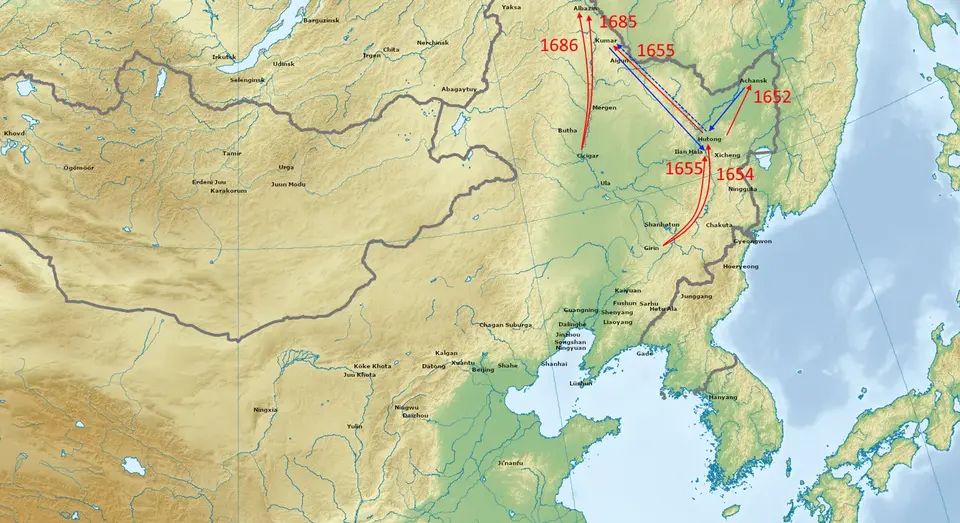
The Battles of Albazin (雅克萨之战) occurred from 1685 to 1686 (the twenty-fourth and twenty-fifth years of the Kangxi reign), representing a series of defensive military counterattacks undertaken by the Qing Empire to repel the colonial expansion of Tsarist Russian Cossack forces in the Amur River basin. In the mid-seventeenth century, Russian adventurers crossed the Stanovoy Mountains, seized the native Daur settlement of Yaksa on the northern bank of the Amur River, and erected a fortified wooden stockade known as Albazino to collect fur tributes by force. After extinguishing the Revolt of the Three Feudatories and restoring administration over Taiwan, the Kangxi Emperor directed frontier preparations by establishing the Military Governorship of Heilongjiang, constructing Aigun fortress, and deploying heavy Dutch-designed bronze cannons (Shenwei Wudi Dajiangjun). In 1685, General Pengchun and General Sabsu launched the initial siege, battering the palisades and compelling Cossack commander Aleksei Tolbuzin to surrender and withdraw to Nerchinsk. When Tolbuzin reoccupied and reinforced the fortress with modern bastion ramparts later that year, Sabsu conducted a second siege in 1686, neutralizing river logistics and killing Tolbuzin with artillery fire. Beset by starvation and scurvy, the surviving garrison faced imminent annihilation, prompting Moscow to request an armistice. The Qing victory checked Russian expansion in the Far East and led directly to the 1689 Treaty of Nerchinsk, which formally established the eastern frontier between the two empires.
The suppression of the Three Feudatories frees Qing military attention to focus on Russian border incursions.
The Qing establishes the Military Governorship of Heilongjiang at Aigun, deploying waterborne forces and artillery.
Pengchun and Sabsu breach the fortress walls with heavy artillery, prompting Tolbuzin to surrender and withdraw.
Tolbuzin returns with reinforcements, constructing modern bastion earthworks on the ruins of Albazin.
Sabsu blockades Albazin and kills Tolbuzin with cannon fire, reducing the garrison through siege and disease.
The signing of the Treaty of Nerchinsk concludes border hostilities and codifies Qing sovereignty over the Amur basin.
During the early seventeenth century, Tsarist Russian pioneers and Cossack bands expanded rapidly across Siberia toward the Pacific Ocean. During the Shunzhi reign, expeditions commanded by figures such as Yerofey Khabarov crossed the Outer Khingan Mountains (Stanovoy Range) and penetrated the fertile Amur River valley. Russian detachments occupied Yaksa, an ancestral stronghold of the indigenous Daur chieftain Albasi, pillaging native villages, levying fur tributes, and establishing the fortified redoubt of Albazino. Preoccupied with securing the Central Plains, suppressing Southern Ming remnants, and consolidating control over domestic populations, the early Qing court was unable to commit significant military resources to the far northeast, permitting Russian garrisons to remain entrenched along the Amur for several decades.
In 1681, the Qing dynasty suppressed the Revolt of the Three Feudatories, followed in 1683 by the submission of the Zheng regime on Taiwan, restoring internal peace. The Kangxi Emperor turned his attention toward securing northern borderlands, conducting personal inspection tours of Shengjing (modern Shenyang) and Jilin. He dispatched Deputy Lieutenant-General Langtan to survey terrain along the Amur and instituted the Military Governorship of Heilongjiang, appointing veteran Sabsu as its first governor. At Aigun, the Qing built an advanced base, constructed transport barges in Jilin, recruited elite Solon and Daur horse-archers and Fujian rattan-shield infantry, and deployed European-cast heavy bronze cannons designed under the supervision of Ferdinand Verbiest, accumulating three years of provisions.
In the fourth month of 1685, the Kangxi Emperor ordered the expeditionary forces forward. Commander Pengchun, Langtan, and Military Governor Sabsu advanced along the Amur from Aigun with over three thousand Manchu, Mongol, Han Banner, and Solon troops, supported by naval barges and artillery. On June 23, the Qing river vanguard intercepted a Russian relief flotilla on the river, neutralizing dozens of enemy troops. By June 24, Qing field forces completed the encirclement of Albazin, throwing up artillery batteries and digging communication trenches.
At dawn on June 25, Qing artillery opened a synchronized bombardment against the wooden fortifications. Cannon fire smashed the parapets and ignited structural fires within the compound, killing over one hundred Russian defenders. Recognizing the hopelessness of continued resistance, Russian commandant Aleksei Tolbuzin raised a white flag, petitioning for permission to evacuate his surviving force to Nerchinsk. In accordance with imperial directives promoting conciliation, Pengchun permitted the garrison to withdraw with personal effects after swearing not to return, subsequently leveling the timber fortifications before returning south to winter quarters.
Upon reaching Nerchinsk, Tolbuzin met reinforcements from Moscow, reneged on his sworn pledge, and returned to Albazin in late 1685 with over eight hundred well-armed Cossacks. Drawing upon European military architecture, the Russians rebuilt the stronghold as an earthen-bastion citadel with subterranean bombproof shelters. Informed of the reoccupation, the Kangxi Emperor ordered an immediate counter-offensive in early 1686. In the summer of that year, Military Governor Sabsu returned to the walls of Albazin with over two thousand seasoned troops.
Adopting a strategy of protracted siege and artillery bombardment, Qing forces dug circumvallation ditches south and east of the fortress, mounting continuous artillery fire against the bastions. In July, Qing gunners scored a direct hit on the battlements, mortally wounding Tolbuzin. Command passed to Prussian mercenary officer Afanasy Beyton, who retreated into underground redoubts. Qing naval and land patrols blockaded the river and overland routes, cutting off external foraging and water supplies. As winter set in, scurvy and frostbite devastated the besieged garrison. Of the original eight hundred defenders, fewer than one hundred survived. Acknowledging tactical collapse, the Russian regency petitioned the Qing court for peace, prompting Emperor Kangxi to order an armistice in early 1687.
The Battles of Albazin concluded with a decisive Qing victory. Qing forces eliminated the forward expeditionary forces of Tsarist Russia in the Amur basin and destroyed the Albazin fortress, ending three decades of Cossack encroachment. The military defeat convinced Russian regents Sophia Alekseyevna and Peter I to pursue diplomatic resolution.
The conflict represented the Qing Empire's first successful defense against early modern Western colonial expansion. Militarily, it protected native Tungusic populations and preserved imperial sovereign integrity along northern frontiers. Diplomatically, it produced the Treaty of Nerchinsk in 1689, which demarcated the eastern border along the Stanovoy Range and the Argun River. By anchoring Qing sovereignty over the Amur and Ussuri basins, including Sakhalin Island, the settlement ensured security throughout Northeast China for more than a century and a half.