Supreme Naval Command
The Kangxi Emperor appoints Shi Lang as Fujian Naval Commander to oversee operations against Taiwan.
Qing Dynasty (清朝) · HISTORICAL EVENT
施琅统一台湾
Shi Lang's Unification of Taiwan (施琅统一台湾) was an epochal naval campaign in 1683 (the 22nd year of the Kangxi reign) during which Fujian Naval Commander Shi Lang led the Qing imperial fleet across the Taiwan Strait to extinguish the separatist Ming Zheng regime and reunite Taiwan with mainland China. In 1661, Ming loyalist Zheng Chenggong (Koxinga) expelled Dutch colonizers to recover Taiwan, establishing it as an anti-Qing redoubt. After subduing the…
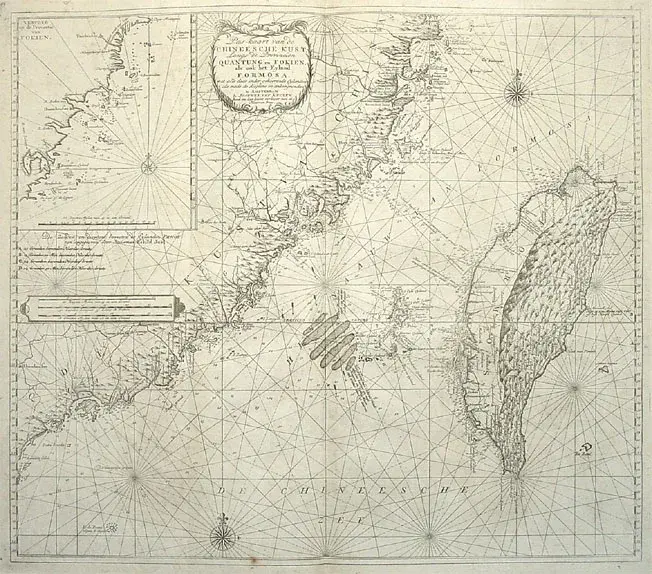
Shi Lang's Unification of Taiwan (施琅统一台湾) was an epochal naval campaign in 1683 (the 22nd year of the Kangxi reign) during which Fujian Naval Commander Shi Lang led the Qing imperial fleet across the Taiwan Strait to extinguish the separatist Ming Zheng regime and reunite Taiwan with mainland China. In 1661, Ming loyalist Zheng Chenggong (Koxinga) expelled Dutch colonizers to recover Taiwan, establishing it as an anti-Qing redoubt. After subduing the Revolt of the Three Feudatories, the Kangxi Emperor pursued peaceful conciliation, but the Zheng leadership refused submission and raided southeastern coastal prefectures. Supported by Fujian Governor-General Yao Qisheng, the emperor appointed maritime veteran Shi Lang as Admiral of the Fujian Navy. In July 1683, Shi Lang led 21,000 naval troops and 238 warships from Tongshan toward the Penghu Archipelago. Utilizing the southeastern monsoon and innovative tactical naval formations, Shi Lang annihilated the Ming Zheng naval vanguard under Liu Guoxuan, destroying nearly two hundred enemy warships. Following the loss of Penghu, Zheng Keshuang surrendered in August 1683. Shi Lang prevented civilian looting, paid homage at Zheng Chenggong's ancestral shrine, and submitted his famous Memorial on Retaining Taiwan, persuading the court to formally establish Taiwan Prefecture under Fujian Province. This victory eliminated the final maritime secessionist stronghold and solidified Qing coastal territorial sovereignty.
The Kangxi Emperor appoints Shi Lang as Fujian Naval Commander to oversee operations against Taiwan.
Shi Lang constructs over two hundred warships in Xiamen, selecting the summer southeast monsoon for the crossing.
Shi Lang sets sail from Dongshan with 238 warships and 21,000 naval troops.
The Qing vanguard probes Magong; Shi Lang is wounded in the eye, withdrawing to Xiyu to regroup.
Deploying the five-plum-blossom formation, the Qing navy destroys nearly two hundred Zheng vessels; Liu Guoxuan flees.
Shi Lang prohibits executions, distributes food to islanders, and releases captives to undermine Taiwanese resistance.
Zheng Keshuang submits formal surrender memorials and territorial registers to Shi Lang in Penghu.
Shi Lang lands at Anping, receives the surrender of Zheng Keshuang, and pays respects at Zheng Chenggong's shrine.
Shi Lang submits his treatise arguing against evacuation and demonstrating Taiwan's strategic indispensability.
The court establishes Taiwan Prefecture under Fujian Province, stationing imperial garrisons to safeguard the territory.
In 1661 (Shunzhi 18), Ming loyalist commander Zheng Chenggong led a maritime expedition across the Taiwan Strait, defeating the Dutch East India Company to liberate Taiwan after thirty-eight years of colonial occupation. Zheng established Chengtian Prefecture, organized agrarian military colonization, and anchored Han civil society across the island. Following Koxinga's death, his son Zheng Jing inherited the princely title of Yanping.
Occupied with suppressing internal rebellions and Ming remnant forces on the mainland, the early Qing court initially lacked naval power to assault Taiwan. To isolate the Zheng regime commercially, the court enacted devastating coastal evacuation edicts, forcing coastal populations inland. While inflicting severe misery on coastal communities, these bans failed to eliminate Ming Zheng maritime naval predominance.
Between 1673 and 1681, the Qing Empire engaged in suppressing the Revolt of the Three Feudatories. Zheng Jing exploited the conflict to land armies in Fujian, seizing Xiamen, Jinmen, Quanzhou, and Zhangzhou. However, with the defeat of the Three Feudatories, imperial armies turned eastward, crushing Zheng forces in coastal battles and compelling Zheng Jing to evacuate back to Taiwan in 1680.
In 1681, Zheng Jing died in Taiwan, triggering violent internal succession strife. Courtier Feng Xifan and royal kin executed regent Zheng Kezang, enthroning twelve-year-old Zheng Keshuang as a figurehead while monopolizing military power alongside General Liu Guoxuan. Compounding political illegitimacy, consecutive crop failures and inflation destabilized the island.
Recognizing the strategic window, the Kangxi Emperor attempted diplomatic conciliation, offering generous hereditary titles. However, the Zheng regime demanded autonomous tributary status modeled on Joseon Korea, demanding to keep their hair, refuse imperial uniforms, and preserve autonomous borders. The court terminated negotiations and prepared for military intervention.
Fujian Governor-General Yao Qisheng repeatedly petitioned the throne to appoint veteran commander Shi Lang: "Only Shi Lang possesses profound maritime mastery to subjugate the islands." Formerly an officer under Zheng Chenggong, Shi Lang defected to the Qing after his family was executed in internal feuds, dedicating his life to maritime strategy. Overcoming skepticism regarding Shi Lang's prior loyalties, the Kangxi Emperor appointed him Fujian Naval Commander in August 1681 to direct the naval expedition.
Arriving in Fujian, Shi Lang overhauled the dilapidated provincial navy. Over two years, he drilled twenty-one thousand seasoned sailors, repaired deep-sea bird-vessels and war-junks, and mounted heavy European cannons and incendiary devices, establishing clear naval artillery superiority over the Zheng fleet.
Strategically, while conventional commanders favored advancing during autumn northwest monsoons, Shi Lang insisted on attacking during the summer southeast monsoon. He reasoned that violent autumn typhoons caused shipwrecks in Penghu's coral reefs, whereas gentle summer south winds allowed the Qing fleet to hold the windward advantage, storming the southern anchorages of Penghu directly. The Kangxi Emperor endorsed the plan, granting Shi Lang absolute field authority.
On July 8, 1683 (the fourteenth day of the sixth month of Kangxi 22), Shi Lang sailed from Tongshan Harbor in Dongshan with 238 warships and 21,000 troops, reaching the Penghu outer islands the following evening.
Zheng commander Liu Guoxuan had heavily fortified the Penghu Archipelago, recognizing that the fall of Penghu meant the loss of Taiwan. He established shore artillery batteries spanning twenty li around Magong Harbor and deployed two hundred warships in fortified positions.
On the morning of July 10, Shi Lang launched an exploratory frontal attack. Steering his flagship into enemy lines, Shi Lang was encircled by heavy Zheng cannon vessels. Amid blazing artillery barrages, an exploding shell wounded Shi Lang in the right eye. General Zhu Tiangui fell in battle while relieving the flagship. Experiencing frontline resistance, Shi Lang sounded the recall, withdrawing to Xiyu Harbor to regroup.
The initial repulse allowed Shi Lang to identify enemy artillery blind spots. On the morning of July 16, under strong southerly winds, Shi Lang divided his fleet into three assault groups: two flanking squadrons of fifty ships each to divert the Zheng wings at Jilong Islet and Niuxin Bay, while Shi Lang personally led eighty heavy warships in a "five-plum-blossom" formation to smash Liu Guoxuan's center.
In the five-plum-blossom formation, five warships operated as a mutual-support unit, with one ship penetrating the front while four shielded its flanks with overlapping cannon salvos. Attacking windward with torrential firepower, Qing warships unleashed fire canisters and broadsides, breaking Liu Guoxuan's formation.
As battle raged through the afternoon, Qing fire-ships ignited multiple Zheng vessels. Surrounded and taking heavy cannon fire on his flagship, Liu Guoxuan fled on a light vessel through shallow reefs back to Taiwan with only thirty surviving craft. The Qing navy annihilated twelve thousand enemy troops, captured five thousand sailors, and destroyed nearly two hundred Zheng warships in nine hours of combat.
Following the Penghu victory, certain staff officers urged Shi Lang to execute all prisoners and eradicate Zheng Chenggong's descendants to avenge his murdered kin. Shi Lang firmly rejected vengeance, understanding that peaceful integration demanded magnanimity.
Shi Lang issued strict disciplinary decrees banning executions, looting, or civilian harassment under pain of death. He provided medical treatment to wounded Zheng captives, opened military storehouses to feed local islanders, and granted unconditional release with travel funds to any prisoner wishing to return to Taiwan. Returning captives disseminated news of Shi Lang's clemency, pacifying panicked populations across Taiwan and dissolving their will to fight.
Confronted with the annihilation of their navy, the Zheng court at Tainan descended into despair. While courtiers debated fleeing to Luzon (the Philippines), Liu Guoxuan argued that with naval defenses ruined, further resistance was futile. On August 18, 1683, Zheng Keshuang dispatched envoys with household registers and surrender petitions to Penghu.
Shi Lang accepted the submission and pledged royal protection. On October 3, 1683, the Qing fleet entered Lu'ermen channel into Tainan. Twelve-year-old Zheng Keshuang led his ministers to prostrate themselves before the imperial envoy, surrendering princely seals and genealogical regalia.
Demonstrating supreme statesmanship, Shi Lang proceeded directly to Zheng Chenggong's ancestral shrine to offer sacrifices. Weeping before the altar, Shi Lang declared: "Loyalty and filial piety demanded our respective paths. Past enmity was private; today's reunification serves the sovereign empire. Heaven knows my heart." His magnanimity touched the island's gentry and solidified public submission.
Following pacification, conservative courtiers in Beijing urged abandoning Taiwan, proposing to evacuate all Chinese settlers back to mainland provinces. They argued that Taiwan was a barren offshore island unworthy of administrative expense.
Recognizing the catastrophic geopolitical danger, Shi Lang submitted his historic Memorial on Retaining Taiwan in December 1683. He demonstrated that Taiwan was fertile, rich in resources, and formed the indispensable maritime gateway protecting Jiangsu, Zhejiang, Fujian, and Guangdong. If abandoned, Western colonizers or pirates would reoccupy the island, imperiling coastal peace forever.
Convinced by Shi Lang's strategic analysis, the Kangxi Emperor officially incorporated Taiwan into the empire in 1684. The court established Taiwan Prefecture under Fujian Province, administering Taiwan, Fengshan, and Zhuluo counties alongside Penghu Subprefecture. An imperial garrison of eight thousand troops was stationed on the island. Taiwan entered a new era of peaceful development and administrative integration within the Chinese realm.
Shi Lang's naval campaign completely destroyed the naval core of the Ming Zheng regime at Penghu, leading to the unconditional surrender of the Zheng leadership. Taiwan and the Penghu Archipelago were incorporated into the Qing Empire without land warfare or civilian destruction, ending twenty-two years of maritime insular separation.
The unification of Taiwan was a transformative milestone in Chinese maritime and territorial history. Creating Taiwan Prefecture under Fujian Province institutionalized civil administration and defense garrisons across the island. The abolition of maritime bans encouraged millions of mainland migrants to settle across the island, cultivating rich agricultural lands and establishing schools that anchored Chinese culture, lineage, and sovereignty indelibly across Taiwan.
Modern historians evaluate Shi Lang as an outstanding maritime strategist whose campaigns served the overriding historical interest of national territorial integrity. By pairing overwhelming military pressure at Penghu with extraordinary political magnanimity during the surrender, he unified Taiwan with minimal bloodshed. His strategic foresight in preserving Taiwan as an imperial prefecture prevented foreign colonial annexation, leaving an enduring legacy of national unity.