Dashun Founded
Li Zicheng established the Dashun dynasty in Xi'an and crossed the Yellow River eastward
Ming Dynasty (明朝) · HISTORICAL EVENT
甲申之变
The Jiashen Incident (甲申之变) was a momentous dynastic collapse, regime transformation, and geopolitical upheaval that occurred in 1644 (the 17th year of Chongzhen, 1st year of Dashun Yongchang, and 1st year of Qing Shunzhi). Severe land concentration, prolonged droughts in northern Shaanxi, and ruinous military surtaxes pushed destitute peasants into armed rebellion. After proclaiming the Dashun dynasty in Xi'an, Li Zicheng marched eastward, swiftly…
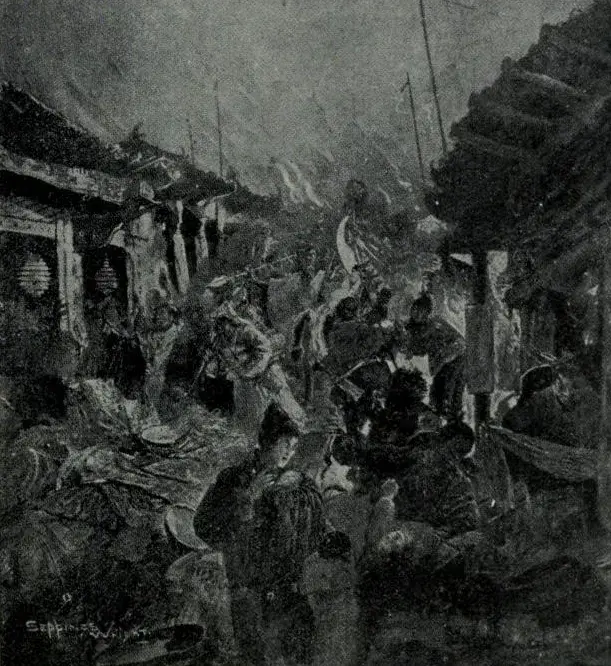
The Jiashen Incident (甲申之变) was a momentous dynastic collapse, regime transformation, and geopolitical upheaval that occurred in 1644 (the 17th year of Chongzhen, 1st year of Dashun Yongchang, and 1st year of Qing Shunzhi). Severe land concentration, prolonged droughts in northern Shaanxi, and ruinous military surtaxes pushed destitute peasants into armed rebellion. After proclaiming the Dashun dynasty in Xi'an, Li Zicheng marched eastward, swiftly capturing Taiyuan and Datong before besieging Beijing. The Chongzhen Emperor refused southern relocation. Following the treasonous surrender of city gates by court eunuchs, Dashun troops captured the capital, and Chongzhen hanged himself on Meishan, terminating the 276-year-old Ming dynasty. Following their entry into Beijing, Dashun forces implemented harsh extortion campaigns against former officials, alienating the gentry and causing civic chaos. Stationed at Shanhaiguan, Liaodong General Wu Sangui defected to the Qing after his family was detained. Qing Regent Prince Dorgon seized the strategic opportunity, leading Banner armies south to crush Li Zicheng at the Battle of Yipianshi in alliance with Wu. Li Zicheng evacuated Beijing, and the Qing dynasty established its capital in Beijing, profoundly redirecting Chinese history.
Li Zicheng established the Dashun dynasty in Xi'an and crossed the Yellow River eastward
Dashun armies captured Taiyuan, Datong, and Xuanfu as Ming garrisons surrendered en masse
Eunuch Du Xun surrendered Juyongguan, clearing the path for Dashun forces to besiege Beijing
Dashun artillery bombarded Zhangyimen; supervising eunuchs opened the gates to outer Beijing
Chongzhen hanged himself on Meishan, leaving a blood testament, terminating the Ming dynasty
Liu Zongmin tortured Ming officials for silver, severely alienating gentry and scholars
Enraged by the seizure of Chen Yuanyuan and his father, Wu broke with Li and sought Qing aid
Allied Qing and Wu forces crushed the Dashun army at Yipianshi; Li Zicheng fled westward
Li Zicheng crowned himself hurriedly, torched the imperial palace, and evacuated Beijing
Dorgon led the Eight Banners into Beijing, pacifying gentry and consolidating imperial authority
During the middle and late Ming Dynasty, imperial clansmen, aristocrats, and powerful landlords aggressively seized peasant lands, forcing massive numbers of smallholders into bankruptcy and vagrancy. From the Tianqi reign of Emperor Xizong through the Chongzhen reign of Emperor Sizong, severe and continuous droughts devastated northern Shaanxi, turning fertile fields into barren wastelands. Confronted with famine, destitute peasants were forced to eat wild weeds and tree bark. Yet corrupt local officials continued to enforce tax collection through torture. Facing growing military pressure from the Jurchen (Later Jin / Qing) in Manchuria, the Ming court imposed exorbitant additional levies—the Liaodong levy, suppression levy, and training levy—driving impoverished peasantry to desperation.
In 1627 (the 7th year of Tianqi), Wang Er united hundreds of starving peasants in Baishui County, Shaanxi, killed the rapacious magistrate Zhang Douyao, and ignited the late Ming peasant rebellions. During the early Chongzhen reign, rebel leaders including Wang Jiayin, Gao Yingxiang, Li Zicheng, and Zhang Xianzhong arose across Shaanxi and the Central Plains. Li Zicheng won widespread popular support by promoting egalitarian slogans such as "Welcome King Chuang, and pay no grain taxes." In 1643, Li Zicheng smashed through Tongguan Pass, slew Ming grand coordinator Sun Chuanting, and annihilated the last imperial field army capable of defending northern China.
On New Year's Day of 1644 (the 17th year of Chongzhen and 1st year of Dashun Yongchang), Li Zicheng formally proclaimed the Dashun Dynasty in Xi'an, adopted the reign title Yongchang, appointed civil officials, and rewarded meritorious generals. Li Zicheng then led hundreds of thousands of elite troops across the Yellow River in a coordinated two-pronged offensive toward the Ming imperial capital of Beijing. Along the march, Ming provincial officials surrendered en masse; Pingyang, Taiyuan, Datong, and Xuanfu capitulated in rapid succession as Dashun cavalry advanced unimpeded.
Within the Forbidden City, Emperor Sizong (Zhu Youjian) found himself entirely isolated. The imperial treasury was depleted. When Chongzhen pleaded with imperial in-laws and grand secretaries to donate private wealth for troop rations, the wealthy courtiers feigned poverty. The Three Battalions defending Beijing had gone months without pay and completely lost morale; moreover, a virulent pneumonic plague epidemic in the preceding winter had decimated the civilian and military population, leaving city ramparts critically undermanned. Courtiers such as Li Mingrui urged the emperor to relocate the capital to Nanjing, but this was obstinately obstructed by Grand Secretary Chen Yan and dogmatic censors. Chongzhen hesitated, forfeiting the final window for strategic relocation.
On the 15th day of the 3rd lunar month, 1644, Dashun vanguard detachments reached Juyongguan Pass, the northwestern gateway to Beijing. Supervising eunuch Du Xun surrendered without firing a shot, while garrison commander Tang Tong defected with his troops. On the 17th day, Li Zicheng arrived before Beijing with his main army, deploying hundreds of thousands of troops in a formidable ring around the outer and inner walls. Li Zicheng sent the turncoat eunuch Du Xun over the wall into the Forbidden City to present terms: Li demanded autonomous kingship over the northwest, a million taels of silver for his army, and practical independence, offering in return to deploy his forces against the Qing. Chongzhen summoned Senior Grand Secretary Wei Zaode for counsel, but Wei bowed his head in silence; Chongzhen indignantly rejected negotiation.
On the 18th day, Dashun artillery relentlessly bombarded Guang'anmen and Zhangyimen. Seeing defeat as inevitable, supervising palace eunuchs Cao Huachun and Wang Dehua threw open the gates. Under a deluge of nocturnal rain, Dashun vanguard units poured into the outer city. At dawn on the 19th, Dashun forces breached the inner city gates. In the Forbidden City, Chongzhen struck the palace alarm bell to summon civil and military officials to court, but not a single courtier appeared.
Driven to utter despair, Chongzhen ordered Empress Zhou and Consort Yuan to commit suicide, severed the left arm of Princess Changping with his sword, killed young Princess Zhaoren, and dispatched trusted eunuchs to smuggle Crown Prince Zhu Cilang and his brothers into hiding. Accompanied solely by eunuch Wang Chengen, Chongzhen climbed Shouhuang Pavilion on Meishan (Jingshan) behind the palace. Biting his finger to write a final testament in blood on his robe: "Possessing meager virtue and a frail body, I have incurred Heaven's wrath, bringing the rebels directly to the capital. All my officials have betrayed me. In death, I have no face to see my ancestors beneath the earth. I remove my crown and cover my face with my hair; let the rebels dismember my corpse, but spare every single civilian." Thereupon, Chongzhen hanged himself from a crooked scholar tree at the age of thirty-three, bringing an end to the Ming central dynasty.
Li Zicheng rode through Deshengmen into the capital and took up residence in the Jiaotai Hall of the Forbidden City. Initially, Li issued orders forbidding looting and arranged a formal burial for Chongzhen and Empress Zhou. However, Dashun leadership lacked comprehensive administrative preparation and sufficient fiscal reserves. To raise military funds, Li Zicheng and Chief General Liu Zongmin launched a ruthless campaign known as "chasing booty and extracting funds" (zhuizang kaoxiang).
Liu Zongmin fabricated thousands of torturous leg-crushing clamps and systematically extorted money based on official rank: demanding 100,000 taels from grand secretaries, 60,000 from ministerial officials, and tens of thousands from Hanlin scholars. Former Senior Grand Secretary Wei Zaode was crushed to death despite paying tens of thousands of taels; imperial aristocrats like Zhu Chunshen and Zhou Kui were subjected to brutal torture. Although tens of millions of taels were amassed, this violent campaign terrorized the scholar-gentry and alienated potential administrative collaborators throughout North China. Simultaneously, Dashun garrisons grew complacent, discipline slackened, and fatal tactical vulnerabilities mounted.
The sole surviving elite military force of the Ming in northern China was the Guanning Iron Cavalry commanded by Liaodong General Wu Sangui, stationed at Shanhaiguan and Ningyuan. When Beijing was threatened, Chongzhen had enfeoffed Wu as Earl of Pingxi, ordering him to abandon Ningyuan and march to relieve the capital. Upon reaching Yutian, Wu learned that Beijing had fallen and the emperor was dead; he withdrew to hold Shanhaiguan and observe shifting political currents.
Recognizing Shanhaiguan's supreme strategic importance, Li Zicheng detained Wu's father, Wu Xiang, forced him to draft a letter urging surrender, and dispatched envoys with 40,000 taels of silver to negotiate with Wu. Realizing the Ming had vanished, Wu initially agreed to submit and began marching toward Beijing to pay homage. However, while en route, Wu received intelligence that Dashun troops had confiscated his family estate in Beijing, tortured his father, and seized his beloved concubine Chen Yuanyuan. Enraged, Wu drew his sword and declared: "If a man cannot protect a woman, how can he face the world!" He executed the Dashun emissaries, marched back to Shanhaiguan, expelled Dashun commander Tang Tong, and fortified the strategic pass.
Outraged by Wu Sangui's defiance, Li Zicheng personally led General Liu Zongmin, advisor Song Xiance, and 80,000 elite troops eastward toward Shanhaiguan on April 13, taking along the Ming Crown Prince and Wu Xiang as hostages. Knowing his limited forces could not resist the overwhelming Dashun army, Wu faced destruction. On April 15, Wu dispatched secret couriers beyond the Great Wall to Prince Regent Dorgon in Shenyang, formally requesting military intervention.
The Qing court had closely monitored developments in China. Dorgon mobilized the primary Manchurian, Mongolian, and Han Eight Banners and marched south at maximum speed. On April 21, Dashun armies deployed along the Shi River and launched a furious assault on Shanhaiguan; Wu's defenders were pushed to the brink of collapse. At dawn on April 22, Wu rode out to meet Dorgon, shaved his forehead in the Jurchen fashion, and opened the gates of Shanhaiguan to the Qing army.
That morning, Dashun troops engaged Wu Sangui's battered regiments at Yipianshi outside the pass. Just as Li Zicheng seemed poised to encircle and annihilate Wu's troops, a ferocious dust storm arose, blinding Dashun soldiers. Suddenly, concealed Qing heavy cavalry burst out from behind Wu's lines, crashing into the Dashun flank with devastating momentum. Unprepared for the shock charge of the elite Qing cavalry, Dashun lines broke and dissolved into panic. Liu Zongmin was wounded by an arrow, and thousands fell. Guarded by loyal bodyguards, Li Zicheng fled in headlong retreat toward Yongping.
Following the crushing defeat at Yipianshi, Li Zicheng retreated to Beijing on April 26. Confronted with the coordinated advance of the Eight Banners and Wu's cavalry, Dashun forces lost all morale. On April 29, Li hurriedly staged a coronation ceremony in the Wuying Hall of the Forbidden City, executing Wu Xiang and his entire household.
On the night of April 30, Dashun soldiers torched the Forbidden City halls, city gates, and government offices before retreating northwest toward Shaanxi laden with confiscated treasure. On May 2, Qing Prince Regent Dorgon led his armies into Beijing. Courting the northern scholar-gentry, Dorgon forbade looting, ordered court mourning for the Chongzhen Emperor, buried him with imperial honors at the Siling mausoleum, and issued soothing proclamations. In October 1644, the young Shunzhi Emperor arrived from Shenyang, ascending the imperial throne in the Forbidden City and formally inaugurating Beijing as the capital of the Qing Empire.
The Jiashen Incident brought about the permanent extinction of the Great Ming Dynasty after 276 years of rule. Although Li Zicheng's peasant movement succeeded in toppling the corrupt Ming regime, peasant-class political limitations, brutal fund-raising campaigns, and tactical hubris resulted in the disastrous defeat at Yipianshi within forty days of entering Beijing. Conversely, the Qing ruling group utilized centralized military discipline and keen strategic foresight to ally with Wu Sangui, route the peasant army, and occupy Beijing with minimal resistance, securing the imperial throne for the Shunzhi Emperor.
The incident reshaped the political landscape and historical trajectory of late imperial China. First, it replaced traditional Han imperial authority with the Manchu Qing Dynasty, inaugurating 268 years of Qing rule over a unified multi-ethnic empire. Second, Ming loyalists established rival Southern Ming regimes in the south, leading to two decades of devastating warfare against Qing armies, during which southern cities suffered severe atrocities such as the Yangzhou Massacre and Jiading Urban Slaughter. Finally, early Qing policies—including the mandatory queue order, clothing regulations, and land enclosures—fundamentally restructured socio-political relations, forming the definitive threshold between late imperial and modern Chinese history.