Liu Bang Captures Xianyang
Liu Bang accepts Ziying's surrender, promulgates the Three Simple Laws, and encamps at Bashang.
Qin-Han Transition (Chu-Han Contention) · HISTORICAL EVENT
鸿门宴
The Feast at Hong Gate (鸿门宴) took place in the twelfth lunar month of 206 BC (the first year of the Han dynasty) at Hongmen near modern Xi'an, marking a legendary diplomatic banquet and lethal political confrontation between Liu Bang (the future Emperor Gaozu of Han) and Hegemon-King Xiang Yu of Western Chu following the overthrow of the Qin dynasty. Under an earlier covenant decreed by King Huai of Chu, the first commander to enter the Guanzhong…
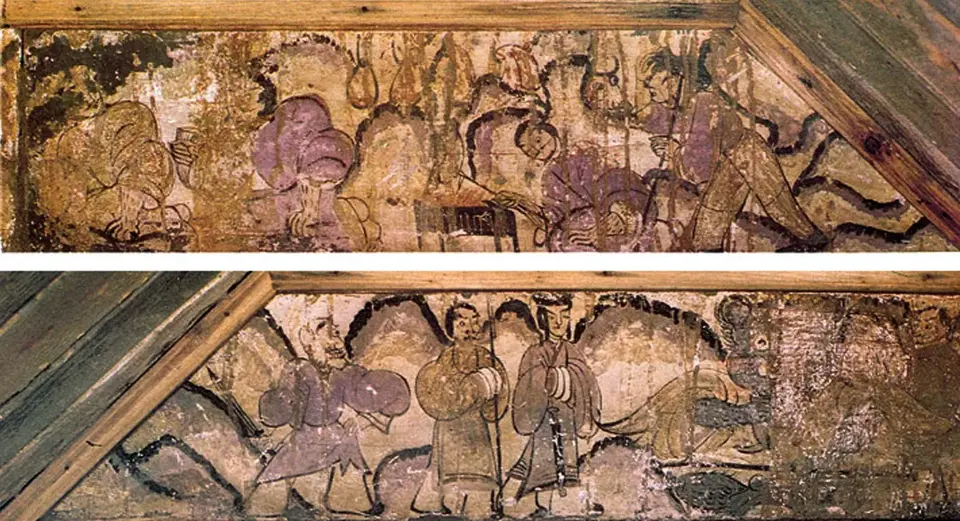
The Feast at Hong Gate (鸿门宴) took place in the twelfth lunar month of 206 BC (the first year of the Han dynasty) at Hongmen near modern Xi'an, marking a legendary diplomatic banquet and lethal political confrontation between Liu Bang (the future Emperor Gaozu of Han) and Hegemon-King Xiang Yu of Western Chu following the overthrow of the Qin dynasty. Under an earlier covenant decreed by King Huai of Chu, the first commander to enter the Guanzhong heartland would be crowned its king. Liu Bang captured Xianyang first, instituted the Three Simple Laws, and withdrew his troops to Bashang. Enraged by traitor Cao Wushang's report that Liu Bang intended to crown himself king, Xiang Yu assembled four hundred thousand soldiers at Hongmen, intending to annihilate the Han encampment. After Xiang Bo warned Zhang Liang, Liu Bang secured Xiang Bo's mediation and personally attended the banquet to offer formal apologies. During the tense feast, advisor Fan Zeng repeatedly signaled Xiang Yu to assassinate Liu Bang, and Xiang Zhuang performed an assassination sword dance, but Xiang Bo parried his thrusts with his own sword. Fan Kuai barged into the pavilion armed with sword and shield to denounce Xiang Yu's perfidy. Deflecting suspicion, Liu Bang feigned a trip to the latrine and fled back to Bashang. The encounter preserved the Han army and set the stage for the epic Chu-Han Contention.
Liu Bang accepts Ziying's surrender, promulgates the Three Simple Laws, and encamps at Bashang.
Xiang Yu storms Hangu Pass; Cao Wushang slanders Liu Bang, prompting Xiang Yu to plan a dawn attack.
Xiang Bo warns Zhang Liang; Liu Bang contracts a marriage pact with Xiang Bo to secure mediation.
Liu Bang offers apologies, Xiang Zhuang performs a sword dance, and Fan Kuai confronts Xiang Yu.
Liu Bang flees back to Bashang on foot, Zhang Liang delivers gifts, and Cao Wushang is beheaded.
In 207 BC (the third year of Qin Er Shi), anti-Qin insurrections flared across China. King Huai of Chu established a solemn pact with insurgent generals: whoever entered the Guanzhong basin and captured the imperial capital Xianyang first would be granted kingship over the territory. Liu Bang, then titled the Lord of Pei, marched westward through the Wu Pass, employing psychological warfare and lenient treatment toward surrendered cities. In the tenth lunar month of 206 BC, the final Qin ruler, Ziying, surrendered at Zhidao, bringing an end to the Qin dynasty.
Upon entering Xianyang, Liu Bang prohibited plunder, sealed the palaces and imperial treasuries, abolished draconic Qin penal codes, and promulgated the Three Simple Laws (mandating execution for murderers, with proportional punishment for wounding and robbery), winning widespread acclaim among Guanzhong citizens. Persuaded by strategists Zhang Liang and Fan Kuai, Liu Bang resisted the temptation to occupy the palaces, withdrawing his forces eastward to Bashang to await the arrival of the confederate armies.
Concurrently, Xiang Yu achieved immortal renown at the Battle of Julu, where he destroyed the main Qin field armies under Wang Li and Zhang Han by crossing the Zhang River and burning his own boats. Xiang Yu emerged as supreme commander over all feudal hosts. In the eleventh lunar month, Xiang Yu led four hundred thousand troops westward. Finding the strategic Hangu Pass garrisoned by Liu Bang's sentries, Xiang Yu was consumed with fury, ordering general Ying Bu to storm the pass and advancing to Hongmen.
At this critical juncture, Liu Bang commanded only one hundred thousand troops at Bashang, facing total numerical inferiority. Seeking personal advancement, Liu Bang's Left Marshal Cao Wushang sent a secret messenger to Xiang Yu, alleging that Liu Bang intended to establish himself as King of Guanzhong, appoint Ziying as chancellor, and monopolize imperial treasures. Xiang Yu's supreme strategist Fan Zeng warned that Liu Bang harbored imperial ambitions, noting auspicious dragon-shaped cloud formations hovering over his camp. Convinced of Liu Bang's betrayal, Xiang Yu distributed feast rations and ordered his army to storm and butcher the Han camp at dawn.
Xiang Yu's paternal uncle, Left Minister of Chu Xiang Bo, was a devoted personal friend of Liu Bang's chief strategist Zhang Liang. Aware of the impending dawn assault, Xiang Bo galloped through the night to Bashang to urge Zhang Liang to flee. Refusing to desert his lord in peril, Zhang Liang informed Liu Bang of the emergency.
Terrified by the prospect of annihilation, Liu Bang sought Zhang Liang's counsel. Zhang Liang ushered Xiang Bo into the pavilion, where Liu Bang received him with elder-brotherly deference, personally serving wine and proposing a future marriage alliance between their children. Liu Bang swore that his seals on the royal storehouses were placed solely to preserve them for Xiang Yu, and that garrisoning the passes was intended to suppress brigands. Persuaded by Liu Bang's apparent humility, Xiang Bo agreed to intercede with Xiang Yu, urging Liu Bang to travel to Hongmen at daybreak to present formal apologies. Returning to Hongmen that night, Xiang Bo pacified Xiang Yu, emphasizing that executing an ally who conquered Qin would represent dishonorable treachery.
At dawn the following day, Liu Bang arrived at Hongmen accompanied by Zhang Liang, Fan Kuai, and barely one hundred cavalry guards. Kneeling before Xiang Yu, Liu Bang offered lavish words of remorse, declaring that while Xiang Yu fought north of the river and he fought to the south, he never envisioned entering Guanzhong first. Mollified by Liu Bang's obsequious demeanor, Xiang Yu exposed his informant, stating that Cao Wushang had manufactured the quarrel. Xiang Yu then arranged a grand banquet, seating himself and Xiang Bo eastward, Fan Zeng southward, Liu Bang northward, and Zhang Liang westward.
Beneath the banquet's surface, tension was acute. Fan Zeng repeatedly cast meaningful glances at Xiang Yu, thrice raising his jade pendant as an urgent signal to strike down Liu Bang. Xiang Yu remained silent and unmoved. Frustrated by Xiang Yu's hesitation, Fan Zeng stepped outside and summoned Xiang Yu's cousin Xiang Zhuang, instructing him to offer toasts and perform a sword dance to assassinate Liu Bang. Xiang Zhuang entered and unsheathed his blade. Recognizing the lethal trap, Xiang Bo drew his own sword and mirrored the movements, using his body to shield Liu Bang at every lunge, preventing Xiang Zhuang from delivering a lethal blow.
Perceiving imminent slaughter, Zhang Liang slipped out of the tent and summoned Fan Kuai. Carrying a heavy iron shield and grasping his three-foot sword, Fan Kuai charged past the sentries, knocking guards to the ground, and burst through the tent flap with blazing eyes. Xiang Yu grasped his sword and rose in alarm, asking who entered. When Zhang Liang introduced him as Liu Bang's bodyguard, Xiang Yu praised his valor, awarding him a large flagon of wine and a raw shoulder of pork. Fan Kuai sliced the meat with his blade, swallowed it raw, and boldly addressed Xiang Yu, declaring that King Huai had promised kingship to the first general entering Guanzhong. He accused Xiang Yu of listening to petty slanderers to murder an honorable comrade, warning that such tyranny mirrored the wickedness of the fallen Qin. Taken aback by this righteous rebuke, Xiang Yu fell silent and offered him a seat.
Shortly thereafter, Liu Bang excused himself on the pretext of visiting the latrine, signaling Fan Kuai to accompany him outside. Outside the pavilion, Liu Bang deliberated whether to bid formal farewell. Fan Kuai urged immediate flight, stating that when one is fish and meat upon another's chopping block, ceremony must be abandoned. Leaving Zhang Liang to cover their absence, Liu Bang relinquished his carriages and fled on foot through mountain trails back to Bashang alongside Fan Kuai, Xiahou Ying, Jin She, and Ji Xin. Once Liu Bang was safe, Zhang Liang reentered the tent, presenting pairs of white jade discs to Xiang Yu and jade flagons to Fan Zeng, falsely claiming that Liu Bang had departed due to drunkenness. Xiang Yu accepted the gifts passively, but Fan Zeng drew his sword and smashed the jade flagons to shards, cursing that Xiang Yu was an incompetent boy whose empire would be seized by Liu Bang. Upon returning to Bashang, Liu Bang immediately executed the traitor Cao Wushang.
The Feast at Hongmen completely neutralized Xiang Yu's immediate plan to execute a preemptive military slaughter of the Han forces. Through tactical humility, Liu Bang retained his hundred thousand veteran troops intact. Months later, Xiang Yu carried out his feudal partition, granting Liu Bang the remote territories of Ba, Shu, and Hanzhong. Following Zhang Liang's counsel, Liu Bang burned the wooden gallery roads behind him to signal non-aggression, gaining vital strategic breathing room to appoint Han Xin supreme general and stage a covert return to conquer Guanzhong.
The encounter at Hongmen represented the definitive turning point in Xiang Yu's political destiny. Possessing absolute military superiority, Xiang Yu surrendered the initiative through complacency and gullibility, forfeiting his premier chance to liquidate his most dangerous rival while betraying his own informant. Fan Zeng's grim prediction was vindicated across four years of civil war, culminating in Xiang Yu's encirclement at Gaixia and suicide by the Wujiang River. The banquet at Hongmen directly enabled the rise of the Han dynasty.