Cao Cao Launches Grand Southern Invasion
Cao Cao leads hundreds of thousands into Jingzhou; Liu Cong surrenders, and Liu Bei evacuates south.
Eastern Han Dynasty (东汉) · HISTORICAL EVENT
赤壁之战
The Battle of Red Cliffs (赤壁之战) was a pivotal strategic naval and land campaign in the winter of 208 along the middle reaches of the Yangtze River between Red Cliffs and Wulin in modern Hubei. After pacifying northern China, Chancellor Cao Cao launched a massive invasion into Jingzhou. Provincial successor Liu Cong surrendered without resistance, and Liu Bei suffered a catastrophic retreat at Changban before consolidating remnants at Xiakou. Entering…
The Battle of Red Cliffs (赤壁之战) was a pivotal strategic naval and land campaign in the winter of 208 along the middle reaches of the Yangtze River between Red Cliffs and Wulin in modern Hubei. After pacifying northern China, Chancellor Cao Cao launched a massive invasion into Jingzhou. Provincial successor Liu Cong surrendered without resistance, and Liu Bei suffered a catastrophic retreat at Changban before consolidating remnants at Xiakou. Entering Jiangling, Cao Cao issued an arrogant summons demanding Sun Quan's submission. Confronting immense pressure, civil ministers in Eastern Wu advocated surrender, but Lu Su brought Zhuge Liang to Chaisang to rally resistance. Persuaded by Zhuge Liang's and Zhou Yu's strategic dissections of northern vulnerabilities, Sun Quan severed his desk corner with his blade, appointing Zhou Yu as commander over thirty thousand marines to unite with Liu Bei. The allied forces engaged Cao Cao's river vanguard at Red Cliffs, repulsing the invaders who retreated to Wulin along the northern bank, where unfamiliarity with waters and rampant pestilence compelled Cao Cao to chain his ships together. Observing the vulnerable formation, Wu veteran Huang Gai proposed a fire assault supported by a deceptive surrender. In the twelfth month, an unexpected southeast gale swept the river; Huang Gai piloted ten oil-soaked fire vessels directly into the chained armada, igniting an inferno that consumed warships and shore encampments. Allied divisions followed up with devastating assaults, driving Cao Cao into a disastrous retreat through the marshy Huarong Trail. The battle shattered Cao Cao's dream of immediate unification and inaugurated the Three Kingdoms era.
Cao Cao leads hundreds of thousands into Jingzhou; Liu Cong surrenders, and Liu Bei evacuates south.
Tiger-and-Leopard Cavalry scatter Liu Bei at Changban; Liu Bei gathers survivors at Xiakou as Lu Su initiates alliance talks.
Zhuge Liang and Zhou Yu persuade Sun Quan at Chaisang; Sun Quan strikes his table, deploying thirty thousand marines.
Allied forces defeat Cao Cao's vanguard on the river; Cao Cao retreats to Wulin and chains his armada together.
Huang Gai launches ten fire ships under a southeast gale, incinerating the northern armada and land encampments.
Cao Cao retreats through the mud of Huarong Trail, leaving garrisons at Jiangling while retiring north.
Following his decisive triumph over Yuan Shao at the Battle of Guandu in 200, Cao Cao methodically destroyed the Yuan heirs and launched a northern expedition against the Wuhuan, unifying the Central Plains and northern frontier. In early 208, Cao Cao assumed the imperial chancellorship and excavated the Xuanwu Training Lake at Ye to instruct hundreds of naval personnel, initiating comprehensive preparations to subjugate the autonomous regimes south of the Yangtze River.
In the seventh month of 208, Cao Cao mobilized hundreds of thousands of veteran northern cavalry, infantry, and auxiliary levies southward along the Han River corridor. Simultaneously, Jingzhou Governor Liu Biao died of illness, and his young successor Liu Cong was manipulated by powerful clans under Cai Mao and Kuai Yue into tendering unconditional submission. Stationed at Xinye, Liu Bei was caught unprepared and forced to flee southward toward Jiangling accompanied by his retainers and over a hundred thousand displaced civilians.
Aware that Jiangling housed enormous military stockpiles and river fleets, Cao Cao feared Liu Bei would occupy the citadel first. He detached five thousand elite Tiger-and-Leopard Cavalry to stage a relentless march covering three hundred li in twenty-four hours, overtaking Liu Bei's refugee column at Changban in Dangyang. Liu Bei's force was scattered, but General Zhao Yun rescued his infant heir Liu Shan, while Zhang Fei stood guard over the Dangyang Bridge to stall pursuit. Liu Bei regrouped with Guan Yu's river flotilla at Hanjiu and retired to Xiakou. Entering Jiangling unopposed, Cao Cao incorporated tens of thousands of Jingzhou marines and over a thousand warships, dispatching an ultimatum to Sun Quan boasting of eight hundred thousand troops assembled to hunt across the southern marshes.
Terror engulfed the court of Eastern Wu, where senior civil counselors led by Zhang Zhao urged immediate capitulation, arguing that the Yangtze barrier was breached. Only Commandant Lu Su stood firm, secretly counseling Sun Quan that courtiers could surrender and preserve office, whereas the sovereign would be stripped of dominion. Lu Su sailed to Jiangxia to coordinate with Liu Bei, arranging for Chancellor's Assistant Zhuge Liang to visit Chaisang. Before Sun Quan, Zhuge Liang analyzed the battlefield: Cao Cao's forces were exhausted by forced marches like a spent arrow unable to pierce silk; northern troops lacked naval skills; and Jingzhou levies were alienated. If Sun and Liu joined forces, victory was assured.
Arriving from Poyang, Grand Commander Zhou Yu reinforced this analysis by identifying four fatal vulnerabilities in Cao Cao's campaign: rear threats from Ma Teng in the northwest, abandoning cavalry for naval warfare, winter pasture shortages for horses, and pestilence among northern conscripts unaccustomed to southern marshes. Zhou Yu requested fifty thousand troops to guarantee victory. Galvanized, Sun Quan drew his sword, severed the corner of his conference table, and proclaimed that anyone who dared urge surrender would share the table's fate, dispatching Zhou Yu, Cheng Pu, and Lu Su with thirty thousand elite troops to the frontline.
In the ninth month of 208, as Liu Bei evacuated south from Fancheng with over a hundred thousand civilians and thousands of baggage carts, progress slowed to barely ten li per day. When lieutenants urged Liu Bei to abandon the populace to secure Jiangling, he famously replied that grand undertakings must prioritize the people. Fearing the loss of Jiangling's arsenal, Cao Cao launched five thousand elite Tiger-and-Leopard Cavalry on a forced march of three hundred li within twenty-four hours, crashing into Liu Bei's rear at Changban. In the ensuing rout, families were separated, but General Zhao Yun fought through enemy cordons to rescue Lady Gan and the infant Liu Shan.
Concurrently, General Zhang Fei held the Dangyang Bridge with twenty horsemen. Ordering cavalrymen to drag branches through the brush to generate dust screens, Zhang Fei leveled his serpent spear across the bridge and bellowed a ferocious challenge that paralyzed the advancing columns, permitting the allied rear to burn the bridge and retire safely. At Hanjiu, Guan Yu arrived with ten thousand marines, joined by Liu Qi with ten thousand garrison troops from Jiangxia. United at Xiakou, Liu Bei's command established defensive cohesion and integrated with Eastern Wu reinforcements.
Following the capture of Jiangling, Cao Cao dispatched his ultimatum to Sun Quan claiming eight hundred thousand troops. This communication ignited panic in Eastern Wu, where senior literati under Zhang Zhao argued that resistance was futile against a legitimate imperial chancellor commanding thousands of warships. Sun Quan was deeply distressed until Lu Su privately urged resistance and escorted Zhuge Liang to Chaisang. Zhuge Liang challenged Sun Quan with psychological brilliance, pointing out that if Liu Bei could command twenty thousand troops in resistance, Eastern Wu's martial gentry could easily prevail by joining forces with the south.
Grand Commander Zhou Yu arrived from Poyang and excoriated Zhang Zhao's faction for defeatist cowardice. Zhou Yu provided precise intelligence demonstrating that Cao Cao's true host numbered no more than one hundred sixty thousand exhausted northern conscripts, alongside seventy thousand distrustful Jingzhou levies. Driving such alienated multitudes across southern waterways violated cardinal military principles. Zhou Yu enumerated the four fatal vulnerabilities regarding cavalry, terrain, winter fodder, and disease, requesting fifty thousand elite marines to achieve total victory. Sun Quan struck his table with his sword, declaring death for defeatists, and appointed Zhou Yu and Cheng Pu as co-commanders alongside Lu Su to lead thirty thousand marines upstream.
In the twelfth month of 208, Zhou Yu led thirty thousand Wu marines westward up the Yangtze, rendezvoused with Liu Bei's forces at Fankou, and advanced toward Red Cliffs. The allied amphibious fleet encountered Cao Cao's vanguard sailing downriver. The vast majority of northern troops suffered acute seasickness upon entering the undulating river waters, while humid conditions ignited epidemic fevers throughout the camps. In the initial clash, light Wu assault galleys outmaneuvered the heavy northern vessels, raining volleys of crossbow bolts and inflicting a decisive opening defeat.
Thwarted in his first river battle, Cao Cao withdrew his armada to Wulin along the northern shore, entrenching opposite the Sun-Liu encampments at Red Cliffs. To counteract the violent rocking that incapacitated his cavalry and infantry, Cao Cao ordered all warships to be locked together in parallel rows using heavy iron chains and broad timber planks, creating floating pontoons wide enough for cavalry maneuvers. While this design stabilized the decks, it eliminated all tactical maneuverability and set the stage for total disaster against an incendiary strike.
Observing the chained northern armada from southern bluffs, veteran general Huang Gai recognized the fatal structural defect and proposed an incendiary assault to Zhou Yu: "The enemy is numerous while we are few; prolonged confrontation disfavors us. Cao Cao has chained his vessels stem to stern, which prevents dispersion; a fire assault will destroy them beyond escape!" Zhou Yu approved the plan and initiated a deception maneuver. Huang Gai dispatched a clandestine letter to Cao Cao feigning humiliation under Zhou Yu and volunteering to defect with his supply galleys. Deceived by numerical superiority, Cao Cao accepted the surrender proposal.
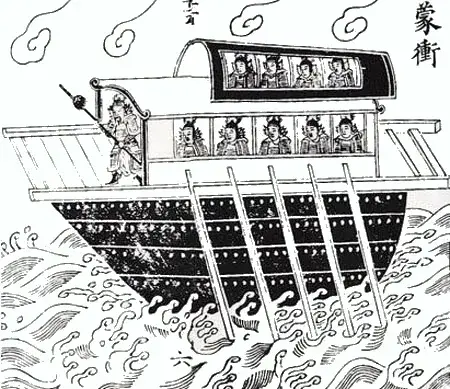
Huang Gai prepared ten fast-sailing assault vessels (mengchong), packing their holds with dry brush, reed bundles, and combustible fish oil, covered by canvas tarpaulins with iron rams mounted on the prows and small dinghies towed behind for evacuation. On a cold night in late December, seasonal weather shifted dramatically as a sudden gale blew from the southeast. Seeing the winds turn, Huang Gai unfurled sails and led his ten fire vessels skimming across the waters toward the northern camp at Wulin.
As Huang Gai's fleet approached, Cao Cao's sentries crowded the gunwales cheering the arrival of the defectors. Two li from the northern docks, Huang Gai brandished his sword and gave the command to ignite the cargo. Within moments, sheets of fire soared skyward. Driven by ferocious southeasterly gusts, the flaming ships rammed directly into the clustered northern armada. The flames leaped across the interlocking chains, turning thousands of ships into an uncontrollable inferno that spread instantly to the shore camps. Multitudes of northern troops drowned or were burned alive amid catastrophic stampedes. Zhou Yu launched his naval squadrons to assault the burning perimeters, while Liu Bei's divisions fell upon the flanks.
Confronting total disaster, Cao Cao escaped through the burning lines with a handful of mounted retainers, fleeing northward into the Huarong Trail. Heavy rainfall had transformed the ancient marsh road into knee-deep mud, trapping horses and wagons. Cao Cao commanded exhausted, starving infantrymen to cut reeds to pave the quagmire, ordering mounted divisions to ride directly over the bodies of fallen soldiers to escape. Emerging from the marsh, Cao Cao famously laughed at his pursuers, claiming that had Zhou Yu or Zhuge Liang ambushed the narrows with fire, his party would have been annihilated. Moments later, allied cavalry crested the horizon, forcing Cao Cao to flee at maximum speed. Stationing Cao Ren at Jiangling and Yue Jin at Xiangyang, Cao Cao retreated to the Central Plains, concluding the campaign in total defeat.
The decisive allied victory at Red Cliffs destroyed Cao Cao's immediate capacity to conquer the southern waterways, neutralizing tens of thousands of veteran soldiers and shattering the myth of northern invincibility. Following the rout, Zhou Yu crossed the Yangtze to besiege Jiangling, driving Cao Ren north after a grueling year of combat; concurrently, Liu Bei marched south, subjugating Wuling, Changsha, Lingling, and Guiyang to secure an independent territorial and fiscal base.
In civilizational and strategic history, the Battle of Red Cliffs stands as the definitive geopolitical watershed of the Three Kingdoms era. It halted the northern conquest of the south, permitting Liu Bei to enter the Sichuan basin to establish Shu Han, while enabling Sun Quan to solidify Jiangnan into the state of Eastern Wu. Geopolitically, the campaign established the tripartite division that characterized Chinese history for over half a century. Tactically, it established the timeless classic of utilizing terrain, seasonal winds, and amphibious fire assaults to overcome overwhelming numerical superiority, inspiring generations of military strategists.