Academy Service
Zhang Zeduan serves in the Northern Song Hanlin Painting Academy, beginning intensive field sketching in Bianjing.
Northern Song Dynasty (北宋) · HISTORICAL EVENT
清明上河圖
Along the River During the Qingming Festival (清明上河圖) refers to the creation, imperial presentation, and tumultuous multi-century transmission of the monumental panoramic handscroll executed by Northern Song court painter Zhang Zeduan. Measuring 24.8 centimeters in height and 528.7 centimeters in length, this ink-and-color masterwork on silk captures the vibrant daily life, civil architecture, and commercial activities of the Northern Song capital,…
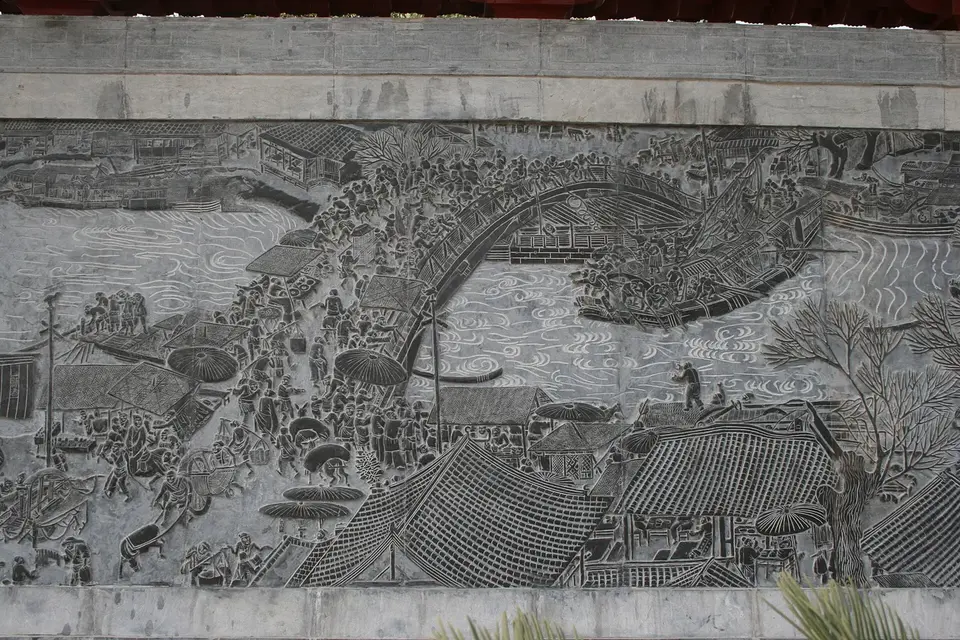
Along the River During the Qingming Festival (清明上河圖) refers to the creation, imperial presentation, and tumultuous multi-century transmission of the monumental panoramic handscroll executed by Northern Song court painter Zhang Zeduan. Measuring 24.8 centimeters in height and 528.7 centimeters in length, this ink-and-color masterwork on silk captures the vibrant daily life, civil architecture, and commercial activities of the Northern Song capital, Bianjing (modern Kaifeng, Henan), during the spring Qingming Festival. The painting unfolds across three distinct spatial narratives: tranquil rural outskirts, busy riverfront shipping along the Bian River centered on the iconic wooden arch Rainbow Bridge, and the thriving urban center bustling with civic commerce. Containing over eight hundred individual figures, dozens of rivercraft, and accurately rendered city walls and storefronts, the scroll was personally titled by Emperor Huizong. Following the catastrophic fall of the Northern Song in the Jingkang Incident, the scroll survived centuries of dynastic collapse, theft, and private collecting before being permanently housed in the Palace Museum in Beijing as an incomparable national treasure.
Zhang Zeduan serves in the Northern Song Hanlin Painting Academy, beginning intensive field sketching in Bianjing.
Zhang Zeduan commences the meticulous multi-year painting of the grand panoramic silk scroll.
Emperor Huizong reviews the completed scroll, inscribers the title in Slender Gold calligraphy, and affixes his royal seal.
Jurchen Jin armies sack Bianjing, looting the imperial treasury and taking the scroll northward.
Scholar Zhang Zhu writes the first definitive biographical colophon authenticating Zhang Zeduan as the painter.
The scroll is stolen from the Yuan imperial collection by a court mounter and disperses into private gentry custody.
Grand Secretary Yan Song is purged, resulting in the confiscation of his art collection, including the scroll, into the Ming court.
Following the confiscation of Bi Yuan's estate, the painting enters the Qing imperial collection.
Abdicated Emperor Puyi smuggles the masterpiece to Manchuria, where it remains hidden through World War II.
Expert Yang Renkai authenticates the scroll, which is officially entrusted to the Palace Museum in Beijing.
During the Northern Song Dynasty, Chinese urban society experienced a profound structural transformation often described by historians as an early commercial revolution. The rigid, enclosed ward and market system of earlier dynasties was completely dismantled, allowing merchants to erect shops, taverns, and workshops directly along thoroughfares without curfew restrictions. Bianjing expanded into a sprawling metropolis of over one million residents, interconnected by sophisticated canal networks and flourishing day-and-night street markets. This rise of an affluent urban burgher class fostered immense popular demand for secular art reflecting everyday life, entertainment, and municipal prosperity.
Emperor Huizong of Song was an exceptionally accomplished artist and lavish patron who elevated the Imperial Painting Academy to its highest historical standing. He established rigorous examinations in painting, emphasizing meticulous naturalist observation and refined draughtsmanship known as Jiehua (boundary painting). Zhang Zeduan, a native of Dongwu (modern Zhucheng, Shandong) who had studied in Kaifeng before joining the Academy, specialized in complex architectural structures, riverboats, carts, and bridges. Recognizing the unique vibrancy of his era, Zhang set out to create an exhaustive pictorial survey of the Northern Song capital at the peak of its material prosperity.
Serving as an Attendant in the Hanlin Painting Academy during the Zhenghe and Xuanhe eras, Zhang Zeduan spent years roaming the docks, avenues, and markets of Bianjing to gather tens of thousands of detailed sketches. Combining panoramic landscape composition with extraordinary miniature precision, he meticulously synthesized these observations into a coherent five-meter silk handscroll.
The composition develops rhythmically from right to left across three panoramic movements. The scroll opens with the pastoral outskirts of Bianjing: misty willows, thatched farmsteads, winding streams, and travelers returning from tending ancestral tombs.
The middle section shifts focus to the Bian River, the vital canal lifeline supplying the capital with southern grain and merchandise. Boats of various drafts crowd the waterway, culminating in the dramatic centerpiece: the Rainbow Bridge, a magnificent single-span timber arch bridge built without supporting river piers. A towering grain barge with lowered masts prepares to navigate the bridge's arch against the surging current. Boatmen frantically drop ropes and steer with long poles, while excited pedestrians on the bridge deck and riverbanks lean over the railings shouting instructions, forming the dynamic emotional climax of the painting.
The third movement leads the viewer through the massive city gate tower into the bustling interior of Bianjing. Here, Zhang captures the full panorama of Song civic commerce: tax offices, pharmacy storefronts, wine mansions hung with advertising banners, inns, artisan stalls, and open street booths. The thoroughfares are crowded with grand sedan chairs of aristocrats, mounted literati, street porters pushing wheelbarrows, wandering monks, Middle Eastern merchants, and common townsfolk. The scroll features exactly 814 distinct human figures, twenty-eight rivercraft, sixty domestic animals, and dozens of buildings, achieving unprecedented ethnographic fidelity.
Upon its completion, Zhang Zeduan presented the handscroll to Emperor Huizong. The delighted monarch endorsed the work by writing its five-character title in his signature Slender Gold calligraphic script and stamping it with his personal double-dragon imperial seal.
However, the peaceful grandeur immortalized on silk was soon shattered. In 1126, Jurchen armies of the Jin Dynasty laid siege to Bianjing in the Jingkang Incident, capturing Emperor Huizong and Emperor Qinzong and plundering the imperial collections. The scroll was transported north as war booty, entering the Jin imperial storehouses. In 1186, during the Jin Dynasty, scholar Zhang Zhu composed the earliest surviving colophon on the scroll, documenting Zhang Zeduan's birthplace and court appointment, which provides the bedrock historical evidence for the painting's authorship.
Over the subsequent eight centuries, Along the River During the Qingming Festival experienced an extraordinary succession of thefts, sales, and confiscations. During the Yuan Dynasty, an unscrupulous court mounter swapped the scroll with a forgery, selling the original into private hands. In the Ming Dynasty, it passed through the collections of Prime Minister Yan Song and connoisseur Xiang Yuanbian; upon Yan Song's downfall, it was temporarily confiscated into the Ming imperial treasury.
During the Qing Dynasty, the scroll was acquired by scholar-official Bi Yuan. Following Bi's posthumous political disgrace in 1799, the scroll was absorbed into the Qing imperial collection and cataloged in the Precious Collection of the Stone Moat. In 1924, prior to his eviction from the Forbidden City, the abdicated emperor Puyi smuggled the painting out of Beijing, eventually storing it in his puppet court palace in Changchun, Manchuria.
Following the defeat of Japan in 1945, the scroll was recovered from chaotic war looting by the Northeast Democratic United Army and preserved in the Northeast Museum. In 1953, renowned connoisseur Yang Renkai authenticated the silk scroll as Zhang Zeduan's authentic Northern Song masterpiece. The scroll was formally transferred to the Palace Museum in Beijing, where it has since been conserved as one of China's most guarded cultural treasures.
Along the River During the Qingming Festival established a monumental precedent in Chinese art history by shifting aesthetic focus from religious iconography and courtly escapism to the vivid, unfiltered reality of ordinary human labor and municipal life. Zhang's synthesis of linear perspective in architectural drawing with fluid figurative brushwork defined the genre of narrative handscrolls, inspiring countless tribute editions in subsequent centuries, including the famous Ming version by Qiu Ying and the Qing court academy remake of 1736.
Beyond its aesthetic genius, the scroll serves as a peerless visual archive of pre-modern urban civilization. It provides modern historians, sociologists, and engineers with concrete visual evidence regarding Song timber arch bridge construction, watercraft design, navigation engineering, commercial layout, municipal policing, and apparel conventions across all social classes. It visually validates written accounts such as The Eastern Capital: A Dream of Splendor, providing an irreplaceable window into one of the most vibrant urban cultures of the medieval world.