Maiden Voyage from Taicang
Zheng He embarked with over 27,000 personnel, eradicated pirate leader Chen Zuyi at Palembang, and secured the Strait of Malacca.
Ming Dynasty (明朝) · HISTORICAL EVENT
郑和下西洋
The Zheng He's Voyages to the Western Oceans (郑和下西洋) refers to the monumental series of seven state-sponsored maritime expeditions conducted between 1405 and 1433 during the reigns of the Yongle Emperor (Zhu Di) and Xuande Emperor (Zhu Zhanji) of the Ming Dynasty, commanded by Grand Eunuch Zheng He. Possessing peerless naval engineering and sophisticated navigational sciences including nautical compasses and celestial star-boards, the Ming court…
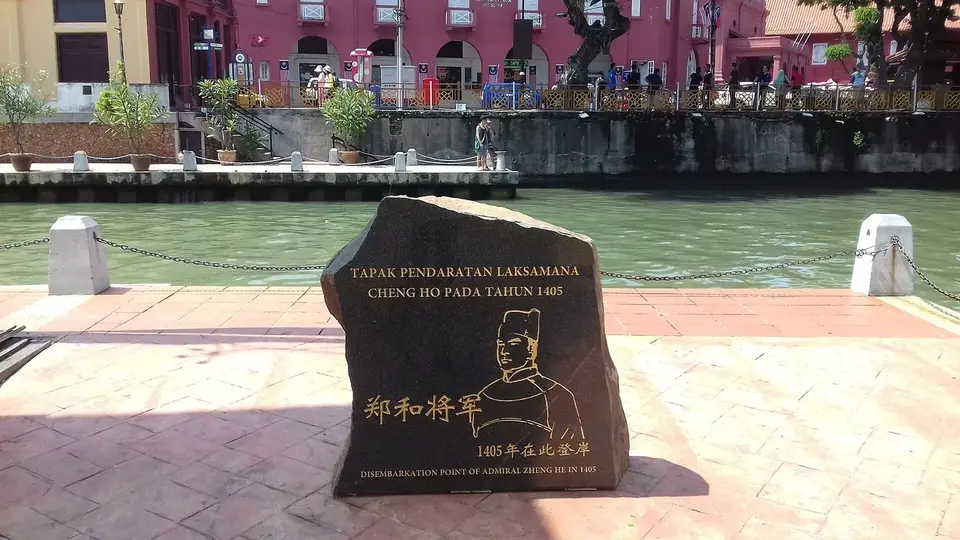
The Zheng He's Voyages to the Western Oceans (郑和下西洋) refers to the monumental series of seven state-sponsored maritime expeditions conducted between 1405 and 1433 during the reigns of the Yongle Emperor (Zhu Di) and Xuande Emperor (Zhu Zhanji) of the Ming Dynasty, commanded by Grand Eunuch Zheng He. Possessing peerless naval engineering and sophisticated navigational sciences including nautical compasses and celestial star-boards, the Ming court assembled a fleet of over two hundred multi-decked ships, including immense treasure ships (Baochuan), crewed by more than twenty-seven thousand sailors, officers, physicians, and translators. Departing from Liujiagang in Taicang, Jiangsu, the armada sailed across the South China Sea, traversed the Strait of Malacca, crossed the Indian Ocean, and navigated the Persian Gulf, Red Sea, and the Swahili coast of East Africa. Throughout these voyages, Zheng He suppressed notorious pirate syndicates, mediated regional armed disputes, invested foreign monarchs, and conducted peaceful exchanges of Chinese silk, fine porcelain, and metalwork for exotic spices, medicines, and precious gems. Predating the European Age of Discovery by nearly a century, Zheng He's maritime expeditions stood as the grandest peacetime naval enterprise in world history, establishing an enduring standard of cooperative maritime diplomacy.
Zheng He embarked with over 27,000 personnel, eradicated pirate leader Chen Zuyi at Palembang, and secured the Strait of Malacca.
The armada visited Champa, Java, Siam, and Calicut, formalizing tributary relationships with regional kingdoms.
Alagakkonara attacked the fleet; Zheng He executed a daring counterstrike, capturing the king and escorting him to the capital.
The fourth voyage crossed the Arabian Sea to Ormuz, opening extensive diplomatic ties with the Islamic world.
The fifth expedition reached Mogadishu, Barawa, and Malindi, escorting foreign ambassadors and presenting giraffes to the court.
The sixth expedition escorted envoys from sixteen nations back to their homelands, reinforcing Indian Ocean maritime security.
Zheng He conducted his final expedition to Mecca and East Africa, succumbing to illness at Calicut during the return voyage in 1433.
Following decades of agricultural rehabilitation during the Hongwu reign, the early Ming Dynasty achieved peak economic prosperity during the Yongle era. Government coffers overflowed, and imperial statecraft actively engaged foreign relations. Chinese shipbuilding and maritime technology attained world-leading supremacy. Shipyards at Longjiang in Nanjing and Taicang manufactured multi-decked oceanic vessels exceeding hundreds of feet in length, utilizing sophisticated watertight compartment technology that drastically minimized sinking hazards. In navigation, Chinese mariners integrated magnetic compass needles with celestial declination star-boards, calculating latitude and keeping accurate dead reckoning across vast oceanic expanses.
After seizing the throne through the Jingnan Campaign, the Yongle Emperor sought unquestioned domestic and international legitimacy for his reign. Disruptions across the Eurasian steppe caused by the campaigns of Timur blocked traditional overland Silk Road conduits, while coastal piracy disturbed maritime sea routes. The Yongle Emperor resolved to direct imperial energies toward the maritime world, establishing a comprehensive tribute trade network based on peaceful international reciprocity. By bestowing imperial gifts and offering trade protections, Ming China sought foreign envoys to Chang'an and Beijing to demonstrate universal sovereign harmony.
In the autumn of 1405 (the sixth month of the third year of the Yongle era), the emperor officially commissioned Grand Eunuch Zheng He and Vice Envoy Wang Jinghong to lead an expedition of 27,800 military and civil officers. The armada of 208 vessels assembled at Liujiagang in Taicang to conduct sea-sacrifices before sailing south to Taiping Port in Changle, Fujian, awaiting favorable winter monsoons.
Riding the northeast monsoon, the fleet navigated to Champa, Java, and Sumatra. On the return passage near Palembang (Old Port), a notorious Chinese pirate confederation commanded by Chen Zuyi feigned surrender while plotting a midnight ambush against the treasure ships. Zheng He anticipated the treachery, ambushed the pirate flotilla, executed thousands of raiders, and captured Chen Zuyi, delivering him to Nanjing for trial. This victory secured the vital shipping lanes through the Strait of Malacca.
During the second and third expeditions (1407 to 1411), Zheng He expanded the fleet's operations deeper into the Indian Ocean basin. The armada visited Siam, Cochin, and the major international entrepot of Calicut on the Malabar coast of southwestern India. Zheng He formally invested local sovereigns on behalf of the Ming court and erected commemorative bilingual stone steles.
During the third voyage to Ceylon (modern Sri Lanka), King Alagakkonara attempted to extort the fleet, mobilizing fifty thousand soldiers to sever Zheng He's line of retreat to the shore. Exhibiting audacious military tactical acumen, Zheng He noticed that the Ceylonese capital was left defenseless. He personally led three thousand elite shock troops in a night assault, storming the capital and capturing King Alagakkonara along with his ministers. The captives were presented to the Yongle Emperor, who demonstrated imperial magnanimity by pardoning the captive monarch and restoring him to his throne, winning the deep respect of South Asian states.
Between 1413 and 1422, during the fourth, fifth, and sixth expeditions, the fleet extended its voyages beyond South Asia across the Arabian Sea, opening direct oceanic connections with the Middle East and the Horn of Africa.
The fleet visited Ormuz on the Persian Gulf, Aden at the mouth of the Red Sea, and Swahili coastal kingdoms in East Africa, including Mogadishu, Barawa, and Malindi (in modern Kenya). At every port of call, Zheng He distributed imperial edicts and engaged in bilateral commerce, exchanging Chinese silk, celadon porcelain, and tea for frankincense, myrrh, ivory, and gemstones. African rulers dispatched ambassadors aboard the Ming vessels to present exotic animals such as giraffes (celebrated as mythical qilin in the Ming capital), lions, zebras, and ostriches to the imperial court.
After an interregnum during which the Hongxi Emperor temporarily halted overseas expeditions, the Xuande Emperor (Zhu Zhanji) ordered the resumption of the voyages in 1430. He commissioned the sixty-year-old Zheng He to lead a seventh and final voyage to re-establish tributary connections.
Covering over twenty kingdoms, the fleet reached Mecca (Tianfang) via the Red Sea and explored the southern stretches of the East African coast. In the early spring of 1433, while returning across the Indian Ocean from the Persian Gulf, Zheng He passed away from physical exhaustion in Calicut. Vice Envoy Wang Jinghong assumed command, safely navigating the fleet back to Beijing in the seventh lunar month of 1433, concluding this historic era of maritime exploration.
A legendary Chinese explorer, admiral, and diplomat of Hui ethnicity, known popularly as Sanbao Taijian. Possessing extraordinary administrative vision and naval expertise, he served as the commander of all seven maritime expeditions, becoming an immortal figure in world maritime history.
The Yongle Emperor of the Ming Dynasty, who envisioned and funded the voyages. His global outlook and decisive patronage provided the political mandate and imperial resources that enabled Ming maritime power to flourish across the seas.
A senior Ming palace official and secondary commander on all major voyages. Following Zheng He's death in Calicut during the seventh voyage, Wang assumed overall command, ensuring the safe return of the entire armada to China.
A Muslim scholar and official translator attached to the fleet who participated in three expeditions. Fluent in Arabic and Persian, he authored Yingyai Shenglan, providing an irreplaceable ethnographic record of societies and trade along the Indian Ocean rim.
A literatus and military secretary who served on four maritime expeditions. He authored Xingcha Shenglan, documenting the geography, political systems, and local customs of the kingdoms visited by the fleet.
Zheng He's expeditions elevated the Maritime Silk Road to its absolute zenith, establishing a cohesive international network connecting East Asia, Southeast Asia, South Asia, the Middle East, and East Africa. Upholding the diplomatic principle of benevolent pacification without territorial conquest, the Ming armada eradicated piracy, mediated regional wars, and guaranteed maritime navigation security across the Indian Ocean.
The expeditions catalyzed immense trans-oceanic commerce. Large volumes of fine Chinese porcelain, silk brocades, and manufactured iron goods were exchanged for tropical spices, woods, and minerals, invigorating domestic production and regional economies. Furthermore, the expeditions laid the demographic and commercial foundations for permanent Chinese diaspora settlements across Southeast Asia, enriching cross-cultural ties for centuries.