Abduction to Fengxiang
Li Maozhen abducted Emperor Zhaozong; Zhu Wen besieged Fengxiang in response
Tang Dynasty (唐朝) · HISTORICAL EVENT
白马之祸
The Baima Disaster (白马之祸) was a brutal state massacre executed in the 6th lunar month of 905 (the 2nd year of Tianyou) by Xuanwu military governor Zhu Wen, instigated by his advisor Li Zhen and Chancellor Liu Can, in which over thirty eminent Tang courtiers were slaughtered at Baima Station in Hua Prefecture (modern Hua County, Henan). During the collapse of the late Tang, Zhu Wen subdued regional warlords Li Keyong and Li Maozhen, assassinated Emperor…
The Baima Disaster (白马之祸) was a brutal state massacre executed in the 6th lunar month of 905 (the 2nd year of Tianyou) by Xuanwu military governor Zhu Wen, instigated by his advisor Li Zhen and Chancellor Liu Can, in which over thirty eminent Tang courtiers were slaughtered at Baima Station in Hua Prefecture (modern Hua County, Henan). During the collapse of the late Tang, Zhu Wen subdued regional warlords Li Keyong and Li Maozhen, assassinated Emperor Zhaozong in 904, installed the puppet Emperor Aidi, and relocated the capital to Luoyang. However, senior scholar-bureaucrats from illustrious aristocratic clans—led by Pei Shu, Dugu Sun, and Cui Yuan—despised Zhu Wen's plebeian military background, forming a severe moral and institutional barrier to his intended dynastic usurpation. Harboring venomous resentment toward the aristocracy after failing the civil examinations for two decades, advisor Li Zhen urged Zhu Wen to eradicate them. Zhu Wen demoted and exiled over thirty senior ministers, intercepting them at Baima Station on the banks of the Yellow River. Li Zhen famously urged: "These men brand themselves the pure stream; throw them into the Yellow River, and make them a muddy stream forever!" Zhu Wen laughed and complied, casting their bodies into the torrents. The massacre eliminated the medieval aristocracy from the court, paved the way for the founding of the Later Liang in 907, and terminated the 289-year Tang Dynasty.
Li Maozhen abducted Emperor Zhaozong; Zhu Wen besieged Fengxiang in response
Zhu Wen captured the emperor back to Chang'an and slaughtered hundreds of palace eunuchs
Zhu Wen dismantled Chang'an and forced the royal court to move to Luoyang
Zhu Wen directed commanders to murder Emperor Zhaozong, enthroning Emperor Aidi
Jiang Xuanhui invited nine imperial princes to Jiuquchi and strangled them
Comet appeared; Liu Can and Li Zhen urged purges; Pei Shu and Cui Yuan were stripped of office
Xuanwu cavalry surrounded Baima Station, executing Pei Shu and thirty ministers
Li Zhen proposed casting the bodies into the river to turn the "pure stream" muddy
Zhu Wen strangled Empress Dowager He and executed conspirators Liu Can and Jiang Xuanhui
Zhu Wen forced Emperor Aidi to abdicate, founding the Later Liang and starting the Five Dynasties
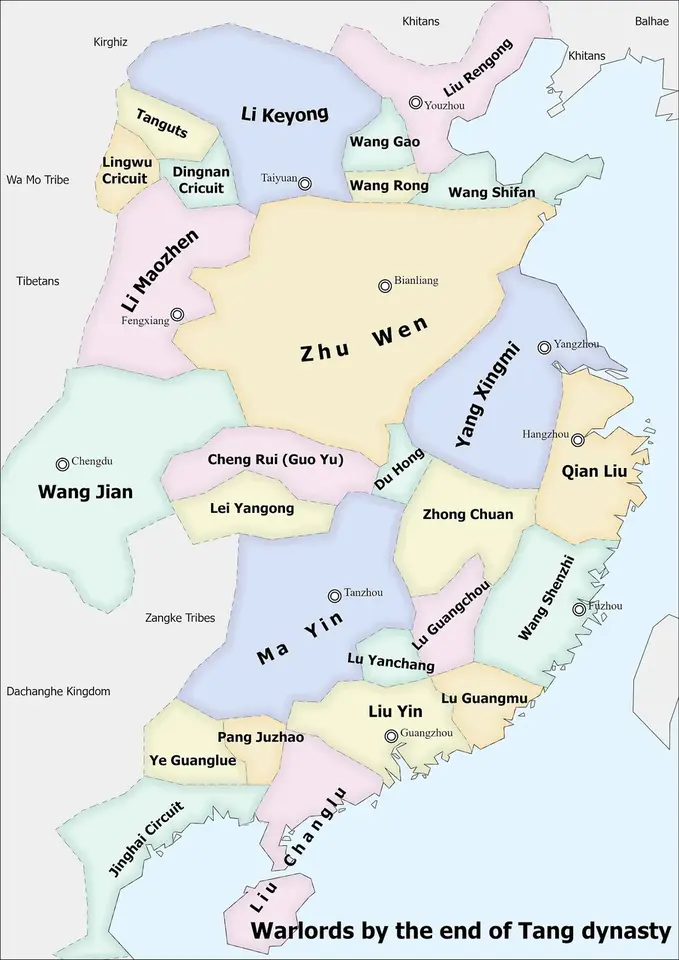
Following the suppression of the Huang Chao Rebellion, central imperial authority in the Tang Dynasty evaporated, plunging China into unchecked warlord anarchy. Operating from his base in Bianzhou, Xuanwu Military Governor Zhu Wen (Zhu Quanzhong) waged unrelenting campaigns across northern China, conquering neighboring commanderies. After inflicting severe defeats upon Hedong Military Governor Li Keyong, Zhu Wen controlled vast territories stretching from Guanzhong in the west to the sea in the east, and from the Huai River to the Yellow River, emerging as the dominant warlord of northern China.
In 901, Fengxiang Military Governor Li Maozhen conspired with eunuchs to abduct Emperor Zhaozong to Fengxiang. In 903, Zhu Wen besieged Fengxiang, compelling Li Maozhen to execute the eunuchs and surrender the monarch. Zhu Wen escorted Emperor Zhaozong back to Chang'an and slaughtered hundreds of palace eunuchs, terminating a century of eunuch domination. In early 904, Zhu Wen systematically dismantled Chang'an's imperial palaces, floating the timber down the Wei and Yellow rivers to Luoyang, forcibly moving the court. In August 904, Zhu Wen directed commanders Zhu Yougong, Shi Shucong, and Jiang Xuanhui to murder Emperor Zhaozong in the palace, placing thirteen-year-old Prince Li Zhu (Emperor Aidi) on the throne. Assuming the titles of Chancellor of State and Prince of Liang with the Nine Bestowals, Zhu Wen's dynastic usurpation was imminent.
Despite monopolizing supreme military authority, Zhu Wen encountered stubborn institutional and psychological resistance from the imperial scholar-gentry. Prestigious aristocratic lineages—such as the Pei of Hedong, Dugu of Henan, Cui of Boling, and Wei of Jingzhao—had monopolized the chancellorship, nine ministries, and Hanlin Academy for centuries. These aristocratic grandees prided themselves on pedigree and classical decorum, privately despising Zhu Wen as a coarse rebel bandit and refusing to grant moral legitimacy to his impending ascension.
Among Zhu Wen's inner circle, advisor Li Zhen served as a vengeful instigator. Born into humble circumstances, Li Zhen possessed sharp intellect but failed the imperial examinations repeatedly over twenty years during the Xiantong and Qianfu reigns. In late Tang aristocratic society, candidates without clan pedigree suffered humiliation and scorn from aristocratic examiners, breeding within Li Zhen an obsessive hatred toward the entire scholar-official class. Entering Zhu Wen's service, Li Zhen became an indispensable confidant, continually preaching that aristocratic ministers were treacherous and must be physically eradicated. Concurrently, upstart Chancellor Liu Can sought to consolidate his influence by purging senior statesmen, conspiring with Li Zhen to formulate a comprehensive purge.
In the spring of 905 (the 2nd year of Tianyou), Zhu Wen accelerated preparations for imperial usurpation. To eliminate potential royalist resistance from the Li Tang imperial family, Zhu Wen ordered Bureau of Military Affairs Commissioner Jiang Xuanhui to host a banquet at the Nine Bends Pool (Jiuquchi) in Luoyang in February, inviting nine royal princes—including Prince of De Li Yu, Prince of Di Li Xu, and Prince of Qian Li Xi. Once the young princes were incapacitated with wine, soldiers strangled them with cords and cast their bodies into the pool.
Zhu Wen then targeted senior aristocratic ministers. Chancellor Liu Can, who had attained the highest office within four years of passing the examination, was ambitious and unscrupulous. Observing that the monarch was surrounded by Zhu Wen's henchmen, Liu Can flattered the warlord servilely. In contrast, senior Chancellors Pei Shu, Cui Yuan, and Dugu Sun commanded immense prestige and openly disdained Liu Can's opportunism, generating fierce resentment.
When Zhu Wen sought to appoint his favorite court entertainer Zhang Tingfan as Grand Minister of Imperial Rites (Taichangqing), Pei Shu firmly objected in court: "Zhang Tingfan is a meritorious provincial officer; why should he covet the office of imperial ritual music? This cannot reflect the Grand Marshal's true intent!" Pei Shu withheld authorization. Enraged, Zhu Wen fumed to his advisors: "I always believed Pei Shu possessed pure character and avoided petty factionalism; now his insolence is fully revealed!" Liu Can seized this opening to fabricate accusations against Pei Shu, Cui Yuan, and Dugu Sun.
In March, Zhu Wen stripped Dugu Sun of his chancellorship, banishing him as Military Governor of Jinghai in Annan; Pei Shu was demoted to Left Vice Director, and Cui Yuan to Right Vice Director, while compliant officials Zhang Wenwei and Yang She were made chancellors. Yang She, a gentle scholar who dreaded the lethal political atmosphere, wept with his family upon receiving the appointment, warning his son Yang Ningshi: "This is a great misfortune for our house and will surely bring calamity upon you!"
Soon after, a blazing white comet swept across the night sky. Astrologers proclaimed: "A celestial comet portends impending catastrophe for both ruler and ministers; only blood purges can appease the heavens." Capitalizing on this omen, Liu Can submitted a roster of aristocratic ministers to Zhu Wen, asserting: "These men gather in secret to slander state policy; executing them will avert celestial disaster!"
Li Zhen reinforced the counsel: "State governance is paralyzed because these pretentious aristocrats corrupt imperial discipline. Furthermore, your Highness seeks the imperial throne, and these ministers will never submit. It is best to wipe them out completely!" Zhu Wen assented.
A devastating purge ensued. Dugu Sun was banished to Dizhou, Pei Shu to Dengzhou, and Cui Yuan to Laizhou. Minister of Personnel Lu Yi was demoted to Puzhou, and Minister of Works Wang Pu to Zizhou. Veteran statesmen including Retired Grand Tutor Zhao Chong and Vice Minister of War Wang Zan were banished to peripheral prefectures. Renowned scholars across the three secretariats and nine courts were branded "frivolous factions," emptying the imperial court. Subsequently, Zhu Wen issued harsher edicts exiling Pei Shu to the tropical wilderness of Longzhou, Dugu Sun to Qiongzhou on Hainan Island, and Cui Yuan to Baizhou.
Exiling the ministers did not appease Li Zhen's vengeance or Zhu Wen's desire to eliminate opposition. Li Zhen warned Zhu Wen: "These ministers possess networks of clients throughout the provinces. Exiling them invites external warlords to rally around them; they must be put to death before they cross the border!" Zhu Wen dispatched elite Xuanwu cavalry to intercept the traveling exiles.
On the 1st day of the 6th lunar month in 905 (July 5, 905), Xuanwu cavalry detained Pei Shu, Dugu Sun, Cui Yuan, Lu Yi, Wang Pu, Zhao Chong, and Wang Zan—totaling over thirty senior ministers—at Baima Station along the Yellow River in Hua Prefecture.
That night, amidst heavy rain and the roar of the Yellow River, Xuanwu cavalry surrounded the post station with drawn blades. An officer read an imperial decree ordering the ministers to commit suicide for treason. Pei Shu wept aloud, while others cursed the usurpers. Soldiers charged in with cords and swords, strangling and butchering the defenseless ministers, drenching the station courtyard in blood.
Following the slaughter, Xuanwu officers asked Li Zhen how to dispose of the bloody corpses. Remembering two decades of examination failures and aristocratic snobbery, Li Zhen sneered with vindictive pleasure, offering his infamous proposal to Zhu Wen: "These gentlemen always proclaimed themselves the pure stream (qingliu); let us cast them into the Yellow River, and make them a muddy stream (zhuoliu) forever!"
Zhu Wen laughed heartily and approved. Xuanwu soldiers dragged the bodies of Pei Shu, Dugu Sun, Cui Yuan, Lu Yi, and thirty other ministers, hurling them into the swirling muddy waters of the Yellow River, which swallowed them completely.
Following the massacre, terror paralyzed the surviving officials, and many fled into seclusion. Zhu Wen pursued remaining kin relentlessly: ordering the execution of retired Grand Commandant Pei Zhi; demoting junior magistrates related to Pei, Cui, and Dugu to distant border posts; and executing dozens of scholars who had merely agreed with him that a willow tree was suitable for making wheel hubs. In late 905, Zhu Wen executed his former conspirators Liu Can and Jiang Xuanhui and strangled Empress Dowager He to conceal his regicide.
The medieval aristocracy was wiped out physically. In April 907, Zhu Wen forced sixteen-year-old Emperor Aidi to abdicate, inaugurating the Later Liang Dynasty. Emperor Aidi was poisoned the following year. The murky waters of Baima Station drowned the last vestiges of the Great Tang.
The Baima Disaster concluded with the total physical extermination of over thirty senior Tang chancellors and ministers, whose bodies were cast into the Yellow River. Accompanied by the assassination of nine imperial princes, the massacre eradicated both the Li Tang imperial family and the aristocratic leadership. Through terror and bloodshed, Zhu Wen destroyed all institutional opposition, paving the way for his formal coronation as Emperor of Later Liang in 907.
The disaster stands as a watershed in the institutional evolution of imperial China. First, it marked the permanent demise of the medieval aristocratic clan system (shizu menfa) that had dominated governance since the Eastern Han, Wei, Jin, and Northern and Southern dynasties. Illustrious clans—such as the Pei, Cui, Lu, and Dugu—were eradicated as political forces, enabling the emergence of a meritocratic, plebeian scholar-officialdom in the Song Dynasty. Second, it extinguished classical court decorum and Confucian constitutional constraints, inaugurating fifty-three years of unbridled warlord violence, dynastic instability, and moral decay throughout the Five Dynasties and Ten Kingdoms period. Third, the catastrophic lesson of unchecked warlordism profoundly influenced Song Taizu Zhao Kuangyin, inspiring his foundational policies of centralizing military commands and privileging civil administration over martial power.