Departure from Chang'an
Driven by textual ambiguities, Xuanzang defies imperial curfews to embark upon his journey to India
· HISTORICAL EVENT
玄奘西行取经
Xuanzang's Pilgrimage for Scriptures and Translation Enterprises (玄奘西行取经) was a monumental seventeen-year overland pilgrimage to India followed by nearly two decades of state-sponsored translation endeavors directed by Master Xuanzang during the early Tang dynasty. During the Sui and early Tang eras, Chinese Buddhist scholasticism was paralyzed by contradictory scriptural interpretations and deficient translations regarding Buddha-nature and the stages of…
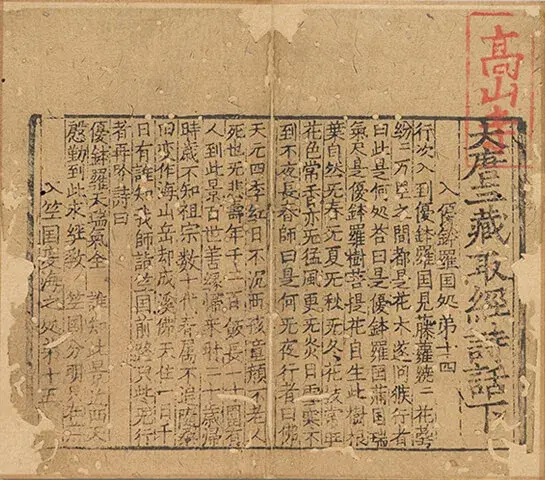
Xuanzang's Pilgrimage for Scriptures and Translation Enterprises (玄奘西行取经) was a monumental seventeen-year overland pilgrimage to India followed by nearly two decades of state-sponsored translation endeavors directed by Master Xuanzang during the early Tang dynasty. During the Sui and early Tang eras, Chinese Buddhist scholasticism was paralyzed by contradictory scriptural interpretations and deficient translations regarding Buddha-nature and the stages of spiritual enlightenment. In 627, Xuanzang vowed to travel to India to obtain the original Sanskrit text of the Yogacarabhumi-sastra. Traveling alone across scorching deserts and frozen mountain ranges, he studied for five years at Nalanda Monastery under Abbot Silabhadra, mastering Mahayana metaphysics and subduing rival philosophers at the celebrated Kanauj assembly. Returning to Chang'an in 645 with 657 Sanskrit manuscripts, Xuanzang was granted supreme state patronage by Emperor Taizong and Emperor Gaozong. Operating from imperial translation academies at Hongfu and Da Cien Monasteries, Xuanzang instituted a rigorous nine-tiered translation protocol. Over nineteen years, his bureau produced 75 major scriptural translations encompassing 1,335 fascicles—including the massive six-hundred-fascicle Great Prajnaparamita Sutra—while dictating the seminal twelve-volume Great Tang Records on the Western Regions and supervising the construction of the Giant Wild Goose Pagoda. This endeavor founded the Faxiang Yogacara school, established the benchmark of New Translations, and transformed Chang'an into the intellectual capital of East Asian Buddhism.
Driven by textual ambiguities, Xuanzang defies imperial curfews to embark upon his journey to India
Studies Yogacara metaphysics under Silabhadra for five years, achieving renown across the Five Indies
Defends his Mahayana thesis for eighteen days at the Kanauj assembly, acclaimed as Mahayanadeva
Returns to Chang'an with 657 Sanskrit texts; Taizong receives him in Luoyang and funds the translation bureau
Bianji transcribes Xuanzang's dictation to complete the Great Tang Records on the Western Regions
Xuanzang oversees the construction of the Giant Wild Goose Pagoda to house the Sanskrit scriptures
Completes the Great Prajnaparamita Sutra and passes away at Yuhua Palace, mourned by over one million citizens
Event Name: Xuanzang's Pilgrimage for Scriptures and Translation Enterprises (玄奘西行取经); Alternative Name: Master Xuanzang's Quest for the Dharma (唐玄奘西行求法), Xuanzang's Quest and Translation of Scriptures (玄奘取经译经); Event Type: Religious Pilgrimage and Classical Scriptural Translation Project (宗教文化求法与典籍翻译工程); Dynasty: Tang (唐代); Location: Chang'an (Da Cien Monastery, Hongfu Monastery, Giant Wild Goose Pagoda) and Indian Kingdoms; Time Period: 627 (First Year of Zhenguan) - 664 (First Year of Linde); Parties Involved: Tang Imperial Court (Emperor Taizong, Emperor Gaozong), Master Xuanzang, Imperial Translation Bureaus; Key Figures: Xuanzang (Chen Yi), Emperor Taizong of Tang, Emperor Gaozong of Tang, Bianji, Silabhadra; Cause: Pervasive scriptural deficiencies and doctrinal conflicts in Chinese Buddhism, motivating Xuanzang to retrieve original Sanskrit texts and establish national translation bureaus; Outcome: Retrieval of 657 Sanskrit texts, nineteen years of imperial translations yielding 1,335 fascicles, compilation of the Great Tang Records on the Western Regions, and founding of the Faxiang school; Impact: Fully erected the philosophical edifice of East Asian Yogacara Buddhism, created a peerless paradigm of scientific translation, and profoundly enriched Asian cultural exchange;
Since Buddhism's initial transmission during the Eastern Han dynasty, the translation of Sanskrit sutras relied heavily upon itinerant Central Asian monks. Because early translators frequently borrowed indigenous Daoist and Neo-Daoist terminology to render complex Buddhist metaphysics, fundamental technical terms became obscured. By the Sui and early Tang dynasties, southern and northern monastic traditions clashed bitterly over the nature of Alayavijnana (storehouse consciousness) and whether all living beings possessed inherent Buddha-nature. The young monk Xuanzang traveled across major monastic centers in Luoyang, Chang'an, and Chengdu, observing that scholars adhered to divergent commentaries without consensus. The foundational Yogacara manual, Asanga's hundred-fascicle Yogacarabhumi-sastra, existed in China only as fragmented summaries. Xuanzang concluded that only an unmediated examination of original Sanskrit manuscripts at the Indian source could resolve domestic theological disputes.
Following the accession of Emperor Taizong, ongoing military friction against the Eastern Turkic Khaganate prompted the imperial court to enforce strict travel curfews across the Guanzhong basin and Hexi corridors. In 627, Xuanzang repeatedly submitted formal memorials requesting imperial travel passes, but his applications were rejected by imperial authorities. While his traveling companions abandoned the enterprise in despair, Xuanzang swore never to take a single step backward toward the East until he reached India. Leveraging an autumn famine that led officials to temporarily permit refugees to seek food along the Hexi Corridor, Xuanzang mingled among displaced commoners and slipped past frontier checkpoints, embarking upon a 50,000-li trek across the uncharted continent.
Reaching northern India after overcoming mortal desert perils and glacial mountain blizzards, Xuanzang toured the sacred sites of the Ganges river plain. In 631, he entered Nalanda Monastery, the premier Buddhist university of ancient Asia, where he was received by the centenarian master Silabhadra. Under Silabhadra's direct tutelage, Xuanzang spent five intensive years mastering the Yogacarabhumi-sastra alongside epistemological and linguistic treatises, becoming one of only ten scholars at Nalanda proficient in fifty distinct scriptural corpuses.
Following his graduation, Xuanzang traveled extensively throughout southern, western, and eastern India, visiting regional monastic centers and collecting rare canonical recensions. Returning to Magadha, he authored the Treatise on the Harmony of the Teachings in three thousand verses, harmonizing the theoretical discord between Madhyamaka emptiness and Yogacara consciousness, followed by the Treatise Demolishing Heretical Views to refute external sectarian critiques. In 642, King Harsha convened the historic Kanauj assembly, where Xuanzang defended his Mahayana thesis for eighteen days without a single detractor able to challenge his logic, earning the supreme honorific title Mahayanadeva. In 643, Xuanzang declined all royal entreaties to remain, embarking upon his homeward journey laden with 150 sacred relics, seven sacred statues, and 657 Sanskrit palm-leaf manuscripts.
In the first month of 645, after seventeen years of arduous travel, Xuanzang returned to the Tang capital of Chang'an. Emperor Taizong dispatched Grand Chancellor Fang Xuanling to coordinate an unprecedented state welcoming ceremony at Zhuque Gate. Flanked by imperial guards and civil dignitaries, hundreds of thousands of citizens lined the capital avenues, burning incense and chanting hymns as the sacred texts were solemnly installed within Hongfu Monastery.
In the second month of 645, Emperor Taizong granted Xuanzang a personal audience at the Yiluan Hall in Luoyang. Struck by Xuanzang's commanding intellect, geographical mastery, and steadfast composure, Taizong repeatedly urged the master to renounce his monastic vows and serve as Grand Chancellor. Xuanzang gracefully declined, expressing his single-minded dedication to translating the sacred scriptures for the spiritual benefit of the empire. Moved by the master's selfless devotion, Emperor Taizong authorized the establishment of an imperially funded national translation academy, pledging full state treasury funding for all translation operations.
In the fifth month of 645, Xuanzang officially inaugurated the national translation bureau at Hongfu Monastery, subsequently relocating to the magnificent royal Da Cien Monastery. Xuanzang selected more than twenty of the empire's most distinguished scholar-monks—including Shentai, Jingmai, Bianji, Puguang, and Daoxuan—while the imperial court appointed senior scholar-bureaucrats to oversee literary style and historical accuracy. Xuanzang formulated an exceptionally rigorous nine-tiered division of labor protocol: distinct functionaries handled primary translation, doctrinal verification, Sanskrit text verification, scribal transcription, stylistic polishing, grammatical review, collation, final standardization, and literary refinement, eliminating ambiguities through collective scholarly debate.
Over nineteen continuous years of monastic labor, Xuanzang imposed strict personal translation quotas, working late into the night beneath candlelight whenever interrupted by administrative obligations. Rejecting the paraphrasing methods of earlier eras, Xuanzang pioneered a literal, mathematically rigorous translation standard known as the New Translations, creating thousands of standardized Buddhist Chinese terms. Before his death at Yuhua Palace in 664, Xuanzang translated 75 individual scriptures comprising 1,335 fascicles—including the colossal six-hundred-fascicle Great Prajnaparamita Sutra and foundational texts such as the Cheng Weishi Lun—surpassing in volume the cumulative output of all preceding translation bureaus in Chinese history.
Simultaneously, recognizing the strategic importance of Central Asian intelligence for imperial defense, Emperor Taizong commissioned Xuanzang to compile a comprehensive geographical account of his travels. Dictated by Xuanzang and compiled by his disciple Bianji, the twelve-volume Great Tang Records on the Western Regions was completed in 646. The work preserved meticulous empirical accounts of 110 surveyed city-states and twenty-eight documented kingdoms, earning high imperial praise and prompting Emperor Taizong to author his celebrated Preface to the Sacred Teachings.
In 652, to safely preserve the fragile Sanskrit palm-leaf manuscripts against fire and dampness, Xuanzang petitioned Emperor Gaozong and personally supervised the architectural design of the Giant Wild Goose Pagoda at Da Cien Monastery. Drawing upon his definitive translations of Yogacara treatises, Xuanzang and his foremost disciple Kuiji founded the Faxiang Yogacara school (also known as the Cien school), elevating Buddhist philosophical logic to its conceptual apex. During the reigns of Emperor Gaozong, scholars from Silla, Baekje, Goguryeo, and Japan flocked to Da Cien Monastery, transmitting Xuanzang's philosophical lineage across the East Asian cultural sphere.
Xuanzang's enterprise represented the undisputed zenith of ancient cross-cultural translation and intellectual synthesis. The 657 Sanskrit scriptures he retrieved completely filled the canonical voids of Chinese Buddhism. Operating through his scientifically structured nine-tiered translation bureau across nineteen years, Xuanzang translated 75 works comprising 1,335 fascicles, exceeding the cumulative translations of all prior masters. His twelve-volume Great Tang Records on the Western Regions and the monumental Giant Wild Goose Pagoda stand as enduring world cultural monuments.
Xuanzang's enterprise permanently expanded the intellectual horizons of East Asian civilization. Philosophically, the Faxiang Yogacara school introduced sophisticated Buddhist epistemology and causal logic, elevating Chinese philosophical discourse to unprecedented analytical rigor and sparking the development of Japanese Hosso and Korean Yogacara traditions. Methodologically, his translation protocol established the earliest institutional model of collaborative scientific translation in global history. Historically, the Great Tang Records on the Western Regions served as the primary archaeological blueprint guiding nineteenth- and twentieth-century rediscoveries of ancient Indian heritage, including Nalanda, Sarnath, and Kapilavastu. Culturally, Xuanzang's unyielding search for truth became an immortal symbol of human perseverance, inspiring the literary masterpiece Journey to the West.