Establishment of Five Classics Chairs
Emperor Wu adopted Dong Zhongshu's counsel to dismiss other schools and appoint Erudites for the Five Classics
Western Han (西汉) · HISTORICAL EVENT
经学
Classical Studies (Jingxue, 经学) represents the paramount interpretive tradition and state ideological system of imperial China, centered on the exegesis, commentary, and philosophical elucidation of the Confucian Five Classics and later Thirteen Classics. Established as state orthodoxy in 136 BCE under Emperor Wu of Han through the creation of Erudite Chairs (Boshi) for the Five Classics, Jingxue governed intellectual life, official appointments, and…
Classical Studies (Jingxue, 经学) represents the paramount interpretive tradition and state ideological system of imperial China, centered on the exegesis, commentary, and philosophical elucidation of the Confucian Five Classics and later Thirteen Classics. Established as state orthodoxy in 136 BCE under Emperor Wu of Han through the creation of Erudite Chairs (Boshi) for the Five Classics, Jingxue governed intellectual life, official appointments, and moral jurisprudence for more than two millennia. The tradition developed across distinct historical epochs: the cosmological, teleological debates of the Western Han New Text School; the philological rigor and comprehensive synthesis achieved by Zheng Xuan in the Eastern Han Old Text School; the metaphysical reinterpretation (Xuanxue) during the Wei-Jin period; the state-mandated harmonization in the Tang dynasty Wujing Zhengyi; the inward, speculative reordering around the Four Books by Song Neo-Confucians like Zhu Xi; the inductive phonological and historical evidential scholarship (Kaozheng) of the Qing dynasty; and finally, the radical institutional reinterpretation by Kang Youwei in the late Qing. Serving as the primary medium of dialogue between dynastic authority (fatong) and moral-intellectual authority (daotong), Jingxue anchored China's political philosophy, judicial reasoning, and social governance until the fall of the imperial order.
Emperor Wu adopted Dong Zhongshu's counsel to dismiss other schools and appoint Erudites for the Five Classics
Emperor Wu adopted Gongsun Hong's advice to enroll students at the Taixue, linking classical proficiency directly to official promotion
Emperor Xuan convened classical scholars to resolve canonical differences, expanding official chairs to twelve New Text traditions
Liu Xin petitioned the imperial court to grant official academic chairs to Old Text classics, sparking deep factional warfare
Emperor Zhang convened scholars at White Tiger Hall; Ban Gu compiled the Baihu Tongyi, formulating unified state canonical doctrine
Zheng Xuan annotated the entire classical corpus, creating the Zheng School and overcoming centuries of New-Old Text disputes
Wang Bi authored commentaries on the Changes, stripping away apocryphal numerology in favor of abstract Xuanxue philosophical inquiry
Kong Yingda's imperial compendium was officially issued, unifying northern and southern schools as the statutory examination standard
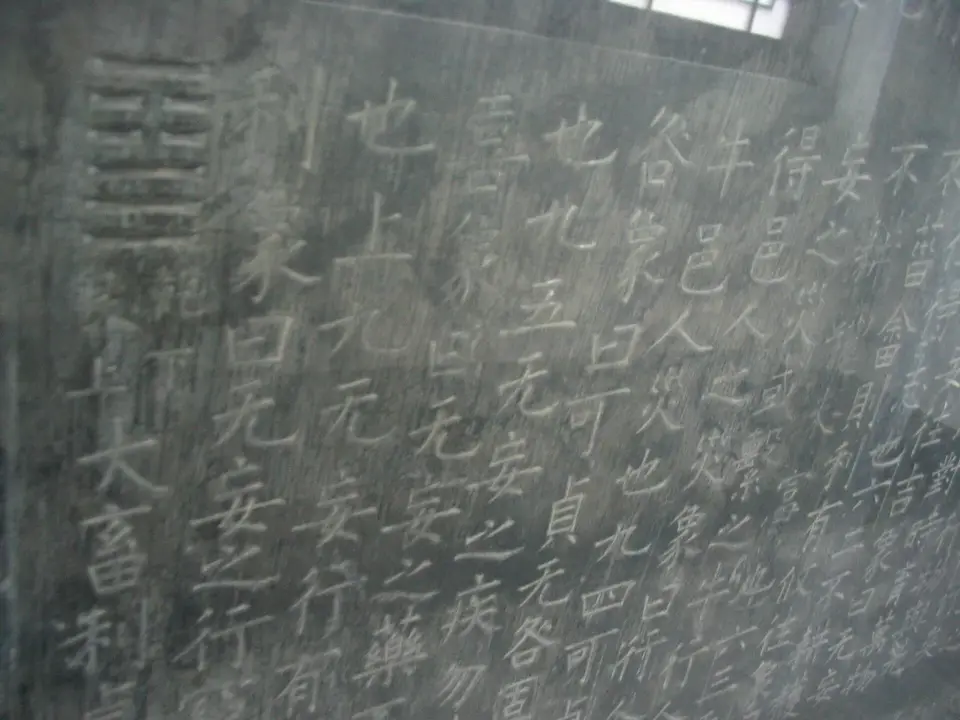
The Tang court engraved twelve classical texts onto stone tablets at the Imperial Academy in Chang'an, fixing official textual standards
Zhu Xi published Sishu Zhangju Jizhu, elevating the Four Books above the Five Classics and framing the core of later state orthodoxy
Ruan Yuan published 1,400 volumes of Qing evidential scholarship, synthesizing the zenith of philological textual research
Kang Youwei utilized New Text doctrines to champion the 1898 Reforms, after which the 1911 Revolution ended the canon's role as state orthodoxy
During the late Spring and Autumn period, Confucius edited and compiled archaic texts into the Six Classics—namely the Classic of Poetry, Classic of Documents, Classic of Rites, Classic of Music, Classic of Changes, and Spring and Autumn Annals—using them as primary curricula for his disciples. In the Warring States period, prominent thinkers such as Mencius and Xunzi extensively elaborated upon canonical doctrines. Following the unification of China, Qin Shi Huang adopted Chancellor Li Si's harsh policy in 213 BCE to burn private philosophical books and prohibit unauthorized Confucian teachings, preserving only utilitarian texts on medicine, agriculture, and divination, along with court archival copies. During the chaotic civil wars following the fall of Qin, Xiang Yu captured and torched the imperial palaces in Xianyang, destroying the imperial library. Except for the Classic of Changes, which survived due to its classification as a divination manual, early canonical bamboo and silk manuscripts were largely incinerated and dispersed.
In the early Western Han dynasty, Emperors Gaozu, Wen, and Jing prioritized political stabilization and economic recovery through Huang-Lao Daoist non-action (wuwei), leaving little institutional bandwidth for state-sponsored classical education. Nevertheless, surviving elderly Qin Erudites, such as Fu Sheng reciting the Classic of Documents from memory, began secretly preserving and reciting canonical passages, gradually reviving classical study among private circles. By the accession of Emperor Wu, decades of agricultural recovery had enriched the imperial treasury, while the court faced urgent challenges: centralizing authority against autonomous feudal kingdoms, launching strategic campaigns against the Xiongnu, and constructing unified imperial institutions. The passive doctrines of Huang-Lao governance no longer served an expansive, centralized empire. Confucianism, with its emphasis on cosmic hierarchy, filial piety, righteous governance, and political unification (dayitong), offered the ideal philosophical framework for imperial legitimacy.
In 140 BCE, Emperor Wu summoned scholars across the empire to evaluate governance principles. Dong Zhongshu submitted his celebrated memorials on Heaven and Human Resonance, urging the throne to eliminate all doctrines that fell outside the Six Arts and Confucian teachings. In 136 BCE, Emperor Wu formally appointed Erudite Chairs (Boshi) dedicated exclusively to the Five Classics. In 124 BCE, adopting Chancellor Gongsun Hong's proposal, the court established fifty official student positions at the Imperial Academy (Taixue) and permitted commanderies to send promising youths for classical study, guaranteeing administrative appointments for those mastering one or more classics. Consequently, classical scholarship became permanently integrated with bureaucratic recruitment, establishing the widespread social conviction that mastering one classic surpassed inheriting a chest of gold.
The classical chairs established during the Western Han belonged exclusively to the New Text (Jinwen) tradition. New Text classics were transcribed into the clerical script (lishu) from oral recitations by early Han elders. Rigorous lineages of transmission emerged, known as "master models" (shifa) and "family traditions" (jiafa). The number of official chairs expanded to twelve following the Shiqu Pavilion Conference in 51 BCE under Emperor Xuan, and reached fourteen under Emperors Yuan and Cheng. The New Text school centered its theoretical doctrine on the Gongyang Commentary to the Spring and Autumn Annals. Dong Zhongshu and his contemporaries expounded the "esoteric words and profound meanings" (weiyan dayi), cosmological cycles of three unities, and portents of omens and disasters (zaiyi). They instituted the practice of "judging legal cases by the Annals" (Chunqiu jueyu), directly applying classical moral principles to judicial sentencing and transforming Confucian exegesis into divine statecraft.
During the late reign of Emperor Jing, Prince Gong of Lu demolished Confucius's ancestral mansion to expand his palace, uncovering hidden ancient manuscripts inscribed in pre-Qin archaic script (guwen), including the Old Text Documents, Rites, Zuo Commentary, and Classic of Filial Piety. Around the same period, Prince Xian of Hejian, Liu De, collected pre-Qin administrative texts from the populace, including the Offices of Zhou (Zhouguan, later known as the Rites of Zhou), depositing them in the imperial archives. Under Emperor Xuan, an ancient manuscript of the Documents was uncovered in Henan. Because these archaic texts exhibited distinct chapters, alternate wordings, and institutional details that differed from the New Text versions, they were collectively termed the "Old Text Classics."
During the reigns of Emperors Cheng and Ai, imperial librarians Liu Xiang and his son Liu Xin systematically collated the imperial collection. Liu Xin recognized the systematic institutional integrity of the archaic texts and vigorously petitioned the throne in 6 BCE through his fiery Memorial Admonishing the Erudites of the Court of Imperial Sacrifices, castigating the New Text chairs for dogmatic obstinacy and careerist complacency. This provoked fierce political backlash from the entrenched New Text establishment, forcing Liu Xin into temporary exile. When Wang Mang usurped the throne to found the Xin dynasty, he leveraged Old Text classics—especially the Rites of Zhou—as ideological blueprints for his archaizing reforms, elevating Old Text scholars to official status and appointing Liu Xin as State Master.
Following the restoration of the Han dynasty by Emperor Guangwu, the official academic chairs reverted strictly to the fourteen New Text lineages due to the collapse of Wang Mang's regime. In 28 CE, Guangwu briefly considered establishing chairs for the Zuo Commentary and the archaic Fei's Changes, but abandoned the effort amid ferocious opposition from conservative New Text Erudites and the sudden demise of designated scholar Li Feng. Thereafter, the Old Text school survived primarily in private academies. However, while late New Text scholarship degenerated into tedious, superstitious apocryphal treatises (chenwei) that filled hundreds of thousands of words for a single character, Old Text scholars focused on historical philology, phonology, and archaic institutional history. Figures like Du Lin, Wei Hong, Zheng Zhong, Jia Kui, Xu Shen, and Ma Rong cultivated thousands of students, gradually eclipsing the intellectual prestige of official New Text teachers.
In 79 CE, Emperor Zhang convened the White Tiger Hall Conference in Luoyang to reconcile ideological disputes between New and Old Text traditions. Ban Gu compiled the conference findings into the Comprehensive Discussions in the White Tiger Hall (Baihu Tongyi), which codified state orthodox doctrine and integrated apocrypha with classical morals. Nevertheless, New Text influence continued to wane. In the late Eastern Han, He Xiu devoted seventeen years to composing the Exegesis of the Gongyang Commentary, offering a masterly synthesis of New Text eschatological stages of history. Simultaneously, Old Text master Zheng Xuan transcended factional dogmatism. Using Old Text versions as his foundation while integrating insightful New Text interpretations, Zheng Xuan produced definitive commentaries on the entire canonical corpus, establishing the revered "Zheng School." Zheng's synthesis effectively concluded centuries of factional rivalry and marked the zenith of Han dynasty classical exegesis.
During the Three Kingdoms Period, classical study shifted from meticulous glosses toward philosophical reflection. In the Cao Wei state, intellectual conflict erupted between the Zheng School and the "Wang School" founded by Wang Su (father-in-law of Sima Zhao). Bolstered by Sima political backing, Wang Su's commentaries gained official standing, highlighting the deep entanglement of classical scholarship with court factionalism. Concurrently, during the Zhengshi era (240–249 CE), Wang Bi and He Yan pioneered Metaphysical Learning (Xuanxue). Wang Bi commented on the Changes and Laozi, discarding Han apocryphal numerology in favor of abstract philosophical analysis, fundamentally revolutionizing the interpretive framework. He Yan's Collected Explanations of the Analects incorporated insightful Han-Wei commentaries, transforming the text into a philosophical touchstone for literati discourse.
During the Northern and Southern Dynasties, territorial division fostered contrasting academic traditions. Southern scholars, immersed in metaphysical debates, favored concise, philosophical formulations: Wang Bi's edition of the Changes, the Pseudo-Kong Anguo Documents, and Du Yu's Collected Explanations of the Zuo Commentary predominated. Northern scholars, operating under northern non-Han dynasties and retaining archaic cultural habits, adhered faithfully to Han exegetical traditions, specializing in granular phonology, ritual terminology, and institutional regulations, taking Zheng Xuan for the Changes and Documents, and Fu Qian for the Zuo Commentary. Contemporary observers summarized this contrast: "Southerners were succinct, grasping the radiant flower; northerners were pedantic, exhausting the leaves and branches."
Following the reunification of China by the Sui and Tang dynasties, the institutionalization of the imperial examination system demanded standardized classical textbooks. In the Zhenguan era, Emperor Taizong commissioned Kong Yingda, Chancellor of the Imperial Academy, to oversee a coalition of eminent northern and southern scholars in compiling unified sub-commentaries (shu). Completed and promulgated in 653 CE under Emperor Gaozong, the Orthodox Meaning of the Five Classics (Wujing Zhengyi) established the definitive textbook for the Mingjing and Jinshi examinations.
The compilation of the Wujing Zhengyi harmonized four centuries of regional discord and established the ironclad rule that "commentaries do not dispute the canon, and sub-commentaries do not overturn commentaries." Between 833 and 837 CE, during the Kaicheng era, the Tang government carved the text of twelve Confucian classics onto massive stone stelae erected at the Imperial Academy in Chang'an, known to history as the "Kaicheng Stone Classics." Promulgated through imperial authority, this standardized corpus solidified imperial ideological hegemony and spread across East Asia, serving as administrative and philosophical benchmarks for kingdoms in Korea and Japan.
Following the turbulence of the late Tang and Five Dynasties, the unquestioned authority of Tang imperial commentaries eroded. In the Northern Song, the rise of the Ancient Prose Movement and intellectual introspection inspired thinkers like Ouyang Xiu, Wang Anshi, and the Northern Song Masters (Zhou Dunyi, Cheng Hao, Cheng Yi, Zhang Zai, and Shao Yong) to doubt, emend, and excise disputed passages of ancient commentaries. Rejecting pedantic glosses, Song scholars declared that "the Six Classics comment on me, and I comment on the Six Classics," seeking direct insight into the sage's original mind and metaphysical truth.
In the Southern Song, Zhu Xi completed this intellectual transformation by extracting the "Great Learning" and "Doctrine of the Mean" from the Classic of Rites and combining them with the Analects and Mencius to form the Four Books, authoring his monumental Collected Commentaries on the Four Books (Sishu Zhangju Jizhu). Meanwhile, Mencius was officially elevated into the canonical pantheon, expanding the tradition into the Thirteen Classics. Zhu Xi's synthesis placed the Four Books above the Five Classics in moral and metaphysical importance. When the Yuan dynasty reinstated imperial examinations in 1315, Zhu Xi's commentaries were designated as the sole official standard for examination essays. The Ming dynasty subsequently compiled the Great Compendia of the Four Books and Five Classics, cementing Cheng-Zhu Neo-Confucianism as undisputed state orthodoxy. In the mid-Ming, Wang Yangming articulated the School of Mind, teaching "innate moral knowledge" (liangzhi) and the "unity of knowing and acting," further redirecting classical learning toward internal moral intuition.
Following the traumatic fall of the Ming dynasty, scholars like Gu Yanwu, Huang Zongxi, and Wang Fuzhi attributed the empire's collapse to the empty moralizing of late Ming intuitionists, advocating "practical statecraft" and rigorous empirical study under the slogan "classical study is the study of principle." Under Qing imperial autocracy and literary inquisitions, Qianlong and Jiaqing intellectuals channeled their energy into apolitical evidential research (Kaozheng), founding the influential Wu and Wan schools of Han Learning. Scholars like Dai Zhen, Hui Dong, Qian Daxin, and Duan Yucai revitalized Han exegetical methodologies, applying meticulous phonology, paleography, and collational rigor to identify textual corruptions and forged works. Governor-General Ruan Yuan compiled the 1,400-volume Imperial Qing Exegeses of the Classics (Huangqing Jingjie), bringing evidential classical scholarship to its ultimate philological summit.
In the nineteenth century, as Western imperialist encroachments threatened the Qing Empire, apolitical evidential scholarship proved inadequate to address mounting crises. The New Text School of the Changzhou tradition experienced a dramatic resurgence. Zhuang Cunyuan and Liu Fenglu revived Gongyang political doctrines, while Wei Yuan and Gong Zizhen utilized the theory of historical evolution to advocate institutional reform. Following the defeat in the First Sino-Japanese War, Kang Youwei authored Study of the Classics Forged during the Xin Period and Confucius as a Reformer, asserting that the Old Text classics were forged by Liu Xin and presenting Confucius as an enlightened political reformer who created ancient precedents to authorize radical institutional modernization. This New Text framework served as the primary philosophical engine behind the Hundred Days' Reform of 1898.
Following the 1911 Revolution and the establishment of the Republic of China, Minister of Education Cai Yuanpei officially abolished canonical recitations in primary and secondary schools in 1912. The iconoclastic New Culture Movement and the Doubting Antiquity School (Gushi Bian) systematically dismantled the divine authority of the classics, reinterpreting them as historical and literary artifacts rather than sacred moral statutes. Jingxue ceased to operate as imperial state orthodoxy, transitioning into modern academic sub-disciplines including classical philology, Chinese philosophical history, and paleography.
Throughout its evolution of more than two millennia, Jingxue transitioned through the Western Han New Text official chairs, the private Eastern Han Old Text resurgence, Zheng Xuan's grand synthesis, Wei-Jin metaphysical exegesis, the Tang imperial unification in Wujing Zhengyi, the Song Neo-Confucian Four Books framework, and the rigorous Qing evidential movement, before culminating in late Qing New Text reformist thought. Following the 1911 Revolution that overthrew dynastic rule, the Ministry of Education of the Republic of China officially abolished classical recitation in schools in 1912. Accelerated by the New Culture and Doubting Antiquity movements, the classics were stripped of their sacred dogma and relocated into universities and research institutes as historical documents, effectively concluding the role of Jingxue as an institutionalized governing orthodoxy.
Jingxue profoundly shaped imperial Chinese civilization and the broader East Asian Sinosphere. Politically, the cosmological theories of Heaven-Human Resonance, moral legitimacy, and centralized unity provided the legal authority and self-limiting mechanisms of imperial rule, enabling civil officials to advise and check the throne through canonical exegesis. Legally and socially, the tradition of adjudicating trials via the Annals Confucianized Chinese law, embedding filial piety and ritual hierarchy into judicial practice and customary life. Academically, the rigorous requirements of canonical commentary spurred the birth and flourishing of Chinese philology, phonology, paleography, textual collation, and epigraphy, preserving invaluable cultural treasures. Moreover, classical learning extended across Korea, Japan, and Vietnam, where it shaped bureaucratic administration, public education, and social morality for centuries.