Outbreak of War
Britain and France launch the Second Opium War following the Arrow Incident and Chapdelaine execution.
Qing Dynasty (清朝) · HISTORICAL EVENT
天津条约 (中英法美俄)
The Treaty of Tientsin refers collectively to four unequal treaties concluded in June 1858 between the Qing Empire and four foreign powers—Russia, the United States, Great Britain, and France—during the Second Opium War. Following the fall of the strategic Dagu Forts, Anglo-French naval forces advanced directly into Tianjin along the Hai River, placing the imperial court in Beijing under immediate military threat. Emperor Xianfeng dispatched imperial…
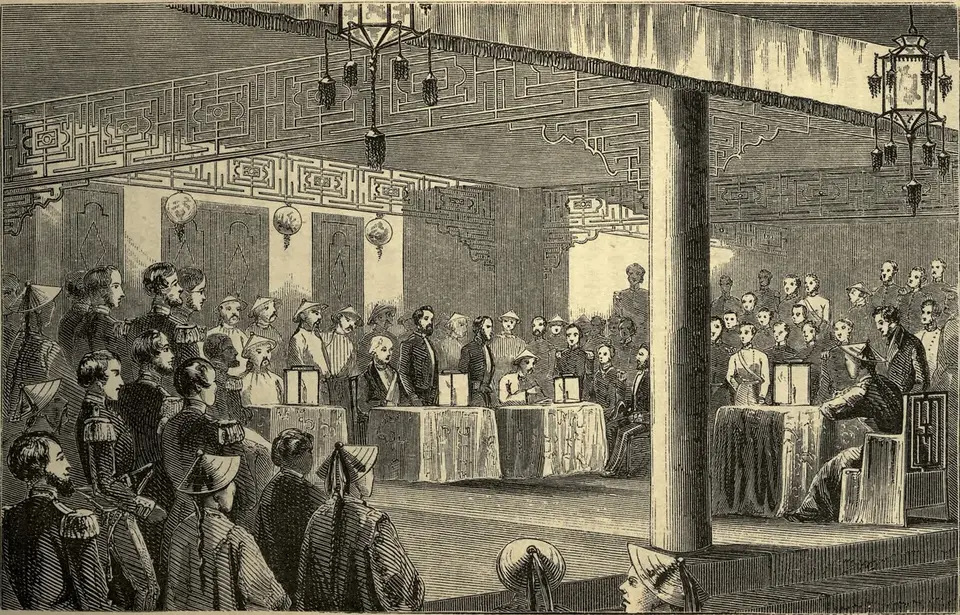
The Treaty of Tientsin refers collectively to four unequal treaties concluded in June 1858 between the Qing Empire and four foreign powers—Russia, the United States, Great Britain, and France—during the Second Opium War. Following the fall of the strategic Dagu Forts, Anglo-French naval forces advanced directly into Tianjin along the Hai River, placing the imperial court in Beijing under immediate military threat. Emperor Xianfeng dispatched imperial commissioners Guiliang and Hua Shana to conduct emergency negotiations at Haiguang Temple. Coerced by ultimatums and gunboat diplomacy, the Qing representatives yielded to sweeping demands, including resident foreign legations in Beijing, eleven additional treaty ports along coasts and the Yangtze River, interior travel and missionary rights, foreign gunboat navigation on inland waterways, and massive financial indemnities. The settlement profoundly altered East Asian international relations and intensified China's semi-colonial subjugation.
Britain and France launch the Second Opium War following the Arrow Incident and Chapdelaine execution.
Anglo-French forces capture Guangzhou and take Viceroy Ye Mingchen captive before sailing north.
Allied naval bombardment captures the Dagu Forts, allowing gunboats to reach Tianjin.
Guiliang and Hua Shana sign the Sino-Russian Treaty of Tientsin at Haiguang Temple.
The Sino-American Treaty of Tientsin is executed, incorporating sweeping most-favored-nation rights.
Qing commissioners yield to Elgin and Gros ultimatums, signing the Sino-British and Sino-French treaties.
Following the conclusion of the 1842 Treaty of Nanking, Western capitalist powers grew increasingly dissatisfied with their limited trade privileges and sought broader access to China's vast interior markets. In the 1850s, Great Britain, supported by France and the United States, invoked the twelve-year treaty revision clause to demand total commercial opening, legalization of the opium trade, diplomatic representation in Beijing, and the elimination of internal transit transit taxes. The Qing court rejected these aggressive demands.
In October 1856, British colonial authorities seized upon the Arrow Incident in Guangzhou as a pretext for open hostilities. Simultaneously, Napoleon III used the execution of illegal Catholic missionary Auguste Chapdelaine in Guangxi to forge an Anglo-French military coalition. In late 1857, allied forces bombarded and captured Guangzhou, taking Governor-General Ye Mingchen prisoner. Encouraged by their swift success, the allied commanders resolved to strike at the imperial center in northern China.
In spring 1858, British plenipotentiary Lord Elgin and French envoy Baron Gros sailed northward with an allied fleet to the mouth of the Bohai Sea. Meanwhile, Russian envoy Euphimy Putyatin and American diplomat William B. Reed accompanied the fleet, masquerading as neutral mediators while coordinating joint diplomatic pressure. After the Qing viceroy of Zhili hesitated to accept their escalating terms, British and French gunboats launched a savage bombardment on April 20, overcoming Qing defenses and capturing the Dagu Forts within hours.
Allied gunboats immediately navigated up the Hai River and anchored at the Sancha estuary in Tianjin, merely a hundred miles from the capital. Overwhelmed by panic, the Xianfeng Emperor hastily appointed Grand Secretary Guiliang and Minister of Personnel Hua Shana as imperial commissioners with discretionary negotiating powers, ordering them to proceed immediately to Tianjin to avert an imminent allied march on Beijing.
In early June 1858, Guiliang and Hua Shana established their negotiating headquarters at Haiguang Temple south of Tianjin. Allied commanders adopted a domineering posture, anchoring ironclad gunboats prominently on the river and threatening to advance immediately on Tongzhou and shell Beijing if their demands met the slightest resistance. Meanwhile, Russian and American envoys acted as duplicitous intermediaries, extracting reciprocal concessions while feeding tactical intelligence to the allied belligerents.
Russia struck first. Envoy Putyatin exploited Qing anxieties by presenting himself as a peaceful neighbor eager to mediate peace. Under this veneer, Putyatin pressured the commissioners into signing the Sino-Russian Treaty of Tientsin on June 13, comprising twelve articles. In addition to securing consular posts, commercial privileges in seven ports, and religious liberties, Article 9 ambiguously stipulated that undefined northern boundaries would be surveyed and demarcated later, creating a legal lever for the subsequent annexation of vast territories north of the Amur and east of the Ussuri rivers under the Treaty of Aigun.
On June 18, American envoy William B. Reed signed the Sino-American Treaty of Tientsin, consisting of thirty articles. While maintaining a facade of non-violent friendship, the United States secured the opening of Chaozhou and Taiwan, tariff reductions, expanded consular jurisdiction, and a comprehensive most-favored-nation clause. This provision guaranteed that any commercial, legal, or territorial privilege granted to any European empire would automatically and unconditionally extend to the United States.
With American and Russian treaties concluded, Britain and France intensified their diplomatic offensive. Lord Elgin formulated an exhaustive fifty-six-article treaty accompanied by four uncompromising non-negotiable ultimatums: permanent foreign diplomatic residence in the imperial capital without traditional kowtow ceremonies; unrestricted navigation of the Yangtze River by foreign commercial and naval vessels; opening of ten new ports along coastal and riverine regions including Hankou, Jiujiang, and Nanjing; and unrestricted interior travel for foreign merchants and missionaries carrying consular passports, alongside four million taels of silver in war indemnities.
Emperor Xianfeng was deeply horrified by the demands for capital residency and interior navigation, viewing them as fatal threats to dynastic stability and ancestral etiquette. He dispatched the veteran negotiator Qiying to Tianjin in a desperate bid to mitigate terms. However, Elgin possessed secret Qing archives captured at Guangzhou exposing Qiying's past deceptive appeasement strategies. British interpreters Thomas Wade and Horatio Nelson Lay publicly confronted and humiliated Qiying in open conference, causing him to flee back to Beijing, where the emperor ordered him to commit suicide.
Qiying's disgrace destroyed the last remnants of Qing diplomatic resistance. Elgin delivered a final ultimatum giving the commissioners forty-eight hours to accept the treaty intact or face an immediate military march on the capital. Faced with total catastrophe, Guiliang and Hua Shana buckled entirely, deciding to sign the document in Tianjin as a temporary delaying tactic to secure the withdrawal of foreign forces, hoping to renegotiate the most humiliating clauses later in Shanghai.
On the evening of June 26, 1858, Guiliang and Hua Shana affixed their imperial seals to the Sino-British Treaty of Tientsin at Haiguang Temple. The following day, June 27, French envoy Baron Gros imposed the forty-two-article Sino-French Treaty of Tientsin, extorting two million taels of silver in reparations and securing special imperial protections for Catholic evangelism and property ownership. Within two weeks, the four humiliating treaties were fully executed, opening the floodgates to foreign domination.
The Treaty of Tientsin dismantled the traditional East Asian tributary order and severely diminished Chinese sovereignty. The establishment of permanent foreign diplomatic legations in Beijing dismantled the long-standing tributary etiquette system, eventually forcing the Qing court to establish the Zongli Yamen as China's first modern foreign affairs ministry. Furthermore, granting Christian missionaries legal protection to propagate faith and acquire property deep in the interior sparked intense anti-foreign sentiments and numerous anti-missionary uprisings across provincial China.
Economically, the opening of eleven new treaty ports—including Niuzhuang, Dengzhou, Taiwan, Tamsui, Chaozhou, Qiongzhou, Hankou, Jiujiang, Nanjing, and Zhenjiang—combined with interior Yangtze navigation rights, permitted foreign commercial capital and subsidized manufactured commodities to flood the most productive agricultural and commercial regions of central China. This economic penetration devastated indigenous handicraft industries and traditional canal transport networks.
Finally, the crushing indemnities totaling six million taels imposed severe fiscal burdens on Qing treasuries. Because Emperor Xianfeng subsequently sought to evade treaty enforcement and prevent foreign ministers from entering Beijing, the unresolved contradictions triggered the 1859 Dagu clash and the 1860 Anglo-French invasion that culminated in the burning of the Old Summer Palace and the Convention of Peking.
Modern and traditional historians regard the Treaty of Tientsin as a critical benchmark in the erosion of China's national independence. The Draft History of Qing lamented that the Haiguang Temple agreements dismantled all natural defenses, leaving the interior entirely vulnerable to foreign exploitation.
Western scholars, including John King Fairbank, analyzed the treaty system established at Tianjin as an unprecedented institutional framework that integrated China into the global treaty port network. By subordinating traditional imperial governance to foreign extraterritoriality and external customs supervision, the settlement permanently locked nineteenth-century China into a semi-colonial trajectory.