Imperial Decree to Reform the Calendar
Following the fall of the Southern Song, Kublai Khan decrees a comprehensive reform of the calendar.
Yuan Dynasty (元朝) · HISTORICAL EVENT
授时历
The Promulgation of the Shoushi Calendar (授时历, lit. "Season-Granting Calendar") was a landmark astronomical and mathematical reform carried out from 1276 to 1281 CE (from the 13th to 18th year of Zhiyuan) under Emperor Shizu (Kublai Khan) of the Yuan Dynasty. Synthesizing centuries of observational tradition and computational innovation, the project was directed by prominent scholars Xu Heng, Wang Xun, and Guo Shoujing. Prior to the reform, the empire…
The Promulgation of the Shoushi Calendar (授时历, lit. "Season-Granting Calendar") was a landmark astronomical and mathematical reform carried out from 1276 to 1281 CE (from the 13th to 18th year of Zhiyuan) under Emperor Shizu (Kublai Khan) of the Yuan Dynasty. Synthesizing centuries of observational tradition and computational innovation, the project was directed by prominent scholars Xu Heng, Wang Xun, and Guo Shoujing. Prior to the reform, the empire used the century-old Daming Calendar inherited from the Jin Dynasty, which suffered from accumulating chronological drift and recurrent eclipse miscalculations. Following the conquest of the Southern Song in 1276, Kublai Khan established a special calendar bureau under Left Assistant Administrator Zhang Wenqian and Neo-Confucian master Xu Heng, with mathematician Wang Xun supervising algorithms and polymath Guo Shoujing directing instrumentation and field surveys. Guo invented seventeen precision observational instruments, including the Simplified Armillary Sphere and the Forty-Foot Gnomon, while conducting the vast "Four Seas Survey" spanning from Siberia to the South China Sea. Eliminating the archaic fictional "Superior Epoch" methodology, the bureau determined the tropical year to be 365.2425 days—differing from the modern scientific value by merely 25.92 seconds. Formally promulgated in 1281, the Shoushi Calendar served the Yuan and Ming dynasties for 364 years, representing the zenith of pre-modern astronomy.
Following the fall of the Southern Song, Kublai Khan decrees a comprehensive reform of the calendar.
Xu Heng oversees administration, Wang Xun directs mathematical modeling, and Guo Shoujing manages instrumentation.
Guo Shoujing constructs seventeen advanced observation instruments, elevating shadow measurement precision to the millimeter level.
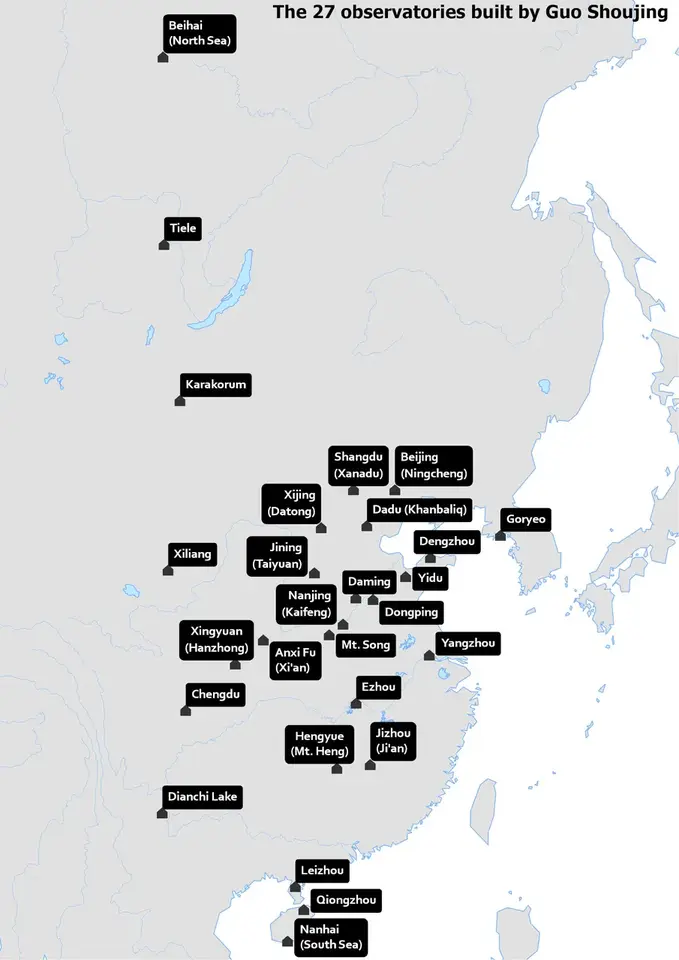
Field teams deploy to twenty-seven stations from Lake Baikal to the Paracel Islands, gathering continental empirical data.
The team abolishes the Superior Epoch, formulating third-order interpolation and spherical trigonometry.
The tropical year is fixed at 365.2425 days; mathematician Wang Xun passes away from exhaustion on the eve of completion.
Kublai Khan reviews the completed calculations at the Wande Hall, christening the system the Shoushi Calendar.
The Shoushi Calendar is officially promulgated across the empire on New Year's Day, establishing a new scientific era.
The Ming Dynasty adopts the algorithms without modification, renaming the system the Datong Calendar for another 276 years.
Japanese astronomer Shibukawa Shunkai utilizes the Shoushi Calendar to compile Japan's first independent national calendar.
In imperial China, the compilation of an authoritative calendar was both an indispensable guide for agrarian production and a paramount ideological symbol of the Mandate of Heaven. From its founding, the Yuan Dynasty retained the Revised Daming Calendar compiled by Jurchen Jin astronomer Zhao Zhiwei in 1180. By the early Zhiyuan era, however, a century of continuous usage had accumulated substantial errors. Predicted solar and lunar eclipses regularly failed to match empirical observations, and seasonal solar terms diverged noticeably from real celestial positions.
In February 1276 (the 13th year of Zhiyuan), Yuan armies under Bayan captured the Southern Song capital of Lin'an (Hangzhou), ending three centuries of geopolitical fragmentation between northern and southern China. The unified empire spanned a vast continental expanse where regional variations in day length and solstice shadows rendered the old northern and southern calendars incompatible. To harmonize administrative governance and agricultural rhythms across the reunited continent, Kublai Khan resolved to abolish obsolete systems and commission a definitive national calendar.
In March 1276, acting upon proposals submitted by senior minister Zhang Wenqian and imperial adviser Liu Bingzhong, Kublai Khan issued an imperial decree establishing an independent Calendar Bureau in the capital Dadu (modern Beijing).
The emperor assembled the most distinguished scientific minds of the medieval world: Neo-Confucian scholar Xu Heng was appointed Director of the Imperial Astronomical Bureau to oversee strategic planning and administrative coordination; mathematical master Wang Xun was designated Grand Astrologer to supervise planetary algorithms and algebraic computations; and polymath Guo Shoujing was named Director of Waterways and Co-Administrator of the Astronomical Bureau, taking charge of instrument engineering and empirical field observations. Assisted by Xingtai scholar Yang Gongyi, this team established the guiding doctrine that "the foundation of calendar making lies in empirical observation, and the instrument of observation lies in precision mechanics," initiating a rigorous scientific overhaul.
Guo Shoujing recognized that chronological precision was fundamentally constrained by the accuracy of observational instruments. The astronomical devices inherited from the Northern Song in Dadu featured nested bronze rings that obstructed fields of view and suffered from mechanical friction.
Between 1276 and 1279, Guo Shoujing designed and constructed twelve large-scale astronomical observation instruments for the imperial observatory, alongside four portable field devices, establishing new standards in mechanical engineering:
First, the Simplified Armillary Sphere (Jianyi). Guo discarded the confusing nested armillary rings of antiquity, separating the equatorial and horizontal coordinate systems into two independent structural components: an equatorial diopter and an azimuth ring. Incorporating miniature copper ball-bearing rollers to reduce rotational friction, Guo's design anticipated the mechanical principles of the modern equatorial telescope mount.
Second, the Forty-Foot Gnomon (Gaobiao) and the Shadow Definer (Jingfu). Traditional eight-foot shadow-measuring gnomons suffered from optical penumbra effects that blurred shadow edges. Guo erected forty-foot bronze and masonry gnomons at Dadu and Gaocheng, scaling height fivefold. Complementing this, he invented the Shadow Definer, an optical pinhole copper plate that projected a focused solar image and gnomon shadow onto a horizontal stone scale, enabling shadow measurements to be read with millimeter precision.
Third, the Upward-Facing Sphere (Yangyi). Guo created a hemispherical copper sundial resembling a concave basin. Inscribed with equatorial coordinate grids, the device used a central pinhole plate to project the sun's rays onto the interior concave surface, enabling direct observation of solar coordinates and solar eclipse magnitudes without blinding the observer.
In addition to these core devices, Guo constructed water-level gauges, polar-sighting tubes, celestial-globe demonstrators (Linglongyi), and portable equatorial sundials. Using these instruments, the bureau conducted continuous day-and-night observations for four years, compiling an unprecedented volume of empirical celestial data.
To eliminate geographical bias caused by observing from a single metropolitan center, Kublai Khan approved Guo Shoujing's ambitious proposal to conduct the "Four Seas Survey" in 1279, executing the most extensive geodetic measurement project of the pre-modern world.
Equipped with portable gnomons and observation spheres, specialized observation teams traversed the imperial realms to establish twenty-seven astronomical stations. The geographical scope was continental: spanning from Goryeo and Dengzhou on the eastern seaboard to Chengdu, Chongqing, and the Dianchi basin in Yunnan; from central cities such as Dadu, Kaiping, Taiyuan, Luoyang, and Hangzhou to Lingnan outposts in Leizhou and Hainan Island. The northernmost station was established at Tiele near Lake Baikal (along the Yenisei River basin in Siberia, at 65 degrees north latitude), near the Arctic Circle, while the southernmost was situated in the South China Sea (the Paracel Islands, at 15 degrees north latitude).
Coordinated by the central observatory in Dadu, the twenty-seven stations conducted synchronized observations during the summer and winter solstices. Teams recorded noon solstice shadow lengths, geographic latitudes based on Polaris elevations, and diurnal time variations. This continental survey supplied an empirical foundation for the new calendar while marking a milestone in geodetic science.
While empirical observations were collected, mathematicians Wang Xun and Guo Shoujing revolutionized mathematical modeling and theoretical algorithms.
Since the Western Han Santong Calendar, astronomers adhered to the mystical concept of the "Superior Epoch" (Shangyuan Jijian), hypothesizing that at an unfathomably distant moment millions of years in the primordial past, the sun, moon, and five planets were aligned in conjunction at the winter solstice. To calculate this arbitrary common multiple, ancient astronomers manipulated empirical data, burdening calendars with cumbersome numerological formulas. Wang Xun and Guo Shoujing abolished the Superior Epoch entirely, adopting a pragmatic epochal baseline fixed at the winter solstice of 1280.
In algebraic computation, the team developed two mathematical breakthroughs: First, the Method of Finite Differences (Zhaochashu). To compute the non-uniform velocities of the sun and moon along the ecliptic, they advanced earlier interpolation methods into third-order polynomial interpolation, matching the mathematical principles formalized four centuries later by Isaac Newton. Second, Spherical Trigonometry (Huoshigeyuanshu). To convert ecliptic coordinates into equatorial coordinates on the celestial sphere, they developed algebraic transformation formulas equivalent to modern spherical trigonometric sines and versines, solving a geometric coordinate conversion challenge that had confounded ancient astronomers.
In the late autumn of 1280, after four years of intensive calculation, the monumental compilation was completed. The bureau organized its findings into multi-volume technical treatises, including the Draft Astronomical Treatise in three volumes, Computational Tables in two volumes, Procedural Step Rules in seven volumes, and comprehensive analytical commentaries.
The definitive calculation established the length of a single tropical year at 365.2425 days (or 365 days, 24 quarters, 2 cents, and 5 mills). Compared to the modern tropical year length of 365.2422 days, the margin of error was a mere 25.92 seconds per year. This value was identical to the Gregorian calendar promulgated in Europe by Pope Gregory XIII in 1582, preceding the Western reform by 301 years.
In November 1280, Kublai Khan granted an imperial audience to Xu Heng and Guo Shoujing at the Wande Hall. Delighted with the achievement, the emperor drew from the ancient phrase "verifying the motions of the sun, moon, and stars to grant the seasons to the people" in the Book of Documents, conferring the title Shoushi Calendar. On New Year's Day of 1281 (the 18th year of Zhiyuan), the Shoushi Calendar was formally promulgated across the empire.
Following its rollout, the Shoushi Calendar achieved unprecedented accuracy, reliably predicting eclipses and planetary conjunctions throughout the remaining century of Yuan rule.
When the Ming Dynasty was founded in 1368, Emperor Taizu instructed the imperial observatory to revise the national calendar. Finding that the mathematical algorithms and tropical year value of the Shoushi Calendar were mathematically unassailable, Ming astronomers retained the numerical tables without alteration, renaming the system the Datong Calendar. The system remained the official calendar of China through the mid-17th century, operating across the Yuan and Ming dynasties for 364 consecutive years.
Beyond China, the calendar reshaped East Asian science. The Goryeo Dynasty adopted the Shoushi Calendar during the reign of King Chungnyeol, and it remained the standard calendar of Korea under the Joseon Dynasty for over two centuries. In Tokugawa Japan, master astronomer Shibukawa Shunkai studied the Shoushi Calendar, using its principles to compile Japan's first indigenous astronomical system, the Jokyo Calendar, in 1684, replacing the ancient Tang dynasty calendar that had been used for eight centuries. The Shoushi Calendar stands as an enduring monument to medieval Chinese science.
The compilation of the Shoushi Calendar concluded in an absolute scientific triumph for the Yuan Dynasty. Over nearly five years of concentrated research, the scientific bureau engineered innovative precision instrumentation, executed the continental Four Seas Survey across twenty-seven stations spanning fifty degrees of latitude, developed third-order polynomial interpolation and spherical trigonometry, and abolished the mystical Superior Epoch. The team determined the tropical year to be 365.2425 days, matching the precision of modern geocentric astronomy. Formally promulgated in January 1281, the calendar provided a unified astronomical framework for the Eurasian empire.
The Shoushi Calendar reshaped medieval world science and East Asian societal governance across multiple dimensions. First, it marked the zenith of traditional Chinese astronomy, instrument engineering, and computational mathematics, achieving a level of solar-year accuracy that matched the 1582 Gregorian calendar while preceding it by more than three centuries. Second, it provided remarkable agrarian and fiscal stability; serving the Yuan for eighty-seven years and adopted verbatim by the Ming as the Datong Calendar for another 276 years, it operated continuously for 364 years as the longest-lived astronomical system in human history. Third, it stimulated East Asian scientific progress, directly inspiring the astronomical developments of the Joseon Dynasty in Korea and providing the foundational models for Shibukawa Shunkai's Jokyo Calendar in Tokugawa Japan.