Introduction of Qin Land Taxes
Shang Yang implemented systematic land taxation and per-acre assessments, creating the need for uniform measurement
Qin Dynasty (秦朝) · HISTORICAL EVENT
统一度量衡
The Unification of Weights and Measures (统一度量衡) was a landmark institutional and technological reform carried out from the late Warring States period through the founding of the Qin Empire. During the chaotic Warring States era, rival principalities maintained disparate metrological units and irregular ratios, severely impeding trade, grain storage, and land taxation. In 344 BCE, Chancellor Shang Yang initiated the reform in Qin by commissioning the…
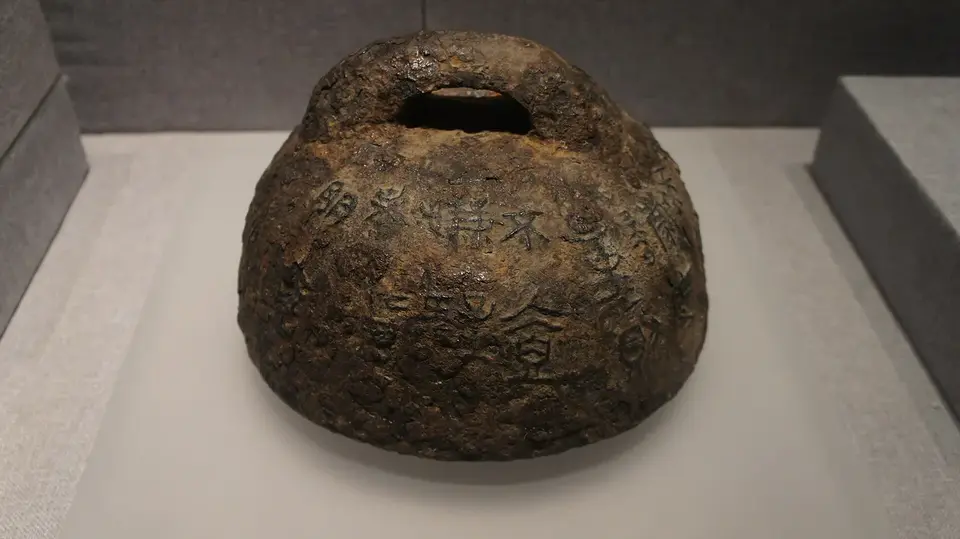
The Unification of Weights and Measures (统一度量衡) was a landmark institutional and technological reform carried out from the late Warring States period through the founding of the Qin Empire. During the chaotic Warring States era, rival principalities maintained disparate metrological units and irregular ratios, severely impeding trade, grain storage, and land taxation. In 344 BCE, Chancellor Shang Yang initiated the reform in Qin by commissioning the bronze Shang Yang Square Sheng, establishing the scientific method of determining capacity through linear cubic dimensions (yi du shen rong). Following the unification of China in 221 BCE, Qin Shi Huang issued his celebrated Twenty-Sixth Year Imperial Edict, extending Qin's standardized metrology across all former rival territories. The imperial court distributed tens of thousands of officially certified bronze and iron weights and measures inscribed with the imperial decree, established strict spring and autumn calibration schedules, and penalized inaccuracies under comprehensive legal statutes. Alongside standardizing the axle gauge and script, this metrological unification dismantled the economic foundations of regional feudalism and shaped Chinese imperial fiscal administration for over two thousand years.
Shang Yang implemented systematic land taxation and per-acre assessments, creating the need for uniform measurement
Supreme Commander Shang Yang commissioned the bronze Square Sheng, applying cubic dimensions to capacity and standardizing Qin units
Qin Shi Huang conquered the six states and promulgated the forty-character edict ordering complete imperial metrological standardization
Imperial workshops mass-produced bronze and iron weights and measures, distributing them across the empire's commanderies
The Qin court enforced the Xiao Lu statutes, penalizing dimensional deviations and instituting annual government calibrations
Qin Er Shi issued an edict reaffirming his father's standardization, casting Two-Edict Bronze Weights across imperial commanderies
During the Spring and Autumn and Warring States periods, the collapse of Zhou royal authority led to regional political fragmentation and independent metrological traditions. Each principality operated under different units of measure and mutually incompatible exchange rates. In the State of Qi, the Tian clan famously altered grain capacity ratios from four sheng per dou to ten fu per zhong to curry favor with the peasantry, while capacity standards in the Three Jins, Yan, and Chu differed widely. In weight systems, Chu utilized the zhu, liang, jin, and yi (twenty liang), whereas northern states measured mass in varied jin or jin units. These discrepancies paralyzed inter-regional commerce, complicated commodity pricing, and posed enormous administrative hurdles for imperial grain taxation, labor conscription, and military logistics.
In 361 BCE, Duke Xiao of Qin ascended the throne and recruited talented ministers to revitalize the state. Shang Yang entered Qin and instituted comprehensive legal and administrative reforms centered on agriculture and warfare. To accurately survey farmland and levy agricultural taxes equitably, Shang Yang standardized field dimensions by legally defining one pace (bu) as six feet (chi) and one mu as two hundred and forty square paces, penalizing anyone exceeding the six-foot pace. In 348 BCE, as Qin instituted formal land taxation, Shang Yang sought to eliminate measurement discrepancies in grain collection and official salaries. In 344 BCE, he officially promulgated a unified system of weights and measures, laying the administrative and technological foundation that transformed Qin into a formidable, centralized military power.
In the twelfth month of the eighteenth year of Duke Xiao (344 BCE), Shang Yang, bearing the rank of Supreme Commander (Daliangzao), supervised the fabrication of the official standard capacity vessel known as the Bronze Shang Yang Square Sheng (Shang Yang Fang Sheng). Inscriptions carved onto the vessel's exterior recorded that on this date, Shang Yang established the capacity of one sheng as exactly sixteen and one-fifth cubic inches (cun). This formulation introduced the rigorous scientific principle of determining volume through linear dimension (yi du shen rong), allowing capacity to be verified through geometric measurement rather than variable grain piles.
Beyond capacity, Shang Yang established precise conversion ratios across linear and weight measures throughout Qin. Length was organized into the cun, chi, zhang, and yin, each following a strict decimal progression. Weight was structured through the zhu, liang, jin, jun, and dan (shi), strictly enforcing twenty-four zhu to one liang, sixteen liang to one jin, thirty jin to one jun, and four jun to one dan (one hundred and twenty jin). Government workshops produced standard measuring vessels distributed to granaries and treasuries across Qin commanderies, ensuring standardized taxation and military manufacturing throughout the reigns of King Huiwen and King Zhaoxiang.
In 221 BCE, King Ying Zheng conquered the six rival states, establishing the first unified centralized empire in Chinese history. In the newly conquered territories, traditional measuring standards diverged sharply from Qin norms, often shielding local nobility who hid taxable land and manipulated grain collection. To eliminate regional economic independence and consolidate fiscal control, Qin Shi Huang adopted the counsel of Chancellors Li Si, Wang Wan, and Kui Zhuang to standardize weights and measures across the empire.
Qin Shi Huang issued the famous Imperial Edict of the Twenty-Sixth Year, a forty-character imperial statute: "In the twenty-sixth year, the Emperor completely annexed the feudal lords, brought great peace to the black-haired people, and assumed the title of Emperor. He thereupon ordered Chancellors Zhuang and Wan to clarify and standardize all discordant and doubtful measurements of legal rules and weights." The central government mandated that this proclamation be cast, carved, or inlaid onto bronze and iron measuring devices distributed to every commandery and county. Numerous excavated weights and measures, including the reverse of the Shang Yang Square Sheng, feature this imperial edict, confirming that the empire systematically universalized Qin's pre-existing standards across the realm.
To ensure universal compliance, the imperial Directorate for Imperial Domestic Affairs (Shaofu) oversaw state workshops in casting tens of thousands of standard weights and measures matching imperial prototypes, dispatching them to local administrative seats.
In weight systems, the empire manufactured standardized hemispherical and conical bronze and iron weights (quan), equipped with arched suspension rings at the top. The weights bore incised imperial decrees and nominal denominations, ranging from one dan (120 jin, approximately 30 kilograms), thirty jin (one jun), twenty-four jin, sixteen jin, eight jin, five jin, down to one jin and fractional liang. Excavated one-dan bronze weights from Shaanxi, Gansu, and Shanxi demonstrate remarkable precision, weighing between 30 and 30.75 kilograms.
In capacity and linear measures, the court cast cylindrical and deep basin-shaped bronze, iron, and ceramic measures inscribed with the twenty-sixth-year edict, maintaining exact capacity parity with the Shang Yang Square Sheng. Imperial rulers crafted of bronze or bone fixed the statutory foot (chi) at 23.1 centimeters, divided into ten inches, serving as mandatory benchmarks for carpentry, civil architecture, and textile commerce.
The Qin state backed its metrological standards with comprehensive judicial enforcement. According to statutes discovered in the Shuihudi Qin bamboo slips (Xiao Lu, Statutes on Verification), local magistrates were required to conduct mandatory annual inspections of all official and commercial weights and measures, comparing them directly against certified imperial reference units. Devices exhibiting physical wear or altered dimensions were immediately withdrawn for government recalibration.
The Qin legal code established meticulous mathematical tolerances alongside severe penalties. Under the Xiao Lu, if a weight diverged from official accuracy by more than one-sixteenth of an ounce (one zhu), the supervising official was formally reprimanded or fined a shield; larger deviations incurred penalties of complete suits of armor. In capacity vessels, discrepancies exceeding one-thirtieth of a sheng triggered severe bureaucratic fines. Furthermore, following ancient cosmological traditions recorded in the Lüshi Chunqiu, local authorities conducted public inspections during the mid-spring and mid-autumn equinoxes, adjusting instruments for seasonal temperature variations to maintain public commercial integrity.
In 210 BCE, Qin Shi Huang died during his eastern inspection tour, and his son Huhai ascended the throne as the Second Emperor. To affirm the continuity of imperial law and honor his father's achievements, Qin Er Shi issued a supplementary decree in 209 BCE, stating that the standardization of weights and measures was an eternal monument to the First Emperor that must be permanently maintained. The Second Emperor ordered this supplementary proclamation engraved alongside the original twenty-sixth-year edict on existing and newly forged standard instruments.
Artefacts bearing both decrees are recognized in modern archaeology as Qin Two-Edict Bronze Weights (Qin Liangzhao Tongquan) and Two-Edict Capacity Vessels. Their widespread recovery across northern and central China confirms that Qin metrological unification remained effective and institutionally continuous until the fall of the dynasty, completing a historical arch spanning four generations of rulers from Duke Xiao and Shang Yang to Qin Shi Huang and Huhai.
The Qin unification of weights and measures brought an end to centuries of metrological discord across the Warring States. By leveraging imperial authority, central state manufacturing, and penal statutes, Qin successfully deployed an integrated measuring network extending from Gansu to the eastern sea, and from the northern Great Wall to the southern territories of Lingnan. Although dynastic warfare accompanied the fall of Qin, the metrological system was entirely inherited by the Han dynasty and recorded in the Book of Han, forming the administrative foundation of imperial measurement across the Han, Tang, Song, Ming, and Qing dynasties.
Politically and economically, the unification dismantled local economic barriers, reduced transaction costs in commercial exchange, and promoted the integration of a unified domestic market. In fiscal governance, standard linear and volume measures provided indisputable statutory benchmarks for land surveying, agricultural taxation, bureaucratic salaries, and military logistics, greatly strengthening imperial mobilization. Scientifically, the "determination of volume by linear measure" embodied in the Shang Yang Square Sheng represented a brilliant breakthrough in metrology, harmonizing spatial geometry and volume calibration. Alongside the standardization of script and chariot axles, uniform weights and measures consolidated the institutional and psychological foundations of unified Chinese civilization.