Cao Pi Establishes the Wei Dynasty
Cao Pi forces Emperor Xian of Han to abdicate; severe surveillance is imposed upon imperial princes, and Cao Zhi's closest allies Ding Yi and Ding Yi are executed.
Cao Wei (曹魏) · HISTORICAL EVENT
《洛神赋》
The composition of the Rhapsody on the Goddess of the Luo River (Luo Shen Fu) ((洛神赋)), originally titled Gan Juan Fu (Rhapsody on Stirrings at Juancheng), refers to the creation of an immortal lyrical masterpiece by the renowned Cao Wei poet Cao Zhi in late 222 CE (the third year of the Huangchu era of the Cao Wei Dynasty). Written while returning to his principality of Juancheng after paying court to Emperor Wen (Cao Pi) in Luoyang, the rhapsody…
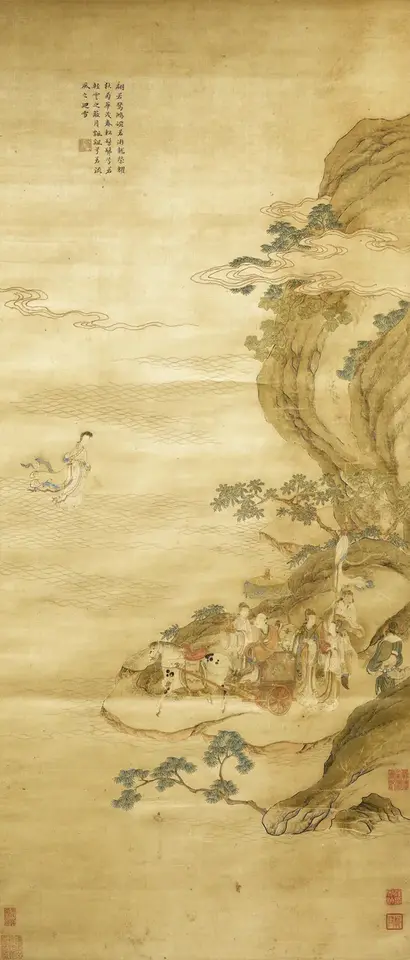
The composition of the Rhapsody on the Goddess of the Luo River (Luo Shen Fu) ((洛神赋)), originally titled Gan Juan Fu (Rhapsody on Stirrings at Juancheng), refers to the creation of an immortal lyrical masterpiece by the renowned Cao Wei poet Cao Zhi in late 222 CE (the third year of the Huangchu era of the Cao Wei Dynasty). Written while returning to his principality of Juancheng after paying court to Emperor Wen (Cao Pi) in Luoyang, the rhapsody was composed on the banks of the Luo River. Crushed by political marginalization, the execution of his closest confidants, and intense fraternal surveillance, Cao Zhi drew upon the literary precedents of Song Yu's Rhapsody on the Divine Maiden and Qu Yuan's Nine Songs to fashion this enduring work of art. The rhapsody weaves a fictional narrative of the poet encountering Mifei, the goddess of the Luo River, across the twilight waters. The two fall deeply in love and exchange sacred pledges, yet are inexorably torn apart because "the paths of mortals and gods are forever divided." Through dazzling poetic descriptions such as "floating gracefully like a startled swan, twisting languidly like a swimming dragon" and "fluttering gently like drifting snow whirled by the wind," Cao Zhi created the archetypal portrait of transcendent feminine grace in Chinese literature. The creation of this work marked the aesthetic zenith of Jian'an literature, leaving a profound impression on literature, painting, and calligraphy for two millennia.
Cao Pi forces Emperor Xian of Han to abdicate; severe surveillance is imposed upon imperial princes, and Cao Zhi's closest allies Ding Yi and Ding Yi are executed.
Accused by imperial overseers of arrogance, Cao Zhi is demoted from Marquis of Pingyuan to Marquis of Anxiang, and later relocated as Marquis of Juancheng.
Cao Pi issues an edict elevating Cao Zhi to King of Juancheng with 2,500 households; provincial princes are summoned to Luoyang for imperial audience later in the year.
Following formal audience, Cao Zhi is ordered to depart Luoyang immediately, journeying through the Yique and Huanhuan mountain passes toward the Luo River.
Encamped at the postal station along the Luo River, inspired by the myth of Mifei and his political misfortunes, Cao Zhi pens the lyrical masterpiece Gan Juan Fu.
Emperor Wen dies and Emperor Ming (Cao Rui) succeeds; to observe his late mother Empress Wenzhao's (Lady Zhen) naming taboo, he retitles the work Luo Shen Fu.
Painter Gu Kaizhi creates the narrative scroll Nymph of the Luo River, and calligrapher Wang Xianzhi writes the Thirteen Lines in Small Regular Script, initiating centuries of artistic adaptations.
In the twenty-fifth year of the Jian'an era (220 CE), King Cao Cao died in Luoyang. His eldest surviving son Cao Pi succeeded as King of Wei and soon forced Emperor Xian of Han to abdicate, establishing the Cao Wei Dynasty and proclaiming the Huangchu era. Deeply mindful of late Eastern Han factional strife and regional warlordism, Emperor Wen instituted a rigorous policy of containment against his own imperial relatives. Princes were stripped of political power, confined to remote principalities, forbidden from assembling followers, and frequently relocated between impoverished fiefdoms under the watchful eye of imperial overseers (fangfu zhiguan).
Under this oppressive regime, the vibrant literary circles that had flourished under Cao Cao's patronage were violently dismantled. As Cao Pi's primary former rival for the heir apparent position, Cao Zhi became the foremost target of imperial suspicion. In 220 CE, Cao Pi ordered the execution of Cao Zhi's closest allies, Ding Yi and Ding Yi, along with their male kin. In 221 CE, following accusations from imperial overseers, Cao Zhi was demoted from Marquis of Pingyuan to Marquis of Anxiang, and subsequently relocated as Marquis of Juancheng.
Cao Zhi (192–232 CE), courtesy name Zijian, was the third son of Cao Cao and Empress Dowager Bian. Precociously gifted with extraordinary poetic velocity and intellectual brilliance, he had been Cao Cao's favored candidate for the succession. However, his free-spirited temperament, Bohemian disregard for formal court ritual, and heavy drinking allowed the calculating Cao Pi to secure the crown. With Cao Pi's accession, Cao Zhi's political ambitions collapsed entirely, and he lived under constant peril of execution.
In the first month of 222 CE, Cao Pi elevated Cao Zhi to King of Juancheng with a nominal revenue of 2,500 households. Later that year, the court summoned provincial princes to Luoyang for imperial audience. Returning to the capital, Cao Zhi found his former friends executed, the old palaces desolate, and his sovereign brother cold and intimidating. After an audience marked by formal distance and veiled reprimands, Cao Zhi was ordered to depart immediately for his eastern principality, forbidden from lingering in the capital.
In late 222 CE, Cao Zhi set out from Luoyang on his journey east to Juancheng. Traversing the Yique gorges and crossing the rugged Huanhuan mountain passes, his retinue reached the banks of the Luo River. In ancient mythology, the Luo River was the sacred home of Mifei, the daughter of the culture hero Fuxi, who drowned in its waters and became its governing deity. The Chu poet Qu Yuan had immortalized divine longing in The Goddess of the Xiang, while Song Yu established the tradition of mortal encounters with goddesses in his Rhapsody on the Gaotang Shrine and Rhapsody on the Divine Maiden.
Surrounded by the autumn twilight and shimmering waters of the Luo, Cao Zhi reflected upon his fall from grace—from favored royal prince to disenfranchised, monitored vassal. Barred from direct political protest, he sublimated his grief, loneliness, and unfulfilled aspirations into the myth of the water goddess, channeling his yearning for justice and transcendent beauty into an immortal rhapsody.
In the early spring of 222 CE, Cao Zhi was granted the title of King of Juancheng. Although elevated from marquis to king, his practical freedom remained nonexistent. Imperial inspectors and supervisory envoys were stationed permanently at his provincial court, cataloging his movements and reporting the slightest perceived infraction to the capital, forcing Cao Zhi to live in unrelenting vigilance and fear.
In the autumn of that year, an imperial edict summoned the princes to Luoyang. Journeying across the Central Plains to the capital, Cao Zhi revisited the imperial palaces built by his father. During the formal court audience, Emperor Wen sat impassive and distant upon the throne, while Cao Zhi prostrated himself as a humble subject. The joyous days of poetic banquets at Yecheng were gone forever, and the slaughter of his allies Ding Yi and Ding Yi cast an icy pall over his spirit. The imperial court ordered the princes to return to their fiefdoms immediately upon conclusion of the rituals.
In late autumn, Cao Zhi and his retinue departed Luoyang through the Pingcheng Gate. Looking back toward the imperial city, the distant peaks of Mount Taibai and the Yique gorges faded into mist. The road ascended the tortuous Huanhuan mountain pass, where biting autumn winds stripped the trees of foliage. The carriages bumped along stony tracks, and an atmosphere of gloom settled over the travelers. Cao Zhi sat within his carriage, feeling like an uprooted tumbleweed or an ensnared falcon, helpless against imperial whim.
Toward evening, the retinue emerged from the mountain pass and arrived at the banks of the Luo River. The setting sun sank beneath the western hills, casting a bloody red glow across the water. The horses were exhausted and stumbling, and the attendants and drivers were famished and weary. Cao Zhi ordered his party to halt at the postal station along the river. Attendants unharnessed the horses to graze upon the lush meadows of Zhitian, while drivers pitched tents and lit cooking fires beneath the willows. Cao Zhi adjusted his robes and walked alone along the riverbank, gazing out across the vast, rolling waters in the gathering twilight.
Strolling alone on the north bank of the Luo River, Cao Zhi's thoughts surged like the current. Rising in the Xionger Mountains and flowing east to the Yellow River, the Luo was sacred in Chinese myth as the domain of Mifei, daughter of Fuxi, who was said to have drowned while playing in its waters and become its divine spirit. For centuries, poets had celebrated her ethereal appearances to mortals.
Cao Zhi lingered at the water's edge, leaning against the carriage shaft with the mountain slopes at his back. Autumn reeds rustled in the evening breeze, rippling the dark surface of the stream. Suddenly, his eyes were arrested by an astonishing sight. There, beside a misty crag where gentle waves lapped the shore, an ethereal maiden stood poised upon the waters.
The maiden possessed unearthly splendor, appearing to condense spontaneously out of the river mists and evening clouds. She stood upon an isolated islet, radiating serene, incandescent light. Breathless with awe, Cao Zhi turned to his driver and asked in astonishment: "Do you see that person across the water? Who can she be, that her form and countenance should be so breathtakingly wondrous?"
The driver peered into the distance, but beheld only the golden reflections of the setting sun and windblown reeds upon the empty stream. Aware of his master's literary sensitivity, the driver replied: "Your servant has heard from ancient lore that the spirit of this stream is named Mifei. Might the vision that my lord beholds be this very goddess of the Luo? What form and countenance does she present? Your servant would gladly hear my lord describe her."
Prompted by the driver's question, Cao Zhi surrendered completely to his poetic imagination. Casting aside court politics and personal sorrow, he immersed his consciousness in this miraculous encounter. In his visionary gaze, the goddess was endowed with immortal life, opening the curtain upon an extraordinary meeting between the divine and the mortal.
Gazing across the waters at the shimmering goddess, Cao Zhi mobilized the full expressive resources of classical Chinese rhetoric to paint a comprehensive portrait of Mifei's physical perfection, demeanor, and attire, crafting an enduring archetype of transcendent feminine grace.
He commenced with sweeping, dynamic metaphors: "Floating gracefully like a startled swan, twisting languidly like a swimming dragon. Radiant as the autumn chrysanthemum, lush as the spring pine. Veiled as the moon behind light clouds, fluttering like snow whirled by the wind." Her posture combined the startling grace of a waterfowl taking flight with the majestic curves of a rising dragon; her brilliance shone like frost-defying chrysanthemums, and her vitality bloomed like evergreen pines in spring.
Describing her proportions, Cao Zhi celebrated natural harmony: "Seen from afar, radiant as the morning sun ascending through dawn clouds; observed up close, dazzling as a fresh lotus rising from clear waters. Her fullness and slender grace are exquisitely balanced, her height precisely proportioned. Her shoulders appear sculpted, her waist as if bound by silk. Her graceful, slender neck reveals luminous, unblemished skin, unadorned by fragrant oils, untouched by powder." Her natural beauty was flawless, requiring neither cosmetic powders nor artificial enhancements.
Detailing her countenance, Cao Zhi captured exquisite, living nuances: "Her lofty coiffure rises like clouds, her delicate eyebrows curve gracefully. Her red lips gleam brightly, her white teeth sparkle within. Her bright eyes glance with sparkling spirit, dimples playing upon her cheeks. Dazzling in her elegant posture, serene in her tranquil demeanor. Tender in emotion, graceful in bearing, captivating in her speech." The towering coils of her hair and the sweep of her brows framed luminous eyes and dimpled cheeks, combining divine majesty with delicate feminine charm.
In her attire, Cao Zhi portrayed celestial magnificence: "Robed in radiant silks of shimmering hue, adorned with earrings of translucent jasper. Wearing hair ornaments of gold and kingfisher feathers, strung with pearls that illuminate her form. Stepping in embroidered slippers for distant wandering, trailing a flowing skirt of light mist-like gauze. Breathing the delicate fragrance of hidden orchids, she lingers hesitation beside the mountain crag." Clad in gossamer robes and adorned with pearls and kingfisher feathers, she walked with hesitating steps upon the riverbank, diffusing the delicate fragrance of mountain orchids.
Gliding across the surface of the Luo, Mifei moved with weightless steps, her silk slippers kicking up water droplets as fine as dust. Floating with the wind, she advanced and retreated across the misty waters, casting radiant glances toward Cao Zhi. Though no words had been spoken, deep emotional affinity passed between them across the stream. Captivated by her purity and beauty, Cao Zhi felt boundless love surging within his heart.
Yet amidst this wonder, anxiety assailed him. In this remote wilderness, no matchmaker could formalize their union. Fearing that this miraculous encounter might dissolve, Cao Zhi entrusted his declarations to the ripples of the water: "My heart rejoices in her gentle virtue, yet my soul trembles in disquiet. Having no worthy matchmaker to unite us, I entrust my words to the gentle ripples. Wishing that my sincere devotion might precede me, I untie my jade pendant to pledge my love."
To prove his unwavering devotion, Cao Zhi loosened a precious jade pendant from his girdle and cast it toward the goddess as an eternal token of love. Far from rejecting his plea, Mifei was deeply touched by his sincerity. She raised a piece of jasper from the waters, pointed toward the deep river to swear an eternal compact, and presented him with a fragrant sachet in return.
In that glorious moment, the divide between mortal and immortal dissolved in mutual devotion. Yet just as their passion reached its peak, Cao Zhi's political instincts reasserted themselves. He recalled the ancient myth of Zheng Jiaofu encountering river nymphs at the Han River, who bestowed their pendants only to vanish into empty air, leaving him deceived.
More ominously, Cao Zhi realized that as an imperial prince living under constant espionage, any unconventional or reckless passion would be seized upon by court rivals as evidence of unbridled behavior and defiance of moral decorum. Caught in an agonizing internal struggle, Cao Zhi forced himself to pull back: "I composed my countenance and stilled my will, upholding the boundaries of ritual propriety to restrain myself." Forcing away his smile, he retreated behind the cold ramparts of ritual propriety, creating an insurmountable distance between himself and the goddess.
This sudden emotional retreat reflected the deep psychological scars inflicted by the oppressive Cao Wei regime. Cao Zhi was not unfeeling; rather, his capacity for deep emotion made his caution all the more agonizing. Yet imperial tyranny and ritual codes acted as an iron shackle, extinguishing the possibility of pure affection and plunging their romance into inevitable tragedy.
Possessing divine prescience, Mifei immediately perceived Cao Zhi's emotional withdrawal. Chilled by his sudden restraint, deep sorrow and disappointment shadowed her countenance. She hesitated upon the waves, her divine radiance flickering in the gathering gloom.
Hovering between water and sky, now soaring aloft, now diving into the depths, her form drifted like mist, embodying unutterable longing and desolation. She understood that despite their spiritual affinity, the immutable laws governing the mortal and divine realms, combined with mortal social constraints, created a chasm that could never be bridged. Their radiant meeting was doomed to end in parting.
Suddenly, winds whipped the waters, and a magnificent divine assembly emerged to escort the goddess home: "Winged fish leap to guard her chariot, jade chimes ring out in harmony as they depart. Six dragons stand abreast with majestic bearing, drawing her cloud chariot forward. Whales leap alongside the carriage wheels, while water fowl soar overhead as her escort." Flying fish leaped from the foam, bells chimed mournfully in the gale, six dragons pulled her cloud carriage, and great whales and river birds accompanied her flight.
Surrounded by her celestial escort, Mifei mounted the cloud chariot. Rising into the heavens, the chariot sped north over the river hills toward the divine realm. At the final moment of departure, Mifei turned her head toward the lone figure of Cao Zhi, uttering a mournful lament: "I mourn that our joyous meeting cannot be prolonged, I grieve that mortal life is fraught with hardship. I lament that the paths of gods and men are divided, I weep that our prime years cannot be shared. Raising my silk sleeve to wipe my tears, they stream down my collar in torrents. Grieving that our happy bond cannot endure, I leave this divine pendant in eternal remembrance."
Covering her face with her sleeve, her tears cascaded like rain, drenching her gossamer robes. She grieved the cosmic divide that forbade their union, weeping that their love should end in eternal separation. With one final, lingering gaze, she sped into the clouds. In an instant, the divine light vanished, the escort disappeared, and only the dark river remained, murmuring mournfully through the autumn reeds.
With Mifei's departure, the magical luminescence faded, leaving the riverbanks cold and desolate. Cao Zhi stood motionless upon the beach, plunged from ecstasy into despair. A sense of profound emptiness washed over him.
Unable to accept that this celestial vision had dissolved forever, and unwilling to resume his bleak earthly journey, Cao Zhi lingered beside the crags where she had stood. Disregarding his attendants' entreaties, he ordered a boatman to row him upstream against the current, searching in vain for trace of her divine presence: "Turning my back upon the lower shore to scale the heights, my feet move forward while my soul remains behind. Cherishing her image in my sorrowful thoughts, I gaze into the distance with longing grief. Hoping her divine form might reappear, I steer my light boat upstream against the flow. Drifting upon the long river, forgetting to return, my longing grows deeper without end. Through the long night I lie sleepless and troubled, drenched by heavy frost until the dawn."
Drifting upon the river through the freezing autumn night, Cao Zhi tossed in anguish, unable to sleep. Thick frost settled across his robes and the wooden deck. He stood alone in the piercing cold, watching the river until the eastern sky grew pale. Yet the waters remained vast and silent, and the goddess never returned.
At daybreak, his attendants urged him to depart, reminding him that imperial decrees mandated his swift arrival in Juancheng, and that delays would invite political retribution. In utter exhaustion, Cao Zhi returned to the shore. His servants hitched the horses and readied the carriages, entreating their lord to resume his journey.
Climbing into his carriage, Cao Zhi grasped the reins and raised the whip. Yet his gaze turned back unceasingly toward the morning waters of the Luo River. The rhapsody concludes with these heartbreaking lines: "I command my servants to harness the horses, for I must return to my eastern domain. I take up the reins and raise the whip, yet linger in sorrow, unable to tear myself away." This final sigh of grief immortalized the lonely figure of the poet against the vast, indifferent landscape.
This sorrowful ending articulated not only grief for a vanished goddess, but also profound despair over his shattered political destiny. The carriage rolled inexorably eastward, but the poet's spirit remained forever anchored at the water's edge, haunted by an impossible dream.
For nearly two millennia, the deeper intellectual motivations behind Luo Shen Fu have generated intense scholarly debate, crystalizing into three primary interpretive schools: the "Lady Zhen Legend," the "Allegorical Political Admonition," and the "Mythological Aesthetic Expression."
The "Lady Zhen Legend" originated in Tang commentator Li Shan's notes to the Wen Xuan, citing the Han Jin Chunqiu. According to this tradition, Cao Zhi had fallen deeply in love with Lady Zhen in his youth, but his father Cao Cao bestowed her upon Cao Pi, making her Empress Wenzhao. In 221 CE, Lady Zhen was forced to commit suicide by Cao Pi. When Cao Zhi attended court in 222 CE, Cao Pi reportedly bestowed Lady Zhen's embroidered pillow upon him. Returning to his fief, Cao Zhi stayed overnight by the Luo River, where Lady Zhen's spirit appeared to him in a dream, prompting him to compose Gan Zhen Fu (Rhapsody Stirred by Lady Zhen); later, her son Emperor Ming changed the title to Luo Shen Fu to observe his mother's taboo.
However, from the Song Dynasty onward, philologists such as Wang Mao, He Zhuo, and Ji Yun refuted this legend. They pointed out that Lady Zhen was five years older than Cao Zhi and an imperial empress; Cao Pi's surveillance over his brother was ruthless, and had Cao Zhi written such an incestuous piece, Cao Pi would have executed him immediately, while Emperor Ming would never have preserved it in imperial libraries. Scholars proved that the original title Gan Juan Fu referred to Cao Zhi's appointment as King of Juancheng, and that similarity in pronunciation led later romance writers to fabricate the connection with Lady Zhen.
In contrast, the "Allegorical Political Admonition" school dominated classical Confucian commentary. Qing scholars such as Ding Yan and He Zhuo demonstrated that Cao Zhi was writing within the "fragrant herbs and beautiful maidens" tradition of Qu Yuan's Li Sao. In this reading, the goddess symbolized the sovereign and high political ideals, while the insurmountable barrier between mortal and goddess represented the tragic alienation between Cao Zhi and his brother Cao Pi. Through this allegory, Cao Zhi lamented that his immense talents were distrusted and discarded by the imperial court.
Modern literary scholars emphasize the "Mythological Aesthetic Synthesis." They view Luo Shen Fu as an autonomous literary masterwork that transcends specific political grievances. Encountering the ancient mythological site of the Luo River, Cao Zhi fused folk myths, the tragic consciousness of Jian'an intellectuals, and a yearning for transcendent beauty, expressing universal sorrow over the fragility of love and the transience of human life.
This multidimensional perspective reconciles earlier dogmatic debates. Scholars recognize that the greatness of the rhapsody lies precisely in its rich symbolism; Mifei was simultaneously the water goddess of the Luo, the personification of unfulfilled political ideals, and the eternal projection of transcendent perfection.
In the morphological history of Chinese literature, Luo Shen Fu represents a watershed transition from the sweeping epideictic rhapsodies of the Han Dynasty to the intimate, lyrical small rhapsodies of the Six Dynasties. In the Western and Eastern Han, masters such as Sima Xiangru and Yang Xiong produced colossal compositions dedicated to imperial hunts, palace architecture, and cosmic rituals, employing obscure vocabulary under the didactic formula of "offering extensive praise with minimal admonition." Cao Zhi dismantled this formalistic convention, transforming the rhapsody into a vehicle for exploring personal emotion and existential tragedy.
The architectural structure of the rhapsody is tightly unified, flowing with the grace of water. Its prosody balances four- and six-character parallel phrases with irregular meters and lyrical Chu-style particles, creating an intoxicating phonetic harmony. The striking phrases coined by Cao Zhi—"floating gracefully like a startled swan, twisting languidly like a swimming dragon," "walking upon the waves with dust rising from silk stockings," and "glancing with sparkling spirit"—became eternal benchmarks of Chinese descriptions of beauty.
Beyond literature, Luo Shen Fu ignited a vibrant cross-disciplinary tradition in visual and performing arts. In the Eastern Jin Dynasty, the master painter Gu Kaizhi was so moved by the text that he created the handscroll masterpiece Nymph of the Luo River (Luo Shen Fu Tu). Using delicate "iron-wire" lines, Gu Kaizhi visualized Mifei floating across the waves, the dragon-drawn cloud chariot soaring through the sky, and Cao Zhi standing in grief upon the shore, achieving the earliest synthesis of painting and narrative literature in Chinese art.
In calligraphy, Wang Xianzhi, the seventh son of Wang Xizhi, transcribed the text in exquisite small regular script. Surviving as a stone inscription known as the Jade Plate Thirteen Lines, it has been revered for centuries as a supreme model of regular script. In the Yuan Dynasty, master calligrapher Zhao Mengfu repeatedly transcribed the entire rhapsody in running script.
In the Tang Dynasty, poets Li Shangyin and Wen Tingyun frequently wove allusions to Mifei and the pillow into their verses. In the Song Dynasty, Su Shi channeled the spirit of the Luo River in his First Rhapsody on the Red Cliff. In the Ming and Qing periods, the legend was adapted into Kunqu and Peking opera, with modern masters like Mei Lanfang performing the role of the goddess, ensuring that Cao Zhi's masterpiece remains an enduring beacon of Chinese cultural aesthetics.
Across two millennia, Luo Shen Fu not only established the aesthetic archetype of Jian'an literature, but also pioneered psychological narrative and symbolic metaphor in classical Chinese prose. Its exploration of tragedy and unrequited beauty remains a permanent spiritual sanctuary for the Chinese intellectual tradition.
The creation of Luo Shen Fu (originally titled Gan Juan Fu) represents the aesthetic summit of Jian'an literary rhapsody. Although concise in length, its imaginative narrative encompasses the initial encounter, spiritual communion, moral hesitation, divine departure, and nocturnal vigil along the river.
Through extraordinary verbal artistry, the rhapsody generated immortal classical phrases—such as "floating gracefully like a startled swan, twisting languidly like a swimming dragon" and "walking upon the waves with dust rising from silk stockings"—demolishing the rigid conventions of Han epideictic rhapsody and establishing a supreme aesthetic benchmark for Six Dynasties lyrical literature.
Luo Shen Fu profoundly deepened the symbolic tradition of "fragrant herbs and beautiful maidens" in Chinese literature. The tragic separation between mortal and goddess elevated personal grief into an enduring aesthetic contemplation, offering generations of Chinese scholars an emotional sanctuary in times of political adversity.
Crown Prince Zhaoming placed Luo Shen Fu at the head of the passion rhapsodies in the Wen Xuan; Li Shan's extensive commentary transformed it into essential study for civil examination candidates, directly guiding the romantic verse of Tang poets Li Shangyin and Wen Tingyun and Song master Su Shi.
With its vivid visual imagery and melancholic atmosphere, Luo Shen Fu exerted an unparalleled influence on Chinese painting, calligraphy, theater, and music. Gu Kaizhi's Nymph of the Luo River scroll is celebrated as a foundational masterwork of ancient Chinese narrative painting.
Wang Xianzhi's regular script transcription remains a supreme model of calligraphy, while Zhao Mengfu transcribed the text repeatedly throughout his life. In the Ming and Qing dynasties, the narrative was adapted into Kunqu and Peking opera, establishing the goddess of the Luo as an enduring cultural emblem of beauty, longing, and tragic romance.
Since its appearance, Luo Shen Fu has garnered the highest acclaim from dynastic historians, literary critics, and calligraphers for its exquisite language and profound emotional resonance.
Liu Xie observed in The Literary Mind and the Carving of Dragons: "Zijian possessed swift wit and brilliant talent; his poetry is beautiful and pure, and his rhapsody Luo Shen Fu radiates splendors like spring flowers and shines with the radiance of dawn, uniting emotion with elegant expression to achieve supreme perfection."
Crown Prince Zhaoming praised Cao Zhi's poetic genius in the Wen Xuan, designating the work as the pinnacle of Wei-Jin lyrical rhapsody.
Song scholar Chao Buzhi remarked in Critique of Chu Elegies: "Ever since Song Yu used the divine maiden to express allegorical intent, throughout posterity only Cao Zijian's Luo Shen Fu has captured its deepest subtleties; its passion is radiant yet extends into vast distance, incomparably superior to superficial romantic verses."
Ming-Qing thinker Wang Fuzhi noted in Jiangzhai Poetry Talks: "Cao Zijian's Luo Shen Fu unites profound feeling with exquisite craft; in the fleeting moment between human and divine, now near, now far, it stands without rival across thousands of years."
Qing scholar Ma Wei concluded in Autumn Window Talks: "The Luo Shen Fu closely resembles the Nine Songs; its spirit fluctuates with ineffable grace, proving that Cao Zhi's reputation as the foremost talent of the Jian'an era is no empty praise."