Imperial Unification
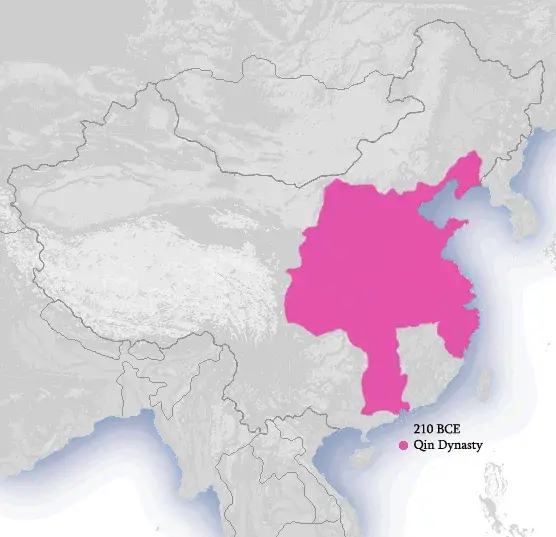
Qin conquers the six states; Li Si establishes thirty-six commanderies across China.
Qin Dynasty (秦朝) · HISTORICAL EVENT
焚书坑儒
The Burning of Books and Burying of Scholars (焚书坑儒), transpiring between 213 and 212 BCE, was a profound cultural purge and ideological homogenization campaign directed by the Qin imperial state under Qin Shi Huang and Chancellor Li Si. Aimed at extinguishing intellectual dissent and securing Legalist administrative absolutism, the campaign comprised two related state crackdowns. In 213 BCE, following Confucian academician Chunyu Yue's conservative…
The Burning of Books and Burying of Scholars (焚书坑儒), transpiring between 213 and 212 BCE, was a profound cultural purge and ideological homogenization campaign directed by the Qin imperial state under Qin Shi Huang and Chancellor Li Si. Aimed at extinguishing intellectual dissent and securing Legalist administrative absolutism, the campaign comprised two related state crackdowns. In 213 BCE, following Confucian academician Chunyu Yue's conservative polemic advocating the revival of Zhou feudal fiefs, Chancellor Li Si denounced the use of ancient precedents to subvert modern laws. Qin Shi Huang decreed the universal confiscation and incineration of the Classic of Poetry, the Book of Documents, and regional historical annals outside imperial archives, exempting only technical treatises on medicine, agriculture, and divination. In 212 BCE, imperial alchemists Hou Sheng and Lu Sheng fled Xianyang after secretly disparaging the sovereign's despotic obsession with penal law and immortality elixirs. Enraged, the First Emperor conducted a ruthless investigation that resulted in the execution of over 460 Confucian scholars and occultists, who were buried alive in pits outside Xianyang. The campaign permanently traumatized the Confucian intellectual tradition and deepened social fractures that doomed the short-lived dynasty.
Qin conquers the six states; Li Si establishes thirty-six commanderies across China.
Chunyu Yue advocates feudalism; Li Si memorializes the emperor to ban private learning and burn books.
Imperial decrees mandate the destruction of non-Qin histories and Confucian classics.
Hou Sheng and Lu Sheng slander the emperor's tyranny and escape with state funds.
Over 460 scholars are buried alive; Crown Prince Fusu is exiled to the northern border.
Xiang Yu captures Xianyang and burns the imperial archives, completing the destruction of ancient texts.
Following the military unification of China in 221 BCE, a fierce debate erupted regarding the imperial administrative structure. Prime Minister Wang Wan and conservative courtiers urged the emperor to enfeoff royal princes across the peripheral lands of Yan, Qi, and Chu. Chancellor Li Si adamantly opposed this, arguing that Zhou feudalism had inevitably fostered fratricidal warfare among independent lords. Qin Shi Huang ratified Li Si's policy, dividing the empire into thirty-six commanderies governed by appointed civil magistrates. Nevertheless, disenfranchised gentry from the conquered eastern states harbored nostalgia for the Zhou order, covertly citing classical texts to critique the centralized Legalist system.
The Warring States era was characterized by the vibrant Hundred Schools of Thought, where philosophical lineages debated morality, cosmology, and statecraft. In contrast, the Qin state was engineered entirely upon Shang Yang's Legalist principles, which demanded unswerving obedience to imperial statutes and recognized officials as the sole legitimate teachers of the populace. Intellectuals gathering in private academies to debate policy, glorify antiquity, and disparage modern imperial decrees were perceived by Qin Shi Huang and Li Si as an intolerable threat to dynastic security.
In 213 BCE (the 34th year of the First Emperor), seventy imperial scholars gathered at the Xianyang Palace to toast Qin Shi Huang. Chief Court Academician Zhou Qingchen lavished flattery upon the monarch, praising the abolition of feudal principalities and the establishment of peaceful commanderies as an achievement surpassing all ancient sovereigns.
However, Qi scholar Chunyu Yue stepped forward and launched a stinging rebuttal: "I have heard that the kings of Yin and Zhou endured over a thousand years because they enfeoffed their sons and brothers as bulwarks. Today, Your Majesty possesses all under heaven, yet your royal sons remain private commoners. Should usurpers arise, how will the state be preserved? I have never heard of any regime enduring that failed to model itself upon antiquity!" By publicly demanding the revival of feudalism, Chunyu Yue crossed an imperial red line.
Qin Shi Huang referred the dispute to Chancellor Li Si. Li Si delivered a comprehensive, uncompromising memorial attacking the conservative literati: "In ancient times, the realm was fractured and chaotic; lords arose and everyone praised antiquity to damage the present. Today Your Majesty has established the great enterprise of imperial unity, yet these foolish scholars refuse to study the present, using deceitful words to confuse the people."
Li Si formulated the decrees: First, all historical chronicles other than the Qin Annals were to be burned; second, all private copies of the Classic of Poetry, the Book of Documents, and philosophical writings of the Hundred Schools were to be surrendered to magistrates within thirty days to be burned; third, anyone discussing these texts in public was to be executed in the marketplace, and those citing antiquity to criticize the present were to suffer the extermination of their clans; fourth, officials who failed to report violations were to share the penalty; fifth, those who failed to burn their books within thirty days were to be branded on the face and sentenced to hard labor on the Great Wall; sixth, only technical manuals concerning medicine, divination, and agriculture were exempt. Qin Shi Huang endorsed the memorial, and massive book burnings swept across the empire, reducing centuries of classical manuscripts to ashes.
In 212 BCE, a fresh crisis erupted around imperial patronage of the occult. In his declining years, Qin Shi Huang developed an intense dread of mortality, spending immense treasury reserves on alchemists like Hou Sheng and Lu Sheng to procure herbal elixirs of eternal life.
Realizing that immortality drugs were impossible to manufacture and terrified of execution for failure, Hou Sheng and Lu Sheng conspired secretly before fleeing. They denounced the monarch: "The First Emperor is violent and autocratic by nature, obsessed with absolute power. He relies exclusively on harsh penal judges and treats his seventy court academicians as decorative puppets... He determines all state affairs himself. It is impossible to seek divine medicines for such an autocrat!" The pair fled with substantial imperial gold.
When Qin Shi Huang discovered their betrayal, his rage was boundless: "I treated Lu Sheng and the alchemists with supreme honor, and now they slander me to amplify my lack of virtue!" He commanded the imperial censors to interrogate all scholars and magicians in Xianyang. Subjected to torture, the prisoners accused one another, implicating over 460 individuals. The emperor ordered all 460 scholars to be buried alive in pits outside the city walls as a public warning. When Crown Prince Fusu remonstrated, warning that the realm was not yet pacified and that harsh measures against scholars honoring Confucius would spark rebellion, the emperor banished Fusu to the northern frontier to supervise the army of Meng Tian.
The campaign was a devastating blow to pre-Qin cultural heritage. Although the Qin court preserved master copies of classical texts in the imperial archives, these official collections were destroyed six years later when rebel general Xiang Yu sacked and torched Xianyang, with the fire burning for three months. The twin catastrophes obliterated numerous historical chronicles, philosophical treatises, and literary works of the Warring States period, forcing Han Dynasty scholars to rely upon oral recitations and hidden wall caches, triggering the century-long Modern and Ancient Text Controversy.
Politically, the persecution shattered any accommodation between the imperial house and the intellectual elite of the conquered eastern states. Denied peaceful participation, the literati class turned decisively toward rebellion. Furthermore, the banishment of Crown Prince Fusu created the fatal power vacuum exploited by Zhao Gao and Li Si upon the First Emperor's sudden death in 210 BCE, leading to Fusu's forced suicide, the accession of the incompetent Second Emperor, and the swift collapse of the Qin Dynasty in the flames of popular insurrection.