Treaty of Weishui
Illig Qaghan advances to the Wei River; Emperor Taizong confronts him at Bian Bridge, concluding a temporary truce.
Tang Dynasty (唐朝) · HISTORICAL EVENT
颉利可汗之灭
The Fall of Illig Qaghan (颉利可汗之灭), also known as the Tang campaign against the Eastern Turks, occurred between November 629 and March 630 (the third and fourth years of the Zhenguan era), representing a decisive military campaign in which Tang Emperor Taizong capitalized on catastrophic steppe blizzards and tribal insurgencies to deploy over one hundred thousand soldiers under legendary strategist Li Jing, capturing Illig Qaghan (Ashina Duobi) and…
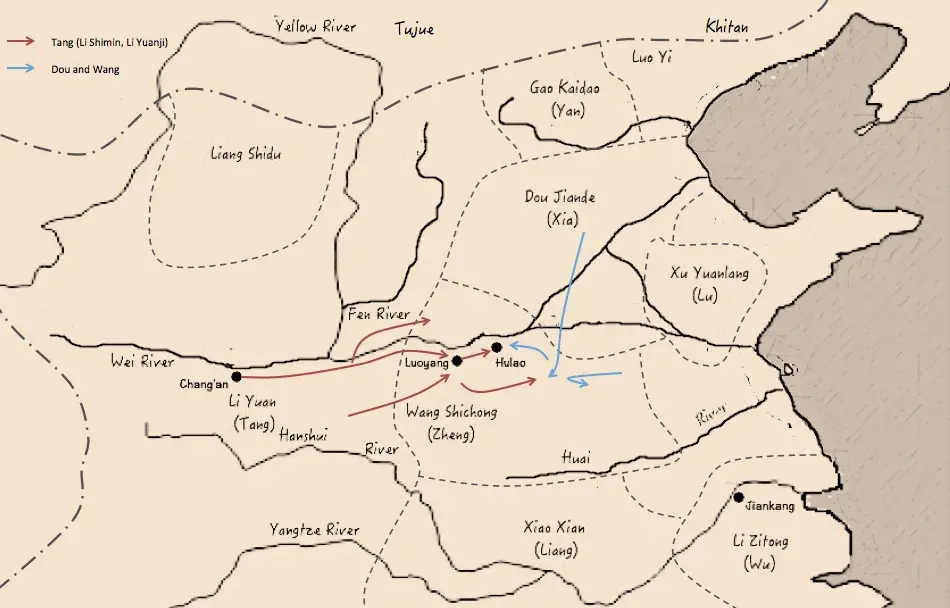
The Fall of Illig Qaghan (颉利可汗之灭), also known as the Tang campaign against the Eastern Turks, occurred between November 629 and March 630 (the third and fourth years of the Zhenguan era), representing a decisive military campaign in which Tang Emperor Taizong capitalized on catastrophic steppe blizzards and tribal insurgencies to deploy over one hundred thousand soldiers under legendary strategist Li Jing, capturing Illig Qaghan (Ashina Duobi) and dismantling the Eastern Göktürk Khaganate. During the late Sui and early Tang transition, the Eastern Göktürks dominated Inner Asia, repeatedly raiding northern China and compelling the newly enthroned Tang Taizong to conclude the humiliating Treaty of Weishui in 626. In the early Zhenguan era, severe winter storms decimated nomadic herds while Tiele tribes rebelled against Illig Qaghan's extortionate rule. Seizing this opportunity, Emperor Taizong dispatched six converging columns under Li Jing. In early 630, Li Jing spearheaded a surprise winter assault through Eyang Ridge against Dingxiang, sending the qaghan fleeing toward Mount Yin. Feigning peace negotiations, Li Jing and Li Ji launched a surprise dawn attack in dense fog, with vanguard commander Su Dingfang overrunning the royal encampment. Illig Qaghan was captured in flight by general Zhang Baoxiang and escorted to Chang'an. The campaign secured Tang northern frontiers, prompted steppe chieftains to acclaim Taizong as "Heavenly Qaghan" (Tian Kehan), and established the multi-ethnic framework of the High Tang.
Illig Qaghan advances to the Wei River; Emperor Taizong confronts him at Bian Bridge, concluding a temporary truce.
Emperor Taizong appoints Li Jing commander-in-chief of six converging expeditionary columns against the Eastern Turks.
Li Jing leads three thousand cavalry through winter snow to surprise Dingxiang, driving the qaghan to Mount Yin.
Su Dingfang and Li Jing strike the nomadic camp in dense fog, annihilating the Göktürk army.
Tang general Zhang Baoxiang captures the fleeing qaghan, dissolving the Eastern Göktürk Khaganate.
Steppe chieftains convene in Chang'an, proclaiming Emperor Taizong "Heavenly Qaghan."
During the collapse of the Sui dynasty, the Eastern Göktürk Khaganate achieved unprecedented military power under Shibi, Chuluo, and Illig qaghans, commanding hundreds of thousands of horse-archers and extracting tribute from rival Chinese warlords. In the early years of the Tang dynasty, nomadic horsemen raided south annually. In August 626, days after the Xuanwu Gate Incident, Illig Qaghan marched over one hundred thousand cavalrymen to the banks of the Wei River outside Chang'an, threatening the imperial seat. Emperor Taizong confronted the invaders at the Bian Bridge with a handful of companions, displaying calculated defiance before executing a white horse to conclude the Treaty of Weishui with gold and silk. The treaty preserved the dynasty, but left Emperor Taizong committed to avenging the insult.
In the ensuing years, Emperor Taizong drilled imperial palace divisions, implemented agrarian reforms, and revitalized state finances. Meanwhile, severe blizzards and bitter cold swept across the northern steppe, burying pastures and wiping out livestock. Facing mass starvation, Illig Qaghan increased tax levies while relying on Sogdian merchants, alienating his nomadic subjects. Subject Tiele tribes—including the Uighurs and Xueyantuo—rose in open revolt, while Illig's nephew Tölis Qaghan defected to the Tang court. Recognizing that internal division and famine had crippled the nomadic state, Emperor Taizong launched an empire-wide counter-offensive.
In November 629, Emperor Taizong decreed a grand campaign against the Eastern Göktürks. He appointed Minister of War Li Jing as commander-in-chief of the Dingxiang March, coordinating over one hundred thousand soldiers across six operational columns: Li Ji advanced through Yunzhong, Chai Shao through Jinhe, Li Daozong from Lingzhou, Wei Xiaojie through Baidao, and Xue Wanche from Changwu, tightening a massive cordon around the steppe.
In January 630, amidst deep snow and subzero temperatures, Li Jing personally led three thousand elite cavalry from Mayi (modern Shuozhou, Shanxi), crossing the rugged Eyang Ridge by night to strike the Göktürk headquarters at Dingxiang. Shocked by the assault, Illig Qaghan lamented: "If the Tang had not committed its entire army, how could Li Jing dare come here alone?" Tang cavalry stormed the perimeter, killing thousands. Illig Qaghan abandoned Dingxiang under cover of darkness, retreating to Tieshan near Mount Yin, where he dispatched emissaries to Chang'an professing submission while secretly intending to rebuild strength once spring grasses sprouted.
Emperor Taizong sent imperial envoy Tang Jian to Tieshan to negotiate terms of surrender. Meanwhile, Li Jing united his forces with Li Ji at Baidao. Discerning that the qaghan was playing for time, Li Jing conferred with Li Ji: "Illig has lowered his guard because imperial envoys are in his camp. If we strike now with ten thousand elite horsemen carrying dry rations, we can replicate Han Xin's classic destruction of Qi, winning an immortal triumph!" Li Ji agreed.
On the night of March 27, 630, Li Jing led ten thousand horsemen over Mount Yin along the Baidao route. He dispatched vanguard commander Su Dingfang with two hundred elite horsemen to penetrate the camp under cover of heavy morning fog. Su Dingfang charged to within one hundred paces before the alarm was sounded, throwing the royal quarters into chaos while the qaghan fled on his swiftest mount. Li Jing's main battle line swept over the panic-stricken camp, killing over ten thousand warriors, taking more than one hundred thousand captives, and seizing hundreds of thousands of sheep and cattle. As Illig Qaghan fled toward the desert with surviving retainers, Li Ji blockaded the northern passes at Qikou. In April, while attempting to take refuge in the mountains, Illig Qaghan was captured by Zhang Baoxiang, an officer under Vice Commander Li Daozong, and conveyed under guard to the capital at Chang'an.
The campaign concluded with the total defeat of the nomadic host. The Eastern Göktürk Khaganate was dismantled, and its vast territories from the Ordos Loop to Lake Baikal were brought under Tang hegemony. Illig Qaghan was escorted to Chang'an, where Emperor Taizong spared his life, appointing him Right Guard General and granting him an imperial estate.
The destruction of the Eastern Göktürks altered the balance of power across Eurasia. Geopolitically, it permanently eliminated the primary military threat along China's northern frontier, re-opening northern branches of the Silk Road to international trade. Ideologically, steppe chieftains gathered in Chang'an in 630 to acclaim Emperor Taizong as "Heavenly Qaghan" (Tian Kehan), marking the first time a Chinese emperor was recognized as legitimate sovereign over both sedentary Han and nomadic steppe peoples. Administratively, the court established loose-rein protectorates (jimi fuzhou) along the frontier, integrating surrendered nomads into the imperial military and administrative fabric, inaugurating the multi-ethnic expansion of the High Tang.