Emperor Taizong Ascends the Throne
Li Shimin assumes the imperial title and establishes the Zhenguan era, adopting the policy of prioritizing popular welfare.
Tang Dynasty (Emperor Taizong Era) · HISTORICAL EVENT
贞观之治
The Reign of Zhenguan (贞观之治) was the celebrated golden age of enlightened statecraft, economic recovery, cultural renaissance, and frontier stability from 627 to 649 under Emperor Taizong (Li Shimin) of the Tang Dynasty. Following the catastrophic devastation of the late Sui turmoil, China's registered population had plummeted to barely over two million households. Ascending the throne, Emperor Taizong embraced the foundational maxim that "the people are…
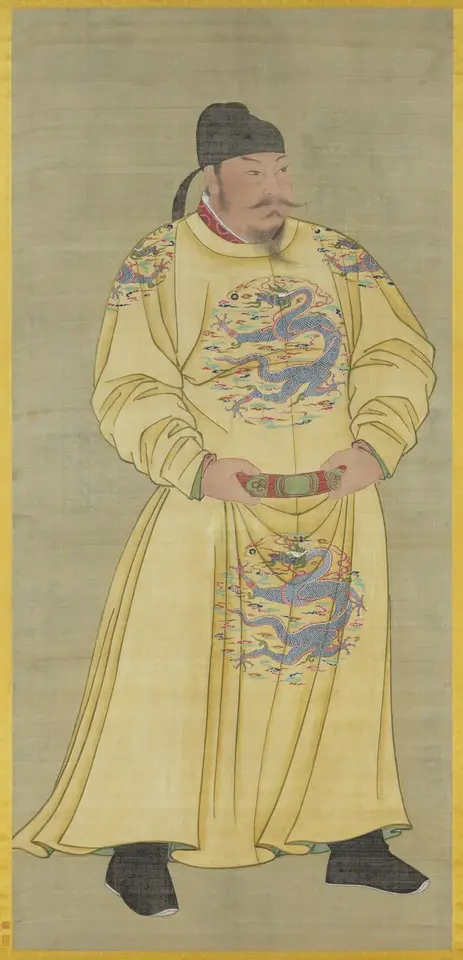
The Reign of Zhenguan (贞观之治) was the celebrated golden age of enlightened statecraft, economic recovery, cultural renaissance, and frontier stability from 627 to 649 under Emperor Taizong (Li Shimin) of the Tang Dynasty. Following the catastrophic devastation of the late Sui turmoil, China's registered population had plummeted to barely over two million households. Ascending the throne, Emperor Taizong embraced the foundational maxim that "the people are like water, and water can float a boat, but it can also capsize it," adopting moral governance, agricultural preservation, and frank admonition as the cardinal principles of state. Throughout his twenty-three-year reign, Emperor Taizong broke factional barriers to promote talent, creating an exceptionally efficient central executive guided by Fang Xuanling's planning and Du Ruhui's decisive execution, while cultivating an extraordinary court culture where upright censors like Wei Zheng could challenge the emperor without retribution. Economically, the crown enforced the equal-field (juntian) and rent-labor (zuyongdiao) systems with low taxation; legally, the court promulgated the Zhenguan Code and instituted mandatory triple-review protocols for capital sentences; diplomatically, Tang armies extinguished the Eastern Turkic Khaganate and established protectorates over Central Asian oasis states, earning Taizong the universal veneration of nomadic chieftains as "Heavenly Khagan." The era established an unmatched historical pinnacle of benevolent imperial administration.
Li Shimin assumes the imperial title and establishes the Zhenguan era, adopting the policy of prioritizing popular welfare.
The crown implements the equal-field and rent-labor regulations, disbanding palace maids and reducing official expenditure.
Imperial armies defeat the nomadic confederacy in the Yin Mountains, taking Illig Khagan captive.
Central Asian and nomadic leaders gather in Chang'an to invest Emperor Taizong with the supreme universal title.
Revision of penal laws is finalized, reducing capital penalties and establishing strict execution review procedures.
Imperial envoy Li Daozong escorts Princess Wencheng to wed Songtsen Gampo, securing southwestern peace.
Emperor Taizong dies at Cuiwei Palace, concluding twenty-three years of governance that set the standard for the High Tang.
In the early seventh century, Emperor Yang of Sui squandered national resources through grand construction projects and three disastrous military expeditions against Goguryeo, provoking nationwide peasant rebellions. Over a decade of destructive warfare decimated the central provinces, turning former farmlands into barren wastes and inflicting catastrophic casualties upon the agrarian population. Historical records attest that while the Kaihuang reign of Sui Wendi recorded nearly nine million registered households, by the Wude era of early Tang, the count had fallen to approximately two million households.
Although the Tang founder Li Yuan unified the realm by suppressing regional warlords such as Xue Rengao, Liu Wuzhou, Wang Shichong, and Dou Jiande, the young dynasty faced acute peril from the Eastern Turkic Khaganate. Chieftain Illig Khagan regularly invaded deep into the heartland with tens of thousands of horsemen, even advancing to the Bian Bridge outside the gates of Chang'an. The imperial granaries stood empty, materials were exhausted, and the fractured empire required immediate stabilization to stave off institutional collapse.
In the sixth month of 626, Prince of Qin Li Shimin launched the Xuanwu Gate Incident and subsequently assumed the imperial throne, inaugurating the Zhenguan era. Having campaigned across China as a field commander from youth, Emperor Taizong possessed intimate familiarity with popular suffering and the fragility of military triumph. From the outset of his reign, he convened constant deliberations with his counselors regarding the causes of past dynastic downfalls, analyzing the rapid collapse of the powerful Sui dynasty as a stark mirror.
Emperor Taizong concluded that sovereign survival demanded putting the welfare of the common folk first, constantly reminding court ministers that rulers depended entirely upon public consent. Confronting an impoverished empire, the sovereign rejected vanity and extravagance, committing to a policy of reducing expenditures, lightening corvée demands, appointing honest magistrates, and securing agricultural livelihood, thereby inaugurating comprehensive systemic reforms.
During the Zhenguan reign, the central bureaucracy centered on the Three Departments and Six Ministries attained institutional perfection. The Secretariat (Zhongshu Sheng) drafted imperial decrees, the Chancellery (Menxia Sheng) reviewed and held veto power over unworkable edicts, and the Department of State Affairs (Shangshu Sheng) oversaw execution through the Six Ministries. To eliminate inter-departmental friction and administrative paralysis, Emperor Taizong established the "Hall of State Affairs" (Zhengshi Tang) as a collective cabinet organ, stipulating that major policies had to be debated and approved jointly before being promulgated, thereby precluding autocratic overreach.
Emperor Taizong exercised remarkable magnanimity in appointments, disregarding former rivalries. He retained his Qin mansion strategists Fang Xuanling and Du Ruhui, who formed a harmonious partnership known as "Fang's deliberation and Du's decision." Simultaneously, he elevated prominent retainers of his late rival Li Jiancheng, including Wei Zheng and Wang Gui, to paramount ministerial posts. In welcoming remonstrance, Taizong encouraged candid critiques; over thirty officials submitted remonstrances, among whom Wei Zheng offered over two hundred detailed critiques on statecraft. Taizong exercised restraint in accepting uncomfortable truths, forging an unexcelled atmosphere of mutual trust between sovereign and ministers. When Wei Zheng passed away in 643, Taizong wept and lamented: "With bronze as a mirror, one can adjust one's garments; with antiquity as a mirror, one can perceive the rise and fall of states; with human character as a mirror, one can discern merits and errors. With Wei Zheng gone, I have lost one of my mirrors!"
In economic affairs, Emperor Taizong prioritized agricultural preservation by systematically executing the equal-field (juntian) and rent-labor (zuyongdiao) systems. The equal-field statutes distributed personal allotment lands and hereditary estates to adult peasants; the rent-labor regulations required taxpayers to pay modest grain and cloth quotas alongside twenty days of annual labor, permitting peasants to commute service obligations through payments of silk, legally preventing the state from conscripting labor during crucial farming seasons.
Drawing lessons from Sui extravagance, Emperor Taizong practiced rigorous personal austerity. Early in his reign, he discharged over three thousand palace maids to return to their families, canceled exotic provincial tributes, halted imperial villa construction, and sheltered leaking palace roofs with coarse straw mats to avoid burdening the public treasury. When severe droughts and locust infestations afflicted the realm, Taizong released grain from state reserves, issued self-reproach decrees, and exempted afflicted regions from taxes. During a severe locust swarm in 628, the emperor inspected palace gardens, caught several locusts, and famously swallowed them before his courtiers, declaring that if the pests consumed popular grain, they should rather consume his own vitals. Within several years, abandoned fields were reclaimed and grain prices fell dramatically: during the mid-Zhenguan era, a peck of rice cost only three to four coins, and travelers crossed thousands of li from the capital to the coasts without carrying provisions.
In legal codification, Emperor Taizong championed the principle that public peace resided in penal restraint, commissioning Fang Xuanling and Zhangsun Wuji to thoroughly revise Sui statutes, formally enacting the Zhenguan Code in 637. The code abolished severe mutilation punishments inherited from past dynasties, deleted ninety-two capital offenses, and reduced over a hundred exile punishments to penal servitude, establishing a streamlined system of twenty penal gradations across five standard punishments. Taizong reiterated to magistrates that the law belonged to all under heaven, advising that verdicts should err on the side of leniency rather than arbitrary cruelty.
To prevent wrongful executions, Taizong instituted the mandatory "Triple Review" protocol for provincial jurisdictions and "Fivefold Review" for capital cases within the imperial capital. The emperor personally reviewed difficult judicial dossiers. In the winter of 632, Taizong released three hundred and ninety condemned capital convicts on parole to return home for the New Year, agreeing that they would voluntarily return to prison the following autumn for execution. By the autumn of 633, every single one of the three hundred ninety prisoners returned to the capital on schedule without a single defection. Deeply moved by this voluntary compliance, Taizong pardoned all of them, producing an enduring legend of moral transformation.
Emperor Taizong placed immense value on educational and cultural revitalization, founding the Institute for the Advancement of Literature (Hongwen Guan) within the imperial precincts. He gathered eighteen eminent scholars, known as the "Eighteen Worthies," to lecture on the classics and debate statecraft. He expanded imperial colleges including the National Academy (Guozi Xue) and Imperial University (Taixue), accommodating over eight thousand students, including noble scions from Goguryeo, Baekje, Silla, Tibet, and Japan, transforming Chang'an into the cosmopolitan center of East Asian educational exchange.
Building upon the civil service examination system instituted by the Sui, Taizong established regular examinations across diverse curricula, including the Presented Scholar (Jinshi) and Mingjing categories. This reform undermined the genealogical monopoly held by Guan-Long aristocrats and Great Lineage clans, opening civil bureaucracy to humble scholars of genuine talent. Watching successful candidates stream through the palace gates, Taizong proudly exclaimed: "The finest heroes of the empire have fallen within my grasp!" Simultaneously, the crown ordered scholars under Fang Xuanling and Wei Zheng to compile standard dynastic histories for the Liang, Chen, Northern Qi, Northern Zhou, Sui, and Jin dynasties, while commanding Confucian master Kong Yingda to edit The Correct Meaning of the Five Classics (Wujing Zhengyi), unifying canonical interpretation across the realm.
In foreign relations, Emperor Taizong abandoned traditional chauvinistic prejudices that exalted Han subjects while despising nomadic peoples, declaring a revolutionary policy of extending universal benevolence to all peoples alike. In the winter of 629, Taizong dispatched Minister of War Li Jing to execute a surprise winter strike across the Yin Mountains, shattering the Eastern Turkic Khaganate and capturing Illig Khagan. Following this triumph, the court adopted Wen Yanbo's enlightened policy of preserving tribal customs, resettling surrendered nomadic clans along the Ordos loop under hereditary tribal chieftains within jimi loose-rein commanderies.
In the third month of 630, hundreds of nomadic and Central Asian chieftains convened in Chang'an, bowing before the emperor and petitioning him to assume the supreme title of "Heavenly Khagan" (Tian Kehan), designating him universal sovereign of both nomadic steppes and agrarian plains. Taizong accepted the accolade, and subsequent imperial rescripts to western rulers were countersigned with the title. In responding to Tibetan requests, Taizong dispatched Princess Wencheng in 641 to wed Songtsen Gampo, carrying agricultural tools, medicine, calendars, and craftsmen that cemented enduring Sino-Tibetan cultural bonds. Subsequently, generals Li Jing and Hou Junji subdued the Tuyuhun and conquered Karakhoja, establishing the Anxi Protectorate. Northern tribes opened the "Heavenly Khagan Route" containing sixty-eight post stations, ensuring unprecedented safety for Silk Road commerce.
Across twenty-three years of rule, the Tang Dynasty emerged transformed from post-war ruin into an imperial superpower. The domestic political culture was remarkably clean, with official corruption curtailed and legal moderation demonstrated by the historical record of only twenty-nine executions across the entire realm in 630. Material prosperity surged as granaries filled and registered households grew from two million to over 3.8 million. Militarily, imperial territory extended from the Korean border across the steppes to the Aral Sea and southward to Vietnam, eclipsing previous Han and Jin dynasties.
The Reign of Zhenguan bequeathed foundational structural paradigms to Chinese imperial history. First, it cemented the mature functional mechanics of the Three Departments and Six Ministries, creating an institutionalized civil bureaucracy. Second, the equitable distribution of land under the equal-field system underpinned the most sustained economic expansion of the medieval world. Third, the open "Heavenly Khagan" multi-ethnic framework established a transcendent universal identity for the imperial state. Finally, the institutionalization of civil service examinations enabled upward social mobility that nourished the administrative brilliance of Wu Zetian's reign and the Kaiyuan Prosperity, remaining the undisputed standard of benevolent imperial governance.