Siege of Mount Baideng
Emperor Gaozu is encircled by Modu Chanyu's cavalry for seven days, escaping through secret diplomacy.
Western Han (西汉) · HISTORICAL EVENT
汉匈和亲
The Han-Xiongnu Heqin Policy (汉匈和亲) was a major strategic diplomatic initiative pursued by the Western Han dynasty to manage relations with the northern nomadic Xiongnu empire. In 200 BCE, dynastic founder Emperor Gaozu (Liu Bang) was encircled by nomadic cavalry at Mount Baideng. Recognizing overwhelming military disparity, the court adopted strategist Liu Jing's proposal in 198 BCE to institute marriage alliances (heqin). For over six decades…
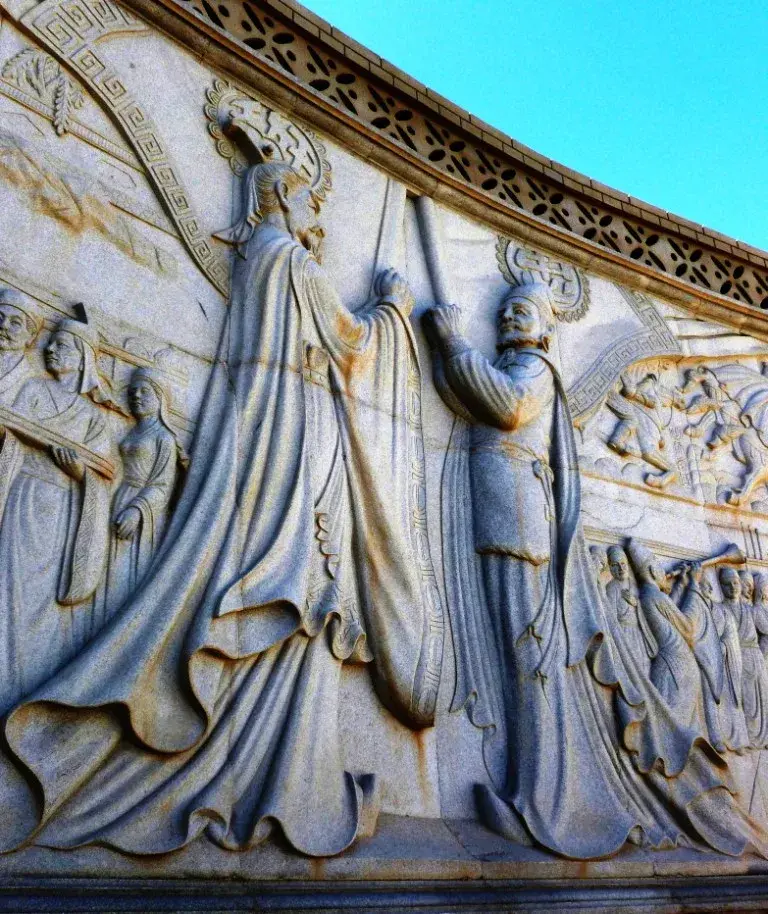
The Han-Xiongnu Heqin Policy (汉匈和亲) was a major strategic diplomatic initiative pursued by the Western Han dynasty to manage relations with the northern nomadic Xiongnu empire. In 200 BCE, dynastic founder Emperor Gaozu (Liu Bang) was encircled by nomadic cavalry at Mount Baideng. Recognizing overwhelming military disparity, the court adopted strategist Liu Jing's proposal in 198 BCE to institute marriage alliances (heqin). For over six decades under Emperors Huidi, Wendi, and Jingdi, the Han married imperial princesses to successive Chanyus, accompanied by annual stipends of silk, grain, and wine, and opened frontier border markets. Under Emperor Wu, a wealthy Han state discarded passive appeasement, launching major campaigns into the Gobi Desert that broke Xiongnu hegemony. Decades later, internal strife fractured the nomads, prompting Southern Xiongnu Chanyu Huhanye to submit as a tributary vassal. In 33 BCE, Emperor Yuan conferred court lady Wang Zhaojun in marriage to Huhanye, an event celebrated as "Zhaojun Departs for the Frontier." This alliance established over half a century of border tranquility without warfare, forging a revered historical symbol of ethnic harmony and geopolitical wisdom.
Emperor Gaozu is encircled by Modu Chanyu's cavalry for seven days, escaping through secret diplomacy.
The court accepts Liu Jing's proposal, sending an imperial princess and annual gifts to Modu Chanyu.
Emperor Wen renews marriage alliances with Laoshang Chanyu, institutionalizing border market trade.
Emperor Wu lays an ambush at Mayi, terminating passive marriage alliances and launching proactive military campaigns.
Southern Chanyu Huhanye surrenders to Emperor Xuan in Chang'an, transforming Han-Xiongnu relations into a tributary alliance.
Emperor Yuan bestows Wang Zhaojun upon Huhanye as the Ninghu Yanshi, opening half a century of border peace.
Protracted civil war during the fall of the Qin dynasty left the Central Plains agricultural economy devastated. Population plummeted, croplands lay abandoned, and early Han emperors could not assemble four chariot horses of identical color, while senior chancellors rode in plain ox carts. Conversely, the Xiongnu nomadic empire had been united under the brilliant generalship of Modu Chanyu, subjugating the Donghu and neighboring steppe confederations to command over 300,000 horse archers. Recurrent nomadic raids across Dai and Yan commanderies posed an existential military peril to the fledgling Han dynasty.
In 200 BCE, Emperor Gaozu personally commanded 320,000 infantry into the north. Outmaneuvered at Mount Baideng near Pingcheng, the emperor was encircled by 400,000 elite nomadic cavalry for seven days without provisions, narrowly escaping capture only through Chancellor Chen Ping's covert diplomacy. The crisis convinced the Han leadership that military victory was unattainable in the short term. Courtier Lou Jing (subsequently named Liu Jing) advised Emperor Gaozu to marry an imperial princess to Modu Chanyu, accompany her with lavish annual gifts, and open border markets, arguing that kinship ties and trade would pacify nomadic aggression while granting the Han state strategic breathing space.
In 198 BCE, Emperor Gaozu formally dispatched an imperial princess to wed Modu Chanyu, escorted by Liu Jing, while inaugurating annual deliveries of silk, cotton, grain, and wine alongside regulated border markets along the Great Wall. This allowed the Xiongnu to trade livestock and leather for Han ironware, farming tools, and textiles. Emperors Huidi, Empress Dowager Lu, Wendi, and Jingdi preserved this state policy, renewing marriage treaties with Laoshang Chanyu and Junchen Chanyu.
Although rogue nomadic chieftains periodically breached treaties to raid border villages, the marriage alliance successfully averted catastrophic, full-scale invasions. The Western Han capitalized upon six decades of peace to implement light taxation, encourage grain cultivation, and breed warhorses, generating tremendous agricultural reserves and bringing about the celebrated Rule of Wen and Jing.
By the accession of Emperor Wu, the Han imperial treasury overflowed with wealth, granaries brimmed with grain, and imperial cavalry divisions were fully trained. In 133 BCE, Emperor Wu laid an ambush of 300,000 troops at Mayi to trap Junchen Chanyu. Although the ambush miscarried, it terminated the passive heqin policy.
Emperor Wu appointed legendary commanders Wei Qing and Huo Qubing to spearhead sweeping strategic counter-offensives across the Ordos loop, Hexi Corridor, and deep into the Gobi Desert. Decisive victories at the Battle of Mobei annihilated elite nomadic forces, pushing the Xiongnu court north of the desert ("no royal court south of the desert") and securing the Hexi Corridor for the newly established Four Commanderies of Hexi.
During the reign of Emperor Xuan, catastrophic blizzards and succession wars fractured the Xiongnu into northern and southern factions. Seeking imperial backing, Southern Chanyu Huhanye resolved to submit to the Han dynasty. In 53 BCE, Huhanye led his followers south to the Great Wall, journeying to Chang'an to pay personal homage to Emperor Xuan as a tributary vassal, receiving imperial subsidies and military protection.
In 33 BCE, Huhanye traveled to Chang'an for a third imperial audience, formally entreating the throne for a marital alliance to seal eternal vassalage. Emperor Yuan bestowed imperial court lady Wang Zhaojun as his bride. Renowned for intelligence and grace, Wang Zhaojun willingly journeyed into the northern steppes, where Huhanye invested her as the Ninghu Yanshi ("Pacifier of the Hu Barbarians").
Wang Zhaojun's arrival introduced advanced Han weaving, farming, and metal-casting technologies to the steppe peoples. She and Huhanye actively dissuaded nomadic raiding, and her descendants worked for generations to maintain amicable ties with the Han court. The frontier gates remained opened for commerce, inaugurating over fifty years of unbroken peace across the northern frontier.
While requiring the sacrifice of imperial women, early Han marriage alliances granted the infant dynasty indispensable strategic respite. Avoiding destructive frontier attrition allowed the imperial court to crush feudal rebellions, repair water conservancy networks, stimulate agricultural reproduction, and assemble an imposing cavalry force, successfully executing a historic geopolitical transition from strategic defense to offensive triumph.
Beyond high diplomacy, the heqin agreements served as conduits for profound material and cultural exchange. Han artisans, agricultural experts, textiles, and ironware spread throughout the Eurasian steppes, transforming nomadic economic practices, while steppe warhorses and animal husbandry invigorated the Central Plains. Crucially, the long tranquility ushered in by Zhaojun's alliance shielded the Hexi Corridor, ensuring unimpeded commercial and cultural transit along the ancient Silk Road.
In the Book of Han (Han Shu, Account of the Xiongnu), Ban Gu observed: "When the Han arose, Emperor Gaozu struggled with an unsettled realm, adopting Liu Jing's scheme to conclude marriage alliances and ease border alarms. Emperors Wen and Jing followed suit, allowing soldiers and peasants to recuperate. Under Emperors Xuan and Yuan, Huhanye submitted at the frontier, offering to guard the passes, and Zhaojun departed for the sands, leaving border populations in absolute peace—a truly glorious epoch."
Tang poet Du Fu immortalized Zhaojun's sacrifice in his Thoughts on Ancient Sites: "Departing the purple palaces, she joined the northern sands; her lone green mound remains, facing the twilight skies. In portraiture alone, men knew her vernal grace; now her jeweled pendants return in spirit under the moon." This commemorated Wang Zhaojun's noble selflessness and monumental legacy for both peoples.