Japanese Monks Seek Preceptors
Yoei and Fushō travel with the imperial embassy to China tasked with finding authentic Vinaya masters
Tang Dynasty (唐朝) · HISTORICAL EVENT
鉴真东渡
Jianzhen's Eastern Voyages to Japan (鉴真东渡) refers to the epoch-making journey undertaken by the Tang Dynasty Vinaya master Jianzhen (known in Japan as Ganjin) between 742 (the first year of the Tianbao era) and 754 (the thirteenth year of the Tianbao era), during which he overcame twelve years of repeated shipwrecks and adversity to transmit authentic Buddhist monastic precepts and Tang cultural civilization to Japan. During the height of the Tang…
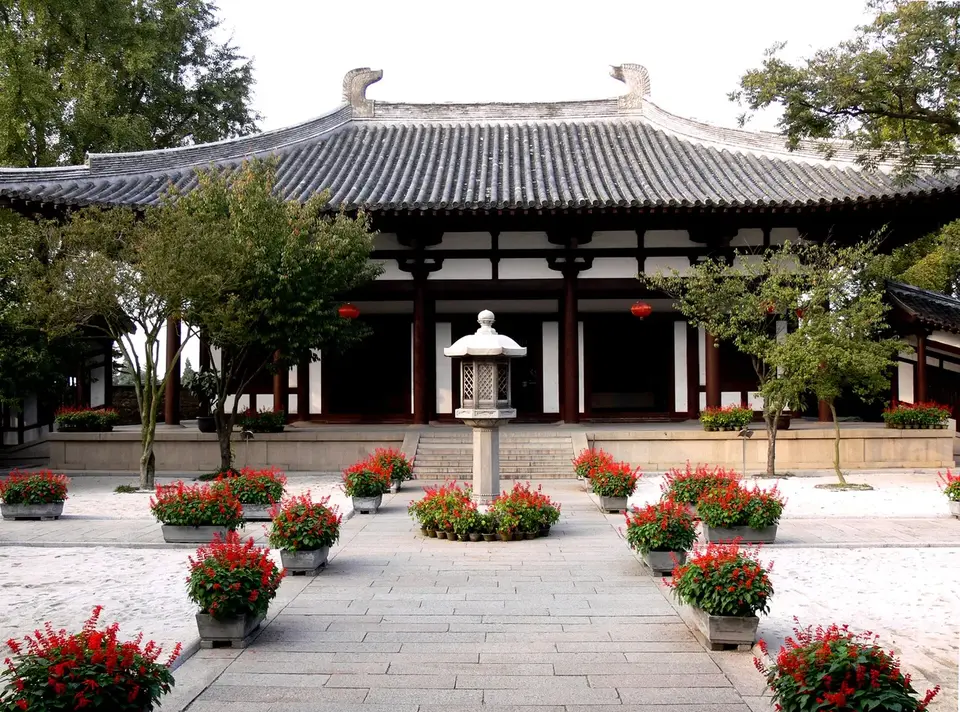
Jianzhen's Eastern Voyages to Japan (鉴真东渡) refers to the epoch-making journey undertaken by the Tang Dynasty Vinaya master Jianzhen (known in Japan as Ganjin) between 742 (the first year of the Tianbao era) and 754 (the thirteenth year of the Tianbao era), during which he overcame twelve years of repeated shipwrecks and adversity to transmit authentic Buddhist monastic precepts and Tang cultural civilization to Japan. During the height of the Tang Dynasty, cultural ties between China and Japan flourished. Although Buddhism was widely patronized in Japan, the monastic community lacked masters qualified to confer the full monastic precepts (upasampadā), leading to chaotic private ordinations and lax discipline. The Japanese court dispatched scholar monks Yoei and Fushō to China to seek authentic preceptors; in the winter of 742, they reached Daming Temple in Yangzhou to entreat Master Jianzhen. Declaring his resolve that "for the sake of the Dharma, why spare physical life?", Jianzhen resolved to lead the expedition. Over the next decade, his mission endured betrayal, official detentions, destructive storms, and shipwreck, stranding the party as far south as Hainan Island. Key disciples perished and Jianzhen lost his eyesight due to infections and hardship, yet his dedication remained unshakable. In late 753, he boarded returning Japanese embassy vessels on his sixth attempt, reaching Nara in the spring of 754. Welcomed with immense reverence, Jianzhen administered precepts to Emperor Shōmu, Empress Kōken, and hundreds of monks at Todai-ji, founded the Ritsu school, and erected Toshodai-ji, establishing an enduring bridge of peaceful cultural exchange between the two nations.
Yoei and Fushō travel with the imperial embassy to China tasked with finding authentic Vinaya masters
Japanese monks petition Master Jianzhen in Yangzhou; the master takes a sacred vow to lead the overseas mission
Four separate departure attempts are frustrated by false accusations, shipwrecks, and government arrests
A violent typhoon blows the ship to Hainan Island; Yoei and Xiangyan perish on the return journey, and Jianzhen becomes blind
Jianzhen embarks from Huangsipu aboard returning Japanese embassy ships, successfully traversing the winter ocean
Jianzhen arrives in Nara, confers vows upon imperial sovereigns and hundreds of clerics, founding the Ritsu school
During the Nara period in eighth-century Japan, Buddhism served as an ideological pillar for state centralization, exemplified by Emperor Shōmu's nationwide construction of provincial temples (kokubun-ji) and the casting of the Great Buddha at Todai-ji. However, the monastic order suffered from systemic flaws: lacking the canonically required "Three Preceptors and Seven Witnesses," lawful ordinations were impossible. Numerous commoners privately tonsured themselves to evade royal corvee and land taxes, resulting in rampant indiscipline and spiritual decay across the clergy.
To regularize the sangha and establish legitimate vinaya lineages, the imperial court resolved to recruit qualified masters from Tang China. In 733, two promising young monks, Yoei and Fushō, sailed with the ninth Japanese diplomatic mission to the Tang court, bearing the solemn responsibility of finding a legitimate preceptor willing to brave the seas.
After studying in Chang'an and Luoyang for nearly a decade, Yoei and Fushō learned that Jiangnan was the preeminent center of Vinaya scholarship, and that Master Jianzhen, abbot of Daming Temple in Yangzhou, was venerated throughout the empire as the supreme luminary of the Nanshan Vinaya school. In the winter of 742, the two monks traveled south to Yangzhou, prostrating themselves before Jianzhen to plead for his aid in restoring authentic monastic precepts in Japan.
Moved by their sincerity, Jianzhen asked his assembly of disciples who among them would volunteer to travel across the ocean. The disciples hesitated, expressing fear of the treacherous, boundless seas where barely one in a hundred travelers survived. Observing their reluctance, Jianzhen sternly proclaimed: "This is a momentous endeavor! For the sake of transmitting the Dharma, why spare our mortal lives? If none of you will go, I shall go alone!" Inspired by his courage, disciples Situo and Xiangyan stepped forward to join the voyage, commencing a heroic chapter of cross-cultural pilgrimage.
In 743 (the second year of Tianbao), Jianzhen commenced secret ship construction and provisions gathering for the maiden voyage. However, a disgruntled disciple named Ruhai quarrelled with maritime craftsmen and falsely denounced the party to local magistrates, alleging they were colluding with pirates. Authorities confiscated the supplies and detained the monks, terminating the first attempt.
In December of that year, Jianzhen privately purchased another vessel to set sail, but violent gales near Langgoupu shattered the hull against river shoals, nearly drowning the crew. In 744, during preparations for a third attempt along the southeastern coastline, maritime authorities intercepted the party once more. Later that autumn, as Jianzhen organized a fourth departure near Fuzhou, anxious disciples in Yangzhou reported his movements to the imperial prefect to protect his safety, prompting soldiers to intercept the master and escort him back to Yangzhou under strict surveillance.
In the spring of 748 (the seventh year of Tianbao), Jianzhen secretly outfitted another ocean-going junk at Xinhe in Yangzhou, setting out on his fifth voyage with thirty-five companions, including Situo, Xiangyan, Yoei, and Fushō. Shortly after entering the open ocean, the vessel was engulfed by a ferocious typhoon that snapped the masts and rudder. For fourteen terrifying days and nights, the battered junk drifted helplessly across tempestuous seas until finally washing ashore at Zhenzhou (modern Sanya) on the southern tip of tropical Hainan Island.
Jianzhen spent over a year teaching on Hainan before embarking on an arduous overland journey back to Jiangnan via Guangxi and Guangdong. The grueling trek took a catastrophic toll: Japanese monk Yoei succumbed to illness at Duanzhou, and Jianzhen's beloved chief disciple Xiangyan passed away in Jiangxi. Overcome by grief and afflicted by tropical diseases and exhaustion, Jianzhen developed severe ophthalmia that ultimately rendered him completely blind. Despite losing his sight and mourning his closest companions, the master remained undaunted, declaring that his life's vow would not rest until he set foot in Japan.
In the autumn of 753 (the twelfth year of Tianbao), the tenth Japanese diplomatic mission headed by Ambassador Fujiwara no Kiyokawa, Vice-Ambassador Kibi no Makibi, and Abe no Nakamaro prepared to return home. Visiting Yangzhou, they invited Jianzhen to accompany their fleet. Evading imperial port inspectors, Jianzhen and twenty-four disciples boarded the vessels at Huangsipu in Suzhou and set sail in November on their sixth attempt.
The four embassy vessels were scattered by vicious winter gales across the East China Sea; the flagship carrying Kiyokawa and Nakamaro was blown as far south as Annan (modern Vietnam). However, the ship carrying Jianzhen and Kibi no Makibi survived the churning waters and made landfall at Akime inlet in Satsuma Province, southern Kyushu, in early 754. In February, the blind master arrived triumphantly in the imperial capital of Heijo-kyo (Nara). Emperor Shōmu and Empress Kōken issued imperial rescripts granting him the supreme title of Master of the Transmission of the Lamp and vesting him with absolute oversight of monastic ordinations. Outside the Great Buddha Hall of Todai-ji, Jianzhen erected a grand ordination altar, personally conferring the bodhisattva and full monastic precepts upon Emperor Shōmu, the Empress, and over four hundred monks, inaugurating an authentic lineage of monastic law in Japan.
Jianzhen's mission concluded in absolute triumph. By establishing a permanent ordination platform at Todai-ji and later founding Toshodai-ji as a specialized academy for Vinaya training, he formally inaugurated the Ritsu school in Japan, ending decades of unregulated private ordination and instilling strict disciplinary standards across the clergy.
Jianzhen's voyage stands as one of the most magnificent milestones in the history of premodern cultural diffusion. Beyond spiritual teachings, Jianzhen and his entourage of master craftsmen, sculptors, and scholars introduced Tang architectural engineering standards, dry-lacquer statue sculpting techniques, classical calligraphy, and advanced botanical pharmacology into Japan. Toshodai-ji remains an immortal national treasure of Tang wooden architecture, while Jianzhen is venerated across Japan as the father of Japanese monastic discipline and traditional medicine. His epic endeavor permanently enriched Japan's Tenpyō culture and remains an enduring monument to Sino-Japanese cultural exchange.