Grand Mobilization
Sima Zhao launches 180,000 troops under Deng Ai, Zhong Hui, and Zhuge Xu to invade Shu.
Cao Wei (曹魏) · HISTORICAL EVENT
灭蜀之战
The Conquest of Shu by Wei (灭蜀之战), waged between August and November 263, was a landmark military campaign that resulted in the complete annihilation of the state of Shu Han by Cao Wei. Following decades of strategic equilibrium inaugurated by the Battle of Red Cliffs, Shu Han had succumbed to domestic decay under the corrupt eunuch Huang Hao, while General-in-Chief Jiang Wei was forced to retreat to Tachong to avoid political persecution. Seeking supreme…
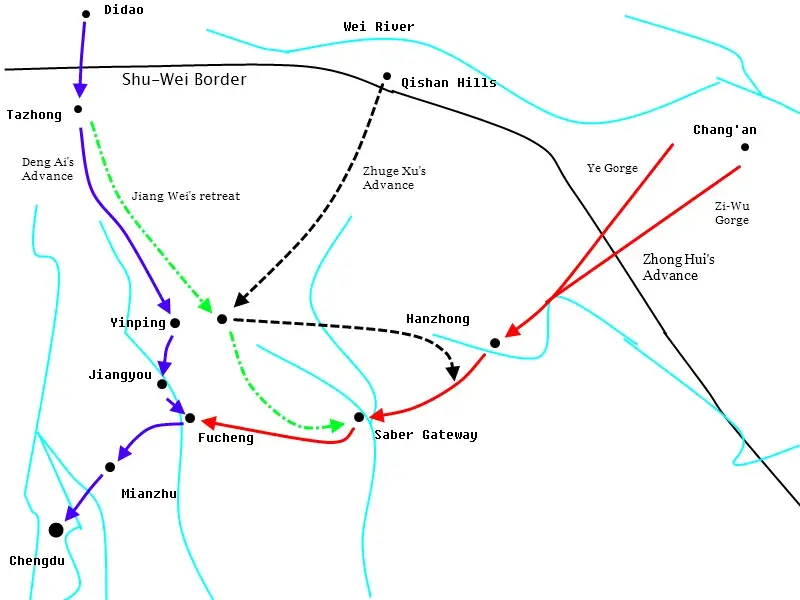
The Conquest of Shu by Wei (灭蜀之战), waged between August and November 263, was a landmark military campaign that resulted in the complete annihilation of the state of Shu Han by Cao Wei. Following decades of strategic equilibrium inaugurated by the Battle of Red Cliffs, Shu Han had succumbed to domestic decay under the corrupt eunuch Huang Hao, while General-in-Chief Jiang Wei was forced to retreat to Tachong to avoid political persecution. Seeking supreme military glory to justify supplanting the Cao clan, Wei regent Sima Zhao marshaled 180,000 troops across three strategic axes to annex the southwestern kingdom. While Zhong Hui captured Hanzhong, Jiang Wei executed a masterful tactical withdrawal to Jiange (Sword Gate Pass), whose sheer cliffs stalled Zhong's 100,000-man main army and brought the invasion to the brink of logistical failure. At this critical juncture, veteran general Deng Ai conceived an unprecedented strategic gamble. Leading ten thousand shock troops along the uninhabited, precipitous Yinping mountain trail, Deng scaled seven hundred li of alpine cliffs, wrapped himself in wool felt to roll down sheer chasms, and emerged behind enemy lines to capture Jiangyou. After annihilating imperial defenders under Zhuge Zhan at Mianzhu, Deng reached Chengdu, prompting Emperor Liu Shan to surrender unconditionally and extinguishing Shu Han after forty-three years of rule.
Sima Zhao launches 180,000 troops under Deng Ai, Zhong Hui, and Zhuge Xu to invade Shu.
Zhong Hui breaches Yang'an Pass and occupies Hanzhong; Jiang Wei retreats toward Sichuan.
Jiang Wei holds Sword Gate Pass; Zhong Hui's army faces critical logistical starvation.
Deng Ai leads ten thousand shock troops across seven hundred li of mountain cliffs, descending Motianling.
Deng Ai crushes Shu imperial guards, killing Zhuge Zhan and advancing on Chengdu.
Liu Shan submits the imperial seal to Deng Ai in Chengdu, extinguishing the Shu Han dynasty.
Jiang Wei complies with imperial surrender edicts at Jiange, concluding resistance.
Following the death of Chancellor Zhuge Liang at Wuzhang Plains in 234, Shu Han enjoyed temporary stability under Jiang Wan and Fei Yi. However, following Fei Yi's assassination in 253, General-in-Chief Jiang Wei pursued an aggressive policy of launching eleven northern expeditions against Wei. While demonstrating tactical skill, these continuous campaigns exhausted national finances and peasant manpower without securing durable territorial gains. Simultaneously, Emperor Liu Shan fell under the sway of the corrupt eunuch Huang Hao, who monopolized power and persecuted honest officials. Fearing execution, Jiang Wei withdrew his elite field units to agricultural colonies at Tachong, severing regular coordination with northern frontier defenses in Hanzhong.
Within Cao Wei, the Sima family consolidated total dictatorial authority after suppressing the Shouchun rebellions. Sima Zhao resolved to orchestrate an unprecedented military conquest to legitimize his impending usurpation of the imperial throne. Assessing his rivals, Sima Zhao recognized that Eastern Wu was protected by the natural moat of the Yangtze River, requiring extensive naval preparations. Shu Han, conversely, possessed a depleted population of less than one million, a distracted ruler, and isolated garrisons. Sima Zhao formulated the grand strategy of conquering Shu first, intending subsequently to build riverine fleets in Sichuan and sweep down the Yangtze to crush Wu.
In August 263, Sima Zhao launched the multi-pronged invasion. General Deng Ai led thirty thousand troops from Didao toward Tachong to pin down Jiang Wei; Regional Governor Zhuge Xu led thirty thousand men from Qishan toward Yinping bridgehead to sever Jiang's retreat; and Grand General Zhong Hui spearheaded the main force of over one hundred thousand troops through the Qinling mountain passes to envelop Hanzhong.
Jiang Wei had repeatedly warned the court of imminent invasion, but Huang Hao consulted shamans and suppressed the intelligence. Consequently, Hanzhong was caught entirely off guard. At Yang'an Pass, defender Jiang Shu defected, while Fu Qian died heroically in combat. Zhong Hui overran Hanzhong's granaries and citadels, driving southward toward the heartland. Utilizing rapid feints, Jiang Wei outmaneuvered Zhuge Xu at the bridgehead and fell back to the natural bastion of Jiange, uniting with southern garrisons under Liao Hua and Zhang Yi.
Jiange (Sword Gate Pass) represented an impregnable natural barrier flanked by sheer limestone cliffs. Jiang Wei entrenched forty thousand veteran troops across the narrow defile, reconstructing fortified palisades and denying the invaders transit.
Zhong Hui threw wave after wave of northern infantry against the pass, but suffered catastrophic casualties without advancing a yard. Strung out across hundreds of miles of rugged mountain pathways, Wei logistical trains suffered devastating attrition, and grain supplies dwindled dangerously. Confronted with mounting starvation and winter frosts, Zhong Hui prepared orders to burn his encampments and retreat to Hanzhong.
Confronting the stalemate, Deng Ai proposed a revolutionary maneuver to Zhong Hui: bypass Jiange entirely by traversing the untracked wilderness along the Yinping route to strike Jiangyou and Chengdu. Seeing no alternative, Zhong Hui consented.
In October 263, Deng Ai led ten thousand elite volunteers into the rugged mountains of Yinping. The route spanned seven hundred li of alpine chasms, virgin forests, and sheer abysses where no paved road existed. Soldiers constructed rope bridges, hacked pathways with axes, and consumed their packhorses when food ran out. Upon encountering Motianling, an impassable vertical cliff, the sixty-six-year-old Deng wrapped himself tightly in thick wool blankets and rolled down the sheer rock face. Inspired by his valor, his soldiers slid and descended with ropes down the chasm.
Emerging like apparitions from the alpine mist, Deng Ai's exhausted troops appeared before the surprised fortress of Jiangyou. Believing divine warriors had dropped from the heavens, garrison commander Ma Miao surrendered without firing an arrow. Deng advanced toward Mianzhu, where Zhuge Liang's son, Zhuge Zhan, marshaled the imperial guards. In a fierce pitched battle, Deng enveloped both flanks, killing Zhuge Zhan and his son Zhuge Shang, eliminating Shu Han's last mobile field reserve.
With Deng Ai's cavalry encamped outside the walls of Chengdu, the capital dissolved into chaotic panic. Rejecting proposals to flee south to Nanzhong, Emperor Liu Shan embraced the defeatist counsel of minister Qiao Zhou. On December 1, 263 (the eleventh day of the eleventh lunar month), Liu Shan dispatched his son with imperial seals to surrender, commanding Jiang Wei at Jiange to lay down his arms. Deng Ai entered Chengdu peacefully, concluding the forty-three-year history of the Shu Han state.
The conquest of Shu Han permanently dissolved the strategic equilibrium established during the Three Kingdoms era. Stripped of its western ally, Eastern Wu found its entire upper Yangtze riverine frontier exposed to northern invasion. The victory confirmed the Sima family's absolute supremacy: Sima Zhao was created King of Jin in December 263, and his son Sima Yan formally usurped the Wei throne in 265 to establish the Western Jin Dynasty. Utilizing Sichuan's timber and shipwrights, the Jin subsequently constructed a massive armada that swept downriver to conquer Wu in 280, unifying all of China.
Deng Ai's crossing of the Yinping trail is celebrated worldwide as a classic triumph of deep-penetration mountain infiltration. Operating without logistical supply lines across seven hundred li of precipitous cliffs, Deng demonstrated unmatched fortitude, improvisational mobility, and psychological daring, perfectly illustrating Sun Tzu's maxim: "Strike where the enemy is unprepared; appear where you are least expected."