Liu Song Dynasty of the Southern Dynasties, Northern and Southern Dynasties (南朝宋) · HISTORICAL EVENT
Compilation of Shishuo Xinyu (《世说新语》成书)
《世说新语》成书
The Compilation of Shishuo Xinyu (《世说新语》成书) refers to the historical undertaking in which Liu Yiqing (刘义庆), Prince of Linchuan and imperial kinsman of the Liu Song dynasty (南朝宋), convened literati and scholars within his patronage network to systematically compile the anecdotal memoirs, witty banter, and philosophical discourses of eminent personalities spanning two centuries from the late Eastern Han to the Eastern Jin into the preeminent masterpiece…
439 CE–444 CEGuangling, Xunyang, and Jiankang (present-day Yangzhou City in Jiangsu Province, Jiujiang City in Jiangxi Province, and Nanjing City in Jiangsu Province / 今江苏省扬州市、江西省九江市、江苏省南京市)
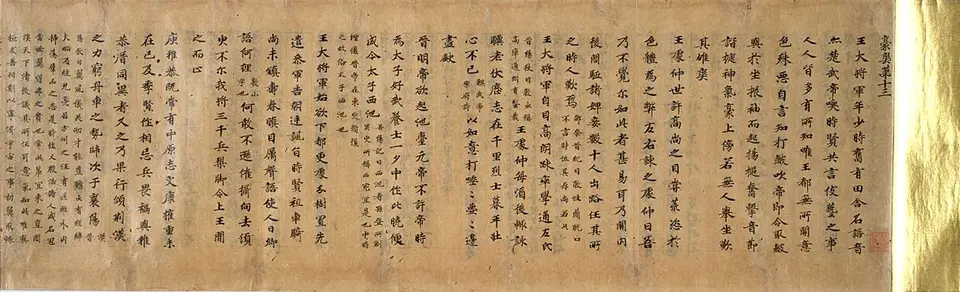
Historic site / architecture of A New Account of the Tales of the WorldImage creditsUnknown authorUnknown author · Public domainImage source
OVERVIEW
The Compilation of Shishuo Xinyu (《世说新语》成书) refers to the historical undertaking in which Liu Yiqing (刘义庆), Prince of Linchuan and imperial kinsman of the Liu Song dynasty (南朝宋), convened literati and scholars within his patronage network to systematically compile the anecdotal memoirs, witty banter, and philosophical discourses of eminent personalities spanning two centuries from the late Eastern Han to the Eastern Jin into the preeminent masterpiece of ancient Chinese character-anecdote fiction (zhiren xiaoshuo / 志人小说). The entire work was compiled approximately between the sixteenth year (439 CE) and the twenty-first year (444 CE) of the Yuanjia era of Emperor Wen of Song, during Liu Yiqing's appointments as governor of Jiangzhou and Jingzhou.
With a profound passion for literature and scholarship, Liu Yiqing widely recruited contemporary luminaries such as Bao Zhao, Lu Zhan, and He Chang as his literary retinue. Drawing extensively from over a hundred historical sources—including the Spring and Autumn Annals of Han and Jin (Han Jin Chunqiu), the Annals of Jin (Jin Ji), and various private memoirs—they classified and compiled more than 1,130 anecdotes concerning the conduct and utterances of notable figures into thirty-six thematic categories, such as Virtuous Conduct, Speech and Conversation, Affairs of Government, and Literature. During the Liang dynasty, Liu Xiaobiao composed comprehensive annotations citing a vast corpus of ancient texts, which substantially elevated the work's evidentiary and documentary value. The book vividly portrays the intellectual landscape, spiritual temperament, and Pure Conversation culture of the Wei-Jin aristocratic elite with concise and evocative prose, establishing the enduring "Shishuo style" of notebook literature and occupying an epoch-making status in the history of Chinese literature and cultural thought.
EVENT TIMELINE
Gathering Worthies and Opening the Princely Fief
Liu Yiqing, Prince of Linchuan, was appointed to govern Jingzhou, establishing administrative bureaus, recruiting eminent literati including Bao Zhao, Lu Zhan, and Yuan Shu into his retinue, and initiating large-scale literary and documentary collection.
Launch of Compilation
Liu Yiqing was reassigned to govern Southern Yanzhou and elevated to Opening the Office with Equal Three Excellencies; in Guangling, he directed the systematic compilation of Shishuo, classifying and recording anecdotes of Han, Wei, and Jin scholars during administrative leisure.
Establishment of Categories
Drawing on character appraisal traditions of the Han and Jin, the compilation team created the thirty-six category framework, completing the selection, collation, and stylistic refinement of more than a thousand entries.
Completion of Compilation
The eight-volume manuscript of Shishuo (later known as Shishuo Xinyu) was finalized and circulated in Guangling and Jiankang; in the same year, Liu Yiqing fell gravely ill, returned to the imperial capital, and passed away.
Xiaobiao's Annotations
Southern Dynasties Liang scholar Liu Xiaobiao completed his extensive evidential commentary on Shishuo Xinyu, citing over four hundred works and ensuring that the commentary became permanently linked with the core text.
Shaoxing Printed Edition
Dong Fen carved and printed the three-fascicle edition of Shishuo Xinyu with Liu Xiaobiao's complete commentary in Wuxing, which survives as the earliest complete block-printed edition today.
Relationship graph
FULL ACCOUNT
Background
Wei-Jin Aristocratic Clan Politics and Xuanxue Pure Conversation
Following the collapse of the Eastern Han dynasty and the institutionalization of the Nine-Rank System for civil appointments, aristocratic clans gradually monopolized political, economic, and social privileges across the state. Eminent hereditary lineages emerged, most notably the Wang clan of Langye, the Xie clan of Chen Commandery, the Huan clan of Qiao Commandery, and the Xun clan of Yingchuan. Amid relentless dynastic transitions and societal upheavals, scholars and literati sought solace in nature, embraced the philosophy of Laozi and Zhuangzi, and engaged in metaphysical dialectics. This gave rise to the intellectual vogue of Xuanxue (Neo-Daoism) and Pure Conversation (qingtan), pioneered by thinkers such as He Yan, Wang Bi, Ji Kang, and Ruan Ji.
Pure Conversation functioned not merely as a metric for evaluating intellectual caliber and philosophical discernment among the scholar-gentry, but also as an indispensable social marker reinforcing aristocratic identity. During elite gatherings, scholar-officials engaged in impromptu repartee, appraised character, and brandished fly-whisks in spirited debate. These interactions generated an abundance of witty remarks, refined bon mots, and poetic anecdotes that became a living reservoir of Six Dynasties literary culture.
Character Appraisal of Eminent Scholars and the Tradition of Character-Anecdote Fiction
During the Han dynasty, elite evaluation focused heavily on local moral standing and public critique (qingyi). In the Wei and Jin dynasties, this appraisal evolved into an aesthetic appreciation of personal charisma, emotional demeanor, and natural talent, epitomized by treatises such as Liu Shao's Treatise on Human Capabilities (Renwu Zhi). Simultaneously, both literati and folk circles began compiling memoirs of eminent worthies. Works like Pei Qi's Forest of Conversations (Yulin), Guo Chengzhi's Master Guo (Guo Zi), and Ge Hong's Miscellaneous Records of the Western Capital (Xijing Zaji) appeared in succession, establishing a unique tradition of character-anecdote fiction (zhiren xiaoshuo).
However, character-anecdote collections before the Eastern Jin were mostly brief in scale, loosely structured, preoccupied with supernatural marvels, or confined to a specific period or locality. The era still lacked an all-encompassing, definitive compilation that comprehensively summarized the aesthetic and intellectual culture of prominent figures across more than two centuries.
Liu Yiqing's Political Circumstances and Literary Retinue
Liu Yiqing (403–444 CE) was a nephew of Emperor Wu of Song (Liu Yu) and the second son of Liu Daolian, Prince Jing of Changsha; he was adopted into the lineage of Liu Daogui, Prince Liewu of Linchuan, and inherited the princedom of Linchuan. During the Yuanjia era, political tensions within the Liu Song imperial house grew increasingly perilous. Emperor Wen of Song (Liu Yilong) harbored deep suspicion toward powerful imperial kinsmen holding key military commands. When Liu Yikang, Prince of Pengcheng, was purged from court for monopolizing power, Liu Yiqing adopted a strategy of political retreat and self-effacement to avert suspicion, dedicating his energies to literary composition and scholarly patronage.
While governing key regional commanderies such as Jingzhou and Southern Yanzhou, Liu Yiqing opened administrative headquarters and recruited distinguished talents across the realm. Renowned writers and scholars such as Bao Zhao, Lu Zhan, He Chang, and Yuan Shu congregated under his banner, forming a prominent literary salon. This highly cultured scholarly circle provided the vital intellectual foundation and editorial labor necessary for gathering, collating, and categorizing dispersed historical documents.
Course of the Event
Gathering Retainers and Extensive Archival Investigation
In the sixteenth year of the Yuanjia era (439 CE), Liu Yiqing was granted the prestigious rank of Opening the Office with Equal Three Excellencies and assigned to govern Southern Yanzhou, stationed at Guangling. During his tenure in Guangling, Liu Yiqing mobilized the scholars within his retinue to conduct an exhaustive search for official and private historical chronicles, personal collections, and memoirs dating from the late Eastern Han to the Eastern Jin. Modern scholarship confirms that Shishuo Xinyu consulted more than a hundred historical texts, including the Brief Account of Wei (Wei Lue), the Annals of Jin (Jin Ji), the Book of the Restoration (Zhongxing Shu), the Stories of the Eight Princes (Bawang Gushi), alongside numerous family genealogies and literary anthologies of eminent individuals.
The compilation team adopted a collaborative workflow. Scholars and retainers were tasked with thematic excerpting, textual trimming, and preliminary collation, while Liu Yiqing personally directed the overall revision and editorial synthesis, ensuring that the finished prose remained concise, elegant, and balanced in narrative pace.
Creation of Thematic Categories and Structural Classification
During the compilation process, Liu Yiqing and his editorial scholars drew inspiration from the classical Confucian curriculum of four subjects—Virtuous Conduct, Speech and Conversation, Affairs of Government, and Literature—while also accommodating the aesthetic tastes and philosophical values of Wei-Jin Xuanxue and scholar-gentry culture. They created an unprecedented thirty-six thematic category framework. The first four categories honored orthodox Confucian virtues, while the fifth category, "Uprightness and Propriety", led into categories such as "Tolerant Greatness", "Insight and Judgment", "Appreciation and Praise", "Character Appraisal", "Quick Perception", "Free and Unrestrained", and "Haughty Disdain". This taxonomy comprehensively encompassed the intellect, integrity, everyday habits, quick-witted rejoinders, and eccentric behaviors of notable personalities.
This innovative structure reconciled Confucian moral pedagogy with the celebration of individual liberty, providing ample narrative space to showcase the eccentric, authentic, and unconventional conduct of Wei-Jin intellectuals who transcended mundane social conventions.
Completion of the Initial Manuscript and Title Dissemination
Toward the conclusion of the Yuanjia era (approximately between 441 and 444 CE), the compilation was brought to fruition under the initial title Shishuo (Tales of the World), comprising eight volumes. Following its completion, the manuscript circulated widely among Liu Song aristocrats and scholar-gentry, garnering widespread acclaim. After Liu Yiqing died while holding the title Prince of Linchuan, the work endured as the crowning achievement of his literary career.
During the Sui and Tang dynasties, to avoid confusion with an earlier work titled Shishuo written by Liu Xiang of the Western Han dynasty, the compilation was gradually retitled Shishuo Xinshu (New Book of Tales of the World) or Shishuo Xinyu (A New Account of the Tales of the World). During the Five Dynasties and Northern Song periods, the eight-volume edition was rearranged into ten volumes. Following successive Tang manuscript transmissions and Song block-printed revisions, it eventually crystallized into the received standard edition of three fascicles containing thirty-six chapters.
Liu Xiaobiao's Commentary and Textual Synthesis
During the Liang dynasty of the Southern Dynasties, the scholar Liu Xiaobiao (Liu Jun) recognized that the concise, archaic diction of Shishuo obscured many intricate historical backgrounds and covert references. He subsequently dedicated his profound academic erudition to providing a comprehensive commentary. Liu Xiaobiao cited more than four hundred ancient works; the overwhelming majority of these Han, Wei, Jin, and Song rare texts and private collections later vanished from transmission.
Liu Xiaobiao's commentary not only provided exhaustive details regarding personal names, ancestral seats, bureaucratic careers, and genealogical pedigrees, but also subjected historical narratives to rigorous evidential scrutiny, even correcting factual inaccuracies in Liu Yiqing's original text. Alongside Pei Songzhi's commentary on the Records of the Three Kingdoms, Liu Xiaobiao's commentary is celebrated as one of the twin pinnacles of evidential historical annotation in the Six Dynasties. From that point forward, the commentary was permanently united with the primary text, shaping the standard form in which Shishuo Xinyu has been transmitted through subsequent generations.
Key Figures
Chief Compiler and Patron
Liu Yiqing: Courtesy name Jibo, native of Suiyu Lane in Pengcheng. Nephew of Emperor Wu of Song (Liu Yu) and second son of Liu Daolian, Prince Jing of Changsha; adopted as heir to Liu Daogui, Prince Liewu of Linchuan, and inherited the title Prince of Linchuan. Modest and discerning, he cherished literature and patronized eminent scholars, presiding over the compilation of Shishuo Xinyu and Youming Lu.
Retainers and Contributing Literati
Lu Zhan: Literatus of the Liu Song dynasty and retainee of Liu Yiqing, Prince of Linchuan. Widely erudite and well-informed, he participated in gathering source materials and establishing the classification categories for Shishuo Xinyu.
He Chang: Literatus of the Liu Song dynasty and guest at Liu Yiqing's estate. Skilled in narrative prose, he participated in compiling and editing the episodic entries of the work.
Bao Zhao: Courtesy name Mingyuan, prominent poet and writer of the Liu Song dynasty. Served in Liu Yiqing's princely retinue where he was accorded high honor, greatly influencing the literary style and aesthetic refinement of the editorial circle during the compilation period.
Classical Commentator
Liu Xiaobiao: Personal name Jun, courtesy name Xiaobiao, native of Pingyuan County in Pingyuan Commandery. Eminent scholar and literatus of the Southern Dynasties Liang. He annotated Shishuo Xinyu, collating disparate variants, verifying historical facts, and citing more than four hundred separate Wei and Jin historical texts and literary anthologies, ensuring that Shishuo Xinyu possesses immense value both as literature and as historical documentation.
Results and Impact
Establishment and Maturity of Character-Anecdote Fiction
The completion of Shishuo Xinyu marked the zenith of artistic maturity and formal refinement for ancient Chinese character-anecdote fiction (zhiren xiaoshuo). Overcoming the fragmented and disjointed nature of earlier episodic records, the work forged a distinct short-story paradigm characterized by brevity, vivid characterization, and evocative portrayal of emotional nuance. Through concise line-drawing prose, it immortalized historical scenes such as Guan Ning severing his woven mat to break fellowship, Wang Ziyou visiting Dai Kui on a snowy night, and Xie Daoyun comparing falling snow to willow catkins tossed by the wind. These celebrated passages exerted a profound stylistic influence on the prose essays, anecdotes, and literary vignettes of subsequent generations.
Eternal Crystallization of the Wei-Jin Demeanor and Cultural Spirit
Beyond its literary excellence, Shishuo Xinyu serves as a magnificent psychological and cultural portrait of the Wei-Jin intellectual elite. It faithfully records the social sensibilities, conversational art, apparel, etiquette, and aesthetic tastes of medieval aristocratic society, allowing later readers across millennia to glimpse the uninhibited spirit, frank demeanor, and genuine eccentricities of Six Dynasties literati. When the official Book of Jin (Jin Shu) was compiled during the Tang dynasty, its historians drew heavily from Shishuo Xinyu, directly transcribing more than three hundred passages into formal biographical annals. The compilation thereby became an indispensable cornerstone for exploring the intellectual and cultural history of the Wei and Jin eras.
Extension of the "Shishuo Style" Literary Lineage in Later Generations
The innovative categorical framework pioneered by Shishuo Xinyu became an enduring archetype imitated by Chinese literati throughout successive dynasties. Authors produced an extensive lineage of derivative works, including Wang Fangqing's Continuation of the New Book of Tales of the World (Xu Shishuo Xinshu) and Liu Su's New Accounts of the Great Tang (Da Tang Xinyu) in the Tang dynasty, Li Deyu's Old Hearsay from Master Liu (Ci Liushi Jiuwen), Wang Dang's Tang Forest of Words (Tang Yulin) and Kong Pingzhong's Continuation of Tales of the World (Xu Shishuo) in the Song dynasty, He Liangjun's He's Forest of Words (He Shi Yulin) in the Ming dynasty, and Wu Sugong's Ming Forest of Words (Ming Yulin) in the Qing dynasty. These successive homages formed an expansive family of "Shishuo style" anecdotal literature in traditional China.
Historical Assessment
Appraisals from the Wei-Jin, Southern and Northern Dynasties, and Sui-Tang Periods
Shen Yue, the Southern Dynasties Liang historian, praised Liu Yiqing in the Book of Song ("Biographies of the Imperial Clan"): "He was frugal and plain in nature, with few worldly desires, and deeply fond of literature and learning. While Prince Dan of Suijun and the Young Emperor lacked scholarly inclination, Yiqing's reputation for fraternal devotion surpassed all other members of the imperial clan. He attracted and patronized scholarly talents, and guests flocked to him in great numbers. Works authored or compiled under his auspices, including Shishuo Xinyu, Biographies of Ancient Worthies of Xuzhou, and Youming Lu, all circulated widely across the realm."
Liu Zhiji, the prominent Tang dynasty historiographical critic, remarked in General Principles of Historiography (Shitong): "Although Liu Yiqing's Shishuo is classified as fiction, it records the charismatic conduct, witty remarks, and deeds of Wei-Jin luminaries with such vividness that they appear right before one's eyes."
Liu Fang, the late Tang and Five Dynasties scholar, observed when assessing Southern Dynasties figures: "Prince Yiqing of Linchuan in the Song dynasty possessed an elegant fondness for verse and prose, guiding and patronizing younger scholars. The Shishuo compiled under his leadership features expansive eloquence and lucid phrasing, standing truly as a grand assembly of eminent minds."
Appraisals from the Song, Ming, and Qing Dynasties
Lu You, the celebrated Song dynasty poet and literatus, noted in his preface to the reprinted edition of Shishuo Xinyu: "Shishuo Xinyu records human affairs from the Han, Wei, Jin, and Song periods; it is justly celebrated for its encyclopedic breadth, and its graceful, resonant diction has never been surpassed by later generations."
Wang Shimao, the Ming dynasty scholar, inaugurated the concept of "Shishuo Studies" in his colophon to the text: "It is an unmatched masterpiece in heaven and earth, irreplaceable and impossible to duplicate. Reading this book is like traveling along the picturesque Shanyin road, where one's eyes are utterly overwhelmed by continuous beauty."
Yu Jiaxi, the renowned Qing dynasty evidential scholar and philologist, concluded in his introductory treatise to Commentary and Critical Notes on Shishuo Xinyu: "Shishuo Xinyu is divided into thirty-six categories, beginning with Virtuous Conduct and ending with Enmities and Animosities. Its structural model derives from the Analects of Confucius, while its narration of the actions of eminent men preserves the lingering tradition of character appraisal from the Wei and Jin. Its prose is concise and vigorous, its phrasing restrained yet profound—truly an authentic echo of the Six Dynasties."
The Qing editors of the Complete Library in Four Sections evaluated in the Annotated Catalog of the Complete Library in Four Sections: "Luminaries of the Jin and Song celebrated romantic unconstraint and eccentric detachment as lofty ideals, and their anecdotes and witty sayings were scattered throughout countless miscellaneous records. Following these earlier accounts, Yiqing pruned, polished, and systematized them into thirty-six categories. Liu Jun then added extensive annotations, drawing upon a vast corpus of documentation, standing as a worthy equal to Pei Songzhi's commentary on the Records of the Three Kingdoms."
Related Entries
Liu Yiqing
Liu Xiaobiao
Xuanxue / Neo-Daoism of the Wei and Jin Dynasties
Records of the Hidden and Visible Realms / Youming Lu
Seven Sages of the Bamboo Grove
Wang Xizhi
Xie An
Biji Xiaoshuo / Notebook Fiction
Bibliography
Shen Yue, Book of Song (Song Shu /), Volume 51 ("Biographies of the Imperial Clan" /).
Li Yanshou, History of the Southern Dynasties (Nan Shi /), Volume 13 ("Biographies of Princes of the Song Imperial Clan" /).
Yao Silian, Book of Liang (Liang Shu /), Volume 50 ("Biographies of Men of Letters: Biography of Liu Jun" /).
Wei Zheng et al., Book of Sui (Sui Shu /), Volume 34 ("Treatise on Classics and Writings III: Masters Section, Fiction Category" /).
Liu Xu et al., Old Book of Tang (Jiu Tang Shu /), Volume 47 ("Treatise on Classics and Writings II" /).
Ji Yun et al., Annotated Catalog of the Complete Library in Four Sections (Siku Quanshu Zongmu Tiyao /), Volume 140 ("Masters Section 50, Fiction Category" /).