Destruction of Opium at Humen
In June, Lin Zexu destroys over twenty thousand chests of confiscated British opium at Humen Beach.
Qing Dynasty (清朝) · HISTORICAL EVENT
中英鸦片战争
The First Anglo-Chinese Opium War (中英鸦片战争), fought from 1840 to 1842 between the British Empire and the Qing Empire, constitutes the foundational watershed of modern Chinese history. In the early nineteenth century, Britain completed the Industrial Revolution and sought global markets for its manufactured goods. To reverse its massive trade deficit in Chinese tea, silk, and porcelain, British merchants engaged in predatory, state-sponsored opium…
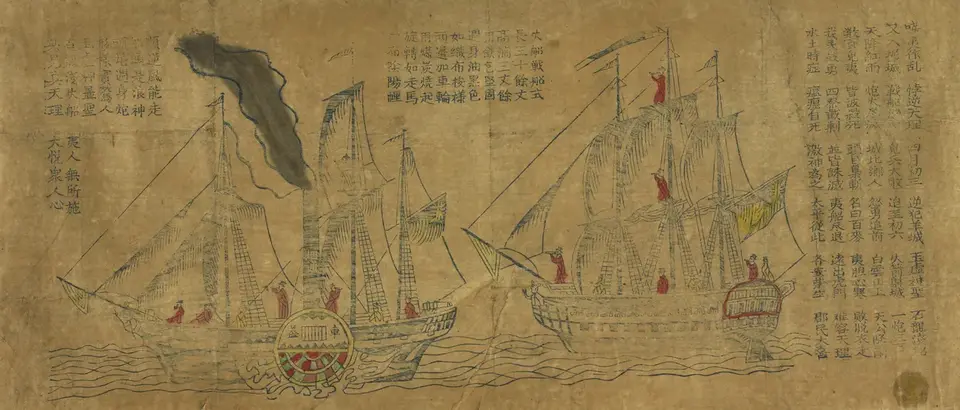
The First Anglo-Chinese Opium War (中英鸦片战争), fought from 1840 to 1842 between the British Empire and the Qing Empire, constitutes the foundational watershed of modern Chinese history. In the early nineteenth century, Britain completed the Industrial Revolution and sought global markets for its manufactured goods. To reverse its massive trade deficit in Chinese tea, silk, and porcelain, British merchants engaged in predatory, state-sponsored opium smuggling, resulting in rampant currency deflation, fiscal exhaustion, and widespread addiction across China. In response, the Daoguang Emperor appointed Lin Zexu as Imperial Commissioner to Guangzhou, where he confiscated and publicly incinerated 2.37 million pounds of British opium at Humen Beach. In June 1840, the British Parliament authorized military expeditionary forces; an armada of forty-eight gunboats under George and Charles Elliot blockaded the Pearl River, initiating open warfare. British forces rapidly bypassed fortified Guangzhou, capturing Dinghai in Zhejiang and sailing to the Dagu forts outside Tianjin, throwing Beijing into panic. Daoguang dismissed Lin Zexu in favor of conciliation, yet British demands expanded relentlessly. Over the following two years, British forces seized Humen, Xiamen, Ningbo, Wusong, and Zhenjiang, despite heroic last-stand resistance by admirals Guan Tianpei, Chen Huacheng, and General Hai Ling. In August 1842, British steam frigates anchored off Nanjing, compelling the court to sign the humiliating Treaty of Nanjing, fracturing Chinese territorial integrity and sovereignty.
In June, Lin Zexu destroys over twenty thousand chests of confiscated British opium at Humen Beach.
In June, British expeditionary fleet blockades the Pearl River, officially initiating the First Opium War.
In July, British forces capture Dinghai; in August, warships reach Dagu, prompting Daoguang to dismiss Lin Zexu.
On February 26, British warships pulverize the Humen forts; Admiral Guan Tianpei dies fighting heroically.
On May 30, Cantonese villagers surround British troops in the muddy swales of Niulangan outside Sanyuanli.
In autumn, Generals Ge Yunfei, Zheng Guohong, and Wang Xipeng perish at Dinghai; Viceroy Yu Qian commits suicide at Zhenhai.
On June 16, Admiral Chen Huacheng falls in action defending the Wusong forts outside Shanghai.
On July 21, General Hai Ling and the garrison fight to the death in Zhenjiang, severing the Grand Canal.
On August 29, Qiying signs the Treaty of Nanjing aboard HMS Cornwallis, concluding the war.
In the early nineteenth century, Great Britain emerged as the world's foremost industrial and naval power. Seeking overseas markets for mass-produced cotton textiles and industrial commodities, British commercial syndicates targeted Qing China. However, in traditional bilateral commerce, Chinese luxury goods—such as black tea, raw silk, and fine porcelain—enjoyed high demand in Europe, whereas British textiles were largely rejected by China's self-sufficient agrarian economy. To settle the mounting deficit, Britain exported millions of silver taels annually to China. To reverse this fiscal drain, the British East India Company and merchant houses such as Jardine Matheson institutionalized the illegal cultivation of opium in Bengal and smuggled thousands of chests into southeastern China.
The explosive growth of opium smuggling wreaked havoc upon late Qing society. Millions of subjects across all social strata became addicted, depleting civilian labor and paralyzing military regiments. Crucially, the massive outflow of silver inflated the domestic silver-copper exchange rate, plunging the peasant economy into distress and crippling imperial tax receipts. Governor-General Lin Zexu submitted impassioned memorials warning Daoguang that if opium remained unchecked, within decades the realm would possess no soldiers to resist invaders and no silver to pay rations. Moved by these warnings, Daoguang appointed Lin Zexu as Imperial Commissioner in late 1838. Arriving in Guangzhou, Lin blockaded foreign factories and confiscated over twenty thousand chests of opium, destroying them in lime pits on Humen Beach in June 1839, demonstrating the nation's resolve against foreign drugs.
The destruction of opium at Humen struck a mortal blow to the lucrative trafficking networks maintained by the British mercantile bourgeoisie. British Chief Superintendent of Trade Charles Elliot dispatched urgent dispatches to London, misrepresenting imperial interdiction as an attack on British property and demanding military retaliation. In April 1840, following acrimonious debates in the House of Commons orchestrated by Foreign Secretary Lord Palmerston, the British government passed military appropriations by a narrow margin, openly casting aside the pretext of free trade to launch armed aggression.
In June 1840, an expeditionary fleet comprising 48 modern steam-powered gunboats, frigates, and troop transports carrying over four thousand royal marines arrived off the Pearl River under Admiral George Elliot. On June 28, the British declared a full naval blockade of the Pearl River estuary. Finding Guangzhou heavily defended by Lin Zexu's boom barriers and coastal militias, the British armada sailed northward along the coastline to strike vulnerable northern defenses.
In early July 1840, British naval detachments entered the Zhoushan Archipelago off Zhejiang, bombarding the commandery seat of Dinghai. Magistrate Yao Huaixiang led a desperate defense with obsolete matchlocks, but heavy naval broadsides demolished the earthen parapets; Dinghai fell, and Yao drowned himself in honorable suicide, marking the first Chinese city seized by Western forces. Establishing an administrative garrison at Dinghai, the primary British fleet continued northward into the Bohai Sea.
In mid-August, British warships dropped anchor off the Dagu Forts near Tianjin, directly threatening Beijing. The imperial court was paralyzed with fear. Viceroy of Zhili Qishan was dispatched to negotiate, receiving Palmerston's aggressive ultimatum demanding territorial cessions and massive indemnities. Misled into believing that conflict stemmed solely from Lin Zexu's "imprudent governance", Daoguang dismissed Lin and Deng Tingzhen, exiling them to Xinjiang, and sent Qishan south to pursue appeasement, prompting the British fleet to withdraw southward.
Paralyzed by panic, the Daoguang Emperor blamed Lin Zexu for provoking hostilities rather than addressing the structural military deficit of the empire. In September 1840, Lin and Governor-General Deng Tingzhen were stripped of their offices and banished to the far western frontier of Ili. The emperor appointed the appeaser Qishan as Imperial Commissioner to travel to Guangdong to negotiate an immediate cessation of arms.
Arriving in Guangzhou, Qishan dismantled the coastal defense infrastructure that Lin Zexu had meticulously constructed. To signal pacific intentions, Qishan demobilized thousands of riverine militia volunteers, cleared underwater barrier piles across the Pearl River, and removed shore batteries. In negotiations with Charles Elliot, Qishan conceded ground, secretly offering Hong Kong Island and millions of silver dollars. Far from mollifying the British, this capitulation exposed imperial weakness, encouraging greater extortion.
In January 1841, dissatisfied with Qishan's concessions, Charles Elliot abrogated the truce and launched surprise assaults against the Chuanbi and Shajiao forts. General Chen Liansheng and his son fought to the death alongside six hundred troops. Recognizing he had been duped, Daoguang arrested Qishan and declared war, appointing Prince Yishan as Imperial General.
On February 25, British warships launched a concentrated assault on the primary Humen forts. Provincial Admiral Guan Tianpei defended Jingyuan Fort with several hundred personal retainers, repeatedly requesting reinforcements from nearby officials who abandoned him. Standing by his guns under lethal grape-shot, Guan commanded counter-battery fire until run through by bullets, dying atop the parapets as the Humen defense collapsed.
Following the fall of Humen, British gunboats occupied the Yuexiu heights overlooking Guangzhou. The disorganized imperial army under Yishan dissolved into panic. In May 1841, Yishan hoisted white flags and signed the humiliating Convention of Guangzhou, agreeing to pay six million silver dollars as a "ransom" to avert bombardment.
However, when British foraging parties pillaged rural villages outside Guangzhou, tens of thousands of local farmers from Sanyuanli and neighboring settlements assembled with spears and agricultural hoes. Encircling British detachments in the muddy rice terraces of Niulangan during a blinding rainstorm that neutralized British percussion locks, the villagers killed dozens of colonial troops and forced the survivors to retreat to their warships, writing a glorious chapter of civilian anti-imperialist resistance.
Disapproving of Elliot's concessions, the British government appointed Sir Henry Pottinger as Plenipotentiary, reinforcing the fleet with iron-hulled paddle steamers and veteran Scottish regiments. In August 1841, Pottinger led dozens of warships northward to attack the economic heartland of Jiangnan.
On August 25, the fleet bombarded Xiamen. Although Provincial Admiral Yan Botao had constructed massive granite sea-walls, fixed gun carriages were outranged by British naval guns. Chinese defenders under General Jiang Jiyun fought heroically before perishing in hand-to-hand combat. Gulangyu and Xiamen were occupied, providing the British with an advanced logistical base for operations against Zhejiang.
In late September 1841, British forces returned to Dinghai. Three garrison commanders—Ge Yunfei, Zheng Guohong, and Wang Xipeng—led five thousand soldiers in defending the mountain redoubts, swearing to die with their posts. Amidst unrelenting naval barrages and driving rain, the Three Generals launched repeated bayonet counterattacks. On October 1, all three generals were slain in action, and Dinghai fell once more.
Advancing against Zhenhai on October 10, British artillery demolished Zhaobao Fort. Viceroy of Liangjiang Yu Qian smoothed his robes and cast himself into a pond, dying by ritual suicide as the defenses collapsed. Ningbo and Cixi fell in rapid succession, extinguishing Qing defenses across eastern Zhejiang.
Alarmed by the loss of Zhejiang, Daoguang appointed his nephew Yijing as General of Grand Prowess, dispatching over forty thousand provincial soldiers to launch an amphibious counter-attack against Ningbo and Zhenhai on March 10, 1842.
However, operational plans were compromised, and British troops ambushed Chinese assault columns with revolving firearms in narrow city lanes. At Mount Dabao outside Cixi, Tibetan auxiliaries and Qing infantry under Sichuan General Zhu Gui fought to the death before being wiped out by high-explosive naval shells. The disastrous counter-offensive shattered the last imperial field army in the southeast.
In June 1842, Pottinger sailed into the Yangtze River estuary to cut the Grand Canal. On June 16, British warships bombarded the Wusong forts guarding Shanghai. Seventy-six-year-old Provincial Admiral Chen Huacheng defended the West Fort, personally firing coastal guns that damaged multiple British steamers.
When Viceroy Niu Jian fled in terror, abandoning the eastern batteries, British forces concentrated fire upon the West Fort. Wounded dozens of times by shell splinters, Chen Huacheng fought until his death on the ramparts, and Shanghai was occupied days later.
In mid-July 1842, the British fleet reached Zhenjiang, the intersection of the Yangtze River and the Grand Canal. Lieutenant-General Hai Ling commanded sixteen hundred Manchu and Chinese Banner troops. On July 21, British assault columns scaled the walls, meeting desperate house-to-house resistance. Refusing surrender, Hai Ling burned his headquarters and perished in the flames.
In August, British warships anchored off Nanjing, training their guns on the imperial capital. With provincial defenses shattered, Daoguang capitulated, commissioning Qiying to sign the Treaty of Nanjing aboard HMS Cornwallis on August 29, 1842, concluding the war in complete dynastic humiliation.
Prior to the formal deployment of the British expeditionary armada, intense naval skirmishes erupted across the Pearl River estuary around Lingding Island and the Chuanbi Channel. On November 3, 1839, British Chief Superintendent of Trade Charles Elliot led the Royal Navy warships HMS Volage and HMS Hyacinth into Chuanbi waters to intimidate Qing maritime patrols and protect illicit British merchant vessels. Provincial Admiral Guan Tianpei immediately hoisted his battle flag, deploying twenty-nine war junks to intercept the intruders.
Confronting heavy broadsides from British frigates, Guan Tianpei stood resolutely on the deck of his flagship, directing defensive fire and coordinating fire-raft counterattacks. Although Qing war junks were structurally outmatched and lacked heavy armor, Chinese sailors fought tenaciously, scoring hits on the hulls and rigging of the British warships. After several hours of combat, the damaged British vessels exploited outgoing tidal winds to withdraw, marking the earliest direct armed clash between Chinese and British military forces in modern history.
Admiral Guan Tianpei's resolute defense at Chuanbi effectively disrupted British calculations that naval intimidation alone would force the Qing court to abandon its opium interdiction policies. Following the engagement, Lin Zexu and Guan Tianpei submitted a joint memorial to Emperor Daoguang detailing the naval exchange, urging the court to cast heavy bronze and iron artillery batteries and construct two-story masonry fortifications at strategic river narrows. Chinese soldiers and civilian laborers worked continuously to install defensive iron chains and sunken palisades, transforming the lower Pearl River into a formidable defensive bottleneck.
On May 18, 1842, prior to the assault on Wusong, British forces launched an amphibious assault on the coastal bastion of Zhapu along Hangzhou Bay. Following heavy naval bombardments that flattened shoreline batteries, thousands of British troops converged on the walled town. Although outer ramparts were breached, three hundred Manchu and Chinese Banner troops under Captain Long Jin retreated into the Guandi Temple in the western suburbs, transforming the religious compound into a defensive redoubt.
British infantry launched repeated assaults with field artillery and Congreve rockets, but were repelled by lethal musket fire from the temple windows; Lieutenant-Colonel Tomlinson of the 18th Royal Irish Regiment was shot dead while leading a breach. Furious at their casualties, British troops set fire to the temple enclosure. Refusing surrender, the entire garrison perished amidst the flames and smoke. The ferocious defense of Zhapu stunned British commanders, standing as one of the most heroic resistance episodes of the war.
The Treaty of Nanjing inaugurated the era of modern unequal treaties for China. The agreement ceded Hong Kong Island in perpetuity to Great Britain, opening the floodgates to imperialist territorial dismemberment. It extorted 21 million silver dollars in war indemnities, depleting imperial treasuries and heaping immense tax burdens on commoners. Five treaty ports—Guangzhou, Xiamen, Fuzhou, Ningbo, and Shanghai—were opened to British residence and commerce. Crucially, the treaty imposed fixed tariff agreements, depriving the Chinese government of sovereign customs authority. Subsequent supplementary agreements granted extraterritoriality and unilateral most-favored-nation status, fundamentally shattering Chinese judicial independence.
The Opium War violently broke China's historical isolation. British manufactured textiles flooded coastal provinces, underselling traditional hand-spun cotton and triggering the separation of spinning and weaving in peasant households. This initiated the gradual dissolution of China's self-sufficient agrarian economy. China was forcibly transformed into an economic dependency of Western capitalism, serving as a captive export market for manufactured goods and a provider of cheap raw agricultural commodities, irreversibly altering the nation's socioeconomic structure into a semi-colonial and semi-feudal society.
The military catastrophe generated profound intellectual reverberations among forward-looking scholars. Lin Zexu organized the translation of Western geographic treatises into the Gazetteer of the Four Continents (Sizhou Zhi). Utilizing these records, the philosopher Wei Yuan compiled Illustrated Treatise on the Maritime Kingdoms (Haiguo Tuzhi), formulating the iconic modern doctrine of "learning the superior techniques of the barbarians to control the barbarians" (shi yi chang ji yi zhi yi). Enlightened intellectuals discarded traditional sinocentric arrogance, inaugurating the modern search for national survival that would culminate in the Self-Strengthening Movement, the Hundred Days' Reform, and the 1911 Revolution.
Karl Marx observed in Revolution in China and in Europe: "The arms of Great Britain tore down the prestige of the Emperor, and forced the Celestial Empire into contact with the terrestrial world. Complete isolation was the prime condition of the preservation of Old China; and when that isolation was violently broken by the English cannon, the dissolution was as certain as that of any mummy carefully preserved in a hermetically sealed coffin, whenever it is brought into the contact with the open air."
The modern historian Chiang Ting-fu reflected in History of Modern China: "The military defeat of the Opium War was not itself fatal; what was tragic was that our scholar-official class remained in a stupor for twenty years thereafter, viewing the disaster as a passing border squabble rather than fundamentally re-evaluating our institutions and civilization."
The late Qing philosopher Wei Yuan cried out in the preface to Illustrated Treatise on the Maritime Kingdoms: "To govern by ancient rules is to invite blindness. If we do not learn the superior techniques of foreigners, how can we master them? The tragedy of opium was not merely foreign cunning, but our own ignorance!"