Alpine Expedition of Little Bolü
Gao Xianzhi leads ten thousand Tang soldiers across the Pamirs, capturing Lianyun Fortress and securing the allegiance of seventy-two mountain kingdoms.
Tang Dynasty (唐朝) · HISTORICAL EVENT
怛罗斯之战
The Battle of Talas (怛罗斯之战) denotes the monumental military engagement in July and August 751 (the tenth year of the Tianbao era during the reign of Emperor Xuanzong of Tang), fought along the Talas River in Central Asia (near modern Taraz, Kazakhstan) between the imperial armies of the High Tang Dynasty and the Abbasid Caliphate. In 750, Gao Xianzhi, Military Commissioner of the Anxi Protectorate, assaulted the Central Asian oasis state of Chach (Shiguo)…
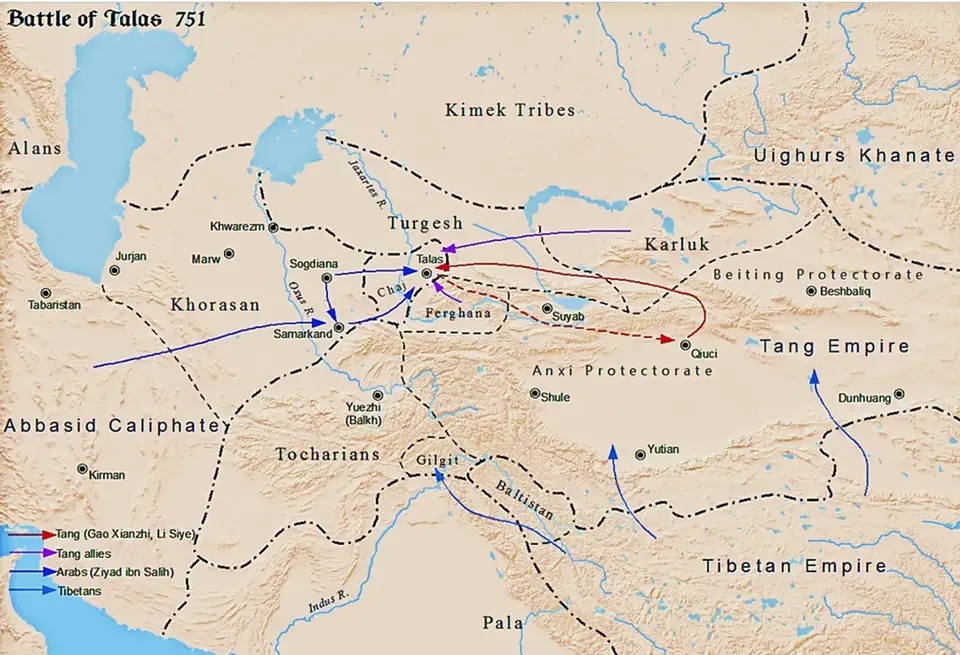
The Battle of Talas (怛罗斯之战) denotes the monumental military engagement in July and August 751 (the tenth year of the Tianbao era during the reign of Emperor Xuanzong of Tang), fought along the Talas River in Central Asia (near modern Taraz, Kazakhstan) between the imperial armies of the High Tang Dynasty and the Abbasid Caliphate. In 750, Gao Xianzhi, Military Commissioner of the Anxi Protectorate, assaulted the Central Asian oasis state of Chach (Shiguo) despite having concluded a formal peace agreement, executing its monarch and seizing massive treasures. The surviving prince fled to neighboring Sogdian city-states and appealed for intervention to the newly established Abbasid Caliphate. Determining to seize the initiative, Gao Xianzhi marched an allied expeditionary force of thirty thousand soldiers—comprising veteran Han infantry and cavalry alongside Fergana (Bahan'na) and Karluk auxiliaries—across the Pamir Mountains, advancing over seven hundred li to confront the Abbasid host outside Talas. For five consecutive days, the opposing imperial armies engaged in fierce, indecisive combat on the riverine plains. On the fifth evening, Karluk nomadic mercenaries, swayed by Abbasid gold and territorial promises, defected and launched a surprise assault against the Tang rear, while Abbasid heavy cavalry mounted a coordinated frontal charge. Trapped in a double encirclement, the Tang formations collapsed. Deputy commander Li Siye wielded heavy modao blades and wooden staves to cleave an escape corridor through the routing allied columns, escorting Gao Xianzhi and several thousand survivors back to the Anxi garrison at Kucha. While the battle established the geopolitical equilibrium between the two empires in Central Asia, captured Chinese artisans transmitted the advanced art of papermaking to Samarkand and Baghdad, fundamentally accelerating the dissemination of knowledge across the Islamic world and Europe.
Gao Xianzhi leads ten thousand Tang soldiers across the Pamirs, capturing Lianyun Fortress and securing the allegiance of seventy-two mountain kingdoms.
Gao Xianzhi breaches a peace treaty to assault Chach, executing its king; the crown prince escapes to rally regional support and appeal to the Abbasids.
The Prince of Chach coordinates with Abbasid governor Abu Muslim to prepare a joint campaign against the Four Garrisons.
Gao Xianzhi leads thirty thousand troops from Kucha, marching over seven hundred li across the Pamir Mountains into the Syr Darya basin.
Tang forces invest the fortress of Talas, while Abbasid commander Ziyad ibn Salih arrives with an army of heavy cavalry.
Tang combined-arms formations and Abbasid shock cavalry engage in a five-day tactical stalemate along the Talas River.
Karluk mercenaries defect to attack the Tang rear; imperial battle lines rupture under double encirclement.
Li Siye wields a wooden staff and modao blade to clear an escape defile, allowing Gao Xianzhi and several thousand survivors to reach Kucha.
Captured Chinese craftsmen establish the first Islamic paper manufactory in Samarkand, initiating the global transmission of papermaking.
General Feng Changqing subjugates Great Bolü, re-establishing imperial control over the mountain passes, while Abbasid embassies arrive in Chang'an.
Following the pacification of the Eastern and Western Turkic Khaganates during the Zhenguan reign of Emperor Taizong, the Tang Dynasty established the Anxi and Beiting Protectorates to govern Xinjiang and the Central Asian borderlands. Under Emperor Gaozong and Empress Wu Zetian, the imperial court fortified the Four Garrisons of Anxi—Kucha (Qiuci), Khotan (Yutian), Kashgar (Shule), and Tokmak (Suiye, later replaced by Karasahr/Yanqi). Supported by military agricultural colonies (tuntian), the Anxi command maintained twenty-four thousand elite regular troops equipped with heavy iron armor, laminated composite bows, repeating crossbows, and double-edged modao polearms, asserting suzerainty over the Thirty-Six Kingdoms and the Sogdian city-states along the Silk Road.
During the Kaiyuan and Tianbao eras, the Tibetan Empire (Tubo) pushed northward across the Himalayas, severing strategic passes in Gilgit (Little Bolü) to interdict tributary traffic to Chang'an. In 747, Gao Xianzhi, an officer of Goguryeo descent renowned for alpine warfare, commanded ten thousand imperial shock troops across the glaciated passes of the Pamirs (Congling), capturing the Tibetan fortress of Lianyun and subduing Little Bolü. In 750, Gao repeated this feat against the kingdom of Qieshi, earning widespread renown across the western kingdoms as the "God of the Mountains."
Simultaneously in the Middle East, the Arab Caliphate expanded into Transoxiana (the fertile river valleys between the Amu Darya and Syr Darya). The Sogdian merchant city-states of Samarkand, Bukhara, and Chach, burdened by religious coercion and poll taxes levied by Umayyad governors, frequently sent diplomatic missions to Chang'an seeking imperial protection, receiving noble titles from the Tang court.
In 749, the Abbasid Revolution overthrew the Umayyad Caliphate, establishing the Abbasid dynasty in Baghdad. The eastern province of Khorasan served as the military cradle of the new dynasty, housing veteran standing field armies under regional governor Abu Muslim. Appointing General Ziyad ibn Salih to administer Samarkand and Bukhara, the Abbasids aggressively expanded eastward toward the Syr Darya, bringing the frontiers of the two continental empires into direct geographic contact.
In 750, a territorial border dispute erupted between Chach (Tashkent), a traditional tributary of the Tang, and the neighboring kingdom of Fergana, a staunch imperial ally. The King of Fergana appealed to Anxi for military aid. Seeing an opportunity for personal enrichment, Gao Xianzhi marched an army to Chach. Acknowledging Tang superiority, King Nachu Chebishi opened the city gates and concluded an official peace treaty with Gao.
However, Gao Xianzhi violated the accord. Once inside the citadel, Tang troops arrested the royal family, pillaged municipal storehouses, and executed hundreds of civilian inhabitants, confiscating camel-loads of gold, jade, and horses. Gao presented the captive monarch to the court in Chang'an, where Emperor Xuanzong, unaware of the breach of faith, ordered the King of Chach executed.
The crown prince of Chach escaped the slaughter, fleeing among the Sogdian kingdoms of the Zarafshan valley to publicize Gao's treachery. Outraged and fearful of imperial predation, the Central Asian city-states allied with the Chach prince, sending envoys to Samarkand to petition Abbasid governor Abu Muslim for military intervention to expel the Tang from the Four Garrisons.
In early 751, Tang scouts operating along the Pamir perimeter intercepted reports that the Prince of Chach had formed an alliance with the Abbasids to launch a coordinated offensive against Anxi. Gao Xianzhi resolved upon a preemptive strike, calculating that fighting within the Four Garrisons would devastate imperial trade routes and surrender strategic depth to the enemy.
In May 751 (the fourth lunar month), Gao Xianzhi held formal departure ceremonies at Kucha. His strike force comprised ten thousand veteran Han regular infantry and cavalry, supported by ten thousand allied mounted lancers from Fergana and several thousand Karluk nomadic horsemen recruited from the Chu River basin, forming an integrated army of thirty thousand troops.
Departing Kucha, the columns marched west along the northern rim of the Tarim Basin through Aksu and Kashgar, confronting the ascent into the Pamir Mountains. Moving through alpine gorges, the army crossed frozen passes thousands of meters above sea level. Despite freezing winds and precipitous cliffs that claimed numerous pack animals, the veteran soldiers completed the crossing within two months, descending into the upper Syr Darya plains outside the expectations of the Abbasid high command.
In July 751, the Tang expedition arrived before the stone-walled city of Talas (modern Taraz, Kazakhstan), a strategic fortification on the northern bank of the Talas River held by a Chach garrison flying Abbasid colors. Gao Xianzhi deployed heavy siege catapults and trench works, seeking to reduce the bastion before enemy relief divisions arrived.
However, Abbasid reactions were swift. Informed by Abu Muslim of the Tang advance, General Ziyad ibn Salih assembled elite Khorasani heavy cavalry and allied Sogdian detachments, marching rapidly from Samarkand. Within days, the Abbasid relief host reached the western banks of the Talas River, forming battle lines opposite the imperial encampment.
On the open riverine plains, the premier military doctrines of East and West met in combat. The Tang force relied on coordinated combined-arms formations: infantry deployed iron-plated Mountain-Pattern and Bright-Shine armor; front ranks set wooden palisades while massed crossbowmen released armor-piercing iron bolts at ranges exceeding several hundred paces; and elite modao shock troops wielded two-meter, double-edged polearms designed to cleave cavalry mounts.
The Abbasid force featured heavily armored Khorasani shock cavalry equipped with mail hauberks, steel helms, and Damascus-forged scimitars, supported by Sogdian archers and mobile camel corps. When the armies engaged, Tang crossbow volleys inflicted severe casualties on the advancing cavalry. As Abbasid riders closed the distance, Li Siye's modao infantry charged into the melee, neutralizing the impact of the charge in close-quarters combat.
Deploying his mounted divisions along both flanks, Gao Xianzhi led counter-charges into the Abbasid line. Combat raged daily from dawn until dusk, resulting in immense casualties on both sides. The riverine floodplains became choked with fallen soldiers and horses. Despite numerical disadvantages, Tang tactical discipline and missile superiority maintained a tactical stalemate through five days of continuous combat.
As the contest degenerated into exhaustion, operational advantage shifted toward sub-surface diplomacy. Recognizing the vulnerability of Gao's mercenary auxiliaries, Abbasid commander Ziyad ibn Salih dispatched Turkic-speaking envoys carrying gold specie to the encampment of the Karluks situated in the Tang rear.
The Karluks had joined the expedition primarily for financial compensation. The Abbasid envoys promised that upon defecting, the Karluks would receive the entire captured Tang logistical train and permanent grazing rights throughout the Chu River valley. Confronted by these incentives, the Karluk chieftains agreed to turn upon their imperial employers.
On the evening of the fifth day, the Karluk cavalry revolted without warning, striking the undefended rear of the Tang positions. They overran the baggage camps, slaughtered imperial crossbowmen, and set fire to supply stores. Simultaneously, Ziyad ibn Salih launched a general frontal assault with his heavy cavalry.
Surrounded on two fronts, the Tang defensive square ruptured. Command structures collapsed amidst smoke and chaos, and the Allied divisions fragmented into isolated pockets fighting for survival.
In the rout, fleeing Fergana auxiliaries and pack animals jammed the narrow mountain defile leading back toward the Pamirs, trapping Gao Xianzhi and his staff in the gorge. Behind them, Abbasid and Karluk horsemen advanced rapidly along the valley.
In this crisis, Deputy Commander Li Siye took command of the rearguard. Armed with a heavy wooden staff and his modao blade, Li charged into the panicked crowd, clearing an escape path through the bottleneck. When Staff Officer Duan Xiushi rebuked Gao for abandoning his men, Gao halted to reassemble surviving soldiers. Li Siye formed an elite rearguard across the mouth of the defile, repelling successive enemy cavalry charges until Gao and several thousand surviving troops cleared the passes back to Kucha.
The battle concluded with a tactical defeat for the Tang expeditionary force, which lost over ten thousand men killed, wounded, or captured. However, Abbasid casualties were similarly severe, deterring Ziyad ibn Salih from pursuing the retreating forces eastward across the Pamir ranges.
Upon returning to Chang'an, Gao Xianzhi was reassigned to the capital as General of the Right Feathered Forest Guard, while General Feng Changqing was elevated to command the Anxi Protectorate. Enforcing strict military discipline and drawing fresh recruits from the interior, Feng restored the combat readiness of the Four Garrisons within two years. In 753, Feng launched an expedition across the Pamirs that subjugated Great Bolü, reaffirming Tang suzerainty over the mountain passes and demonstrating that the setback at Talas had not dismantled imperial control over the Tarim Basin.
Simultaneously, bilateral relations between the Tang and the Abbasid Caliphate stabilized into peaceful diplomatic exchanges. Between 753 and 755, Abbasid embassies visited Chang'an to present gifts; during the An Lushan Rebellion in 756, the Caliphate dispatched thousands of auxiliary soldiers to assist Emperor Suzong in liberating the capital, reflecting mutual geopolitical respect.
While the engagement was a regional military collision, its cultural consequences transformed world history. Among the thousands of Chinese prisoners escorted west were skilled artisans, weavers, silversmiths, and experienced papermakers, accompanied by military secretary Du Huan.
The Abbasid administration transported these artisans to Samarkand, where existing writing materials—parchment and Egyptian papyrus—were prohibitively expensive. Recognizing the utility of Chinese papermaking, the regional governor established the first state paper manufactory in the Islamic world at Samarkand. Utilizing local flax, hemp, and river water, Chinese craftsmen produced high-quality, lightweight rag paper that became celebrated across the Middle East as "Samarkand paper."
Paper mills subsequently spread to Baghdad, Damascus, and Cairo, eventually reaching Morocco and Moorish Spain in the twelfth century, replacing parchment throughout Europe. The proliferation of affordable paper facilitated the Abbasid translation movement, preserved classical learning, and laid the material foundation for the European Renaissance and the democratization of knowledge.
The captivity of military secretary Du Huan produced an extraordinary historical record of the medieval Islamic world. A relative of Tang chancellor and historian Du You, Du Huan was marched as a prisoner through Khorasan to the Abbasid capitals of Kufa and Baghdad. He resided in the Caliphate for over a decade, traveling through Persia, Mesopotamia, Syria, and across the Red Sea into East Africa and the borders of the Byzantine Empire, observing Islamic legal institutions, mosques, and trade markets.
In 762, taking advantage of restored diplomatic relations, Du Huan boarded a merchant vessel in the Persian Gulf, returning by the Maritime Silk Road to Guangzhou. Upon his return, he authored Record of My Travels (Jingxing Ji), providing the first eyewitness account of the Islamic world preserved in classical Chinese literature, excerpts of which were preserved by his uncle in the encyclopedic history Tongdian.
The Battle of Talas resulted in a tactical defeat for the Tang expeditionary force. Of the thirty thousand soldiers who crossed the Pamirs, over half were killed, wounded, or captured, with only several thousand surviving troops returning to Kucha under Li Siye's rearguard protection. However, the Abbasid army suffered substantial attrition, deterring any further eastward advance across the Pamir ranges. Tang authority throughout the Tarim Basin remained secure until the domestic eruption of the An Lushan Rebellion in late 755 forced the withdrawal of frontier garrisons to protect the dynastic heartland.
The Battle of Talas represents a watershed in Eurasian geopolitical and cultural history. Geopolitically, it demarcated the frontier of Chinese military influence in Central Asia, allowing Islamic cultural traditions to gradually supplant Sogdian, Buddhist, and Zoroastrian institutions throughout Transoxiana. Culturally and technologically, the transfer of Chinese papermakers to Samarkand and Baghdad catalyzed an intellectual revolution across the Islamic world and medieval Europe, replacing animal skins with durable rag paper and facilitating the preservation and translation of classical philosophy, science, and literature that heralded the modern age.