Succession Crisis
The Zhengde Emperor dies without issue; Grand Secretary Yang Tinghe designates Zhu Houcong to succeed to the imperial throne.
Ming Dynasty (明朝) · HISTORICAL EVENT
大礼议
The Great Rites Controversy (大礼议) was a protracted political and ritual confrontation fought between the young Jiajing Emperor (Zhu Houcong) and the Ming civil bureaucracy between 1521 and 1524. Following the death of the heirless Zhengde Emperor in 1521, Senior Grand Secretary Yang Tinghe invoked ancestral dynastic statutes to summon the emperor's cousin, Zhu Houcong, the son of Prince of Xing, from Anlu in Huguang to assume the throne. Immediately upon…
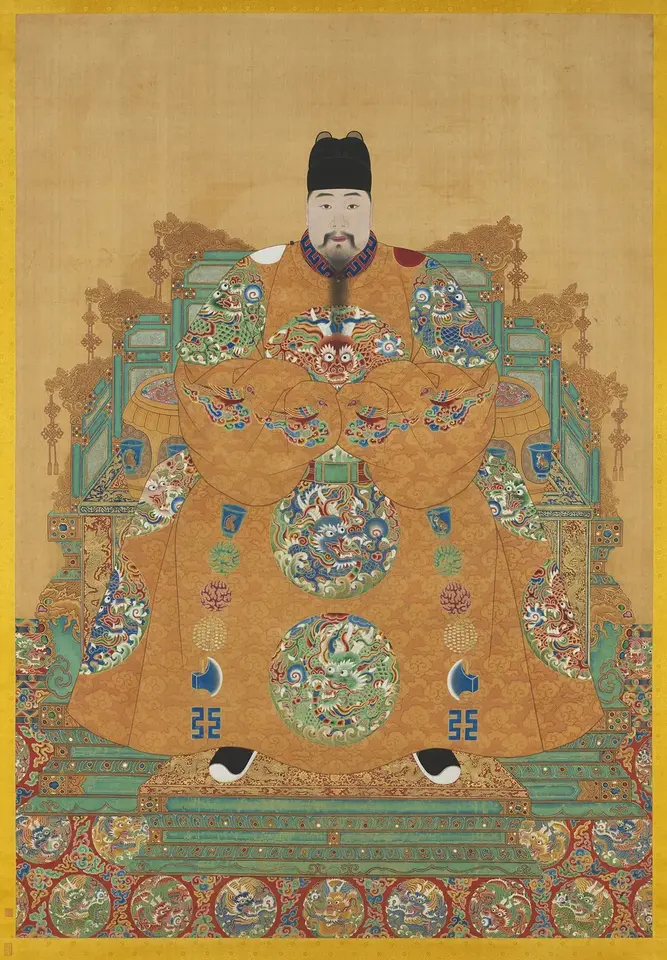
The Great Rites Controversy (大礼议) was a protracted political and ritual confrontation fought between the young Jiajing Emperor (Zhu Houcong) and the Ming civil bureaucracy between 1521 and 1524. Following the death of the heirless Zhengde Emperor in 1521, Senior Grand Secretary Yang Tinghe invoked ancestral dynastic statutes to summon the emperor's cousin, Zhu Houcong, the son of Prince of Xing, from Anlu in Huguang to assume the throne. Immediately upon accession, Yang Tinghe and senior ministers cited Song dynasty precedents to demand that the new emperor be ritually adopted by Emperor Xiaozong as his deceased father, while addressing his biological parents as uncle and aunt. Resolutely resisting this demand, the fourteen-year-old sovereign argued that he had inherited the imperial mantle rather than personal adoption, refusing to sever natural filial obligations to his biological parents. Supported by reformist scholars Zhang Cong and Gui E, the emperor waged a three-year debate against the court establishment. In July 1524, over two hundred officials knelt at Zuoshun Gate in collective protest; an enraged Jiajing Emperor ordered palace guards to arrest and flog 134 officials, killing seventeen. Purging the old leadership, the emperor elevated his father to Emperor Xian and later enshrined him in the Imperial Ancestral Temple as Emperor Ruizong. The episode marked the zenith of imperial prerogative over ministerial checks, establishing forty years of autocratic rule.
The Zhengde Emperor dies without issue; Grand Secretary Yang Tinghe designates Zhu Houcong to succeed to the imperial throne.
Zhu Houcong refuses to enter Beijing as an adopted crown prince, forcing ministers to permit entry through Daming Gate.
The emperor commands ritual honors for his biological parents; Yang Tinghe demands he recognize Xiaozong as his imperial father.
Zhang Cong submits his memorial distinguishing between inheriting the throne and domestic adoption, founding the New Rites faction.
Conceding the emperor's unyielding determination, Yang Tinghe resigns, followed by Jiang Mian and Mao Ji.
The emperor recalls Zhang Cong and Gui E to Beijing, formally preparing to invest his biological father as Emperor Xian.
Over two hundred officials led by He Mengchun and Yang Shen stage a weeping sit-in outside Zuoshun Gate to halt the decree.
Palace guards arrest protest leaders and flog 134 officials outside the Meridian Gate; seventeen die of injuries.
The emperor designates his late father as Emperor Xian and promotes Zhang Cong and Gui E to head the Grand Secretariat.
The Prince of Xing is posthumously elevated to Emperor Ruizong and his spirit tablet is enshrined in the Imperial Ancestral Temple.
In March 1521, the thirty-one-year-old Zhengde Emperor (Zhu Houzhao) died suddenly at the Leopard Quarter palace inside the Forbidden City. Capricious and reckless throughout his life, the emperor left neither biological heirs nor surviving brothers, plunging the Ming succession into an existential constitutional crisis.
Senior Grand Secretary Yang Tinghe handled the succession with swift efficiency. In secret consultation with Empress Dowager Zhang and the Directorate of Ceremonial, Yang Tinghe invoked the ancestral injunctions of dynastic founder Zhu Yuanzhang permitting brotherly succession in the absence of direct sons. He designated the fourteen-year-old Zhu Houcong—the only surviving son of Zhu Youyuan, Prince of Xing, who was the fourth son of Emperor Xianzong—to assume the imperial throne. Yang Tinghe drafted the deceased sovereign's valedictory edict, dismissed military sycophants, and preserved imperial tranquility in Beijing.
However, a profound constitutional disagreement emerged regarding the legal nature of the succession. Under orthodox Cheng-Zhu Neo-Confucianism, the imperial line had to be transmitted in an unbroken genealogical continuity. Yang Tinghe, Minister of Rites Mao Cheng, and the Hanlin scholars argued that because Zhu Houcong had been summoned to inherit the imperial lineage of the Hongzhi Emperor (Xiaozong), he was obligated under ritual law to be formally adopted into the primary lineage.
Under this legal theory, Zhu Houcong had to recognize Emperor Xiaozong as his ritual father and reclassify his biological father, Prince of Xing, as imperial uncle, while demoting his mother Lady Jiang to imperial aunt. To the young prince, who was deeply attached to his late father and well-versed in the classics, this demand was an intolerable violation of filial piety. Zhu Houcong asserted that he had been summoned to inherit the throne under ancestral mandate, not as an adopted private son, rejecting the demand to repudiate his biological father.
The constitutional conflict erupted even before the new emperor entered the capital. On April 21, 1521, Zhu Houcong's imperial retinue arrived at Liangxiang, outside Beijing. Minister of Rites Mao Cheng, acting on Yang Tinghe's instructions, presented a ceremonial schedule requiring the prince to wear crown prince vestments, enter through Dong'an Gate, and reside in Wenhua Hall to receive ministerial petitions before enthronement.
The young prince recognized this arrangement as an implicit acceptance of adoption and refused to move. He confronted the welcoming delegation, arguing that the imperial bequest commanded him to succeed to the throne as emperor, not as an adopted imperial prince. Paralyzed by the prince's unyielding stance, Yang Tinghe was forced to capitulate. Zhu Houcong entered triumphantly through the southern Daming Gate, proceeding directly to the Hall of Fengtian to ascend the throne as the Jiajing Emperor.
Only six days after his coronation, the Jiajing Emperor commanded the Ministry of Rites to deliberate honorary titles for his late biological father and mother. Yang Tinghe and Mao Cheng submitted a joint memorial invoking Han Emperor Ai and Song Emperor Yingzong, arguing that imperial adoption required the emperor to acknowledge Xiaozong as imperial father while downgrading the Prince of Xing to imperial uncle.
The emperor rejected the proposal with indignation, asking his ministers how an emperor could be compelled to call his biological father uncle. The outer court mobilized overwhelming resistance: hundreds of civil officials across all six ministries, the Censorate, and the Hanlin Academy submitted joint memorials insisting that dynastic law and ritual purity could not be compromised for private affection. Caught in an administrative deadlock, the court ground to a standstill.
The political breakthrough occurred in July 1521, when newly graduated Metropolitan Graduate Zhang Cong submitted his landmark Memorial on the Great Rites. Grounding his argument directly in the classical Book of Rites and Ceremonies, Zhang Cong demonstrated that Han Emperor Ai and Song Emperor Yingzong had been raised in the palace as designated crown princes, justifying their ritual adoption; by contrast, the Jiajing Emperor had been summoned directly from a princely fief to preserve the dynasty.
Zhang Cong argued that inheriting the throne was distinct from domestic adoption, proving that forcing the emperor to disown his biological parents violated cardinal Confucian morality. Supported by officials Gui E and Xi Shu, Zhang Cong provided the intellectual legitimacy the emperor needed. The emergence of this New Rites faction shattered the consensus of the bureaucracy. Facing mounting royal disfavor, Yang Tinghe resigned in February 1524, followed by his successors Jiang Mian and Mao Ji.
With the resignation of the veteran grand secretaries, the Jiajing Emperor gained decisive control. In June 1524, he summoned Zhang Cong and Gui E to Beijing, commanding the Ministry of Rites to bestow the title of Imperial Biological Father Emperor Xian upon the Prince of Xing. Outraged by this perceived betrayal of ancestral orthodoxy, the traditional civil bureaucracy mounted a desperate collective resistance.
On July 12, 1524, following the morning audience, Vice Minister of Personnel He Mengchun and Yang Tinghe's son, Yang Shen, mobilized over two hundred officials outside Zuoshun Gate. The assembly included twenty-three vice ministers, twenty Hanlin compilers, thirty supervising secretaries, and over forty censors. The officials knelt outside the palace gates, weeping loudly and pounding the bronze doors in protest. Yang Shen shouted that the state had nurtured scholars for 150 years for this hour of martyrdom.
Refusing to tolerate ministerial defiance, the Jiajing Emperor ordered the imperial guards to arrest thirty-six ringleaders. The following day, 134 junior officials were subjected to brutal floggings in front of the Meridian Gate. Seventeen officials died from traumatic injuries, while Yang Shen was stripped of office and exiled for life to Yunnan.
The bloodshed at Zuoshun Gate eradicated bureaucratic resistance against the throne. In September 1524, the Jiajing Emperor formally promulgated the titles, designating his biological father as Emperor Xian and Emperor Xiaozong as Imperial Uncle. Promoters of the New Rites—Zhang Cong, Gui E, and Xi Shu—were elevated to the Grand Secretariat and high ministerial posts.
In 1538, the emperor took the final step of elevating his father to Emperor Ruizong, placing his spirit tablet into the Imperial Ancestral Temple alongside dynastic ancestors and situating his ceremonial rank above the Zhengde Emperor. The seventeen-year struggle concluded with the total victory of the Jiajing Emperor, establishing an era of unchallenged monarchical autocracy that defined the remainder of his forty-five-year reign.
The Great Rites Controversy concluded with the crushing victory of the monarch over the bureaucratic establishment. The brutal flogging and execution of seventeen officials outside the Meridian Gate destroyed the moral self-confidence of the Ming civil bureaucracy, terminating the tradition of collective ministerial remonstrance that had restrained previous rulers.
The purge of Yang Tinghe's coalition allowed the emperor to reshape the Grand Secretariat. Cabinet appointments were no longer determined by bureaucratic consensus or moral standing, but by personal imperial favor. The Jiajing Emperor exercised direct, uncompromising control over civil appointments, financial resources, and military operations, creating an autocratic system that concentrated decision-making within the inner court.
In state ritual, the controversy altered imperial ancestral lineage. By elevating a cadet prince to Emperor Ruizong and placing his tablet above the Zhengde Emperor in the Imperial Ancestral Temple, the emperor dismantled classical mourning hierarchies. He extensively revised the Great Ming Collected Statutes and initiated massive liturgical renovations, including the separate sacrifices to Heaven and Earth in Beijing.
Politically, the struggle institutionalized opportunistic factionalism. The meteoric promotion of Zhang Cong and Gui E demonstrated that rapid advancement could be secured by anticipating royal desires rather than adhering to administrative norms. Court politics devolved into bitter vendettas between sycophants and moralists, initiating the factional decay that plagued the late Ming dynasty.
In the History of Ming, Qing historians observed that the Jiajing Emperor ascended the throne from a cadet branch with remarkable intellectual sharpness, actively managing imperial governance in his youth. However, they criticized his unbending severity during the Great Rites Controversy, noting that while his desire to honor his biological parents stemmed from genuine filial affection, his ruthless punishment of veteran ministers inflicted permanent harm upon court morale.
In his Guoque, Ming historian Tan Qian questioned the tragic nature of the conflict, asking whether the weeping officials at Zuoshun Gate acted out of true loyalty or dogmatism. He observed that while Yang Tinghe's position was rooted in legal precedent and the emperor's stance in natural filial devotion, Zhang Cong utilized canonical scholarship to dismantle bureaucratic resistance, ultimately allowing the sovereign to govern with unchecked personal power.
In his Records of Ming Scholars, the philosopher Huang Zongxi characterized the Great Rites Controversy as the foundational upheaval of the late Ming state. He concluded that the blood spilled upon the palace flagstones at Zuoshun Gate shattered mutual trust between ruler and minister, opening the deep political fractures that ultimately contributed to the fall of the dynasty.